

What's in this guide
What symbolism actually does
A symbol is a thing that means more than itself. The distinction that matters is that the literal level never dissolves. When Frodo carries the Ring, it is genuinely a piece of jewellery he is genuinely carrying to a genuine volcano — and it is also power, corruption, addiction, and the burden of history. The story works on both levels simultaneously. If you removed the second meaning, the first would still function as plot. That double-functioning is the whole trick, and it's what separates symbolism from an author lecturing through a mouthpiece.
Symbolism is also the least forced when it grows out of things the story already needs. The best symbols are load-bearing objects — the murder weapon, the family home, the recurring weather — that would earn their place on the page even if they meant nothing extra. Meaning is the interest the object pays; it is not the reason the object exists. Hold on to that principle and most of the classic mistakes solve themselves.
Symbol vs metaphor vs allegory
These three get conflated constantly, and the confusion produces muddy prose. The cleanest way to tell them apart is by scope and by how literal the surface stays.
| Symbol | Metaphor | Allegory | |
|---|---|---|---|
| What it is | A concrete thing that carries a second, abstract meaning. | A direct equation of one thing with another to illuminate it. | An entire narrative in which every element maps to a hidden meaning. |
| Scope | A recurring object or image across a work. | Usually a single phrase, sentence, or passage. | The whole story, start to finish. |
| Surface stays literal? | Yes — the object remains fully itself. | No — it states A is B, not that A resembles B. | Partly — characters function but exist mainly to signify. |
| Example | The green light in The Great Gatsby. | "Hope is the thing with feathers." | Animal Farm as the Russian Revolution. |
| Reader effect | Deepens on reflection and rereading. | Lands in the moment, in a single line. | Understood as a sustained one-to-one code. |
A quick rule of thumb: a metaphor is something you write in a sentence, a symbol is something you build across a book, and an allegory is a book that is secretly about something else. If you want the sentence-level cousins in depth, our guides to and break down how to make individual comparisons land without cliché.
The types of symbols
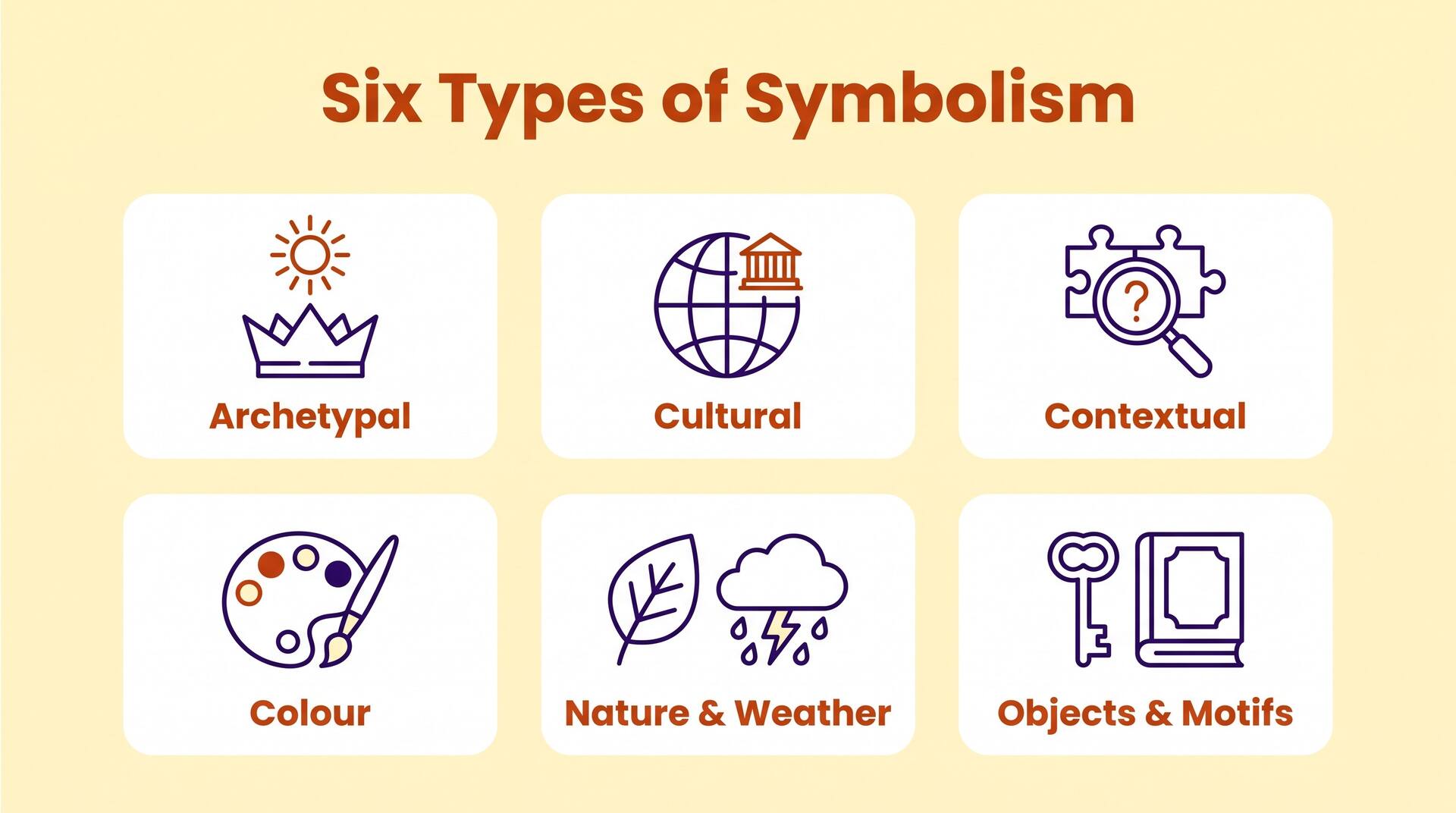
Symbols draw their power from different sources. Knowing which kind you're using tells you how much setup a reader needs before the meaning will register.
Universal / archetypal
Meanings so widely shared they need almost no setup: light and dark, the journey, water as renewal, the seasons as a life cycle. Powerful because instantly legible — risky because they tip into cliché fastest. Use them, but give them a specific, personal twist.
Cultural / religious
Meanings a particular tradition assigns: a cross, a lotus, the colour white for mourning in some cultures and weddings in others. These depend entirely on the reader's frame — the same image can carry opposite meanings across audiences, so know who you're writing for.
Contextual / authored
The most valuable kind: an ordinary object the story itself teaches to mean something. A conch shell means nothing until Golding makes it mean order. These are yours to build, and because you control the setup, they never feel borrowed.
Colour
Red for passion or danger, green for envy or money or growth, grey for moral fog. Cheap if stated, potent if patterned — let a colour recur across scenes and shift its charge, rather than announcing it once.
Nature & weather
Storms at emotional breaking points, spring for rebirth, a drought that mirrors a marriage. Effective when the environment does the feeling the character suppresses — dangerous when it merely underlines what the prose already said (the old 'pathetic fallacy' trap).
Objects & motifs
A recurring item — a watch, a scar, a key, a song — that gathers meaning through repetition and changing context. The workhorse of the novel, because a motif can travel the whole arc and mean something different each time it returns.
Famous literary examples of symbolism
Six symbols that reward study, each doing a job the plot could not do as efficiently in plain statement.
The green light — The Great Gatsby
The light at the end of Daisy's dock is Gatsby's whole yearning made visible: the future he reaches for, the past he can't recover, and the American Dream's promise of a self remade. Fitzgerald never explains it — he just returns to it, and its meaning thickens each time.
The scarlet letter — Nathaniel Hawthorne
The embroidered 'A' begins as a mark of shame and, across the novel, is reworked into 'Able' and something like grace. A single symbol whose meaning is deliberately unstable — proof that a symbol can argue, not just represent.
The conch shell — Lord of the Flies
A found object that Golding teaches to mean civilisation and the rule of law. Its authority holds exactly as long as the boys agree it does, and it shatters at the moment order does. A perfect authored symbol: meaningless until the story builds the meaning.
The mockingbird — To Kill a Mockingbird
Innocence that harms no one and is destroyed anyway. Lee lets one line of dialogue plant it, then trusts the reader to apply it to two characters without ever spelling out the connection. Restraint is what keeps it from becoming a lecture.
The white whale — Moby-Dick
Melville makes the whale mean so many things — nature, God, the unknowable, Ahab's own obsession reflected back — that the multiplicity becomes the point. A symbol large enough that no single reading exhausts it.
Weather & the red room — Jane Eyre
Brontë threads storms, fire, and cold across Jane's emotional turns, and the locked red room becomes a recurring emblem of confinement and injustice. Environment and object working together, each returning at the exact structural beats.
Weaving symbolism into your draft
Symbolism fails most often when it's bolted on in revision — a writer decides the book 'needs' symbols and sprinkles them over a finished draft. It reads exactly as retrofitted as it is. Here's the order that produces symbols readers believe.
- 1
Start from theme, not the symbol
Name the abstract idea your book is actually about — freedom, inheritance, the cost of ambition. The symbol is the vehicle; you can't choose a vehicle before you know the destination. If you can't state your theme in a sentence, no symbol will rescue it.
- 2
Choose an object the world already contains
Look for something the story needs anyway — a setting, a possession, a job's tool, a recurring place. A symbol drawn from the fabric of the plot never feels imposed, because it was going to be there regardless.
- 3
Introduce it neutrally, first
Its first appearance should carry no visible weight — just an object, doing its literal job. The reader files it away. Meaning attaches later; if you load it on the first mention, you've announced it, and announced symbols are dead symbols.
- 4
Build meaning through repetition and context
Bring it back at charged moments and let the surrounding scene bend its meaning. A watch that appears at a birth, a deadline, and a deathbed accrues a meaning about time that no single instance states. Recurrence in shifting contexts is the engine.
- 5
Never explain it
The fastest way to kill a symbol is to have a character or the narrator gloss it. Trust the pattern. If readers can miss it entirely and still enjoy the book — while attentive readers feel the extra layer — you've calibrated it right.
- 6
Pay it off at a turning point
Let the symbol return, transformed, at a structural climax — the conch shatters, the letter is reinterpreted, the green light goes dark. The payoff is where a motif stops decorating and starts meaning.
Strengthen a motif across your whole draft
The hard part of symbolism is consistency across a long manuscript — a motif you planted in chapter two has to resurface, subtly changed, in chapters nine and twenty-six, and that's easy to lose track of over 70,000 words. AIWriteBook's chapter AI chat is built for exactly this kind of surgical revision: it works one chapter at a time and shows every suggested change as a diff you accept or reject, so you can ask it to thread a recurring object through a scene, or dial a colour motif up or down, while keeping your own sentences intact.
It helps to give a symbol somewhere real to live. When you build your setting with the free , the objects, places, and rituals it generates become natural candidates to carry meaning later — and staging a symbol inside a specific, sensory scene is easier when the has laid down the concrete details for the meaning to attach to. Meaning sticks to things readers can see, hear, and touch.
A word of caution the tools can't give you: symbolism is one place where a heavier hand always hurts. The same instinct that produces an over-explained symbol produces an unearned plot rescue — both reach past the story to hand the reader something the story hadn't yet earned. If that failure mode interests you, our guide to the dissects it from the plotting side.
Give your theme something to hold
Build a world whose objects can carry meaning, draft chapters around a central motif, and revise every recurrence with accept/reject diffs — starting from your own idea.
Common symbolism mistakes
Almost every failed symbol fails in one of these five ways. Each has a one-line fix.
Over-explaining it
The narrator or a character stops to tell the reader what the object means. The instant a symbol is glossed, it stops being a symbol and becomes a caption. Cut the gloss and trust the pattern to carry it.
One symbol, one meaning, stated once
A symbol mentioned a single time isn't a symbol — it's a decoration. Meaning comes from recurrence in changing contexts. If it appears once, either build it out or let it be a plain object.
Retrofitting in the edit
Sprinkling 'meaningful' objects over a finished draft reads as exactly what it is. Symbols have to be seeded during drafting so their setup exists. If you find a symbol late, go back and plant its earlier appearances — don't just add the payoff.
The symbol fights the plot
A symbol that contradicts what the scene is doing confuses rather than deepens — bright spring imagery over a scene of quiet despair, with no ironic intent. Make sure the second meaning and the literal action are pulling the same direction, or that the tension between them is deliberate.
Too many competing symbols
Five motifs jostling for attention cancel each other out. A novel can usually carry one dominant symbol and two or three minor motifs. Beyond that, readers stop tracking and start skimming. Pick your central image and let it lead.
Intent vs reader interpretation
Here is the uncomfortable truth every writer of symbols eventually meets: you do not fully control what your symbols mean. Readers bring their own frames, and a well-made symbol is generative precisely because it's open — Melville's whale means different things to different readers, and that's a strength, not a bug. Some readers will find symbolism you never consciously planted, and they aren't wrong; patterns you wrote by instinct are still patterns in the text.
The practical stance is to hold your intent lightly. Plant your symbols with a clear purpose, calibrate them so the pattern is discoverable, and then let go. Your job is to make the layer available, not to enforce a single reading. A symbol that only means the one thing you intended is closer to allegory; a symbol that stays alive in many readers' hands is doing the richer work. Aim for the second, and accept that you're building a resonance, not a code.
Symbolism FAQ
Meaning is something you build, not something you state
Symbolism is patient work. You choose an object the story already needs, introduce it without fanfare, let it gather meaning through recurrence, and pay it off when the reader least expects and most feels it. Every classic example on this page follows that arc — and every failed symbol skips a step, usually by explaining itself or arriving too late to be seeded.
Start from your theme, pick one central image, and trust your reader. The layer you build quietly is the one they'll still be thinking about after the last page.