

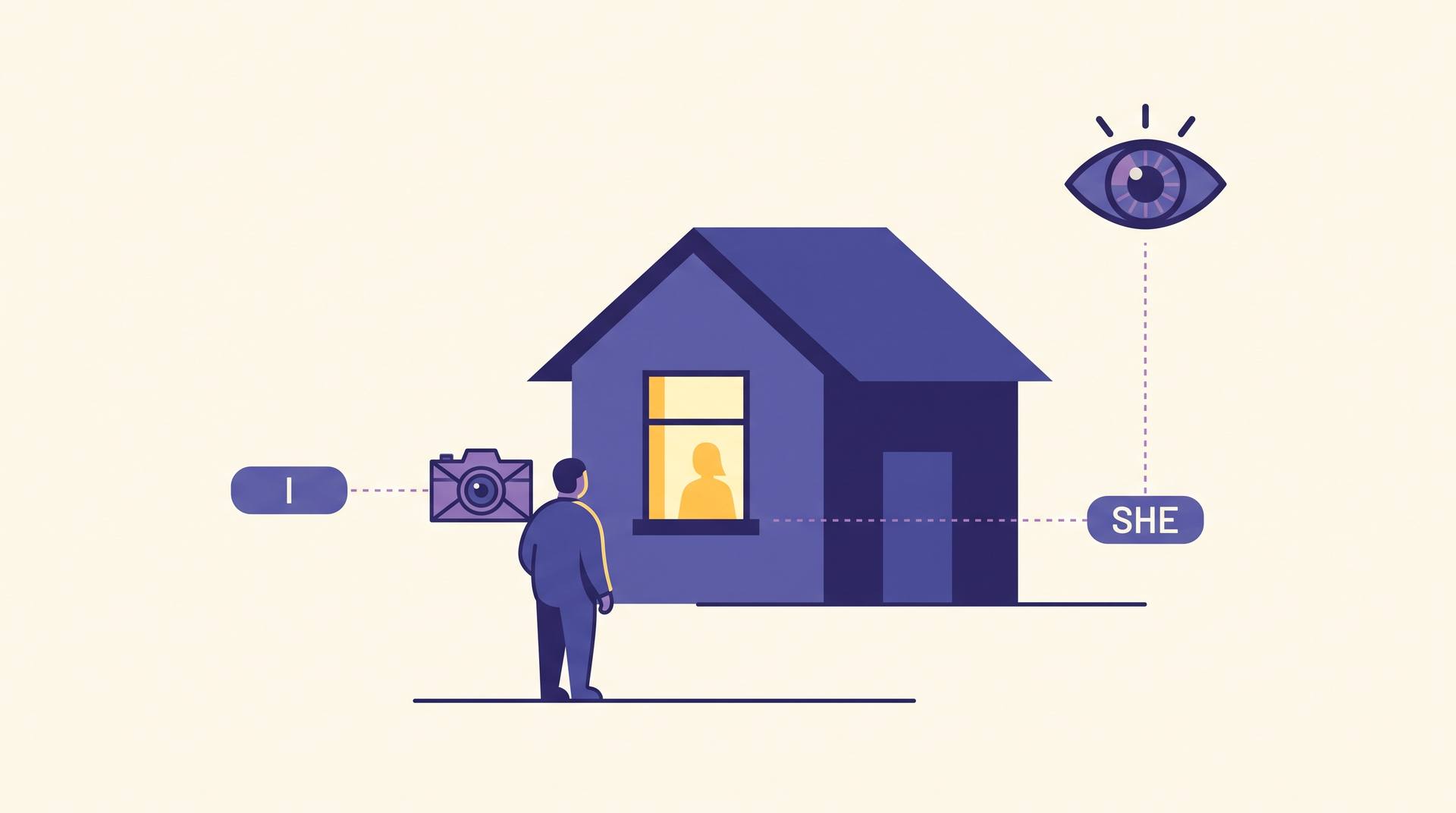
What POV actually decides
Every writing guide tells you that first person uses "I" and third person uses "she". That is true and almost useless. The pronoun is the visible part. What you are really choosing is an information contract: which facts can reach the reader, in whose words, and with how much distance between the reader and the character's nervous system.
Once you sign that contract, it governs every scene. A first-person narrator cannot report a conversation she was not in without an excuse — a letter, an eavesdrop, someone telling her afterwards. A third-person limited narrator can cut to another chapter and another head, but only at a scene break, and only if you have established that the book does that. An omniscient narrator can do nearly anything and pays for it in intimacy.
That is why POV is the decision that most often sends a draft back to page one. Not because the prose was bad, but because chapter 19 needed a fact the narrator had no way to learn, and the only fix is a different narrator.
The useful question is never "which sounds better?" It is: across the whole book, what does the reader need to know, and who is in a position to tell them?
The three real options
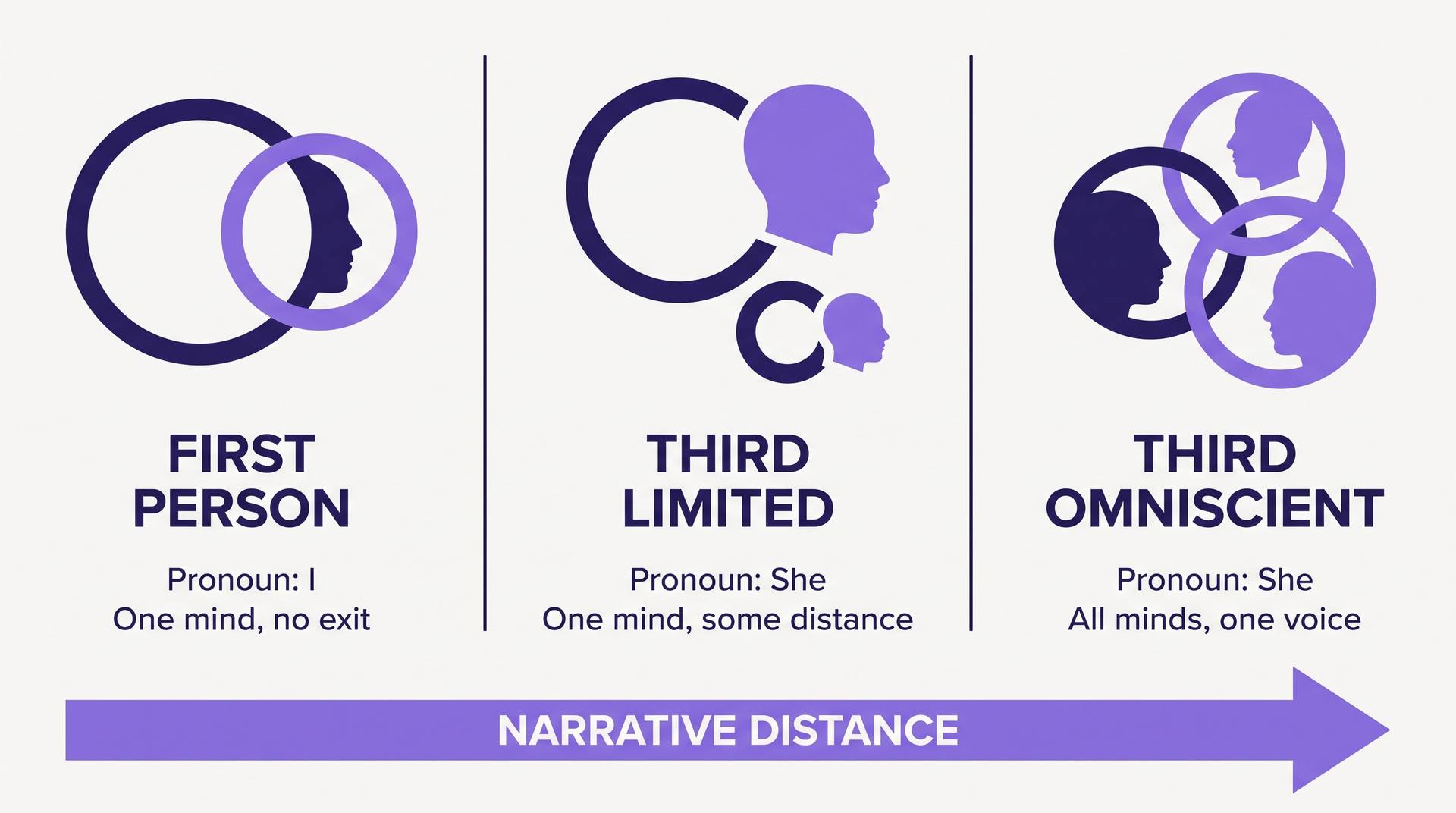
In practice modern fiction runs on three modes, not two. Treating "third person" as one thing is the source of most POV confusion, because third limited and third omniscient behave nothing alike.
| Mode | Mind access | Whose voice narrates | What it costs you |
|---|---|---|---|
| First person | One character, from inside, permanently | The character's, including her blind spots and bad opinions | You can never show what she does not witness, and her voice has to carry 300 pages |
| Third limited | One character per scene, from just behind the eyes | A narrator coloured by that character, but not identical to her | Every POV switch needs a scene break and a reason; readers resent switching to a head they did not ask for |
| Third omniscient | Anyone, any time, plus facts nobody in the book knows | A distinct narrating intelligence with its own attitude | Distance. And it only works if the narrator is genuinely interesting company |
There is a fourth mode, second person, and it is not a stunt — it is just rare and expensive. We covered when "you" earns its place separately. Omniscient in particular gets misused so often that it deserves its own treatment: see what omniscient narration really requires before you commit to it.
Pick yours in four questions
Answer honestly about the book you are actually writing, not the book you admire. Four questions is usually enough, because POV problems cluster around a small number of structural facts.
Question 1 of 4
Does the plot depend on events your main character is not present for?
A parallel investigation, a villain's planning, a subplot in another city. If yes, first person will fight you in every act.
This gives you a default, not a verdict. The honest test is to write one difficult scene both ways before you commit — which is exactly what the next section does.
One scene, three POVs
Same beat every time: a woman named Dara stands outside a lit house, deciding whether to knock. Watch what changes and, more importantly, what becomes impossible.
Passage
The porch light was on, which meant nothing. He left it on for months after the funeral; he left it on the week he changed the locks. I stood at the bottom of the steps doing arithmetic I had done a hundred times — three years, two unanswered letters, one debt that was mine — and I did not knock, because I already knew what his face would do.
What you gain
Compression and bias in the same breath. Her history arrives as thought, not exposition, and her certainty about his face is information about her, not about him.
What you lose
Everything inside the house. If the reader needs to know that he has been waiting up for her since nine, this POV cannot deliver it without a contrivance.
Notice that no version is better prose. They are different contracts. Write your own hardest scene — not your easiest — in two of these modes before you commit, then read both aloud a day later. If you want to try the exercise without inventing a scene from scratch, our scene builder will draft the beat and you can rewrite it in the second POV.
Mistakes that cost rewrites
Head-hopping and calling it omniscient
Slipping into a second character's thoughts mid-scene is not omniscient narration. Omniscient has a consistent narrating voice that stands above everyone; head-hopping just loses the thread. If you cannot name the narrating intelligence, you are in third limited and you broke it.
First person with a narrator who has no voice
If you can swap every "I" for "she" and the paragraph reads identically, first person is doing nothing for you. You have taken on all the restrictions and none of the benefit. Either give the narrator syntax, slang and blind spots of her own, or go to third.
The camera that sees the narrator
"My emerald eyes flashed." "A blush crept across my freckled cheeks." People do not perceive themselves from outside. Describing your first-person narrator usually requires a mirror, and the mirror scene is the oldest cliché in the drawer.
Retrofitting POV after the draft
Find-and-replacing pronouns is not a POV change. Real conversion means rebuilding what each scene knows, and it typically touches a third of the manuscript. This is why the four questions above are worth twenty minutes now.
Adding POV characters to solve pacing problems
A second viewpoint feels like new energy and usually is not — it is the same stalled plot at half speed in two places. Add a POV only when that character wants something the first one cannot pursue.
Two of these are really voice problems in disguise. If your narrator sounds like nobody in particular, the fix lives in author's perspective and how it differs from POV, not in the pronouns.
Genre expectations
Conventions are not rules, but breaking one costs you something and you should know the price before you pay it.
Young adult
First person present tense is close to a default, largely because immediacy and a strong voice are the genre's selling points. Third limited is accepted; omniscient reads as old-fashioned.
Epic fantasy
Third limited with a rotating cast, one POV per chapter, is the modern standard. Omniscient survives here more than anywhere else because the world itself needs narrating.
Romance
Dual POV — both leads, alternating, usually third limited — is what readers expect, because the genre's pleasure is knowing what each one is too proud to say.
Thriller and mystery
Classic detective fiction leans first person; modern thrillers alternate third limited between hunter and hunted to manufacture dread. Whichever you pick, the reader's information must be rationed on purpose.
Literary fiction
Anything goes, including the second person and the shifting collective "we". Expectation here is that the choice is meaningful rather than defaulted.
Memoir and narrative non-fiction
First person past, with an adult narrator who understands more than the person in the story did. That gap between the two is the form's main instrument.
Drafting POV with AI
AI is genuinely useful here for one reason: the expensive part of testing a POV is writing the same scene twice, and that is exactly the work you can hand off. Use it to compare, not to decide.
Set POV once, at the outline
In AIWriteBook, point of view and tense are part of the book setup, so every chapter the chapter generator drafts inherits the same contract instead of drifting between heads around chapter nine.
Generate the A/B, judge it yourself
Ask for your hardest scene in first person and in third limited, then read both aloud. The model has no taste about which fits your book; you will know within two paragraphs.
Keep it in your voice, not the model's
The writing style feature lets the AI copy a sample of your own prose, which matters far more in first person than in third — a borrowed narrator voice is the fastest way to make a first-person book feel generic.
Fix drift in the chapter chat
When a chapter slips into another character's head, the in-editor chat can rewrite the offending passage and show the change as a diff you accept or reject line by line, which is far safer than regenerating the whole chapter.
A model will happily write any POV you ask for and will not warn you that the plot needs a viewpoint you did not give it. The four questions are still yours to answer.
Frequently asked questions
Decide once, then commit
Almost every POV disaster is a decision made by drift — chapter one happened to come out in first person, and nobody revisited it until the plot needed a scene the narrator could not attend. Twenty minutes of deliberate choosing now is worth a month of restructuring later.
So: answer the four questions, write your hardest scene twice, read both aloud, and then write the rest of the book in the mode that won. If you change your mind, change it at chapter three, not chapter thirty.
POV is one decision among several that shape a draft before the first sentence exists. The rest of them are laid out in our complete guide to writing a book.