

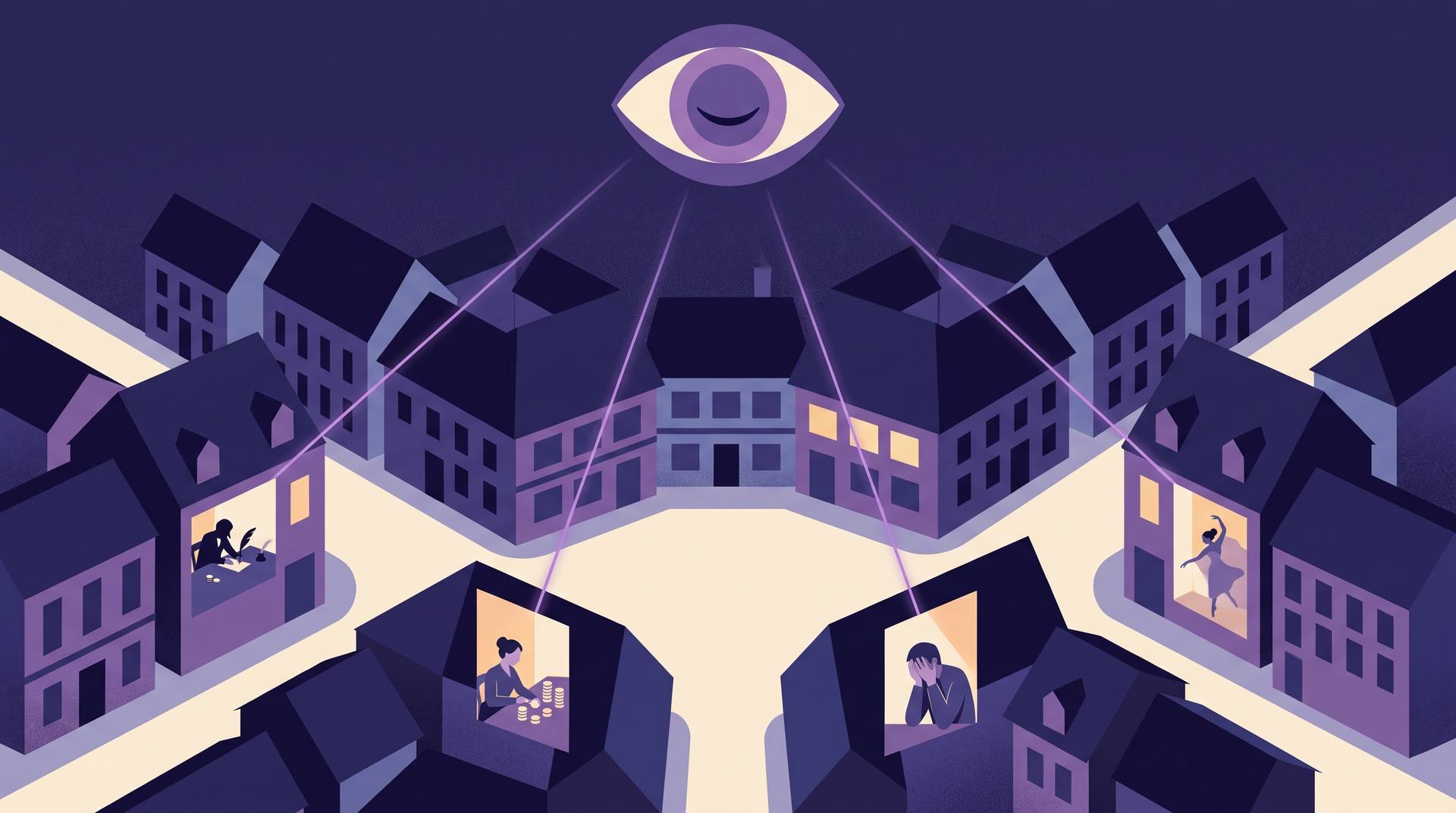
Most explanations of third person omniscient POV stop at "the narrator knows everything." That is true and almost useless. Every unpublished manuscript that gets rejected for head-hopping was written by someone who believed exactly that and then wandered from mind to mind because the definition seemed to license it.
The useful version is narrower. Third person omniscient is a POV in which a single narrating consciousness — one that is not any character in the book — reports on the story with unrestricted access to every mind, every place, and every point in time, and speaks in a voice that stays recognisably its own from the first page to the last. The unrestricted access is the easy half. The consistent voice is the half that makes it work.
Definition
Third person omniscient POV: the story is told by an external narrator who uses he, she, and they, is not a character in the events, and can report the thoughts, histories, and futures of anyone in the book — while remaining one continuous voice rather than a relay of borrowed ones.
The word omniscient describes what the narrator can know. It does not describe how much the narrator chooses to tell, and the gap between those two is where all the craft lives.
Omniscient vs limited, in the parts that matter
Third person limited puts the camera behind one character's eyes and locks it there for a scene, a chapter, or the whole book. Third person omniscient hands the story to a narrator standing outside everyone. Both use he and she; that shared pronoun is why the two get confused constantly, and why a manuscript can drift from one to the other without the writer noticing.
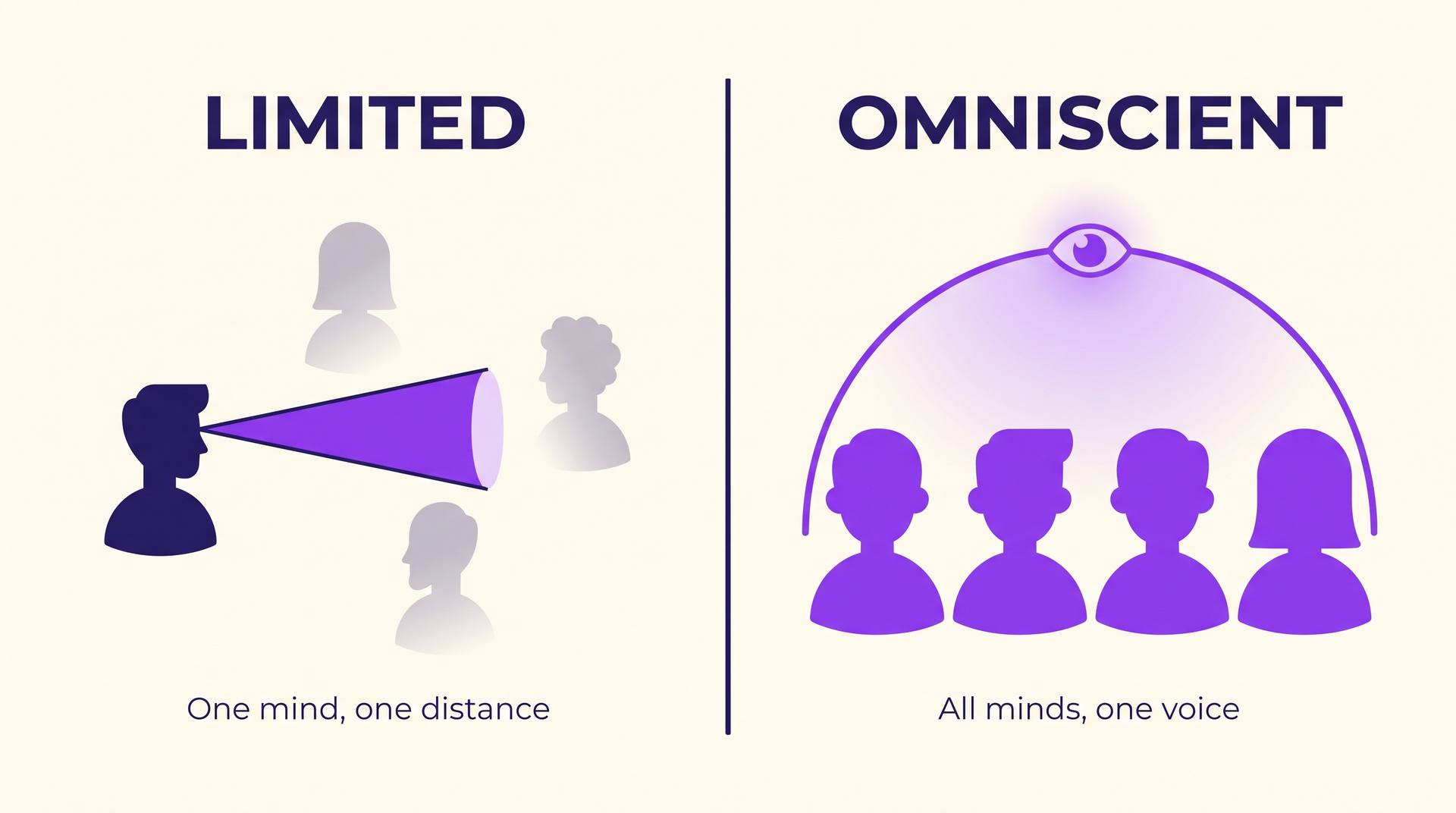
| Question | Limited | Omniscient |
|---|---|---|
| Whose thoughts can we read? | One character's, per scene | Anyone's, including people who never appear again |
| Who is talking? | A voice coloured by the viewpoint character's vocabulary and biases | A separate narrator with its own vocabulary, wit, and opinions |
| What can it know about the future? | Only what the character knows now | Everything, and it can say so decades early |
| Where does suspense come from? | The reader is trapped in one person's ignorance | The reader knows more than the characters and watches them walk into it |
| Main failure mode | Claustrophobia; a passive protagonist has nothing to look at | Emotional distance; nobody's fate feels urgent |
That last row is the honest trade. Limited buys intimacy at the cost of scope. Omniscient buys scope, irony, and the pleasure of dramatic irony at the cost of the reader's automatic identification with one person. Neither is more sophisticated. If you are still deciding, our piece on what an author's perspective really means works through the choice from the story's side rather than the technique's, and the rarest option of all gets its own treatment in the guide to second person POV.
Four moves only an omniscient narrator can make
If your draft would read the same in limited third, you are paying omniscient's price without collecting on it. These four moves are what you bought.
The simultaneous cut
Two people in different rooms, both reacting to the same event, both wrong about the other — reported inside one paragraph rather than across two chapters. Limited has to schedule this; omniscient can just do it.
The flash-forward verdict
The narrator tells you now what a decision will cost in twenty years. Once the reader knows how it ends, every subsequent scene runs on the tension between what the character hopes and what the narrator has already confirmed.
The judgement
An omniscient narrator is allowed to have an opinion about its characters and to state it. That editorial voice is a large part of why readers remember Austen's or Eliot's narrators as personalities in their own right.
The wide shot
A town, an army, a plague, a century of a family. When the real subject is a system rather than a person, no single viewpoint character can see enough of it, and omniscient is the only POV with the reach.
Head-hopping is not omniscience — it is the counterfeit
Head-hopping is what happens when a writer switches viewpoint mid-scene without a governing narrator to hold the switch together. It reads as sloppiness because it is not one voice moving between minds; it is several limited third narrations spliced end to end and hoping nobody notices the seams.
The difference is voice ownership. In real omniscience the narrator reports the interiors; the prose around those interiors never changes register. In head-hopping the prose itself takes on each character's diction as the viewpoint slides, so the reader loses the thread of who is telling the story.
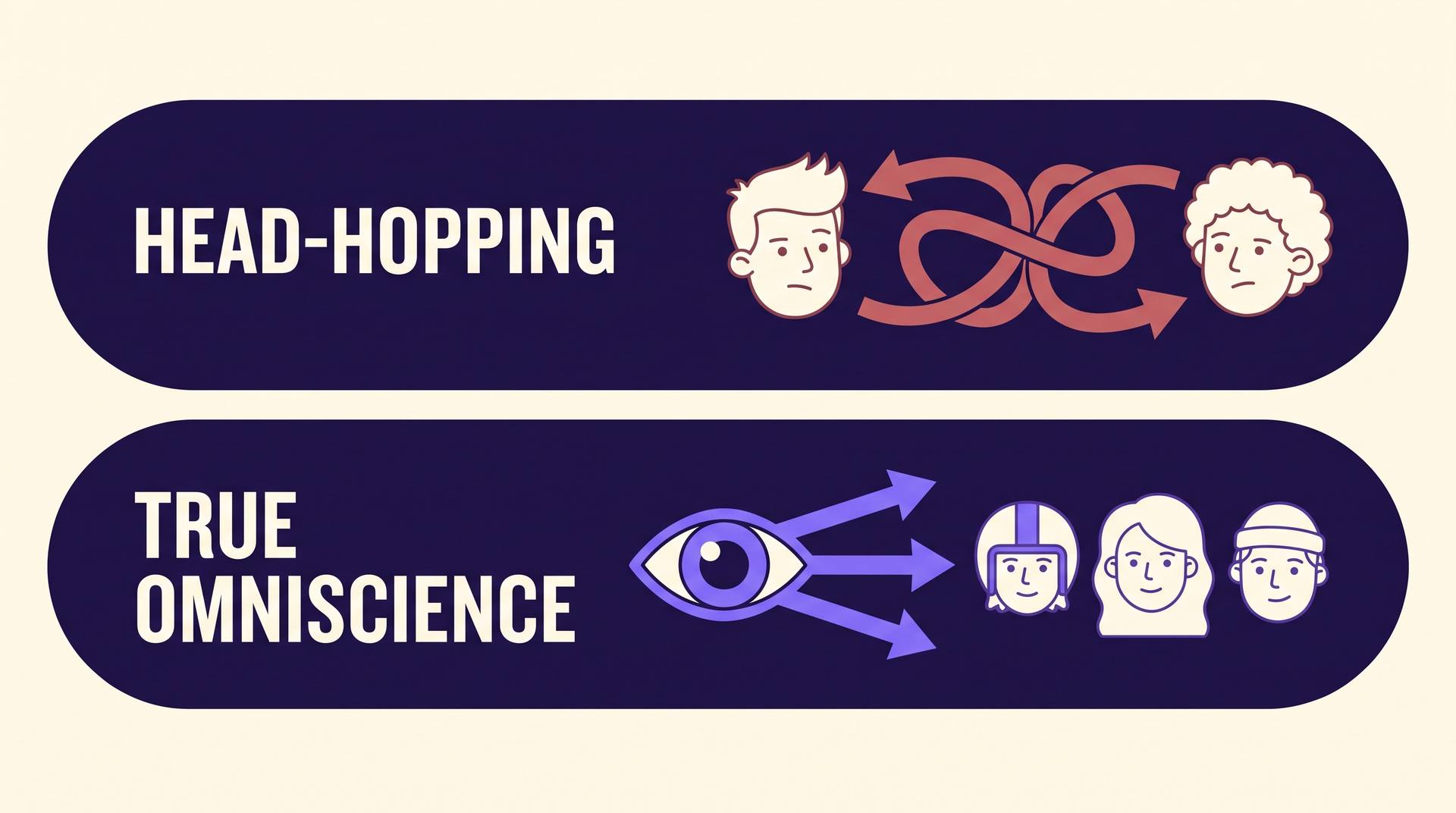
Head-hopping
She hated how he chewed. God, what a boor. He noticed her staring and felt his ears go hot — she was judging him again, the stuck-up cow. She wondered whether he would ever say anything worth hearing.
Omniscient
She had decided against him somewhere around the soup, on the evidence of his chewing. He mistook her attention for interest and reddened, which she read as guilt. Neither of them would be right about the other for another eleven years.
The second version reports two interiors in three sentences — more access, not less. What holds it together is that the sentences belong to a narrator who is above both of them, judges both of them, and knows how the marriage turns out. Nothing borrows either character's vocabulary.
The one-line test
Read your scene aloud and ask: could every sentence here have been spoken by the same person? If the answer changes when the viewpoint changes, you are head-hopping. If a single consistent narrator could have said all of it, you are omniscient — even if you visited five minds.
Six novels, and what each one does with the POV
Reading these with the technique in mind is worth more than any list of rules. Each of them solves the distance problem differently.
Pride and Prejudice — Jane Austen (1813)
The narrator is a wit with opinions, and the famous opening sentence is a judgement about a whole society before any character has spoken. Austen mostly stays close to Elizabeth, then steps out to correct her — which is how the book teaches you to distrust a heroine you like.
Middlemarch — George Eliot (1871-72)
The widest of them. Eliot moves across an entire provincial town, and her narrator repeatedly stops the story to argue about how one should judge the people in it. When a narrator asks why we always sympathise with Dorothea and not Casaubon, that question is only available in omniscient.
Anna Karenina — Leo Tolstoy (1878)
Famous for granting interiority to a dog and, briefly, to a minor character in a crowd scene. Tolstoy uses omniscience as an argument: everyone in the book has a full inner life, including the people the plot does not care about.
Dune — Frank Herbert (1965)
The most instructive modern case, because Herbert breaks the rule everyone teaches. He layers several characters' thoughts inside a single scene — often within a page — and it works because the register never wavers and because a book about prescience and political scheming is genuinely about who knows what.
The Book Thief — Markus Zusak (2005)
Omniscience with a body: the narrator is Death, and it interrupts to tell you which characters will die and when. Knowing the ending early does not deflate the book — it converts every subsequent chapter into dread, which is the flash-forward move used at full strength.
Good Omens — Terry Pratchett and Neil Gaiman (1990)
Comic omniscience. The narrator digresses, footnotes itself, and cuts between an angel, a demon, and four horsemen in a single sequence. The jokes depend on the reader seeing what none of the characters can, which is a structural argument for the POV rather than a stylistic one.
It is a truth universally acknowledged, that a single man in possession of a good fortune, must be in want of a wife.
No character in the novel believes this. The narrator is reporting a consensus in order to mock it — a sentence that is impossible in first person and awkward in limited third.
When to choose it, and when not to
Reach for omniscient when
- The real subject is larger than any one person — a family across generations, a town, a war, an institution.
- You want the reader to know something the characters do not, and to squirm about it for three hundred pages.
- The narrating voice is itself part of the pleasure: ironic, funny, mournful, morally opinionated.
- You are writing an ensemble in which no single character deserves to be the centre.
Choose something else when
- The book runs on one person's mistaken understanding of events — a mystery, a psychological thriller, most first-person-shaped stories.
- Your genre's readers expect deep immersion in one head; romance and most YA still lean heavily on close third or first.
- You are writing your first novel and want the fewest possible ways to go wrong. Limited third is far more forgiving.
- The emotional payoff depends on the reader discovering something at the same moment the protagonist does.
One practical note that rarely gets said: omniscient is harder to sell in a query letter, because the voice has to be strong enough on page one to justify the distance. A limited-third opening earns attention with a character; an omniscient opening has to earn it with the narrator. If yours does not sound like anybody in particular, it will read as a synopsis.
Drafting in an omniscient voice without losing it
The practical difficulty of omniscient is drift. Chapter three is written by a wry, wide-angle narrator; chapter nineteen, written four months later on a Tuesday, has quietly become close third from the protagonist's shoulder. Nothing in the manuscript flags it, and beta readers usually report it as "the middle sags."
Two habits fix most of it. Keep a short voice sheet — five sentences that sound exactly like your narrator, including one judgement it would make — and reread it before every session. And plan which mind each scene enters before you write it, rather than deciding mid-paragraph. Our free scene builder is useful for the second habit: it turns a scene premise into a beat-by-beat structure you can annotate with whose interior the narrator opens, so viewpoint becomes a decision you make once instead of forty times a page.
If you are drafting on AIWriteBook, the more direct lever is the writing style setting: paste a passage in your intended narrative voice and chapters get written to match it, which is exactly the constraint an omniscient book needs, since the narrator is the one element that must never change. From there the chapter generator writes to your approved outline, and when a paragraph slides into a character's diction you can open the chapter AI chat, ask for it in the narrator's register instead, and accept or reject the rewrite line by line rather than regenerating a chapter you were mostly happy with.
The ensemble problem is separate and worth its own pass. An omniscient book usually carries more named characters than a limited one, and readers forgive a narrator who knows everything only if the people it knows about are distinct. Our character creator is a fast way to give each of them a want and a contradiction before you start, and the character development guide goes deeper on making them diverge on the page. The related trap is telling every interior instead of dramatising any of it — the fix is the ordinary one described in show, don't tell, which omniscient writers need more than anyone, because the POV makes summarising feelings so easy.
Questions writers actually ask
It is less fashionable in commercial fiction than it was, and close third has been the default since roughly the 1980s. But it never went away — The Book Thief, Good Omens, and most large-canvas literary and epic fantasy novels use it, and there is no evidence that readers reject it. What they reject is a flat one.
Yes, and it usually must. Knowing everything is not an obligation to say everything. The convention is that the narrator may decline to tell you something, but should not tell you something false — a narrator who conceals in order to spring a cheat ending reads as a trick rather than a twist.
There is no fixed number. Dune regularly does three or four in a page. The workable limit is set by voice: as many as you can report without the prose changing register, and no more.
No. Third person objective — the camera-eye mode of Hemingway's Hills Like White Elephants — reports only what could be seen and heard, entering nobody. Objective is the narrowest access in third person; omniscient is the widest.
You can, and plenty of nineteenth-century novels do, but it needs a visible rule the reader can learn — an omniscient prologue and interludes with limited chapters between them, for instance. What fails is mixing them at random within scenes, which is head-hopping under a more flattering name.
It does, particularly in older category romance, and some readers genuinely do not notice it. That is not a reason to write it deliberately; agents and editors notice, and it is the single most common structural note on unagented submissions in third person.
The short version
Third person omniscient is defined by a narrator, not by access. The unlimited access is the permission; the consistent, opinionated, recognisable voice is the technique. Get the voice right and you can enter five minds in a page without a reader blinking. Get it wrong and two minds in a scene will read as an error.
POV is a decision that belongs near the start, alongside premise and structure, because retrofitting it costs a full rewrite. Our guide to writing a book covers where that decision sits in the order of everything else.