

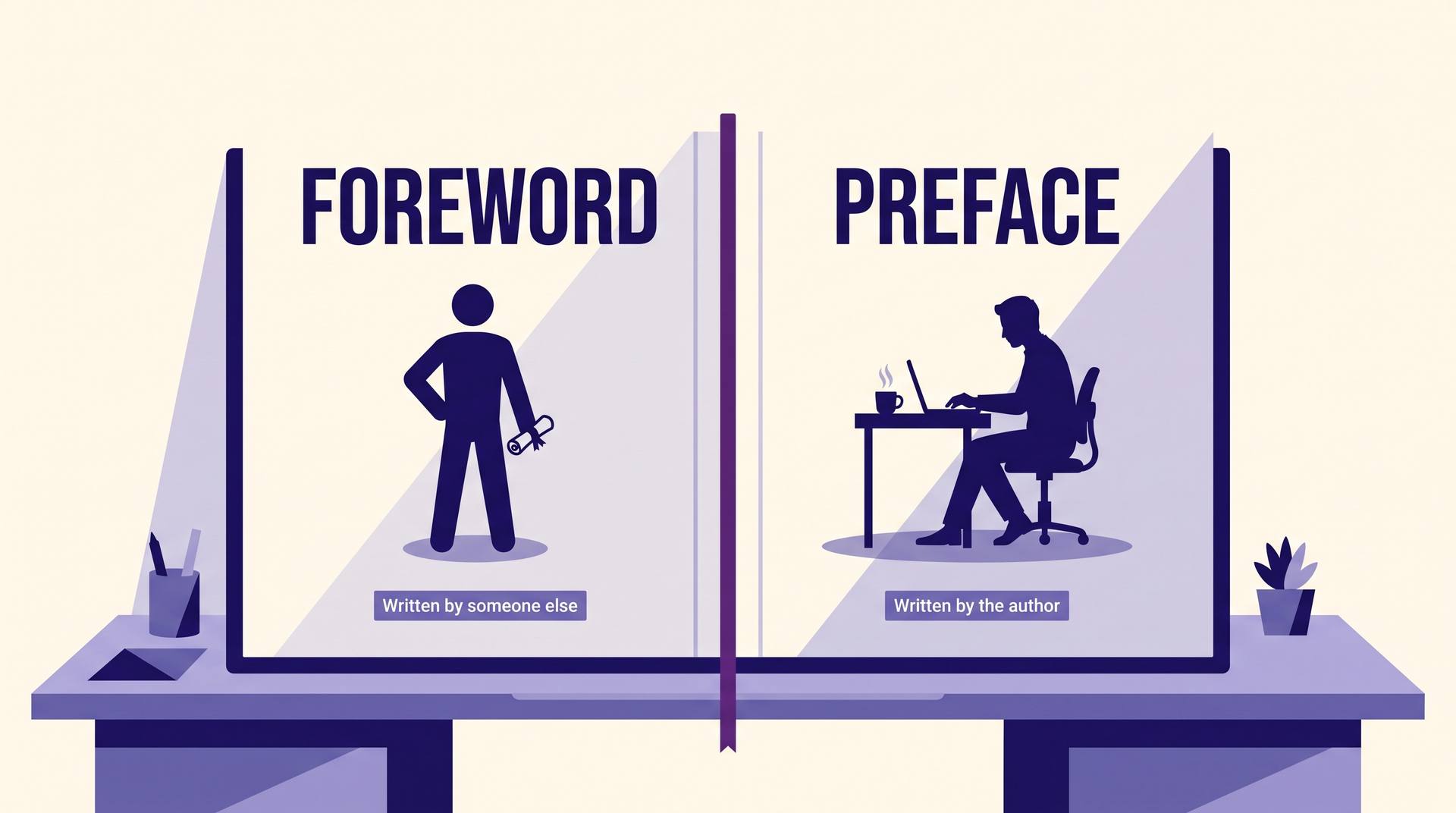
The difference in one line
A foreword is written about you and your book by another person, usually someone with a name your readers trust. A preface is written by you, about how the book came to exist. Same shelf, opposite voices.
Foreword
Signed by a guest — a better-known author in your genre, a subject expert, an editor, sometimes the person whose story you told. It is credibility on loan. The guest is not there to summarise your plot; they are there to say why you are worth an evening of the reader's life. Two to four pages, signed with their own name and often their own city and date, and it appears before your preface because the outside voice speaks before the house voice.
Preface
Signed by you, and about the book rather than the subject. Where the idea came from, what you cut, which archive opened, what changed in the second edition. If you find yourself explaining your argument rather than your process, you have wandered into an introduction. Our deep dive on what a preface is walks through the anatomy line by line.
One spelling note that costs authors reviews: it is foreword, not forward. The word is fore plus word — the words that come before the words. Every misspelled Foreward on a title page is a signal to a browsing reader that nobody proofread the rest.
Foreword vs preface vs introduction vs prologue
Four sections, constantly confused, including by publishers who should know better. Two questions separate all four: who is speaking, and are they talking about the book or inside it?
| Question | Foreword | Preface | Introduction | Prologue |
|---|---|---|---|---|
| Who writes it? | Somebody else | You | You | You, or your narrator |
| What is it about? | You and why this book matters | How the book got made | The subject itself | Story events, before chapter one |
| Is it part of the story? | No | No | Yes, it is content | Yes, it is fiction |
| Signed and dated? | Yes, with the guest's name | Usually, with your initials | No | No |
| Safe to skip? | Yes | Yes | No | No |
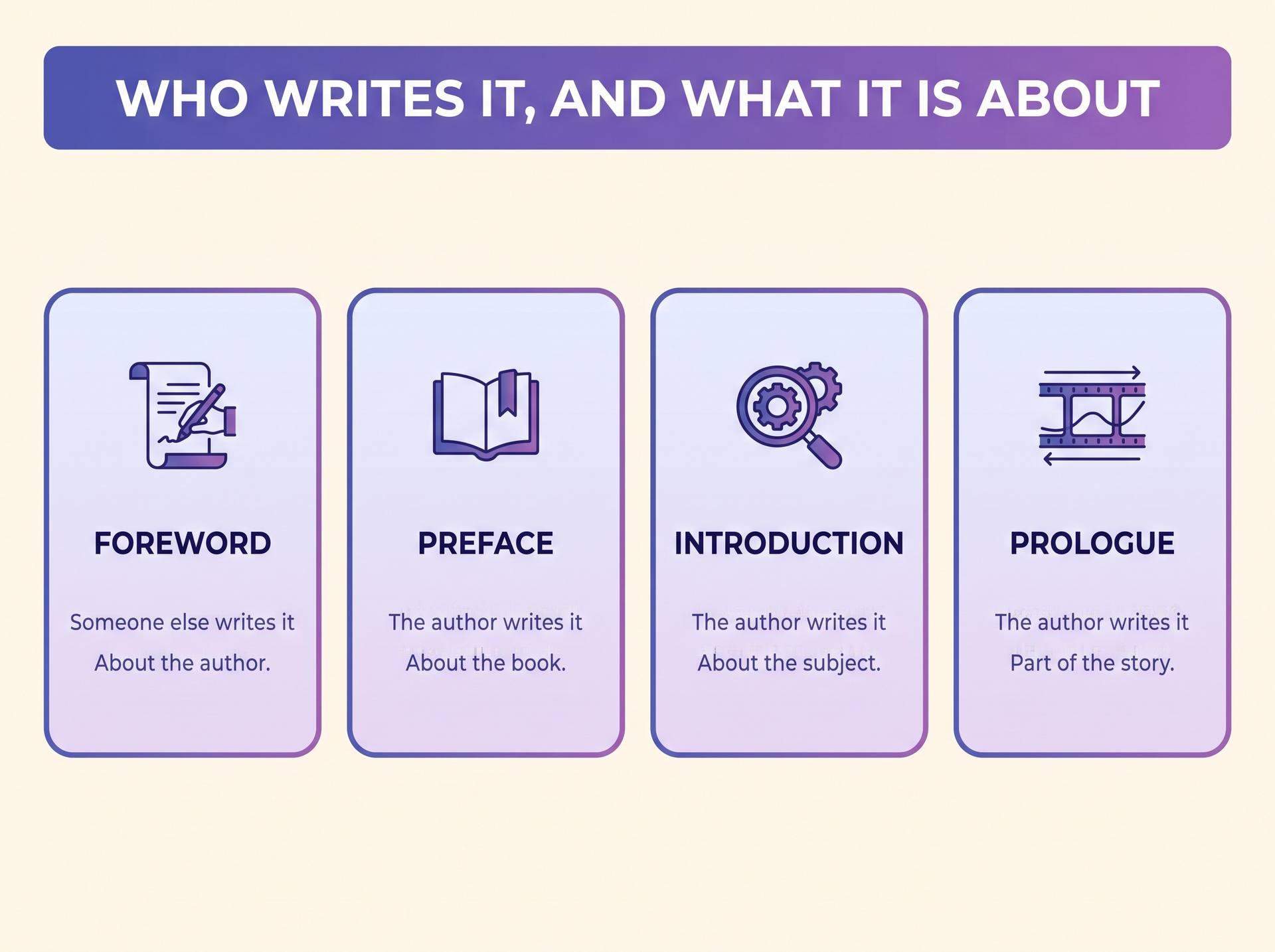
The last row is the one that decides your book's shape. Anything a reader can skip without losing the thread belongs in front matter. Anything they cannot skip belongs in the book. That is why a prologue is numbered pages of story and not front matter at all — we cover when a prologue earns its place in a separate guide.
Where each one sits
Front matter has a conventional order, and the two sections in this comparison sit next to each other in it. Outside voice first, house voice second, subject third.
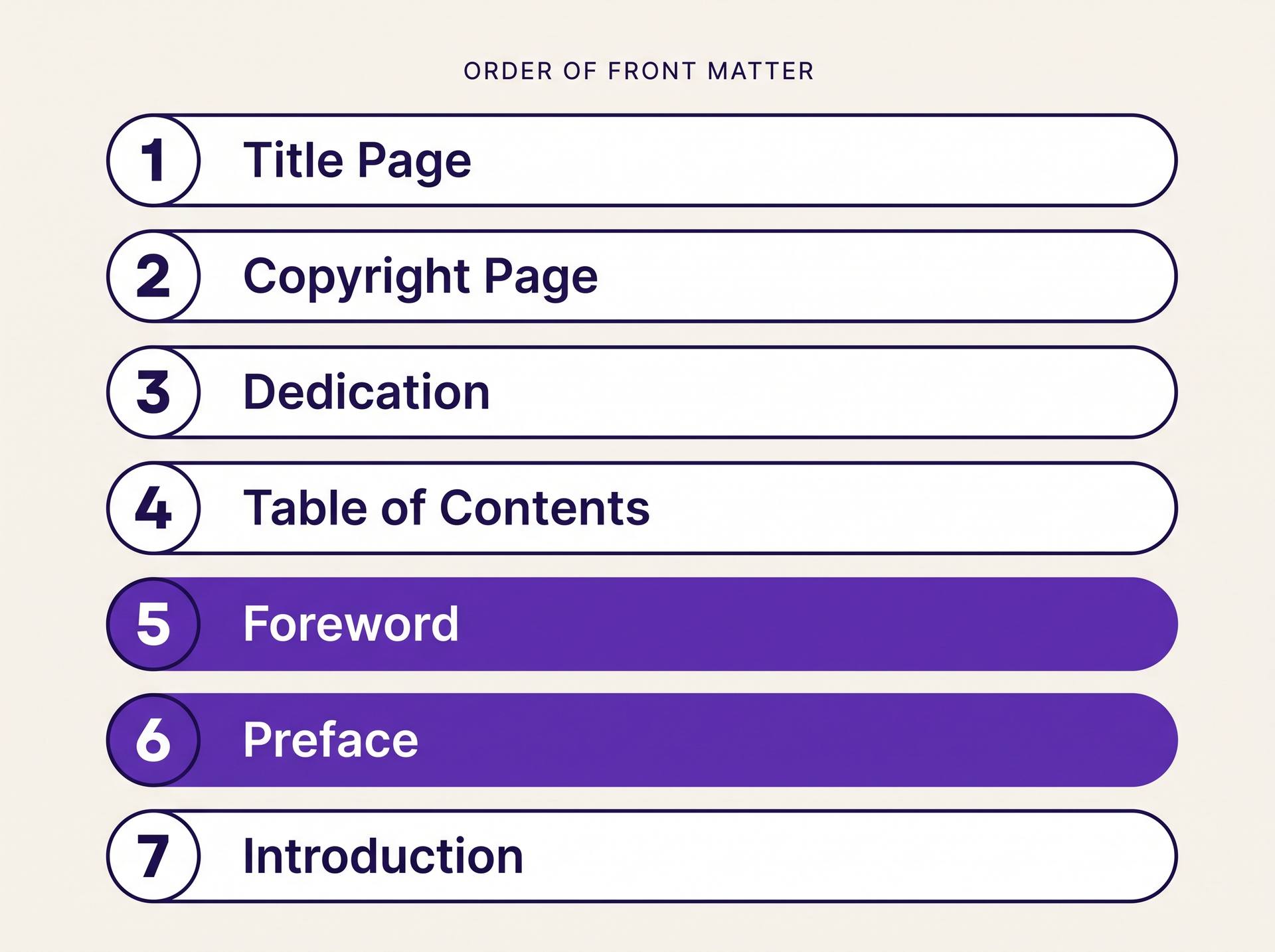
Two practical notes. Front matter is traditionally numbered in lowercase roman numerals, with arabic numbering restarting at chapter one — which is why a foreword never eats into your book's page count in a reader's mind. And the copyright page directly above it is the one piece of front matter that is genuinely non-optional; our copyright page generator produces a correctly worded one in under a minute.
Famous examples, including the ones that break the rule
The tidiest way to learn the distinction is to look at books where it gets bent on purpose.
The Lord of the Rings — a foreword that is really a preface
Tolkien's Foreword to the Second Edition is signed by Tolkien himself, which by the strict definition makes it a preface. It is where he explains how the story grew, complains about the index, and delivers his famous denial that the book is an allegory of the war. The label was conventional; the content is pure preface. Nobody has ever been confused by it, which tells you how much latitude a well-written section buys.
On Writing — three forewords, all by the author
Stephen King opens On Writing with a First Foreword, a Second Foreword and a Third Foreword, all in his own voice, each a page or two, each explaining a different part of how the book came to be. Again: prefaces by definition, forewords by label. King gets away with it because each one does real work and none of them stalls the reader.
Frankenstein — the preface somebody else ghosted
The 1818 first edition of Frankenstein carries a preface written in Mary Shelley's voice but actually drafted by Percy Shelley. Thirteen years later she wrote her own introduction to the 1831 edition, telling the Villa Diodati ghost-story-contest origin that every reader now knows. Two editions, two front-matter strategies, and the second one is the reason we have the origin story at all.
What genre fiction actually needs
Here is the part most guides will not say plainly: if you are writing romance, fantasy, thriller, cosy mystery or litRPG, you probably need neither. Genre readers open a book to be inside a story within seconds. A page of throat-clearing before chapter one is the fastest way to lose the Look Inside sample, and the Look Inside sample is where the buying decision happens.
The exceptions are real but narrow. A foreword earns its place when a recognisable name in your subgenre agrees to write it and their readers overlap with yours — that is borrowed trust, and it works. A preface earns its place on a second edition, an omnibus, a boxed set, or when your novel rests on research a reader might otherwise doubt: a historical novelist who spent two years in parish records has something worth saying, briefly.
The frequent third case is a writer who wants a preface but actually wants a prologue — an opening scene set before the main timeline. If what you have in mind involves characters doing things, that is story, not front matter, and our guide to writing a prologue readers don't skip is the right place to take it.
One more honest option: put it at the back. Author's notes, research credits and thank-yous land better after the last page, when the reader already cares. The AIWriteBook back matter generator drafts that closing section — note, acknowledgements and also-by list — from your book's own details.
When to include one, and when to skip
Worth the pages
- A recognised name in your genre has agreed, and their readers are your readers.
- You are publishing a second edition and readers deserve to know what changed.
- Your novel rests on unusual research, lived experience, or real events a reader might question.
- You are collecting a series into an omnibus and want to frame it as a whole.
Skip it
- It is your first novel and no guest is attached — the pages buy nothing.
- What you actually want to write is a scene, which means you want a prologue.
- Your only material is thanks and credits, which belong in the back matter.
- It would push the Look Inside sample past your opening hook.
Five mistakes that show up again and again
Writing your own foreword
If your name is on it, it is a preface. Calling it a foreword and signing it yourself reads as a mislabel to anyone in publishing — Tolkien and King can carry it, a debut cannot.
Using front matter to apologise
The self-published preface that opens with a note about being a first-time writer, or how tight the budget was, buys nothing. A reader who is already holding the book does not need to be talked down to it.
Hiding essential information in there
If chapter one cannot be understood without your preface, the material belongs in chapter one. Readers skip front matter freely, and the ones who skip should lose nothing.
Chasing a big name you have no relationship with
A cold ask to a bestselling author almost always fails, and a foreword by someone your readers have never heard of adds pages without adding trust. No foreword beats a weak one.
Letting it run long
Two pages is generous for either section. Four is a limit. Anything past that and you have written a first chapter that is pretending not to be one.
How to ask someone for a foreword
Asking is a small piece of business, and the writers who get a yes are the ones who make it easy to say yes. Four things do most of the work.
- 1
Ask someone one rung up, not ten
The realistic yes comes from an author whose readership overlaps yours and who is slightly further along — not the genre's biggest name. A midlist author with a warm newsletter list is worth more to your sales than an unreachable one.
- 2
Send the finished book, not the pitch
Attach the complete, proofread manuscript as an EPUB or PDF. Asking someone to endorse a draft they cannot read is asking them to gamble their reputation.
- 3
Name the length and the deadline
Say 400 to 600 words and give a date at least six weeks out. Unbounded requests get postponed forever; bounded ones get scheduled.
- 4
Offer to draft it, and mean it
Many busy authors will happily edit a draft they would never have written from scratch. Offer it plainly, make clear that every word stays theirs to change, and let them refuse without friction.
Subject: Foreword for a debut cosy mystery? 500 words, deadline 1 March Hi Ruth, I wrote the village mystery that readers of your Marlow books keep asking for — same small-town scale, same slow-burn amateur sleuth. The finished manuscript is attached, 74,000 words, professionally edited. Would you consider a 400 to 600 word foreword by 1 March? Happy to send a draft you can rewrite entirely, and equally happy to hear no. Either way, thank you for the Marlow books. They are why I started. Joanna
Two more details. Agree in writing that the foreword may appear in every edition and format of the book, so a paperback reprint or an audio edition does not need a fresh conversation. And put your contributor's short biography under their signature — the author bio generator produces a clean two-sentence version if they send you a rambling one.
Doing it faster inside AIWriteBook
Front matter is the part of a book writers put off, because it is fiddly and unglamorous and comes at the end when energy is gone. AIWriteBook handles the mechanical half so you only spend judgement on the parts that need it.
Write or import your manuscript, and the chapter writer and its AI chat let you draft a preface in the same voice as the rest of the book and accept or reject each suggested change line by line rather than swallowing a block of generated text. The copyright page generator and the back matter generator cover the pages around it, and the export step assembles front matter, chapters and back matter into a KDP-ready PDF, EPUB or DOCX with the roman-numeral numbering already correct.
If your foreword arrives from a contributor writing in another language — which happens more than you would think in translated genre fiction — whole-book translation handles the whole file in one pass rather than a paragraph at a time.
Questions writers ask
Yes, and plenty do. The foreword comes first because the guest voice speaks before the house voice, then your preface, then any introduction. Just watch the total: a guest foreword plus your preface plus an introduction is three pieces of throat-clearing before chapter one, which is more than most readers will sit through.
Foreword. It is fore plus word, meaning the words that come before the main text. Forward is a direction and has nothing to do with books. It is one of the most common typos on self-published title pages, so check it twice before you export.
The person who wrote it owns their words unless you agree otherwise in writing. In practice you ask for permission to publish it in all editions and formats of the book, credit them by name, and list them on the copyright page. Get that agreement by email before you publish rather than after.
Aim for 400 to 800 words, which is roughly two printed pages. Four pages is the outer limit for either. If yours has grown past that, it has stopped being front matter and become a chapter that needs a number.
Almost never on a first edition. Genre readers want to be inside the story quickly, and a preface delays that. Second editions, omnibus collections and research-heavy historical fiction are the honest exceptions.
The short version
Foreword: their name, about you. Preface: your name, about the book. Introduction: your name, about the subject. Prologue: story, and therefore not front matter at all. Every other rule about these sections is a consequence of those four lines, and every argument in a writers' forum about them is really an argument about whether the section was worth including in the first place.
For genre fiction, the default answer is no, and that is a perfectly respectable answer — the pages you save go to the opening scene, which is what sells the book. When you do include one, keep it under two pages, sign it honestly, and get the spelling right. The rest of the front matter, the chapters and the export are covered step by step in our complete guide to writing a book.