

Why the prologue is the riskiest page in your book
A prologue is the only part of a novel readers have been trained to skip. Agents say it, editors say it, and plenty of readers will tell you outright that they start at chapter one. That reputation was earned by decades of prologues that dumped world history before anyone had a reason to care about the world.
None of that means prologues are dead. It means the bar is higher. A prologue has to do something chapter one structurally cannot do, and it has to do it in under about 1,500 words. If you are still deciding whether your book needs one at all, start with our breakdown of what a prologue actually is and how it differs from a preface or an introduction — this piece assumes you have decided yes and want to write a good one.
One useful reframe before you start: a prologue is not the beginning of your story. It is the beginning of your reader's relationship with your story. Judge every line by that.
First: should your book even have one?
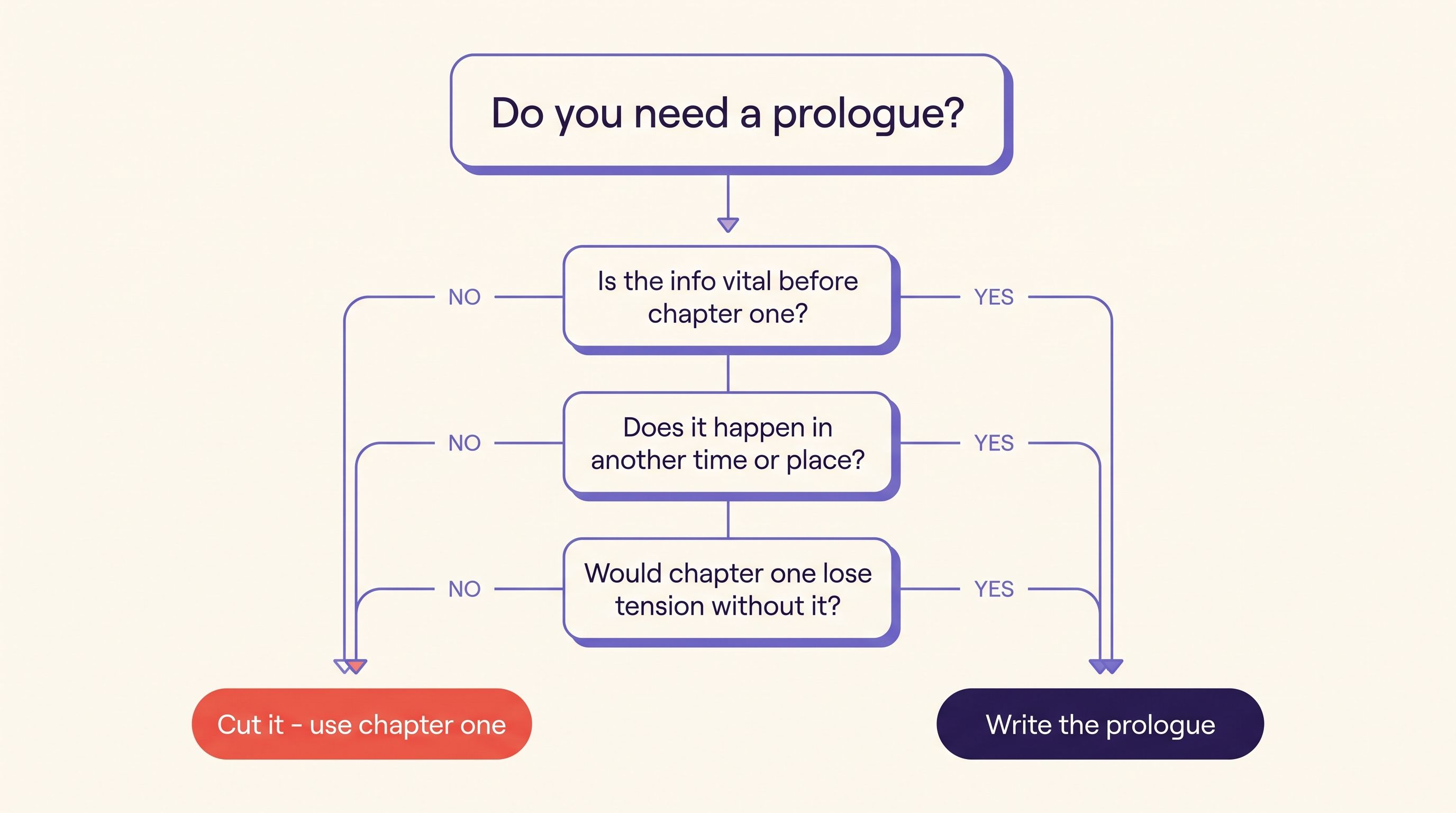
Answer three questions honestly. Most manuscripts fail on the first one, and the fix is usually to move the material into chapter one where it belongs.
Question 1 of 3
Is the information genuinely vital before chapter one?
Not interesting. Not atmospheric. Vital — chapter one is confusing or toothless without it.
The four jobs a prologue can do
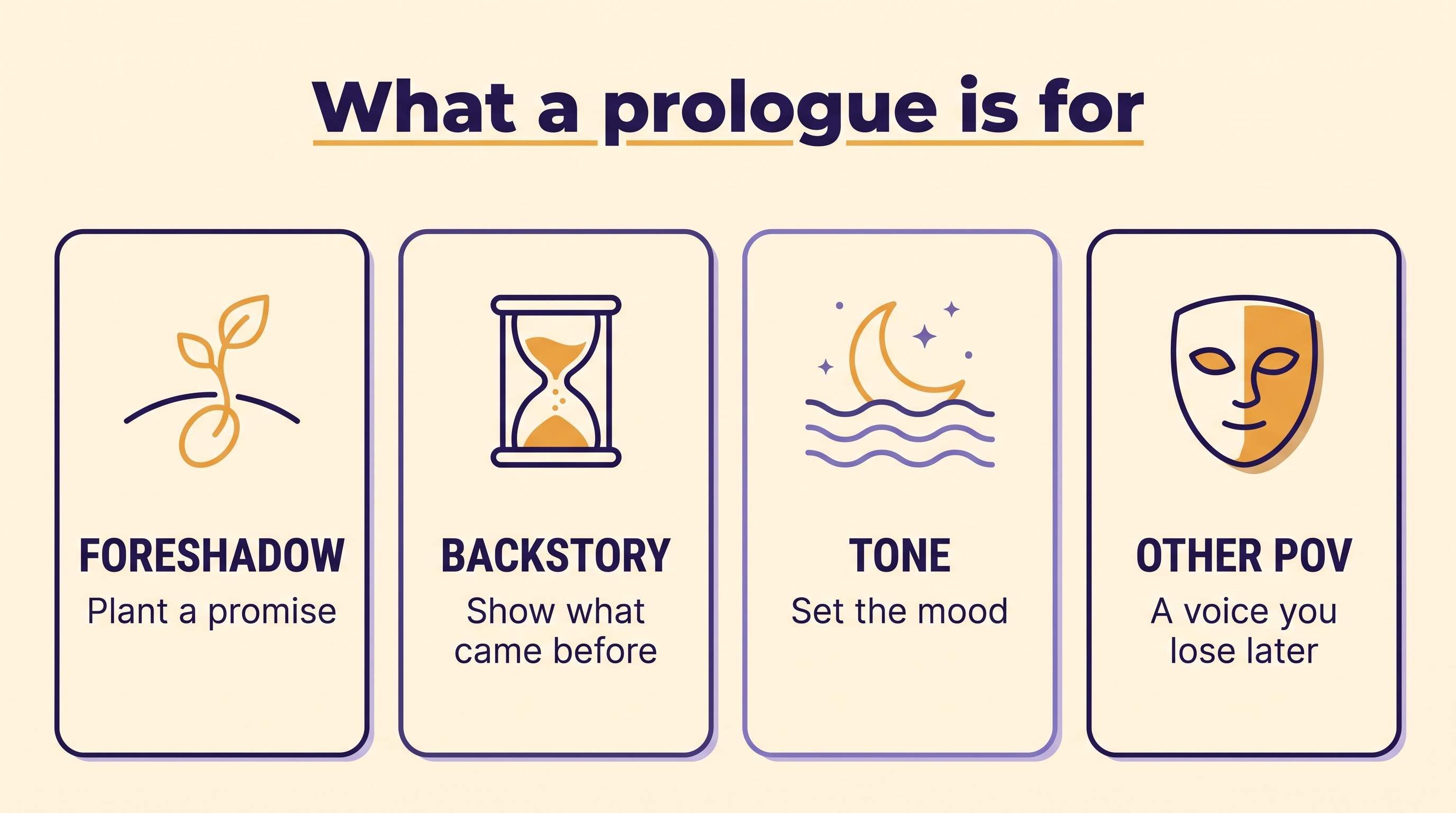
Every prologue that works is doing at least one of these four things — and the strongest ones do exactly one, deliberately. If you cannot name which job yours is doing, that is your first revision.
Foreshadow
Show a fragment of something that will matter much later — a death, a betrayal, an object — without explaining it. The reader spends the whole book waiting to recognise it. This is the most reliable job because it creates a debt the story has to pay, and payment is satisfying. If you want more on planting and paying these off cleanly, our guide to foreshadowing techniques goes deeper than we can here.
Deliver backstory you cannot dramatise later
The night the town burned. The experiment that went wrong forty years ago. Use this only when the event has no living witness who could plausibly tell it inside the story. If a character could recount it over a drink in chapter nine, let them.
Set the tone contract
A prologue can tell the reader what kind of book they are holding before the quieter opening chapters arrive. A cozy mystery that opens on a body, a literary novel that opens on a voice — both are making a promise. Break that promise later and you will see it in your reviews.
Give a point of view you lose afterwards
The villain, the victim, the god, the town itself. If your novel is locked into one close third-person perspective, the prologue is the one legitimate place to hand the reader information your protagonist will never have. That gap between what the reader knows and what the hero knows is the engine of dread.
The method: six steps from blank page to a prologue that holds
This is the order that produces the fewest rewrites. Notice that the actual prose is step four — everything before it is deciding what the scene owes the book.
Name the job in one sentence
Write it down before you draft: "This prologue exists to make the reader dread the lighthouse." One job, one sentence. If you need an "and", pick the more important half. A prologue trying to foreshadow, explain the magic system, and introduce three houses will do none of them.
Pick a moment, not a period
The single most common failure is writing a summary of a decade instead of a scene lasting minutes. Choose one continuous moment with a person in it who wants something. "The war lasted nine years" is a note to yourself. "She counted the boats coming back and stopped at four" is a prologue.
Decide what the reader is allowed to understand
Aim for roughly this: the reader should fully understand the emotion and only partly understand the situation. Full comprehension of both means there is nothing to carry forward. Comprehension of neither means confusion, and confused readers close books. Withhold names and explanations, never feelings.
Draft it in one sitting, then cut it in half
Write hot and long, then be ruthless. A prologue in the 500–1,500 word band is almost always stronger than the same content at 3,000. Cut every sentence of explanation that the following chapters will supply anyway — which is usually most of the second half of a first draft.
End on the hook, not the resolution
The last line of a prologue is the most reread sentence in your first fifty pages. It should open something rather than close it: a question, an image, a threat left standing. Then chapter one begins somewhere else entirely and the reader is willing to wait, because they are waiting for something.
Test the deletion
Delete the prologue and give chapter one to a reader cold. If the book still works completely, the prologue was decoration. If chapter one now feels flat or confusing, you have proof the prologue is load-bearing — and you know exactly which parts are doing the work.
Step five is the one writers hand-wring over most. If you want a fast way to pressure-test that final line, our free first chapter hook generator will spin alternative openings and closers from your premise so you can see your options side by side instead of staring at one sentence for an hour.
Last night I dreamt I went to Manderley again.
Not technically a prologue, but the template every good one follows: a narrator who already knows how it ends, an image loaded with meaning the reader does not yet have, and no explanation offered.
Three worked examples, by genre
Same method, three very different jobs. Each one is built to the shape described above — a single moment, one job, emotion clear and situation withheld.
A cartographer finishes a map of the northern coast and finds one island on it she never surveyed. She burns the map. The island is on the next one too.
It plants an object the plot will pay off, establishes that the world is quietly wrong rather than loudly magical, and never mentions a prophecy, a chosen one, or the names of four kingdoms. The reader learns the rules of the book's mood, not its lore.
Last line: "She drew the coast a third time and did not look at the sea."
If your prologue is set far from chapter one in time, keep the transition clean: date the sections or change the tense deliberately rather than hoping readers infer it. Writers working in a specific genre will also find shape-specific advice in our fantasy novel guide, where prologues carry more world-building weight than anywhere else.
Five mistakes that get prologues skipped
The history lecture
Three centuries of politics before a single character wants anything. Readers do not retain lore they have no emotional use for yet. Move it into conflict later.
The unnamed hooded figure
Mystery by pronoun. "The figure moved through the dark, its purpose known only to itself." Withholding identity is fine; withholding all specificity leaves nothing to hold onto. Give the reader concrete sensory detail even while you hide the name.
The duplicate opening
A prologue that covers the same emotional ground as chapter one, from the same viewpoint, at lower intensity. Now the book has two beginnings and the weaker one goes first.
The dream, the prophecy, the funeral
These are not banned, but they are so heavily used that a reader recognises the move immediately. If you use one, the execution has to be unusually specific to survive the familiarity.
The tone the book never delivers
A brutal, blood-soaked prologue glued onto a gentle novel to make the opening pages exciting. This is the one readers punish hardest, because it is a broken promise rather than a slow start. Editors call it front-loading; reviewers call it bait.
Several of these problems disappear entirely if you drop the prologue and open the novel mid-action instead — our piece on starting in medias res covers when that trade is worth making.
The AI-assisted shortcut
The slow part of writing a prologue is not the prose. It is generating enough candidate moments to find the one that actually foreshadows the ending you have planned. That is work AI is genuinely good at, and it is built into how AIWriteBook drafts a book.
Start from the outline, not the page
Because AIWriteBook builds your outline and characters before any chapter is written, it already knows what your ending owes the opening. Ask it for prologue options that plant something the final act will pay off, and you get candidates tied to your actual plot rather than generic openings. You can also sketch structure first with the free outline generator if you are still shaping the book.
Generate several, keep one
Draft three prologues from three different jobs — one foreshadowing, one villain point of view, one tone-setting — and read them back to back. Choosing between real drafts is far easier than judging an idea in the abstract, and the two you discard usually donate a line each to the one you keep.
Cut it down in the chapter chat
The chapter AI chat edits with a diff view and accept or reject on every change, so you can ask it to halve the length or strip explanation and then approve the cuts line by line. That matters for a prologue more than any other chapter, because the whole craft of it is subtraction — and your voice survives when you are the one approving each cut.
Keep the voice yours
Writing style copy lets the system match a sample of your own prose, so the prologue does not read like a different author wrote the first 900 words of your novel. If you imported an existing manuscript, it can pull the voice from that.
None of this replaces the judgement in step one. You still decide what the prologue is for. The tool removes the blank-page tax on finding out which version of it works.
The one test that matters
Give a reader your prologue and your first chapter, then ask one question: what do you want to know? If they name something specific — who was in the car, whether the island is real, why she stopped waving — the prologue is doing its job. If they shrug, or if they answer with a summary of what happened, cut it and start at chapter one.
Prologues are not a genre requirement or a stylistic flourish. They are a structural tool with one narrow use: giving the reader something chapter one cannot give them, in the smallest number of words possible. Get that right and nobody skips it.
This piece is part of our wider guide to writing a book, which walks the whole path from premise to published manuscript.