

The definition, in one line
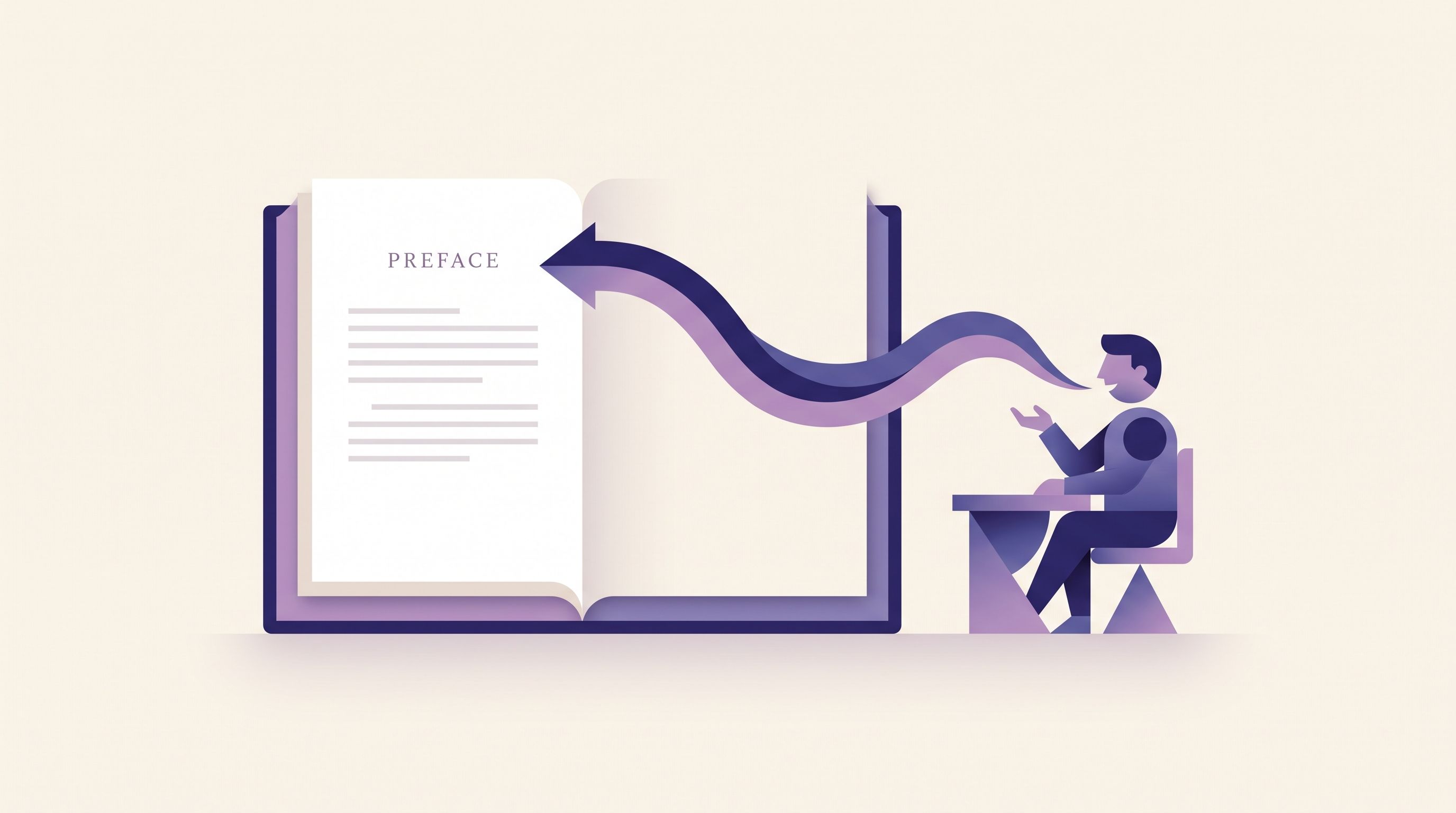
A preface is a short, author-written section of front matter in which the author explains why and how the book was written — its origin, its scope, its limits, and what changed between editions.
The word comes from the Latin praefatio, a speaking-before. That is exactly what it does: before the argument begins, the author speaks in their own voice about the making of the thing you are holding. It is usually one to four pages, signed and dated, and it is almost always written last, once the author finally knows what the book turned out to be.
The test that settles nearly every case: if the passage is about the subject, it is an introduction and belongs to the content. If it is about the book — the years it took, the archive that opened, the second edition that corrects chapter nine — it is a preface. Readers skip prefaces freely and that is fine. Nothing a reader needs in order to understand chapter one should be hiding in there.
Preface vs foreword vs introduction vs prologue
These four get swapped constantly, including by publishers. They differ on two axes only: who wrote it, and what it is about.
| Part | Who writes it | What it is about | Typical use |
|---|---|---|---|
| Preface | The author | The book itself — origin, method, scope, edition changes | Nonfiction, academic, second editions |
| Foreword | Someone else, usually a name readers recognise | Why this author and this book are worth your time | Nonfiction seeking borrowed credibility |
| Introduction | The author | The subject — it is part of the content and shouldn't be skipped | Nonfiction, textbooks, essay collections |
| Prologue | The author, in the narrator's voice | The story — a scene that happens before chapter one | Fiction, memoir |
Only the foreword is written by another person, and only the prologue is part of the story. If you're weighing whether your novel needs an opening scene set apart from chapter one, that is a separate decision about prologues — a preface is a nonfiction instrument and rarely belongs in a novel at all.
Where the preface sits in the front matter
Front matter runs in a conventional order, and the preface has a fixed seat in it: after the foreword someone else wrote, before the introduction that starts the actual argument.
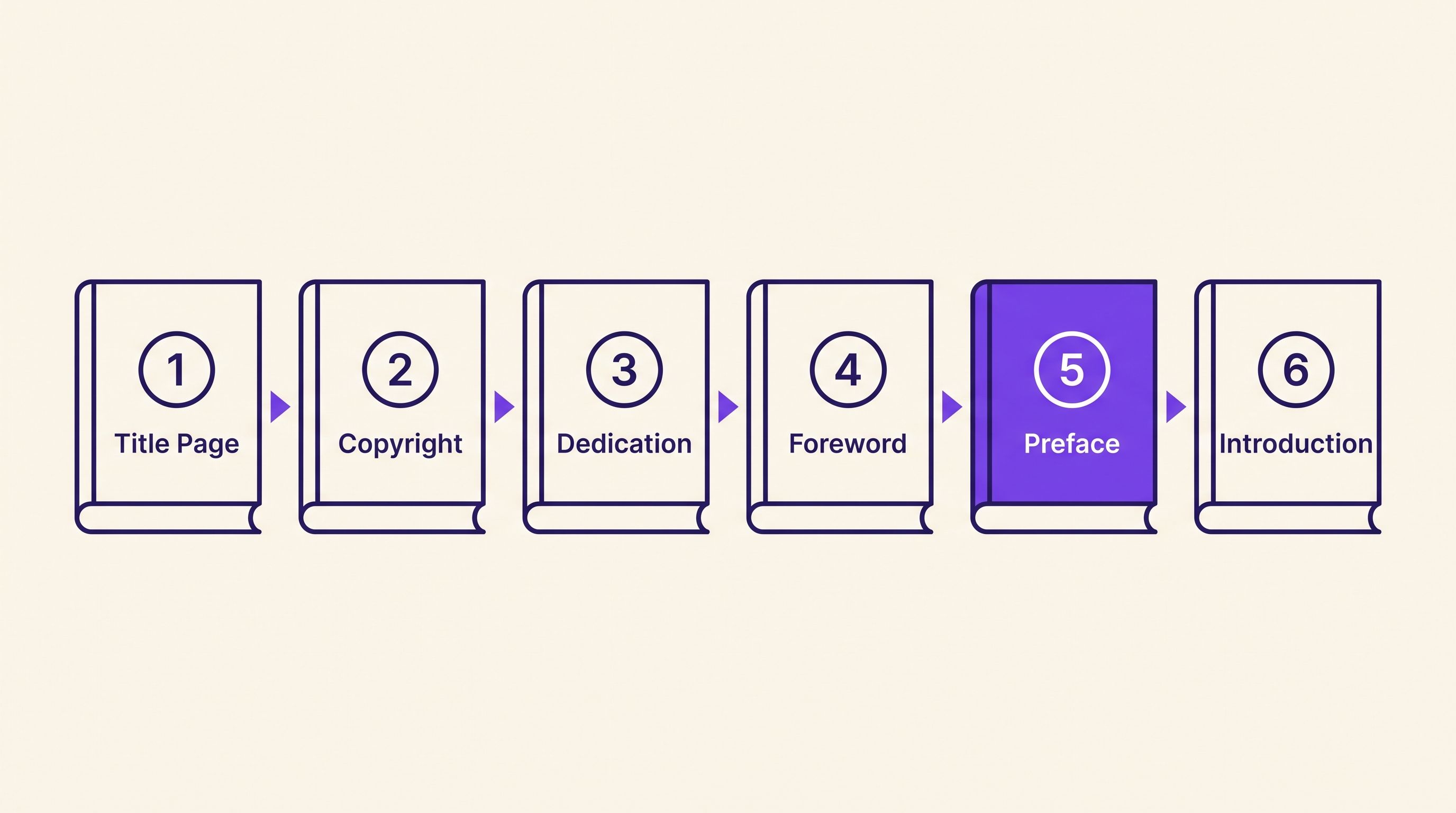
- 1
Title page
Title, subtitle, author name, publisher imprint.
- 2
Copyright page
Rights notice, ISBN, edition line, disclaimers. Fiddly and legally load-bearing — you can draft one in a minute with our free copyright page generator and then check it against your own imprint details.
- 3
Dedication
One line, no explanation. Explaining the dedication is what the acknowledgements are for.
- 4
Foreword
Written and signed by someone other than you. Omitted in most books, and there is no shame in omitting it.
- 5
Preface
Your voice, about the book. Signed with your name, place and date.
- 6
Introduction
Your voice, about the subject. This one is content — number it with the body if it carries argument.
Two small conventions that catch people out: front matter is traditionally paginated in lowercase roman numerals, and the preface goes before the introduction even though a foreword by someone else goes before both. Acknowledgements can sit either at the end of the preface or as their own section — pick one and be consistent across a series.
What actually goes in a preface
Five moves, in roughly this order. You will not need all five in every book, but a preface that contains none of them is just throat-clearing.
The specific moment the book started. A question you couldn't answer, a job you did for eleven years, a box of letters. Concrete beats grand.
What the book covers and — more usefully — what it deliberately does not. This is where you disarm the reviewer who wanted a different book.
How you know what you claim to know: interviews, archives, your own practice, and how sources are handled.
For a second edition, say plainly what changed and why. Readers who own the first edition are deciding whether to buy again.
Thanks where they are owed, then your name, place and date. The date matters more than writers expect — it timestamps the claims.
A short sample preface
Original, written for this guide. Watch how each paragraph does exactly one of the five jobs and then stops.
Preface
This book began as a spreadsheet I kept for myself. For six years I ran the night shift at a small municipal water plant, and every time something failed I wrote down what failed, what we tried, and what actually fixed it. By the time I left there were four hundred rows, and it was obvious that almost none of it existed in the training manuals.
Origin — one concrete scene, no grand claims.
What follows covers small plants: under fifty thousand residents, chronically understaffed, usually running equipment older than the operator. It is not a treatise on municipal engineering, and readers looking for design theory will be happier elsewhere.
Scope, including what the book refuses to be.
Every procedure here was performed by me or watched by me. Where I have relied on someone else's account, they are named in the notes, and where the standards have changed since I did the work, I say so in the text rather than quietly updating my memory.
Method — how the author knows what they claim.
This second edition corrects the filtration figures in chapter nine, which were wrong in a way three readers were kind enough to explain to me at length.
Edition changes, stated plainly.
R. Okonjo Duluth, March 2024
Name, place, date. Nothing else.
Roughly three hundred words. That is a completely respectable length for a preface, and it is longer than many good ones.
Three real examples worth knowing
Frankenstein, and the two different openings
The 1818 first edition of Frankenstein opens with an unsigned Preface — written by Percy Bysshe Shelley, in Mary Shelley's voice, framing the story's plausibility. The 1831 edition instead carries Mary Shelley's own Introduction, in which she finally tells the famous story of the wet Geneva summer and the ghost-story contest. It is the clearest case in English literature of the same book being fronted two entirely different ways, and of an author reclaiming her own front matter thirteen years later.
Huckleberry Finn's Explanatory
Mark Twain opens with a short author's note explaining that the book's several dialects were deliberate and painstaking, not careless. It is a preface in everything but name, and it does one job only: heading off a misreading before it can happen.
Harper Lee's refusal
For the 1993 anniversary edition of To Kill a Mockingbird, Harper Lee contributed a brief note saying she was against introductions and would rather the book meet readers on its own. That is a real option, and for most novels it is the right one.
Common mistakes
Putting essential material in it
Readers skip prefaces. If your definitions, your framework, or your argument's first move is in there, it will be missed — move it to the introduction or to chapter one.
Writing it first
A preface describes a finished book. Written up front, it describes the book you intended, which is a different book. Draft it last and it takes twenty minutes instead of a week.
Selling instead of explaining
Praise for your own book reads as desperate in your own voice. That job belongs to a foreword, where someone else does it, or to the blurb on the back.
Apologising
The preface that lists everything the author wishes they had done better teaches the reader to distrust the pages ahead. State scope, not regret.
Bolting one onto a novel
Fiction almost never wants a preface. If you feel the need to explain the novel before it starts, the explanation usually belongs inside the novel.
Quick answers
No. Most novels should not have one, and plenty of nonfiction is better without. Write one when there is a real story about how the book came to exist, when you need to state scope, or when a new edition changed materially. Otherwise skip it — an unnecessary preface delays the reader for nothing.
One to four pages, roughly 300 to 1,200 words. Under 300 words it usually reads as an afterthought; over about 1,500 it has quietly become an introduction and should either be retitled or split.
Yes, and many good nonfiction books do. The preface handles the book, the introduction handles the subject. Keep them genuinely separate — if you find yourself repeating material between the two, one of them is doing the other's job.
Getting help with the front matter
The preface itself should be yours — it is the one page in the book that is explicitly about your experience of writing it, and a machine has no experience to report. What AI is genuinely good at here is the scaffolding around it, and the drafting pressure on everything else.
In AIWriteBook you write your book chapter by chapter with an AI that has the whole manuscript in view, so when you finally sit down to draft the preface last, you can ask the chapter chat what the book actually ended up covering and get an honest answer rather than your own hopeful memory of it. For nonfiction, source grounding keeps the claims you make about your method traceable, which is exactly the material a good preface summarises. The short bio that follows your signature can come from the author bio generator, and the legal page in front of it from the copyright page tool.
The short version
A preface is you, briefly, on the record about your own book: where it came from, what it covers, how you know, what changed. Write it last, keep it under four pages, sign it, and never hide anything essential inside it.
Front matter is the last mile of a much longer job. If you're earlier in the process, the complete guide to writing a book walks the whole route from idea to published file, and the preface is a pleasant hour near the end of it.