


On this page
What the hero's journey actually is
In 1949 the mythologist Joseph Campbell noticed something strange: myths from cultures that had never met — Greek, Buddhist, Aboriginal, Norse — kept telling the same underlying story. He called it the monomyth, the single story humanity tells over and over. A person is called away from safety, refuses, is pushed anyway, meets a guide, faces a trial that nearly destroys them, and comes home carrying something the community needs.
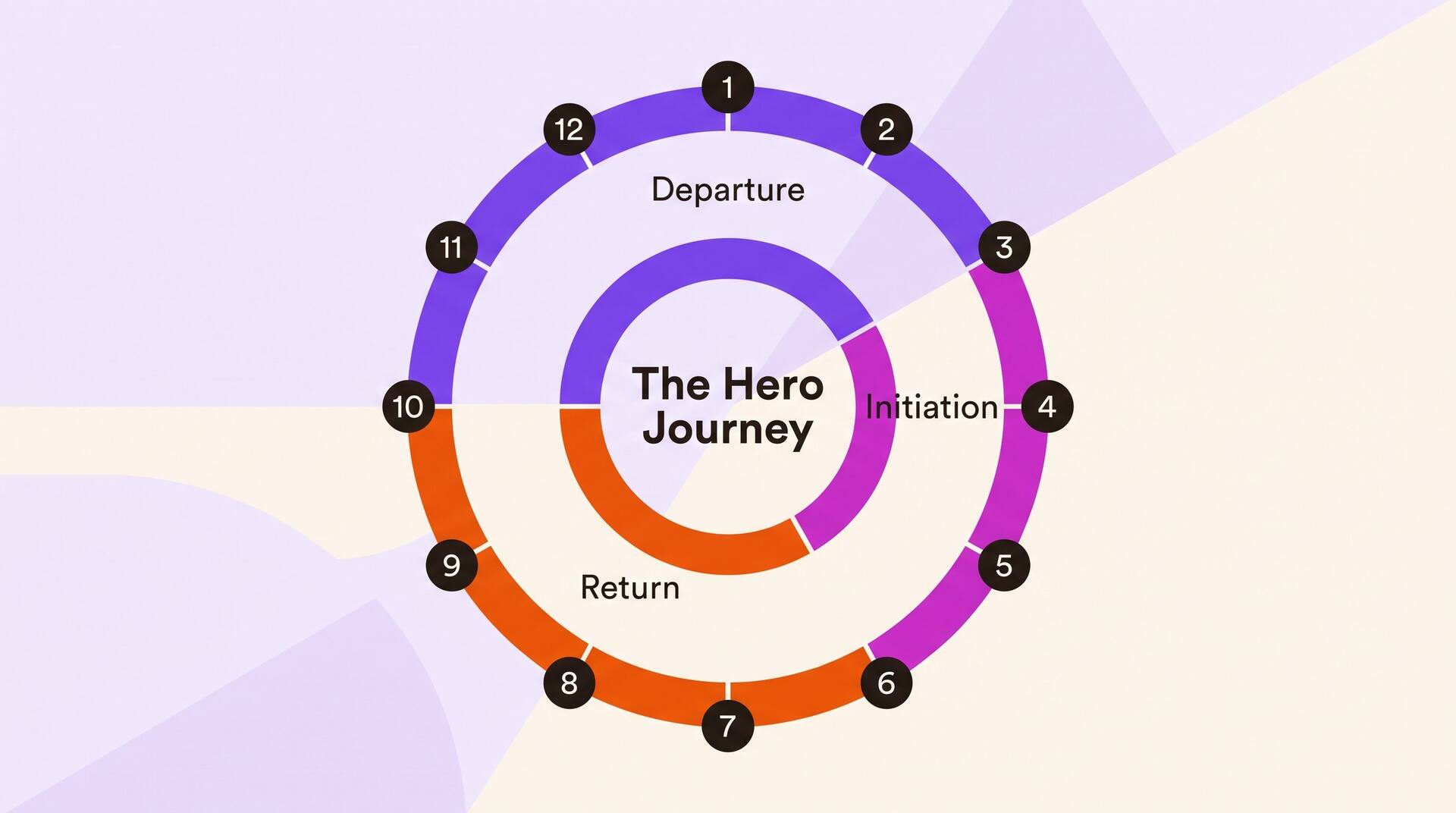
Campbell's version was dense and academic. The reason writers use it today is Christopher Vogler, a Hollywood story analyst who distilled it into twelve teachable stages in The Writer's Journey — the framework behind everything from Star Wars to The Lion King. When people say 'the Campbell hero's journey,' they usually mean Vogler's twelve-step, circular map: the ordinary world on top, the special world below, and a threshold between them the hero must cross twice.
The circle matters. Unlike a straight structural line, the monomyth stages insist the hero comes back to where they started — but changed, so the same world now looks different. That return is the whole point. A hero who wins but never comes home has an adventure; a hero who returns transformed has a journey.
The twelve stages
Tap any stage to expand it. The first act keeps the hero in the ordinary world; stages five through eight happen in the special world below the threshold; the last act brings them home. Each stage lists what happens and a famous book or film that nails it.
What happens
We meet the hero in their normal life, before the story disturbs it. This stage exists to make us care and to establish what the hero lacks — the flaw or absence the journey will fix.
Seen in: The Shire in The Lord of the Rings; Luke's moisture farm on Tatooine.
How to actually use it
The mistake is treating the twelve stages as a checklist to march through in order. Working writers use the monomyth two other ways, both better.
First, as a diagnostic. Draft your story however you like, then lay the twelve stages over it and look for the gaps. No refusal of the call? Your hero may feel too eager and the stakes too low. No real ordeal? Your midpoint is probably soft. The framework is most useful not as a blueprint but as an X-ray of a draft that isn't working.
Second, as a character engine. The stages are also roles — mentor, threshold guardian, shapeshifter, shadow — and casting those roles well does more for a story than hitting the plot beats. A strong mentor who equips then dies raises the ordeal's stakes automatically. If you want to build those roles deliberately, our guide to character archetypes and the roles that fill the hero's journey pairs directly with this structure.
And remember the monomyth is one lens among several. It sits comfortably inside three-act structure — the threshold crossing is your first plot point, the ordeal your midpoint or climax. If you want to see how it lines up against Freytag's pyramid and the three-act line side by side, our complete plot diagram guide charts all three against each other.
When not to use the hero's journey
The monomyth is a tool, not a law, and it fits some stories badly. Force it and you get a manuscript that feels generic — the exact 'AI-story sameness' readers complain about.
Character-driven literary fiction
Stories where the change is internal and ambiguous, with no external quest or clear victory, resist the circle. A quiet novel about a marriage dissolving has no threshold to cross or elixir to carry home.
Ensemble and mosaic stories
The monomyth follows one hero. Books with a web of equal protagonists — many of the best fantasy sagas, most social novels — need a structure that can hold several arcs at once, not a single wheel.
Stories about stasis or defeat
The monomyth is fundamentally optimistic: the hero returns with a boon. Tragedies, downfall arcs, and stories about characters who cannot change are actively distorted by forcing a triumphant return.
The rule of thumb: if your story is about a person going out to get something and coming back transformed, the monomyth will help. If it is about staying, dissolving, or losing, reach for another shape.
Common mistakes
Treating it as a checklist
Marching through twelve stages in strict order produces mechanical, predictable plots. Use the stages that serve your story and cut the rest — most great films skip or blend several.
A mentor with no cost
Mentors matter most when their guidance costs something or when losing them raises the stakes. A mentor who simply dispenses advice and sticks around is wasted structural weight.
A weightless ordeal
If the hero faces their greatest fear and is never truly at risk of losing, the resurrection has nothing to prove. The ordeal must threaten the thing the hero most wants to protect.
Writing your journey with AI
Once you know which stages your story needs, AIWriteBook turns the map into a manuscript without flattening it into monomyth mush. Set the structure in the outline builder, place the threshold, ordeal, and resurrection where your pacing wants them, and generate a chapter plan that serves your arc rather than a generic template.
The roles are where the real depth lives. Build your hero, mentor, and shadow with explicit goals and wounds using the free character creator, then draft chapter by chapter with a chapter AI chat that shows every change as an accept-or-reject diff — so the transformation reads as earned and in your voice, not stamped from a mold.
Take your hero across the threshold
Build the roles, place the twelve stages where your story needs them, and draft a chapter outline you control — from your own premise, today.
Hero's journey FAQ
Use the circle, don't obey it
The hero's journey endures because it names something real about how humans experience change: we leave, we struggle, we come back different. That truth is worth knowing. But the twelve stages are a description of stories that work, not a recipe that makes them work — the specific, surprising choices are still yours to make.
Learn the stages so you can see them in your draft, cast the roles so your hero has something to push against, and cut every beat that doesn't earn its place. Then take your protagonist across the threshold.
Keep going with the full How to Write a Book guide, from first idea to finished manuscript →