


Short answer
At an average typing speed of about 40 words per minute, 500 words takes roughly 12 minutes to type. Real writing runs at 500 to 1,500 words per hour, so expect 20 to 60 minutes for a first draft, and up to two hours if the piece needs research.
Realistic time ranges by type of writing
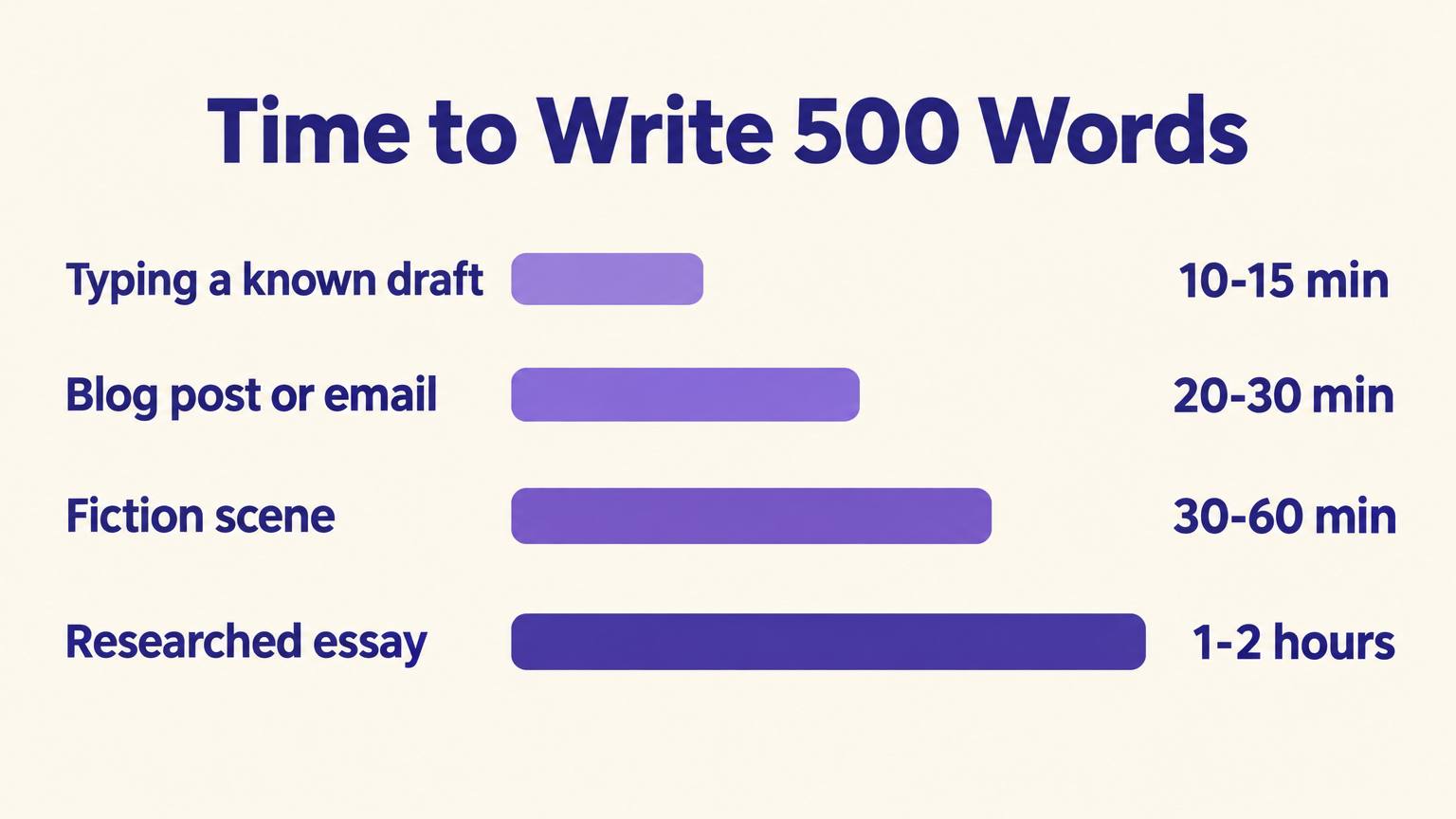
500 words is about one double-spaced page in a manuscript, or two pages of a printed paperback. If you want to see how that adds up to whole books, read how many words are in a 200-page book. How long a page of your own takes depends far more on what you are writing than on how fast your fingers move.
- Transcribing or retyping something already composed in your head: 10 to 15 minutes.
- A blog post, newsletter or work email on a topic you know: 20 to 30 minutes.
- A fiction scene with dialogue and a clear goal: 30 to 60 minutes.
- An essay or non-fiction section that needs sources: one to two hours, mostly reading.
What actually changes your speed
- Knowing what comes next
- The biggest factor by far. Writers who start a session with a three-line plan for the scene routinely double their words per hour, because the pauses disappear.
- Editing while drafting
- Rewriting each sentence before moving on can cut output in half. Drafting and revising are different jobs, and doing both at once makes each slower.
- Research
- Every fact you stop to check is a context switch. Mark it with a placeholder like [CHECK] and keep going.
- Experience
- Beginners often manage 300 to 500 words an hour. Working novelists in a groove commonly report 1,000 to 2,000. The difference is mostly practice at not stopping.
- Interruptions
- A notification is not a five-second cost. Getting back into a scene takes minutes, so a phone in another room is worth more than any tip below.
Do not forget editing time
A finished 500 words is not the same as a drafted 500 words. A good rule of thumb is to budget as long again for revision as you spent drafting, and more for anything high stakes like a query letter or an opening chapter. A 30-minute draft becomes about an hour of total work.
Paste a draft into our free word counter to check length, reading time and repeated words before you revise, so you know whether you are cutting or adding.
Seven ways to write 500 words faster
Each of these removes a specific source of hesitation.
- 1
Write the plan first
Before starting the timer, jot three bullet points: where the scene starts, what changes, where it ends.
- 2
Use a timed sprint
Set 25 minutes and do not stop typing. Most people hit 400 to 700 words in their first sprint.
- 3
Stop mid-sentence
End each session halfway through a thought. Starting the next day is effortless because you know the next words.
- 4
Leave placeholders
Names, facts and perfect words can wait. Type [NAME] or [BETTER WORD] and move on.
- 5
Draft out of order
Stuck on a transition? Skip it and write the part you can see clearly.
- 6
Dictate
Most people speak three to four times faster than they type. Dictated drafts need more cleanup but arrive much faster.
- 7
Let AI draft the scaffolding
Generate a rough version of the chapter from your outline, then rewrite it in your own words. Revising is faster than inventing from a blank page.
Where AI fits, honestly
AI does not make your thinking faster, but it can take the blank page away. In AIWriteBook you write an outline, and the chapter writer drafts each chapter from it using the characters and plot you defined. You then rewrite and refine with the chapter AI chat, which shows its edits as changes you accept or reject one by one.
If speed costs you your voice, it is not worth it. The writing style builder learns from samples of your own prose so drafts sound like you, and the chapter generator stays inside the outline you approved, so the time you save goes into revision instead of fixing generic text.
Daily goal planner
See how a daily habit adds up to a finished draft.
38 minutes a day
140 days to a full draft
about 20 weeks
Not sure how long your book should be? Check how many words are in a novel for genre ranges.
Five hundred words a day is a book a year with time left over for editing. Protect the half hour, plan before you type, and keep drafting separate from polishing. For the rest of the process, from outline to final manuscript, see our how to write a book guide.