

The short answer
A 200-page book contains about 50,000 to 60,000 words. The standard estimate is 275 words per page, which puts a 200-page book at roughly 55,000 words — a typical length for a short novel, a novella-plus, or a focused nonfiction book.
That single number assumes standard formatting: a 5.5×8.5 or 6×9 trim size, an 11- or 12-point serif font, and normal line spacing. Change any of those and the word count per page moves, sometimes dramatically.
The honest answer to 'how many words is 200 pages?' is therefore a range, not a point. This guide gives you the range, the formatting choices that move you within it, and a calculator to pin down your specific case.
Three things to remember
- A 200-page book is about 50,000–60,000 words (≈275 words/page)
- Trim size, font size, and line spacing each shift words per page
- Word count, not page count, is the number retailers and editors care about
The word-count formula
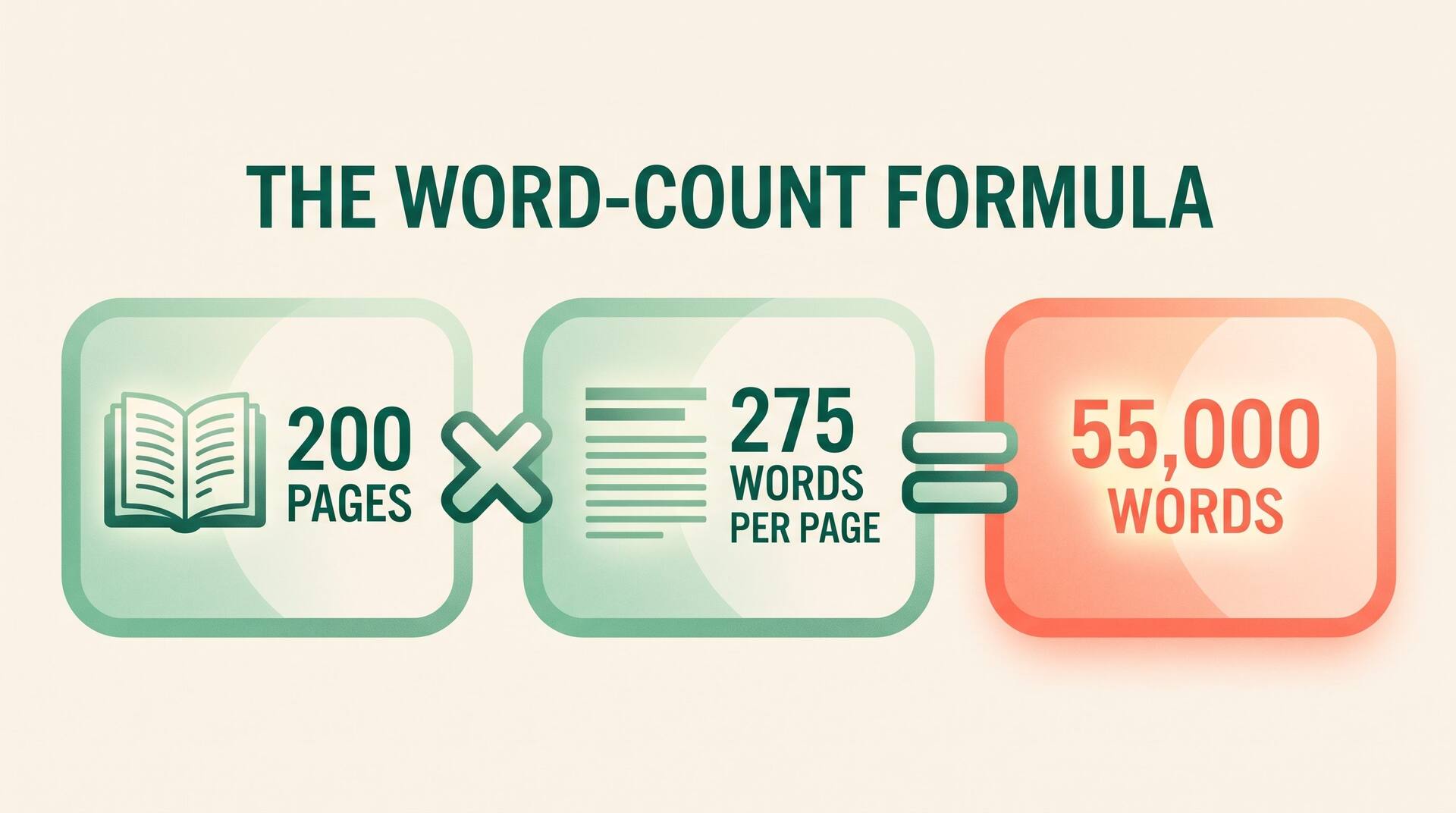
Page count is an output of word count, formatting, and trim size — not an input. Here is the formula publishers use to convert between the two.
Start with words per page
Standard trade formatting yields about 250–300 words per page, with 275 as the common working average. Mass-market paperbacks pack more; large-print and children's books far fewer.
Multiply by page count
Words ≈ pages × words-per-page. For 200 pages at 275 words: 200 × 275 = 55,000 words. At the lower bound of 250 you get 50,000; at 300 you get 60,000.
Adjust for your trim and font
A 6×9 book with 11pt type fits more words per page than a 5×8 book with 12pt type. The wider the page and smaller the font, the higher your words-per-page — and the fewer pages your manuscript needs.
Word count calculator
Set your page count and words-per-page to see the estimated total. Use 275 for a standard estimate, lower for large or spacious formatting, higher for dense mass-market layouts.
Estimated word count
55,000
words
This works both ways. Have a word count and want the page estimate? Divide your words by the words-per-page figure. A 70,000-word manuscript at 275 is about 255 pages.
200 pages by genre
Because genres use different typical formatting and trim sizes, a 200-page book means a slightly different word count in each. Here is what 200 pages usually represents.
A short novel, right at the lower edge of standard novel length. Many literary and commercial novels at this count read as tight, fast books.
Often denser pages and tighter spacing push the count up. A 200-page thriller reads quickly thanks to short chapters and white space.
A category-romance length. Many series romances target exactly this range, making 200 pages a natural fit.
Slightly more generous spacing and a focus on pace mean a 200-page YA book often lands a little under the adult equivalent.
A focused, single-topic book. Subheadings, lists, and figures reduce running text, so the word count can sit lower than the page count suggests.
Larger fonts, wider spacing, and illustrations mean far fewer words per page — a 200-page book here can hold half the words of an adult title.
What changes the number
Five formatting choices decide how many words fit on each page — and therefore how a fixed word count translates to a fixed page count.
Trim size
The physical page dimensions. A 6×9 page holds noticeably more text than a 5×8. Larger trim equals more words per page and fewer total pages for the same manuscript.
Font size
11pt versus 12pt changes words per page by 10–15%. Drop to 10pt and you pack in more; bump to 14pt large-print and the page count nearly doubles.
Line spacing
Single, 1.15, or 1.5 line spacing meaningfully changes the page count. Most published books use spacing close to single; manuscripts shown double-spaced are not representative of the printed book.
Margins
Wider margins shrink the text block and raise page count. Print-on-demand platforms require minimum margins, which sets a floor on how dense your pages can be.
Chapter breaks and white space
Frequent chapter breaks, section breaks, and dialogue-heavy pages add white space, inflating page count relative to raw word count. A dialogue-driven novel runs longer in pages than its word count implies.
Common book lengths at a glance
Once you know the 275-words-per-page rule, every common page count converts easily. Here is a quick reference.
What those totals mean in drafting time
Those numbers get easier to plan against once you turn them into drafting hours. At 500 words in a focused hour, 55,000 words is roughly 110 hours of writing, or about five months at five hours a week. Typing speed sets the floor on that: 30 words a minute caps you near 1,800 words an hour before you pause to think at all, so if you type well below that, a few weeks of typing practice is one of the cheapest ways to shorten a first draft. Past roughly 60 words a minute the bottleneck moves to deciding what comes next, and extra speed stops buying you pages.
KDP page count vs your page count
If you self-publish on Amazon KDP, the page count you see is not the one you chose — KDP recalculates it from your interior file.
When you upload your manuscript, KDP's print specifications determine the final page count based on your trim size, font, margins, and the platform's minimum-margin rules. A 55,000-word book might come out as 180 pages at 6×9 with 11pt type, or 230 pages at 5×8 with 12pt type.
This matters because KDP's printing cost — and therefore your minimum price and royalty — is driven by the printed page count, not your word count. More pages means higher print cost per copy. Choosing a slightly larger trim and standard font can lower your page count, your print cost, and your break-even price.
The practical takeaway: write to a word-count target, then choose formatting that lands you at a page count and print cost you are happy with. Do not write to a page target — it is the one number you do not fully control.
200-page word count: frequently asked questions
About 50,000 to 60,000 words, with 55,000 as the standard estimate using 275 words per page. The exact figure depends on your trim size, font, and spacing — larger pages and smaller fonts push the count higher.
Planning your book with confidence
A 200-page book is about 55,000 words at standard formatting — but now you have the full picture: the 275-words-per-page rule, the formatting choices that move you within the 50,000–60,000 range, and the way KDP recalculates pages from your interior file. Set a word-count target for your genre, write to it, and let the page count fall out of the formatting you choose.
Plan with the stable number and the rest takes care of itself. For more on shaping, trimming, and polishing a manuscript to its right length, see our complete book editing guide. complete book editing guide