

A novel is typically 70,000 to 90,000 words. Anything under 40,000 words is a novella; anything over 120,000 starts to worry agents and drives up print costs. If you have no other information, aim for 80,000.
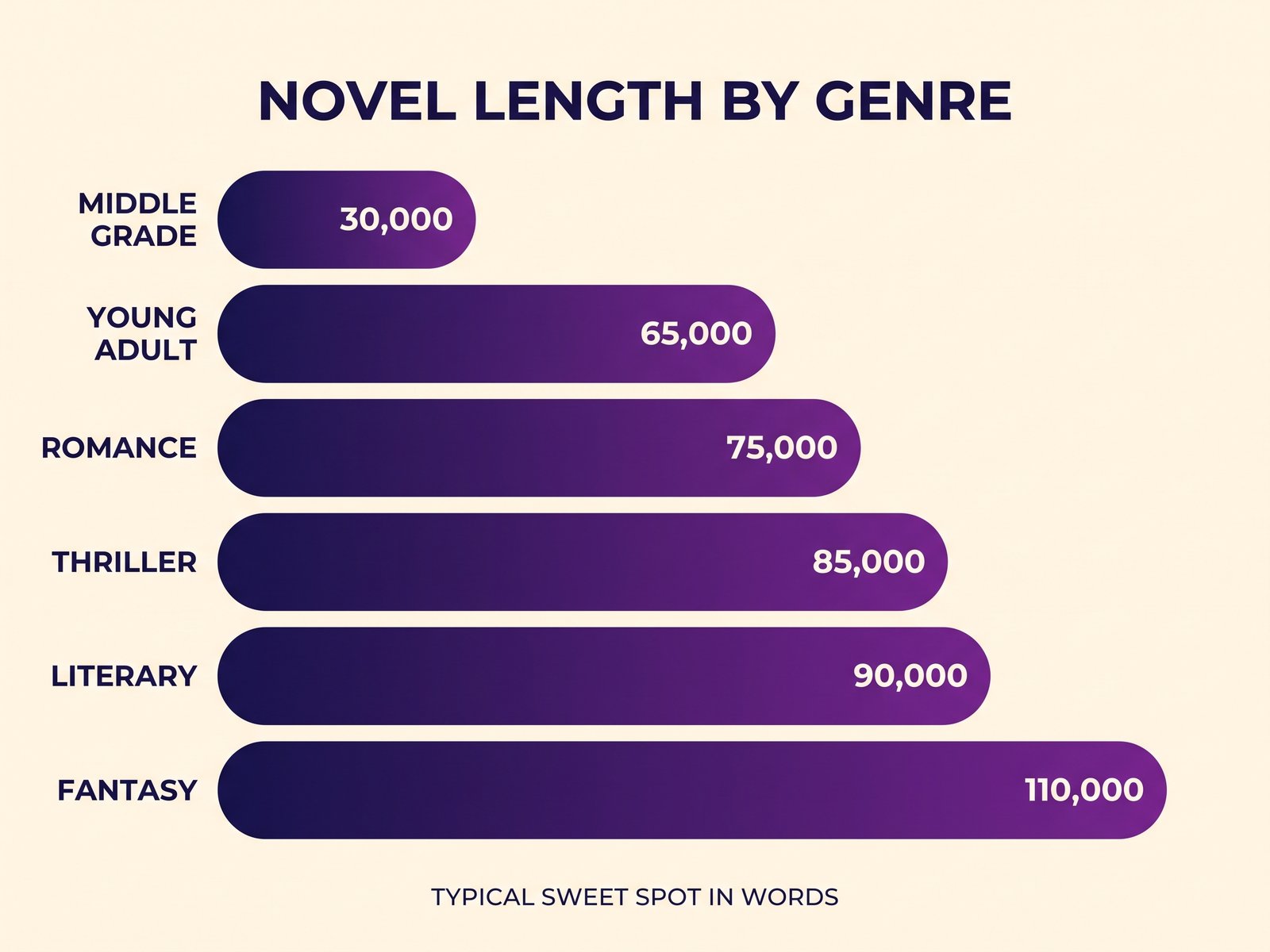
That range is the default, not the rule. Genre moves it more than anything else, which is what the table below is for.
Novel length by genre
These are the numbers acquiring editors and agents carry in their heads. The sweet spot is where a manuscript raises no questions at all; the minimum and maximum are the edges where someone starts asking why.
| Genre | Minimum | Sweet spot | Maximum |
|---|---|---|---|
| Middle grade | 20,000 | 30,000-50,000 | 60,000 |
| Young adult | 50,000 | 60,000-80,000 | 90,000 |
| Contemporary romance | 50,000 | 70,000-85,000 | 100,000 |
| Category romance | 40,000 | 50,000-60,000 | 70,000 |
| Mystery / cozy | 60,000 | 70,000-90,000 | 100,000 |
| Thriller / suspense | 70,000 | 80,000-95,000 | 110,000 |
| Literary fiction | 60,000 | 80,000-100,000 | 120,000 |
| Historical fiction | 80,000 | 90,000-110,000 | 140,000 |
| Science fiction | 70,000 | 90,000-110,000 | 130,000 |
| Fantasy | 80,000 | 100,000-120,000 | 150,000 |
| Epic fantasy | 110,000 | 120,000-160,000 | 200,000+ |
| Horror | 60,000 | 75,000-95,000 | 110,000 |
| Western | 45,000 | 55,000-75,000 | 90,000 |
| Memoir | 60,000 | 70,000-90,000 | 110,000 |
Debut authors sit lower in every band than established ones. A first fantasy novel at 190,000 words gets rejected on the query alone; the same author's fifth book at that length gets published.
What famous novels actually weigh
Published word counts are a useful reality check, because the books people cite as "normal length" are usually nothing of the sort.
The Great Gatsby
~47,000F. Scott Fitzgerald
Shorter than most novellas people apologise for.
Fahrenheit 451
~46,000Ray Bradbury
A canonical novel that would today be pitched as a novella.
The Hobbit
~95,000J. R. R. Tolkien
Sits neatly inside the modern fantasy band.
Harry Potter and the Philosopher's Stone
~77,000J. K. Rowling
The debut is short; book five runs roughly 257,000.
The Hunger Games
~99,000Suzanne Collins
Upper end of young adult, and it earned every word.
A Game of Thrones
~298,000George R. R. Martin
The reason unpublished writers think 300k is achievable.
War and Peace
~587,000Leo Tolstoy
The outlier everyone quotes and nobody should imitate.
The pattern is worth naming: the short ones are debuts and the enormous ones are book three, four or five of a proven series. Length is a privilege you earn, not a starting position.
Why the number actually matters
Word count is not a vanity metric. It changes two concrete things: whether an agent reads past your query, and what your book costs to print.
Querying agents
Your query letter states the word count in the first or last line. An agent who reads "145,000 words, debut contemporary romance" has already learned that the manuscript is roughly double the market length and that you may not know the market. It is the cheapest possible rejection for them and the most avoidable one for you.
KDP page count and pricing
Amazon prints on demand, so paperback cost scales with page count, and page count scales with words. At roughly 250-300 words per printed page, an 80,000-word novel is around 280-320 pages, while a 150,000-word one pushes past 500. That extra paper eats your royalty on every single copy, and the higher list price you need to cover it makes the book harder to sell.
Reader expectation
Romance readers who buy a series expect a consistent reading time. A 45,000-word entry in a line of 80,000-word books reads as a rushed cash-in, and reviews say so.
Before you query anyone, get the exact figure rather than the one your writing app rounded: our free word counter takes a pasted manuscript and returns the word count along with a page-count estimate you can quote in the letter.
If you are working backwards from a target page count rather than a word count, the arithmetic in our breakdown of how many words a 200-page book holds is the fastest way to do it, and the per-page figures behind it are covered separately.
Four mistakes that inflate a manuscript
Almost every overlong first novel is overlong for one of these reasons, and all four are fixable in revision rather than by cutting scenes you love.
- 1
Writing the warm-up
The first two or three chapters are often the author getting to know the characters. The real book starts in chapter four. Cutting the run-up routinely removes 8,000-15,000 words and improves the opening.
- 2
Backstory delivered up front
Worldbuilding and history that arrives before the reader cares costs thousands of words and buys nothing. Move it to the point where a reader would ask the question, or delete it.
- 3
Two books in one manuscript
A 160,000-word fantasy is frequently a 90,000-word novel with a second, weaker novel welded to it. Finding the natural break is more valuable than trimming adjectives.
- 4
Padding to hit a number
Writing to a word target rather than to the story produces recognisable filler: repeated beats, dialogue that restates the last scene, weather. Editors spot it instantly.
Hitting a target length without padding
Length problems are structural, which is why they are easier to solve before drafting than after. When you set up a book in AIWriteBook you set the number of chapters on the Basics step, and the outline is generated to fill exactly that many chapters. Divide your genre's sweet spot by a realistic chapter length and you have your chapter count before a single scene exists: 85,000 words at around 3,000 per chapter is 28 chapters.
If you are already past that point and holding a manuscript that is 30,000 words too long, the AI Editor sidebar in the chapter editor is the better tool: you ask for a tighter version of a chapter and its suggested edits appear highlighted in your text, so you decide what stays rather than letting a model rewrite your prose wholesale. And if the answer turns out to be that you have two books, the series planner will lay out where the split falls.
Neither approach involves writing to a word quota. The target shapes the chapter count, the chapter count shapes the outline, and the outline shapes the draft.
Set the length before you write it
Set your chapter count from the range above and get an outline built to that shape. The first chapter is free.
Frequently asked questions
40,000 words. Below that, the industry classifies the work as a novella, and most award bodies and publishers use the same line. Between 40,000 and 50,000 you are technically writing a novel but a short one, which is normal in category romance and unusual almost everywhere else.
Roughly 300 to 360 printed pages, depending on trim size, font and leading. A standard 5.5 x 8.5 inch paperback at 11pt runs close to 280 words per page, so 90,000 words lands near 320 pages.
It counts as a novel, and it is the NaNoWriMo target, but it is short for most genres. A 50,000-word manuscript is a comfortable fit in category romance, middle grade and some literary fiction, and a hard sell in fantasy, science fiction or historical fiction, where readers expect at least 80,000.
Yes, and the penalty is commercial rather than artistic. Past about 120,000 words a debut becomes expensive to print, riskier to acquire and slower to sell, so agents pass on manuscripts they might otherwise have liked. Established authors are not held to the same limit.
So what number should you write to?
Find your genre in the table, take the sweet-spot range, and aim at the lower half of it if this is your first book. That is the whole answer. The band exists because it reflects what readers in that genre finish and what publishers can price, not because anyone is policing creativity.
Then stop counting until the draft is done. A word count is a diagnostic tool for revision, and a distraction during a first draft. Once you have the complete manuscript in front of you, the number tells you something useful: whether you wrote the book you meant to write, or two of them.
For the revision work that follows, the book editing guide covers what to cut and in what order.