

The short answer
A typical novel has 15 to 40 chapters. If you want a single number to aim for, 25 chapters of roughly 3,000 words each gives you a standard 75,000-word novel — squarely in the sweet spot for most adult fiction.
But that number is a result, not a rule. You do not decide "my book will have 30 chapters" and then fill them. You write scenes, group them into chapters at natural breaks, and the count is whatever falls out. The question worth asking is not "how many chapters?" but "how long should each chapter be, and where should it break?"
The rest of this guide gives you the genre benchmarks so you know whether your draft is in normal territory — and the craft decisions that actually set the number.
Three things to remember
- Chapter count follows from word count and chapter length, not the reverse
- Genre sets reader expectations — thrillers run short, literary fiction runs long
- A chapter should end on a reason to keep reading, not at a word target
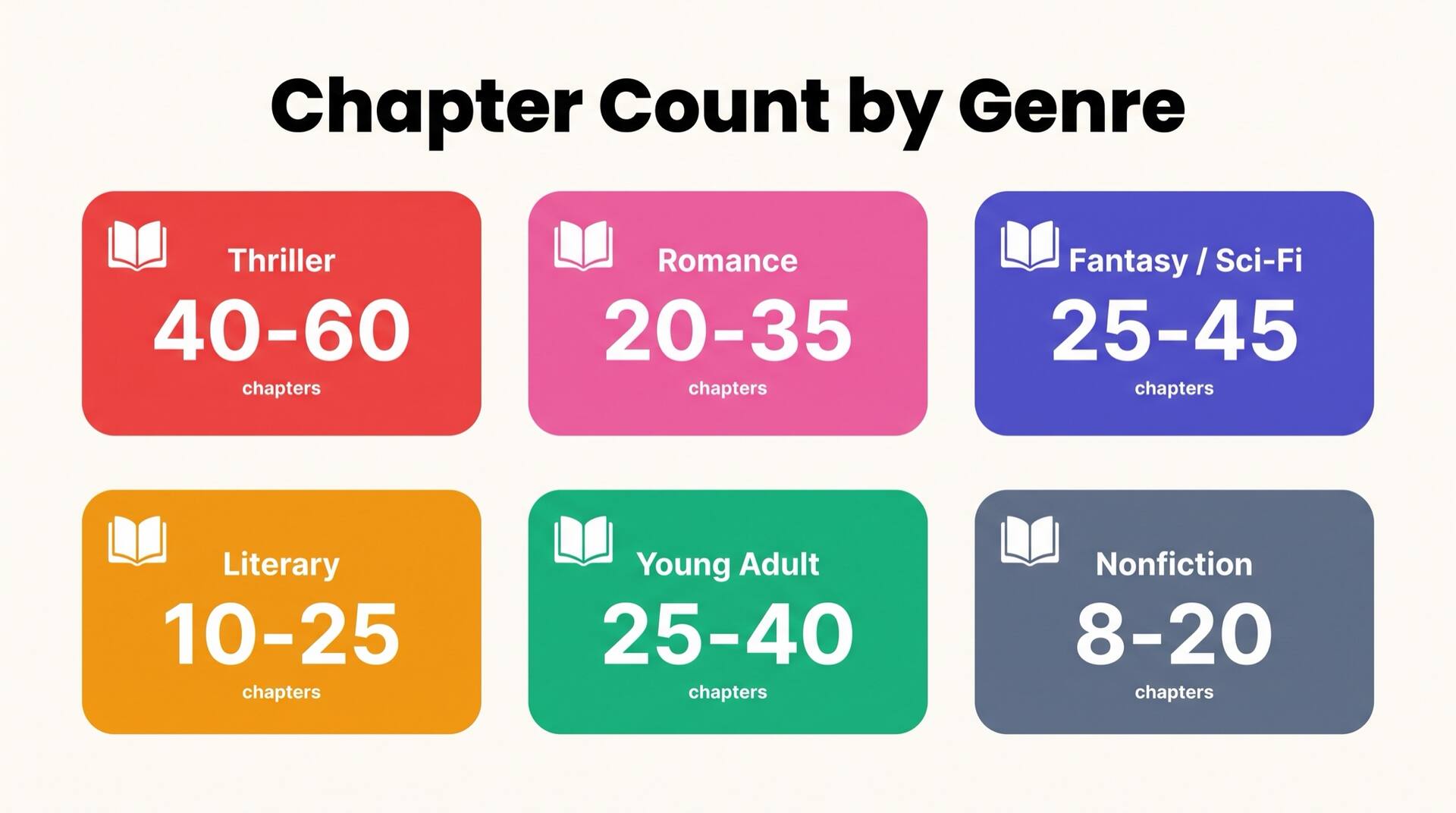
Average chapter count by genre
Chapter count tracks total length and chapter rhythm, both of which vary by genre. Here are the working ranges editors expect.
Short, punchy chapters of 1,500–2,500 words. The high chapter count is the engine — every break is a cliffhanger that pulls the reader to the next one.
Medium chapters of 2,500–4,000 words, often alternating POV between the two leads. Chapter breaks tend to fall on emotional beats.
Longer books (100,000+ words) with substantial chapters of 3,000–5,000 words. Multi-POV epics break chapters by viewpoint character.
Often longer, less uniform chapters. Some literary novels use just a handful of long chapters; others abandon numbered chapters for sections.
Fast pacing with shorter chapters of 2,000–3,000 words. Keeps momentum high for readers who want to fly through the book.
Driven by argument structure, not scenes. Each chapter is one major idea, usually 3,000–6,000 words, often broken into subheaded sections.
Why pacing decides chapter count
Chapters are a pacing tool. The break between them is the single most powerful rhythm device you have — it is the moment the reader decides whether to keep going or put the book down.
Each break is a decision point
Readers stop at chapter breaks. A chapter that ends mid-tension borrows energy against the next one — "just one more chapter" is built entirely out of chapter breaks placed on hooks.
More breaks means faster feel
Two books of identical length feel different if one has 20 chapters and the other has 50. More breaks read faster because the reader keeps hitting the small reward of finishing a chapter.
Genre sets the tempo
A thriller wants the reader breathless, so it breaks constantly. Literary fiction wants the reader to sit inside a moment, so it breaks rarely. Match your chapter rhythm to the experience your genre promises.
One scene is not always one chapter
A chapter can hold one scene or several. The decision is about energy: end the chapter where you want the reader to feel the pull forward, even if the scene technically continues into the next one.
Short chapters vs long chapters
Neither is better — they create different reading experiences. Knowing what each does lets you choose on purpose.
Short chapters (1,000–2,500 words)
+ Propulsive and addictive. Create the "one more chapter" effect. Forgiving for readers with little time — easy to read in short bursts. Dominant in thrillers and commercial fiction.
− Harder to build deep, immersive scenes. Constant breaking can feel choppy or gimmicky if the hooks are weak.
Long chapters (4,000–7,000 words)
+ Allow immersive, layered scenes and slow-burn tension. Signal a literary or epic register. Give complex POV shifts room to breathe.
− Higher barrier to picking the book back up — a tired reader may not start a chapter they cannot finish. Demands stronger sustained writing.
Mixing lengths is the professional move. A long, immersive chapter followed by three short, fast ones is how skilled writers control acceleration through a book.
How bestsellers actually break down
Looking at real books beats any rule. Here is how some well-known titles structure their chapters.
The Da Vinci Code — Dan Brown
105 chaptersAn extreme case of the short-chapter thriller engine. Chapters of a few pages each, almost all ending on a cliffhanger. The structure is the page-turner.
Harry Potter and the Sorcerer's Stone — J. K. Rowling
17 chaptersLonger, fuller chapters of around 4,500 words. Each chapter is a self-contained mini-adventure with its own title — a middle-grade convention that aids memory and momentum.
The Girl with the Dragon Tattoo — Stieg Larsson
29 chaptersGrouped into parts, with substantial chapters. The slow build of the first part uses fewer, longer chapters before the pace tightens.
Gone Girl — Gillian Flynn
Alternating dual POVChapters alternate between Nick and Amy. The structure itself — whose chapter comes next — becomes a tool for withholding and revealing information.
How to plan your chapter count
You do not need to lock chapter count before you write. You need a target length and a chapter rhythm. The count takes care of itself. If you want to see the shape in advance, sketch the chapters in an outline before you draft a word.
Set your target word count first
Decide your book's length based on genre: 70,000–90,000 for most adult fiction, 90,000–120,000 for fantasy and sci-fi, 50,000–70,000 for YA and romance. This is the number that actually matters to readers and retailers.
Pick a target chapter length
Choose the reading experience you want. Fast and propulsive? Aim for 2,000-word chapters. Immersive and literary? Aim for 4,000–5,000. This is the real lever for chapter count.
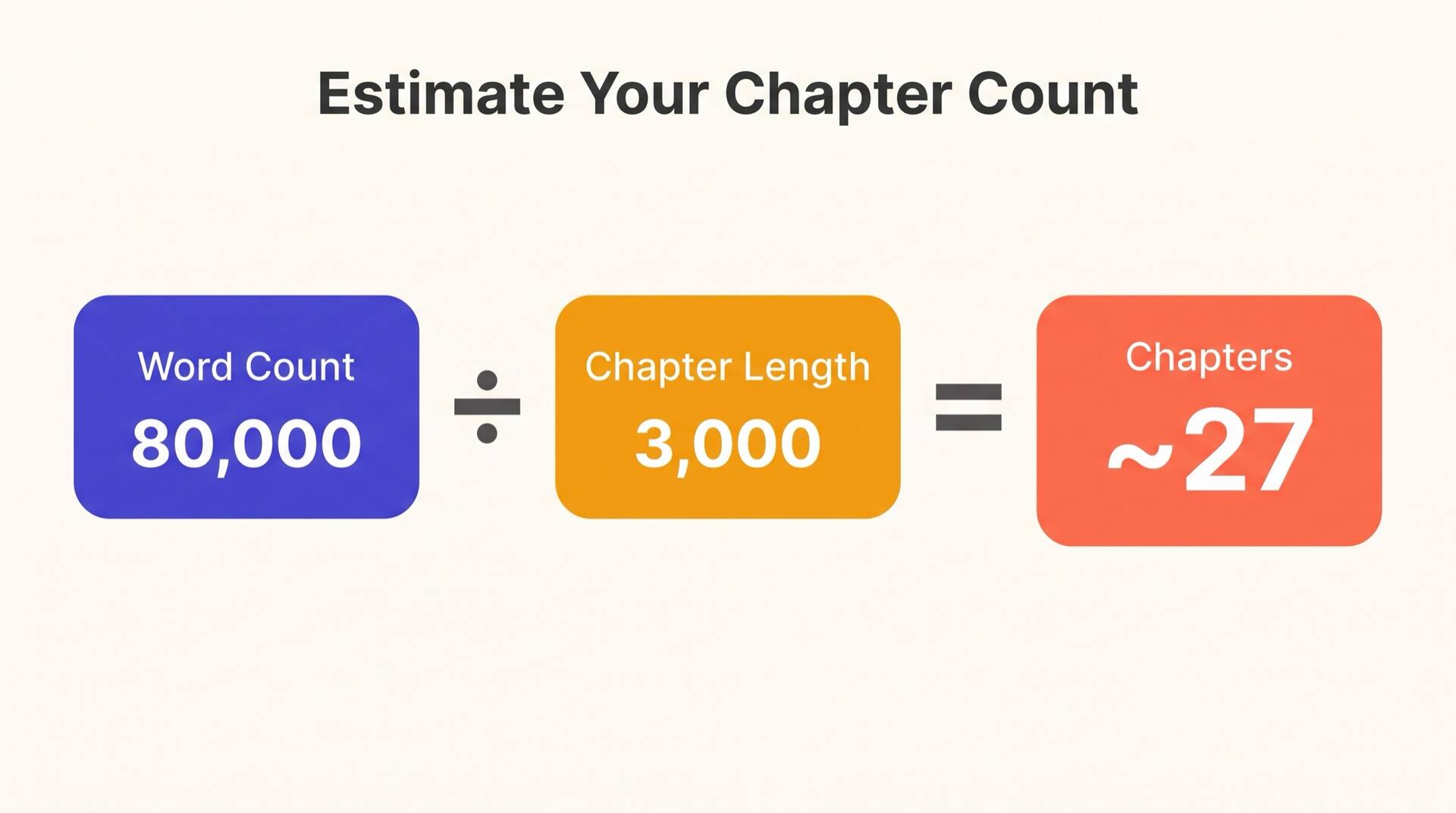
Divide to get a rough count
Word count divided by chapter length gives your ballpark. An 80,000-word book at 3,000 words per chapter is about 27 chapters. Treat it as an estimate, not a quota.
Break on hooks, not on word counts
When you draft, end each chapter where the tension peaks — a revelation, a decision, a door opening. Let real chapters run short or long. The hook matters more than uniformity.
Balance in revision
After the first draft, look at chapter lengths side by side. A chapter three times longer than its neighbors usually wants splitting; a tiny orphan chapter usually wants merging. Even rhythm is a revision job, not a drafting one.
Using AI to plan and balance chapters
AI is genuinely useful for the structural side of chapter planning — the part that is math and pattern, not voice. You can generate a chapter-by-chapter outline in seconds, then adjust the count and balance from there.
- Generate a chapter-by-chapter outline from your premise, with a target count and word budget per chapter.
- Audit a finished draft for uneven chapter lengths and flag outliers that should split or merge.
- Check whether each chapter ends on a hook — paste the final paragraphs and ask what pulls the reader forward.
- Map your chapter count against your genre's working range and your book's target length.
- Suggest natural break points inside an over-long chapter that is doing the work of two.
AI is excellent for structure and balance. The scenes, the hooks, and the voice are still yours to write.
Chapter count: frequently asked questions
There is no single ideal, but 20–40 chapters covers most adult novels. A practical default is to take your target word count and divide by 3,000 — that gives a chapter count in the normal range for nearly every genre.
So how many chapters should your book have?
However many it takes to break on the right hooks at the right rhythm for your genre. If you need a starting number: target your genre's word count, divide by 3,000, and let the real chapters land where the tension peaks. Most books that follow that approach finish somewhere between 20 and 40 chapters — and the few that don't usually had a good reason.
Stop counting chapters and start counting hooks. A book with the right breaks in the right places will land on a chapter count that feels inevitable in hindsight. For everything from outline to final chapter, see our complete how to write a book guide.