


What's on this page
New authors ask the wrong question. They ask how to get reviews fast, when the question that actually protects their book is how to get reviews that stay up. Amazon runs some of the most aggressive review-fraud detection of any platform on the internet, and it does not send a warning before it wipes a batch of reviews it decides are connected to you. So this guide does two things at once: it shows you the channels that reliably produce reviews — advance-reader teams, sample funnels, a back-matter ask, and a timed email follow-up — and it draws a hard line around the shortcuts that get reviews deleted or, worse, get a book suppressed. Every tactic here is one you can run on your own catalog today without asking a stranger to break the rules for you.
What Amazon actually allows
Amazon's community guidelines exist to keep reviews honest, and almost every author who loses reviews lost them by crossing a line they didn't know was there. The core rule is simple: you may ask people to review your book, but you may not give anyone anything of value in exchange for a review, and you may not have reviews written by people Amazon can connect to you personally or financially. A reviewer also needs a valid payment method and at least fifty dollars of lifetime spend on their account before Amazon will let their reviews post.
Everything legitimate flows from that. You can hand out free advance copies as long as you never require a review in return and never make the review positive as a condition. You can email your own mailing list and ask them to review. You can put a polite request in the back of the book. What you cannot do is pay per review, run review swaps with other authors, funnel reviews through friends and family, or offer a gift card, a prize entry, or a free product in trade. Gifting the book itself is fine; gifting anything on top of it is not.
Allowed
- Giving away free advance copies with no review required
- Asking your own email list or readers to leave an honest review
- A back-of-book request pointing readers to your review page
- Editorial reviews from recognized outlets, added via Author Central
Against the rules
- Paying per review or offering gift cards, prizes, or discounts for one
- Review swaps with other authors or reciprocal-review groups
- Reviews from family, employees, or anyone financially tied to you
- Requiring a review, or a positive one, in return for the free copy
One quiet exception people miss: editorial reviews. A blurb from a credible publication, a well-known author, or an industry outlet can be placed in the dedicated Editorial Reviews section through Author Central. It does not show as a star rating, but it sits high on your page and never gets caught in the customer-review filters.
Build an advance-reader (ARC) team
An ARC — advance review copy — is the single most reliable review engine for indie books, and it works because of timing. You give a group of genuine readers a free copy in the weeks before release, and you ask them to post an honest review on or shortly after launch day. Done right, you open your book's first week with a cluster of real reviews instead of the blank slate that makes browsers hesitate.
The mistake is treating an ARC team as a one-time launch stunt. The authors who never run short on reviews build the team as a standing asset: a mailing list segment of readers who opted in specifically to receive early copies, cultivated book after book. Your fifth release inherits the reviewers your first release earned. Start small and honest, and the compounding takes care of the rest.
Recruit before you finish
Add a line to your existing readers, your newsletter, and your social profiles: reply if you want an early copy in exchange for an honest review. You want willing readers, not a headcount.
Distribute a real copy
Send an ePub or a watermarked PDF through a service like BookFunnel or StoryOrigin two to four weeks out. Never attach the file to a mass email — deliverability and piracy both punish that.
Ask clearly, once, for launch week
Tell readers exactly when the book goes live and ask them to post their review that day or the day after. Give them the direct review link so there is zero friction.
Follow up, then prune
A gentle reminder a few days after launch recovers a surprising share of reviews. Keep the readers who actually deliver, thank them, and carry them into the next book's team.
How many ARC readers do you need?
Assume a conversion rate, not a promise. In practice, somewhere between a fifth and a third of ARC readers actually post a review, and that's normal — life gets in the way. If you want ten launch reviews, line up thirty to fifty committed readers. Recruiting for the conversion rate instead of the target is what separates a full launch from a quiet one.
Your launch-week review checklist
Reviews in the first week do the heaviest lifting, because they arrive when your book has the most visibility and the least social proof. Tick these off as you go — the bar fills as you complete each step, and each one is fully inside Amazon's rules.
0 of 8 done
The sample funnel and the back-matter ask
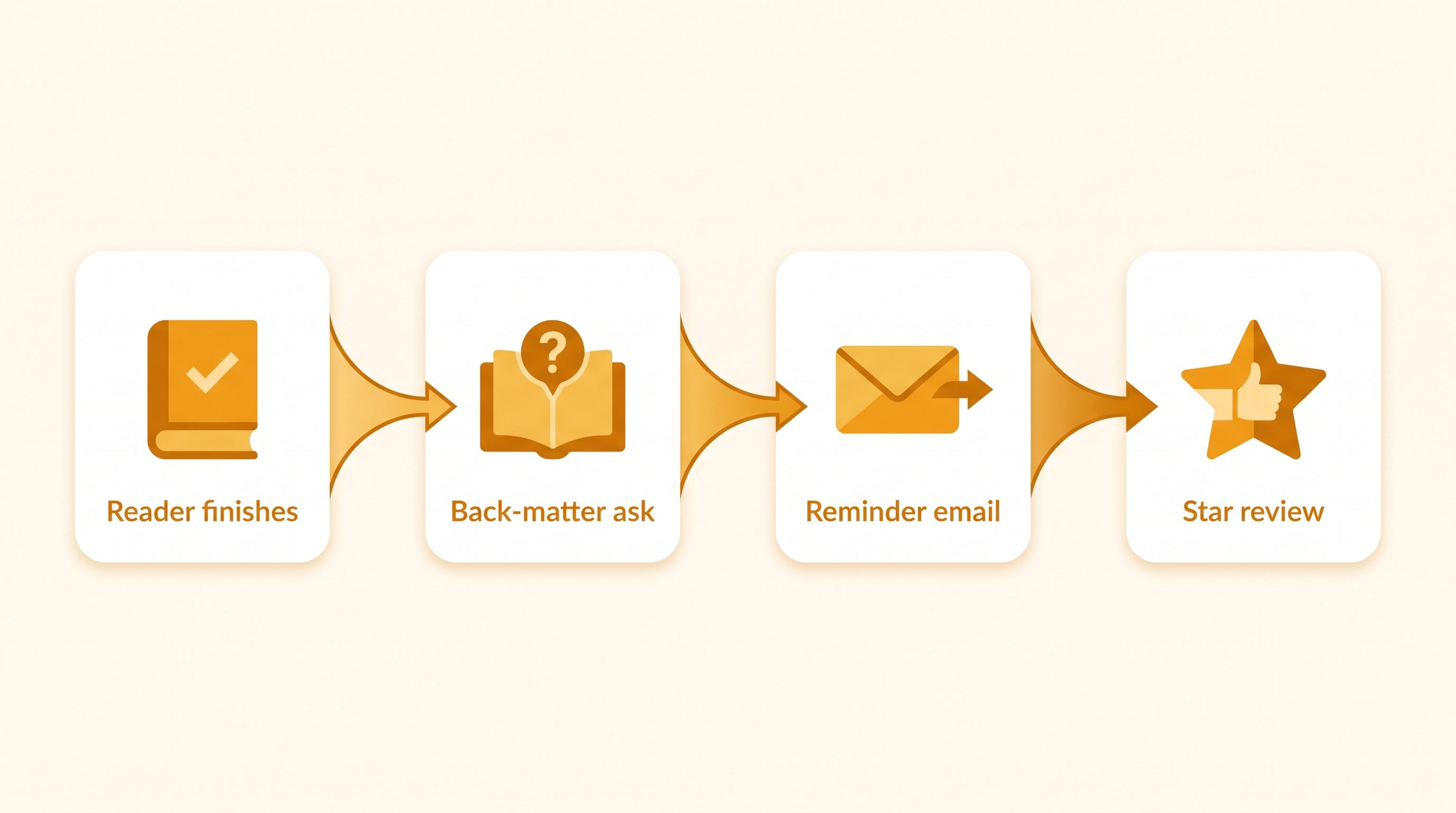
Every buyer who finishes your book is a reviewer you already paid nothing to acquire — most of them just never get asked. The last page of the book is the highest-intent moment you will ever get, because the reader has just felt whatever your ending made them feel. A short, warm back-matter request there converts better than any email ever will. Two or three sentences: what a review means to an independent author, and a link or a plain instruction to leave one.
Feed the top of that funnel by making the book easy to start. A strong free sample, a first chapter that hooks, and a clean description all pull more readers to the final page where the ask lives. This is also why the ask has to be genuinely brief and human — a heavy, guilt-tripping plug at the end sours the exact goodwill you spent a whole book building. Point them to the review page and get out of the way.
Amazon deep-links to your review form. Send readers to your product page and add "/#customerReviews" so they land right on the review section, or use the direct write-review URL for your ASIN. One tap fewer is measurably more reviews.
A follow-up email sequence that converts
If you have a mailing list, a short timed email sequence around launch will out-produce any single blast. The goal is not volume of emails; it's meeting the reader at the moment they're most likely to act — right after they've finished. You're not requiring anything, so this stays firmly inside the rules. You're reminding willing readers, at the right time, with the least possible friction.
Keep every message about the reader, not about your ranking. Nobody leaves a review to help your sales; they leave one because you asked kindly and made it effortless. Say what an honest review means for a small author, drop the direct link, and stop. Personality beats polish here — a note that sounds like a person gets more replies than a designed template.
It's live — and thank you
To your ARC team: the book is out, here's the direct review link, please post today if you can. Warm, short, one clear action.
A gentle nudge
For everyone who hasn't reviewed yet. No pressure, just a reminder that a couple of honest lines make a real difference. Re-share the link.
The read-through trigger
For readers who came through a reader-magnet funnel, an automated message that fires a few days after download, when they've likely finished, asking for a review.
The evergreen ask
In every future newsletter, a quiet standing line: if any of my books meant something to you, a review helps more than you'd think.
Reviews follow a book worth reviewing
No launch tactic saves a book readers don't finish. Write, structure, and format a manuscript people actually want to talk about with AIWriteBook, then run the review playbook above on top of it.
Review services worth using — and the ones to avoid
There is a legitimate industry built around connecting books with reviewers, and there is a black market that will get your book flagged. The line is whether money changes hands for the review itself. Services that distribute your book to opted-in readers, or that provide editorial reviews clearly labeled as such, are fine. Services that guarantee a number of star reviews for a fee are selling you a violation, and Amazon is very good at spotting them. Pitching book bloggers yourself is the unglamorous alternative, and it runs on the same discipline software companies use for SaaS link building: a short list of sites that genuinely cover your genre, one specific reason each of them would care, and a single polite follow-up.
Editorial reviews sit in their own category and are worth understanding. A paid editorial review from an outlet like a recognized trade publication is allowed because it's disclosed and placed in the Editorial Reviews section, not the customer stars. It buys credibility, not a rating. Just never let a paid editorial service quietly post as a customer review — that's the exact behavior the filters hunt for.
Legitimate
- ARC distribution platforms that reach opted-in readers (BookSirens, NetGalley, StoryOrigin)
- Editorial review outlets that post to the Editorial Reviews section, disclosed
- Book-blogger and reviewer outreach, offering a free copy with no strings
Avoid
- Anyone guaranteeing a set number of five-star customer reviews for money
- Fiverr-style "review packages" and bot or fake-account networks
- Paid review swaps or reciprocal groups dressed up as communities
A cheap batch of paid reviews is the single fastest way to lose a book. Amazon can remove every review on the title, strip the buy box, or close the account, and it rarely explains which review triggered it. No launch is worth that risk.
What gets reviews pulled
Amazon's filter doesn't read minds, but it reads signals — the same kind of account-linking patterns that fraud detection systems look for in banking and identity verification — and a few honest authors get caught because they accidentally look like manipulators. Know the patterns so you never trip one by mistake.
Account connections
Reviews from people who share a household, a Wi-Fi network, a shipping address, or a payment method with you can vanish. This is why family reviews are both against the rules and technically detectable.
Suspicious velocity
Dozens of reviews landing in a few hours, all glowing, all from new accounts, reads as coordinated. A steady trickle of real reviews is safer than a manufactured spike.
Unverified-purchase clusters
A wave of reviews from accounts that didn't buy the book, with no Verified Purchase badge, draws scrutiny. ARC reviews are legitimate but weigh less and look thinner in bulk.
Incentive language
A review that says "I got a free copy for my honest review" is fine and honest; one that hints at a reward, a swap, or a paid arrangement can be removed and can flag the whole title.
If reviews disappear, don't refill them faster — that compounds the signal. Slow down, keep every source clean, and let the honest reviews accumulate. Amazon almost never reverses a removal on appeal, so prevention is the only real strategy.
Turning launch reviews into long-tail growth
Launch reviews get you off zero; long-tail reviews are what compound. A year after release, the books still gathering reviews are the ones with the ask baked into the reading experience — a back-matter request every reader sees, a reader magnet that funnels new subscribers to a finish-and-review moment, and an author who mentions it, lightly, in every newsletter. None of that requires a campaign. It requires the ask to live inside the machine so it keeps running without you.
Volume matters less than most authors think past the first handful. Getting from zero to about fifteen reviews changes how a page converts; getting from three hundred to four hundred barely moves anything. So aim your early energy at crossing that first threshold cleanly, then let the evergreen systems keep the count climbing while you write the next book — which is the best review magnet you'll ever build.
Keep doing
- Leave the back-matter ask in every edition and every format.
- Roll last book's reviewers into this book's ARC team.
- Reply to and thank reviewers publicly where you can — it earns more.
Stop worrying about
- Chasing a big round number once you're past the first fifteen.
- Deleting or fighting the occasional critical review — a perfect page reads fake.
- One-off review blitzes that spike and then flatline for months.
Tools that make the ask effortless
The difference between an author who gets reviews and one who doesn't is usually just whether the ask is written and in place. These free tools draft the pieces for you.
Email sequence generator
Draft the launch-day, day-three, and read-through review emails in your voice, timed and ready to schedule.
Back matter generator
Write the short, warm review request and end pages that turn finishers into reviewers.
Blurb generator
A sharper description pulls more readers to the last page where your review ask lives.
Amazon review questions, answered
How many reviews does a book need to sell well?
The meaningful jump is from zero to roughly fifteen. That's where a page stops looking untested and browsers start trusting it. Beyond a few dozen, each additional review adds very little to conversion, so pour your early effort into clearing that first threshold rather than chasing a big number.
Can I give away free copies in exchange for reviews?
You can give away free copies and you can ask for an honest review, but you cannot require a review, or a positive one, as a condition of the copy. The gift has to be the book alone — no gift cards, prizes, or extras on top — and the reviewer must disclose that they received a free copy.
Why did my reviews disappear from Amazon?
Amazon removes reviews it believes are connected to the author or manipulated. Common triggers are shared addresses, Wi-Fi, or payment methods with the reviewer, a sudden spike of reviews from new accounts, or any hint of incentive. Amazon rarely explains which review caused it and almost never restores them, so the fix is prevention, not appeal.
Are ARC reviews as valuable as verified-purchase reviews?
They're legitimate and they help, but they carry a bit less weight. A review without the Verified Purchase badge counts, yet Amazon trusts verified reviews more and large clusters of unverified ones can draw scrutiny. Use ARC reviews to seed launch week, then let organic verified reviews build on top of them.
Is it against the rules to email my list asking for reviews?
No. Emailing your own subscribers to ask for an honest review is fully allowed, as long as you're not paying them or requiring a positive review. A timed sequence around launch and finishing is one of the safest, most effective review channels you have.
Should I pay for a review service?
Only for legitimate ones. ARC distribution platforms and disclosed editorial reviews are fine to pay for because you're paying for reach or credibility, not for the star rating itself. Never pay a service that guarantees a number of customer star reviews — that's a direct violation and the fastest way to get a book flagged.
Earn them slow, keep them forever
Getting Amazon reviews isn't a trick you run once; it's a small set of honest habits you build into how you publish — one piece of the wider self-publishing on Amazon discipline. Recruit a real advance-reader team, put a warm ask on the last page, send a short timed email sequence, and stay clear of every shortcut that trades money or favors for stars. Do that and your reviews arrive steadily and, more importantly, they stay up.
Set the systems, launch clean, and let the count climb while you write the next book. For the wider launch and marketing picture, work through the rest of our complete Amazon KDP guide.