


Most first books are not abandoned because the idea was bad. They stall at chapter three because the writer never decided what the book was about, how long it should be, or when they would actually write it. This guide fixes that in order: decide, plan, draft, revise, publish. It works for novels, memoirs and nonfiction alike. If you want an interactive version with checklists for each phase, use our book writing process course; if you want to know how AI tools fit in, read how to write a book with AI.
The short answer
To write a book: (1) decide why and for whom you are writing, (2) pick one idea and test it, (3) choose your genre and target length, (4) gather your research, (5) outline every chapter, (6) set a daily word-count goal, (7) write the whole first draft without editing, (8) rest it and revise the structure, (9) edit line by line and get feedback, and (10) publish. At 500 words a day, a 60,000-word book takes about four months of drafting.
The Most Important Advice
Don't try to write a perfect first draft. Your goal is to get the whole book on paper. You can always revise later, but you can't edit a blank page. Give yourself permission to write badly at first.
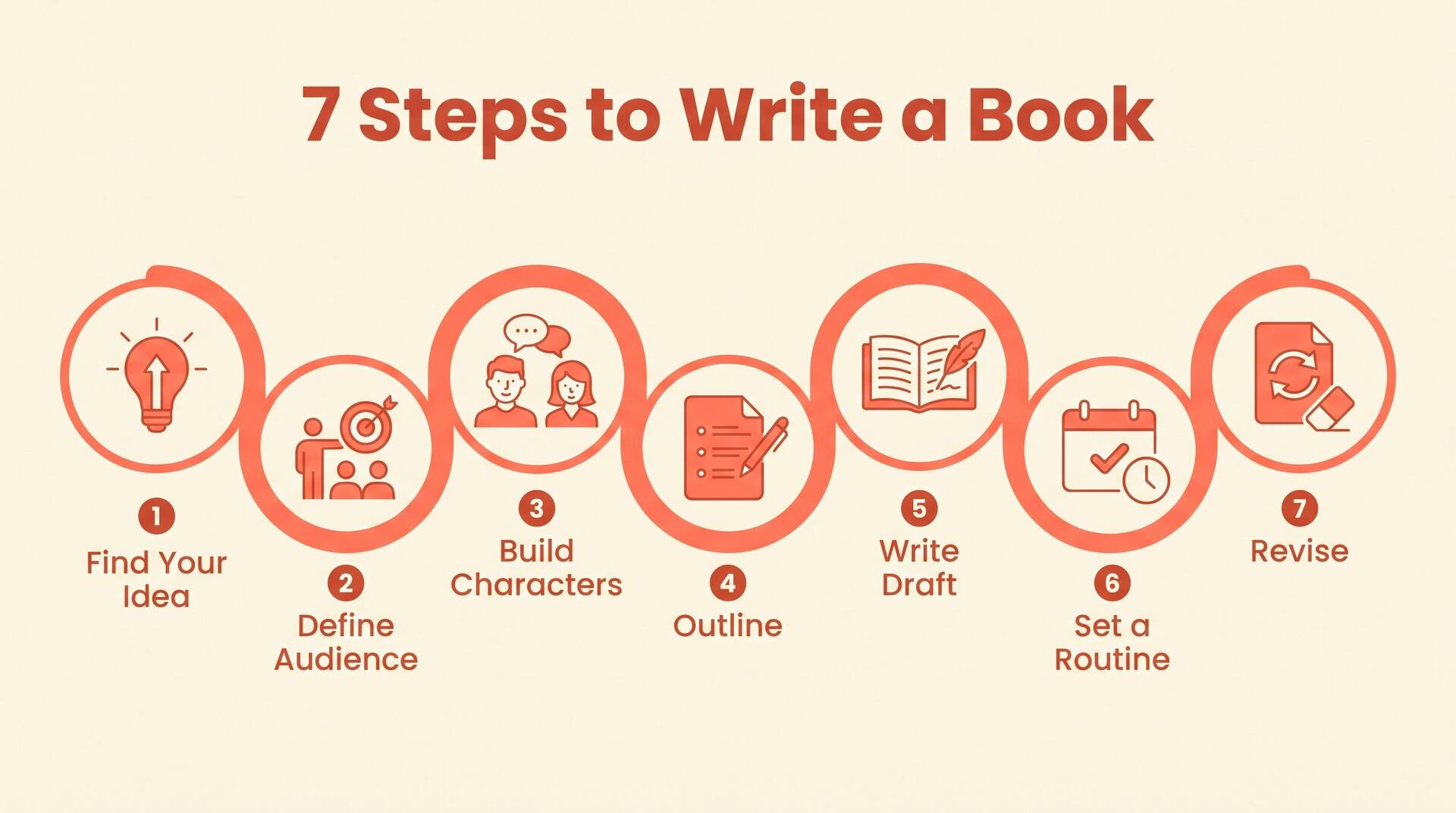
Decide why you are writing and who it is for
Before the idea, settle the purpose. A book written to entertain readers of cozy mysteries, a book written to win clients for your consulting practice and a memoir written for your grandchildren need different lengths, tones and publishing routes. Write one sentence that names your reader and what they get from the book. You will use it to make every later decision.
- Finish this sentence: "This book is for ___ who want ___."
- Pick one main goal: income, authority, a creative milestone or a family record
- Name three books your reader already loves or buys; that is your shelf
Example: "This book is for new managers in tech who want to run their first one-on-ones without dread." That one line already tells you the length (short), the tone (practical) and the format (nonfiction with templates).
Choose your book idea and test it
You probably have several ideas. Pick the one you could still care about after six months of work, then test it before you write a word of the book. If nothing stands out yet, a book idea generator gives you dozens of premises to react to until one clicks. If you are stuck on the very first page, our guide on how to start a book covers openings in depth.
- Write the idea as a one-sentence premise: who, wants what, and what stands in the way
- Explain it out loud to a friend in 30 seconds and watch whether they lean in
- Search Amazon for your idea: some competition is good, it proves readers exist
Example: J.K. Rowling's idea for Harry Potter came to her on a delayed train. She spent the four-hour journey imagining the world before she wrote anything down, which is exactly the kind of testing this step asks for.
Pick your genre, format and target length
Genre sets reader expectations, and length sets your schedule. A cozy mystery runs about 70,000 words, a romance 60,000 to 90,000, an epic fantasy 100,000 or more, and a practical nonfiction book 30,000 to 60,000. Choosing a number now turns "write a book" into a finite project. See how many words are in a novel for genre-by-genre ranges.
- Read three recent bestsellers in your genre and note their length and chapter count
- Decide fiction or nonfiction, and first or third person, before you outline
- Write your target word count at the top of your manuscript file
Example: a first-time author choosing a 65,000-word romance with 26 chapters of about 2,500 words each knows from day one that the book is 26 chapter-sized tasks.
Research and gather your material
Every book needs raw material. For fiction that means characters, setting and the rules of your world; our guide on how to write a novel goes deeper on character and plot. For nonfiction it means your stories, case studies, data and expert sources; the nonfiction book writing guide covers how to organize them. Collect enough to start, not everything you could ever use.
- Keep one notes file per book with sources, quotes and character details
- Set a research deadline so it does not become a way to avoid writing
- Mark gaps with [TK] while drafting and research them later
Example: Andy Weir researched orbital mechanics for The Martian as questions came up during writing, rather than finishing all research first, which kept the draft moving.
Outline your book chapter by chapter
An outline is the single biggest predictor of whether a first book gets finished. It does not need to be rigid: a few lines per chapter saying what happens or what the reader learns is enough. Our step-by-step guide to creating a book outline shows several methods, from a simple list to the three-act structure.
- Write one or two sentences for every chapter before you draft any of them
- Check that each chapter changes something: the plot moves or the reader learns
- Leave room to change the outline when the draft surprises you
Example: J.K. Rowling plotted the Harry Potter books on a hand-drawn grid of chapters and subplots. If you would rather start from a draft, the free outline generator builds a chapter-by-chapter plan from your premise in a minute.
Set a writing schedule and a daily word-count goal
Books get written in small, repeated sessions, not in rare bursts of inspiration. Pick a time slot you can protect and a daily goal you can hit on a bad day. At 500 words a day, a 60,000-word draft takes about 120 writing days; at 1,000 words, about two months. Our writing productivity tips help you guard that time.
- Write at the same time each day so it becomes a habit, not a decision
- Track words per session in a simple spreadsheet or calendar
- Start small: 300 words a day you actually write beats 2,000 you skip
Example: Stephen King writes about 2,000 words a day, every day. Toni Morrison wrote before dawn while working full time as an editor and raising two sons.
Write the complete first draft
Your only job now is to reach the end. Do not reread yesterday's chapter, do not polish sentences, and do not restart. A finished messy draft is worth more than three perfect chapters. When you stall, our guides on writing a first draft and overcoming writer's block get you moving again.
- Turn off spell-check and silence your inner editor until the draft is done
- End each session mid-sentence so tomorrow starts easy
- If a scene is not working, write a note in brackets and skip ahead
Example: Ernest Hemingway stopped each day when he still knew what came next, so he never sat down to a blank page the following morning.
Let it rest, then revise the big picture
Put the draft away for two to four weeks. When you return, read it straight through as a reader would, taking notes but not fixing anything. Then revise the structure first: missing scenes, slow middles, chapters in the wrong order, arguments that do not build. Sentence-level polish comes later, once the shape is right.
- Read the whole draft in as few sittings as possible to feel the pacing
- List every structural problem before changing a single line
- Cut anything that does not serve your reader sentence from step 1
Example: many published novels go through three or more full revisions. Raymond Carver said he rewrote some stories twenty or thirty times.
Edit line by line and get feedback
Now tighten every sentence: cut filler words, fix repetition, check facts and dialogue. Then give the manuscript to readers who are not your mother. Use the self-editing guide for your own passes, and find beta readers who read your genre for honest reactions before you pay for professional editing.
- Read your dialogue aloud; your ear catches what your eye misses
- Ask beta readers where they got bored or confused, not whether they liked it
- Fix the problems three readers agree on; weigh the rest
Example: a 3-reader feedback round where two of three readers flag the same slow chapter tells you exactly where to cut first.
Publish your book
You have two main routes. Traditional publishing means querying literary agents and waiting months for a deal; self-publishing means you control the cover, price and release date and can be on sale in days. Compare both in self-publishing vs. traditional publishing, then follow our walkthrough on how to publish a book on Amazon if you go independent.
- Decide your route before final edits; it changes formatting and timelines
- Invest in a professional cover; readers do judge a book by it
- Start telling readers about the book before launch day, not after
Example: Andy Weir first released The Martian as a free serial on his website, then self-published it on Kindle for 99 cents before a major publisher picked it up.
Your Progress
Complete 10 more steps to finish the guide
Where AI fits in writing a book
AI writing tools now help at almost every step above: brainstorming premises, turning a premise into a chapter outline, drafting chapters in a consistent voice, and suggesting edits. They work best when you stay the author: you decide the reader, the idea and the story, and the tool speeds up the heavy lifting.
For a full workflow, read how to write a book with AI. If you already use ChatGPT, how to write a book with ChatGPT shows the prompts and the limits of a general chatbot for a full-length book. For an interactive checklist that follows these steps phase by phase, open the free book writing process course.
Frequently asked questions about writing a book
How do I start writing a book with no experience?
Start with one sentence that names your reader and what they get from the book, then write a one-line premise and a short chapter outline. Set a small daily goal, such as 300 to 500 words, and write the first draft without editing. Experience comes from finishing, not from preparing.
How long does it take to write a book?
A first draft of a 60,000-word book takes about four months at 500 words a day, or two months at 1,000 words a day. Add one to three months for revision and editing. Most first-time authors finish a publishable book in six months to a year.
How many words should my first book be?
Aim for the typical length of your genre: about 70,000 to 90,000 words for most adult novels, 60,000 to 90,000 for romance, 100,000 or more for epic fantasy, and 30,000 to 60,000 for practical nonfiction. Shorter is fine for a first book as long as it delivers on its promise.
Do I need an outline to write a book?
You do not need a detailed one, but even a few lines per chapter makes you far more likely to finish. Writers who prefer discovering the story as they go can outline loosely and adjust after each chapter.
What are the steps to write a book?
Decide why and for whom you are writing, choose and test your idea, pick a genre and target length, research, outline, set a writing schedule, write the full first draft, rest and revise the structure, edit line by line with beta reader feedback, and publish.
Can I write a book if I am not a good writer?
Yes. Clear, plain writing is a skill you build by drafting and revising, and most published books were rough in their first draft. Revision, beta readers and an editor turn an ordinary draft into a good book.
Should I write a book with AI?
AI can speed up outlining, drafting and editing, especially for nonfiction and genre fiction. You still decide the idea, the reader and the story. Amazon KDP accepts AI-assisted books and asks you to disclose AI-generated content when you publish.
How do I publish my book once it is written?
Either query literary agents for a traditional deal, or self-publish through platforms such as Amazon KDP, IngramSpark or Draft2Digital. Self-publishing needs an edited manuscript, a cover, a description and formatted ebook and print files.
Your Journey Starts Now
You now have a complete roadmap for writing your book. But here's the truth: knowledge without action produces nothing. The difference between dreamers and authors is simple: authors sit down and write.
Start today. Write your reader sentence, set a timer for 30 minutes, and begin. Your book is waiting to be written, and you're the only one who can write it.