


What Actually Causes Writer's Block?
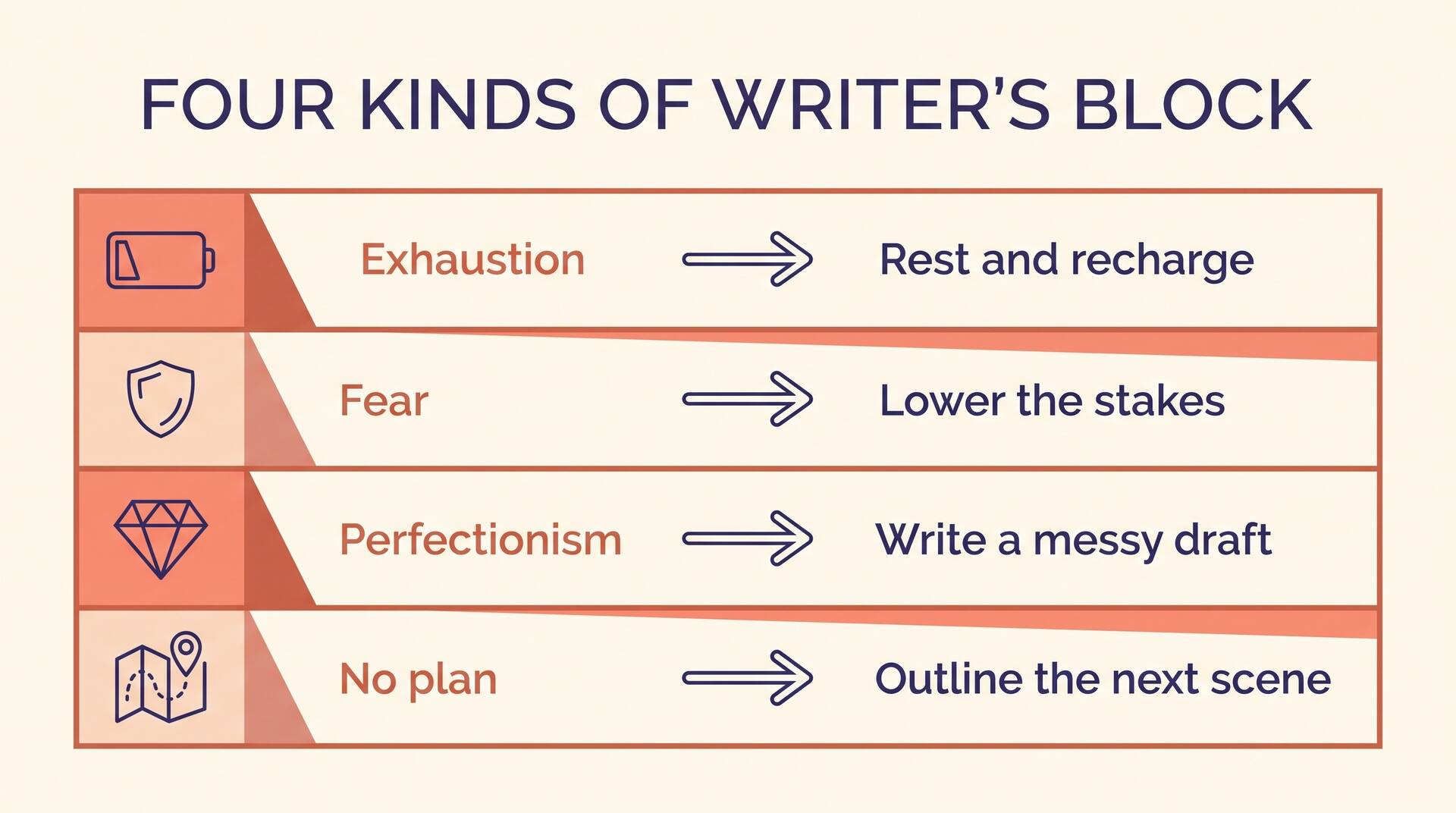
Writer's block isn't laziness or lack of talent. It's usually a symptom of something deeper: fear of failure, perfectionism, burnout, or simply being stuck on a story problem your conscious mind hasn't solved yet.
Understanding the root cause of your block helps you choose the right solution. A block caused by exhaustion needs rest, while one caused by fear needs a mindset shift. Let's explore techniques for every type of block — and if the real problem is that you're not sure what comes next, our step-by-step guide to writing a book maps the whole journey from idea to finished draft.
Quick Self-Assessment
What best describes your current writing block?
12 Proven Techniques to Beat Writer's Block
Save the ones that resonate with you for quick reference later
The Pomodoro Technique
Set a timer for 25 minutes and write without stopping. No editing, no checking email, no distractions. The time limit creates urgency that bypasses overthinking.
Write Badly on Purpose
Give yourself permission to write the worst possible version of your scene. Often, the act of writing anything breaks the dam and quality improves naturally.
Change Your Environment
Work from a coffee shop, library, or even a different room. New surroundings activate different neural pathways and can spark fresh thinking.
The Coffee Shop Effect
Ambient noise actually boosts creative thinking. Try background noise apps or lo-fi music playlists designed for writing.
Morning Pages
Write three pages of stream-of-consciousness first thing every morning. This clears mental clutter and primes your brain for creative work.
Take a Walk
Stanford research shows walking boosts creative output by 60%. Many writers solve plot problems while walking away from their desks.
Talk It Out
Explain your story to someone or even to yourself out loud. Verbalizing often reveals solutions your typing brain missed.
Start in the Middle
Skip the scene that's blocking you and write a later scene you're excited about. You can fill gaps later.
Read for Inspiration
Read a book in your genre or a craft book about writing. Often, other authors' words spark your own ideas.
Change Your Medium
Switch from typing to handwriting, or try dictating your story. Different methods engage different parts of your brain.
Set Micro Goals
Instead of 'write chapter 5,' try 'write one paragraph.' Tiny goals reduce overwhelm and build momentum.
End Mid-Sentence
When you stop writing, stop mid-sentence. Tomorrow, you'll know exactly where to start, eliminating blank-page paralysis.
When Nothing Seems to Work
Sometimes writer's block is your brain telling you something's wrong with the story itself. When that's the case, revisiting how to structure a novel often surfaces the real issue faster than any quick fix. If techniques aren't working, ask yourself:
- Is my protagonist's goal clear and compelling enough?
- Am I writing the wrong scene, is there a more interesting place to be in the story?
- Do I actually want to tell this story, or am I forcing something that doesn't excite me?
Writer's Block Is Temporary
Every writer who has ever finished a book has faced the blank page and won. Writer's block feels permanent in the moment, but it always passes. The key is having a toolkit of techniques ready when it strikes — and if a blank first page is the wall, letting our story starter generate an opening you can react to often gets the words moving again.
Remember: the goal isn't to write perfectly. It's to write. Start with any technique from this list — or spin up a few fresh writing prompts to jump-start a session — and trust that momentum will follow.