

Fantasy novels demand more from their authors than almost any other genre. You're not just writing a story—you're constructing an entire world from scratch, complete with its own rules, history, cultures, and logic. The best fantasy writers make this look effortless, but behind every Tolkien or Le Guin is thousands of hours of deliberate craft. This guide breaks that craft into learnable steps.
Fantasy Subgenre Explorer
Fantasy is not a monolith. Understanding where your story fits helps you meet reader expectations while finding your unique voice:
Epic / High Fantasy
Grand-scale stories set in fully invented secondary worlds. These novels feature world-threatening conflicts, complex magic systems, and large casts of characters. The stakes are civilizational.
Multi-POV narratives, detailed maps, extensive lore, clear good-versus-evil (or morally gray) conflicts, series format (trilogies or longer).
The Lord of the Rings, The Stormlight Archive, A Wizard of Earthsea
Secondary world, prophecy, chosen one or reluctant hero, quests, ancient evil
Worldbuilding Fundamentals
Worldbuilding is the foundation of fantasy. A well-built world feels lived-in rather than invented. Here are the five pillars:
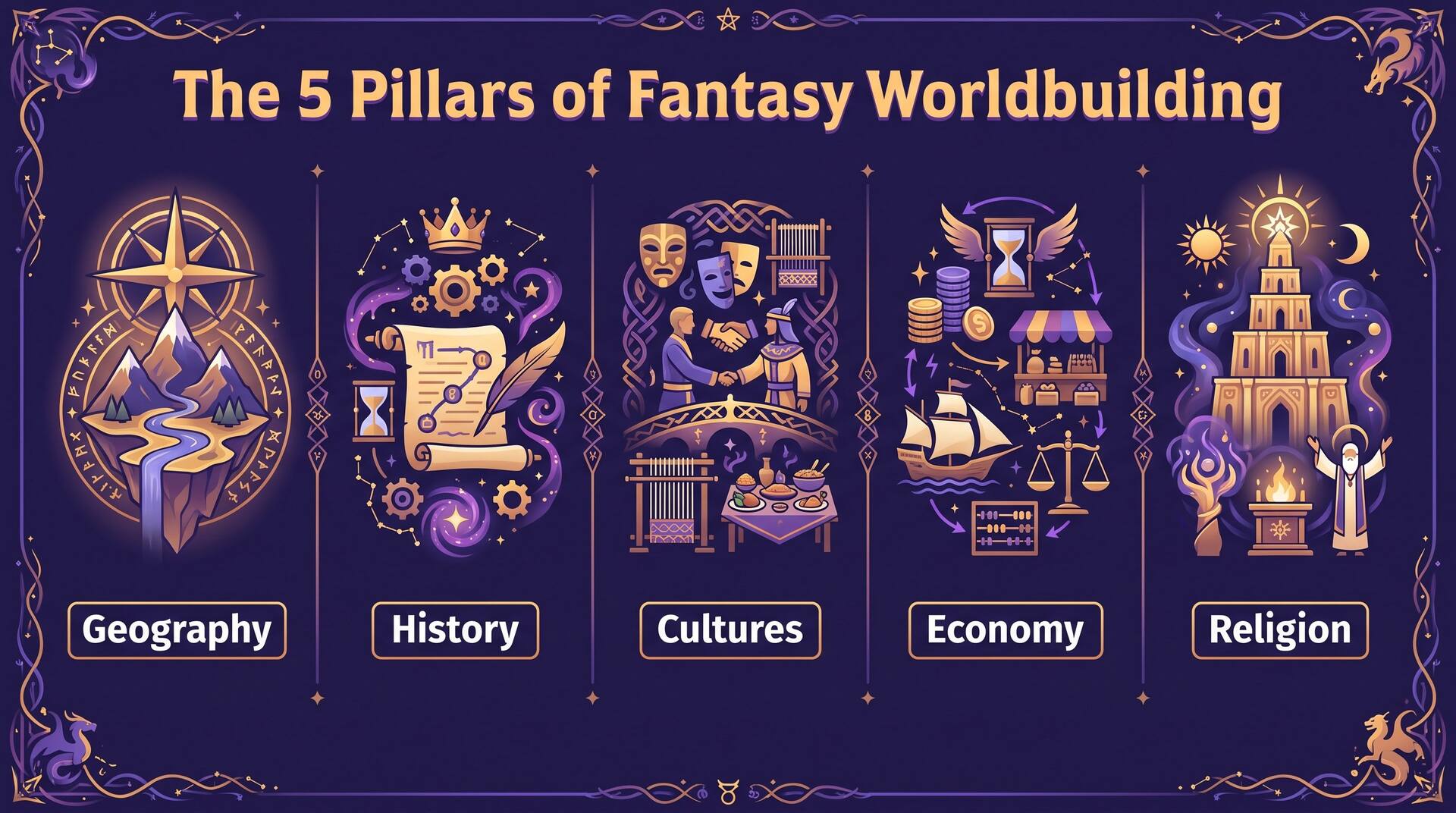
Geography & Environment
Terrain shapes everything—trade routes, military strategy, cultural identity, even religion. Mountains create isolation; rivers create commerce. Your geography should drive your story, not just decorate it.
Tip: Draw a rough map early. It doesn't need to be beautiful, but knowing where things are prevents continuity errors and suggests natural conflict points.
History & Lore
Your world didn't begin when your story starts. Past wars, fallen empires, ancient pacts, and forgotten magic create depth. History explains why things are the way they are and provides fuel for present-day conflict.
Tip: Write a one-page timeline of the last 1,000 years. You'll use maybe 10% of it in the actual novel, but knowing the rest makes everything feel more real.
Culture & Society
How do people live? What do they eat, celebrate, fear, and worship? Culture encompasses customs, taboos, art, social hierarchy, gender roles, and daily life. Multiple cultures create natural friction and richness.
Tip: Base cultures on internal logic, not Earth analogues. Ask what environment, history, and resources would produce—then build from there.
Economy & Trade
Money and resources drive conflict. Who controls the food supply? What's the currency? Is magic a commodity? If it is, someone has to source it and move it: a kingdom that arms its soldiers in enchanted steel needs a procurement system as badly as any modern army does, and whoever runs that system holds power the throne cannot see. Economic systems create believable power structures and motivations that go beyond good and evil.
Tip: Identify your world's most valuable resource. Now decide who controls it and who wants it. You've just created a major source of conflict.
Religion & Philosophy
What do people believe? Are the gods real and active, or matters of faith? Religious and philosophical systems shape morality, law, and war. In fantasy, the line between belief and reality can blur—use that.
Tip: Create at least two competing belief systems. Religious tension has driven some of the most compelling fantasy narratives ever written.
Creating Magic Systems
Your magic system defines your fantasy. It can range from mysterious and unexplained to rigorous and rule-bound. Understanding the spectrum helps you choose the right approach for your story:
Hard Magic
Clear rules, defined limits, logical costs. Readers understand what magic can and cannot do. Tension comes from creative problem-solving within constraints.
Soft Magic
Mysterious, undefined, wondrous. Magic retains a sense of awe and unpredictability. Tension comes from the unknown and the numinous.
Most great fantasy falls somewhere between these extremes. Sanderson's First Law: the ability to solve problems with magic is directly proportional to how well the reader understands that magic.
Source
Where does magic come from? Innate talent, learned skill, divine gift, natural force, or ancient artifact? The source affects who can use magic and what it means socially.
Cost
What does magic require? Physical exhaustion, life force, rare materials, sanity, or moral corruption? Cost creates stakes. Free magic creates no tension.
Limitations
What can magic NOT do? Limitations are more important than abilities. If magic can do everything, nothing is interesting. The things magic cannot fix are where your story lives.
Cultural Impact
How does magic shape society? If healing magic exists, what happens to medicine? If fireballs exist, how does warfare change? Magic should transform the world it inhabits.
Consistency
Whatever rules you establish, follow them. Nothing breaks reader trust faster than magic that works differently based on plot convenience. Document your rules and refer to them.
Epic Plot Structures
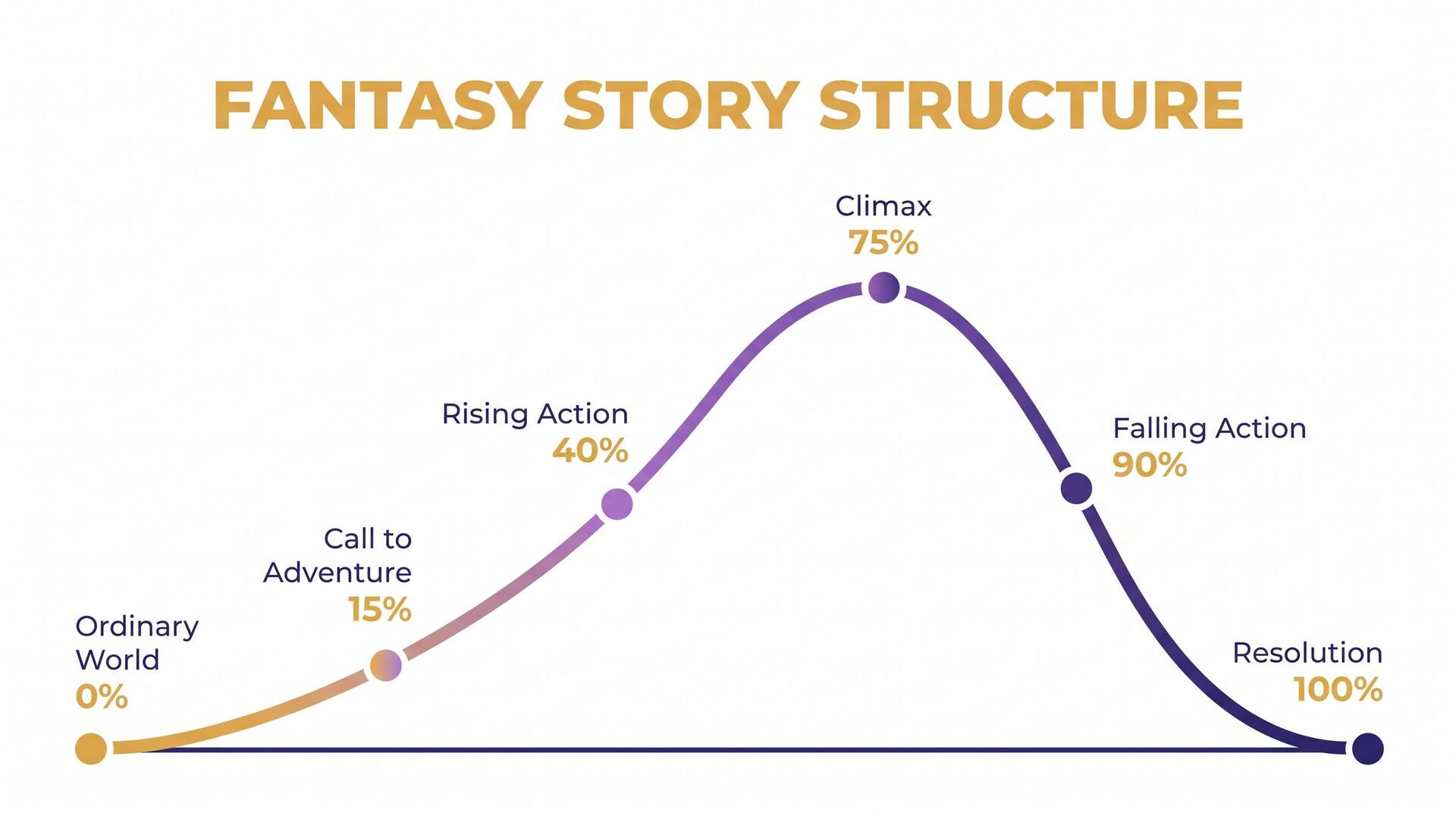
Fantasy plots often follow archetypal patterns. Here are six essential story beats that drive epic narratives:
The Ordinary World
~10%Establish what's normal before you shatter it. Show your protagonist's daily life, relationships, and desires. The reader needs to understand what's at stake before the adventure begins.
The Inciting Disruption
~10%Something breaks the status quo. A mysterious stranger arrives, an ancient evil awakens, a forbidden power manifests. This event makes the old life impossible and the quest necessary.
Rising Complications
~30%Your protagonist encounters escalating challenges. Each obstacle should be harder than the last, revealing new facets of the world and forcing character growth. Allies and enemies emerge.
The Midpoint Shift
~10%A revelation or reversal that redefines the quest. What the protagonist thought they were fighting for changes. The true nature of the conflict becomes clear, raising stakes dramatically.
The Dark Moment
~20%Everything falls apart. The protagonist faces their greatest failure, loses something precious, or confronts an impossible truth. This is where character is forged—through crisis.
The Climax & Resolution
~20%The final confrontation, where all threads converge. The protagonist uses everything they've learned. The resolution should feel both surprising and inevitable—earned, not given.
Building Cultures & Societies
Believable cultures make fantasy worlds feel alive. Consider these five essential elements:
Social Hierarchy
Who holds power and why? Nobility, merchants, mages, warriors, priests? The power structure creates automatic conflict between those who have and those who don't.
Language & Communication
How people speak reveals who they are. Slang, formality, idioms tied to the world ('by the three moons'), naming conventions—all build immersion without exposition dumps.
Rituals & Traditions
Coming-of-age ceremonies, harvest festivals, funeral rites, wedding customs. Rituals reveal what a culture values, fears, and celebrates. They're also excellent scene-setting tools.
Conflict & Prejudice
No society is harmonious. Racial tension, class warfare, religious persecution, generational divides—internal friction makes cultures feel real and generates organic story conflict.
Daily Life
What do ordinary people eat, wear, and do for work? How do they entertain themselves? These small details create texture. A world of only warriors and wizards feels hollow.
Common Fantasy Writing Mistakes
Worldbuilding at the Expense of Story
Spending pages describing your magic system, history, or geography while nothing actually happens. Readers came for a story, not an encyclopedia.
Fix: Weave worldbuilding into action and character. Show the magic system through a character using it under pressure, not through a lecture.
Chosen One Without Agency
A protagonist who's special because of prophecy, bloodline, or destiny—but never makes meaningful choices. Destiny is boring when the character is passive.
Fix: Even destined heroes must choose. Make the prophecy ambiguous, the destiny rejectable, or the cost of fulfilling it genuinely terrible.
Generic Medieval Europe
Defaulting to castles, taverns, and feudal lords because that's what you've seen in other fantasy. This creates interchangeable worlds that feel like copies of copies.
Fix: Draw from diverse historical and cultural sources. Study non-European civilizations. Or invent something entirely new based on your world's unique geography and history.
Inconsistent Magic Rules
Magic that conveniently solves problems in one scene but mysteriously doesn't work in another. This destroys tension because readers can't anticipate what's possible.
Fix: Document your magic rules before writing. If you need to break them, make that violation a major plot point with consequences.
Neglecting Character for Spectacle
Massive battles, elaborate magic, and epic scope—but flat characters the reader doesn't care about. Spectacle without emotional investment is just noise.
Fix: Ground every epic moment in personal stakes. The battle matters because someone we love might die, not because the special effects are impressive.
Fantasy Novel Writing Checklist
AI-Powered Worldbuilding Tools
Building a fantasy world is immense work. AI tools can accelerate the process while keeping your creative vision intact:
- Generate detailed cultural profiles and social structures
- Brainstorm magic system rules, costs, and edge cases
- Create consistent world history timelines and lore documents
- Develop character backgrounds rooted in your world's cultures
- Maintain consistency across hundreds of worldbuilding details
AI excels at expanding and stress-testing your ideas. The creative vision—what makes your world uniquely yours—must come from you.
Your World Awaits
Fantasy writing is among the most demanding and rewarding creative work you can undertake. Every world you build, every magic system you design, every culture you craft adds to the rich tradition of a genre that has shaped imaginations for centuries.
The world in your head is waiting to be written. Start with one detail—a magic system, a map, a character with a secret—and build outward. Your readers are out there, waiting for a world only you can create.