


Every novelist you admire was once a beginner staring at a blank page. The difference between those who become writers and those who just dream about it? They started. This guide gives you the foundation to begin your fiction writing journey with confidence, and it pairs well with the broader guide to writing a book.
The Beginner's Mindset
Before we discuss technique, let's address the biggest barrier: perfectionism. Your first draft will not be good. That's not pessimism—it's reality, and it's okay. Professional authors write terrible first drafts. The magic happens in revision.
The first draft is just you telling yourself the story.
Fiction Fundamentals
Every story, from a short tale to an epic saga, is built on these core elements:
Character
Who is your story about?Readers connect with characters, not plots. Your protagonist needs wants (what they're pursuing), needs (what they actually require for growth), and flaws (what makes them human and interesting). Studying proven character archetypes gives you a reliable starting point.
Tip: Start with one character you find genuinely interesting. Build your story around their desires and struggles.
Conflict
What's in the way?No conflict, no story. Conflict can be external (a villain, nature, society) or internal (fear, doubt, moral dilemmas). The best stories have both, intertwined.
Tip: Ask: What does my character want? What's stopping them? Make the obstacle meaningful.
Setting
Where and when?Setting isn't just backdrop—it shapes character, creates mood, and can drive plot. A story set in Victorian London feels different from one in modern Tokyo, even with identical characters.
Tip: Choose settings you can describe vividly. Personal experience or deep research makes settings come alive.
Plot
What happens?Plot is the sequence of events, but it's not just 'stuff happening.' Each scene should either advance the plot or reveal character—ideally both. Every action has consequences.
Tip: Think in cause and effect. 'This happened, therefore that happened' is more engaging than 'this happened, then this happened.'
Theme
What's it about, really?Theme is the deeper meaning—what your story says about life, humanity, or the world. You don't need to know your theme when starting; it often emerges through writing.
Tip: Don't force a message. Write authentically and themes will develop naturally.
Story Structure Made Simple
Structure provides a roadmap. Here's the most universal pattern:
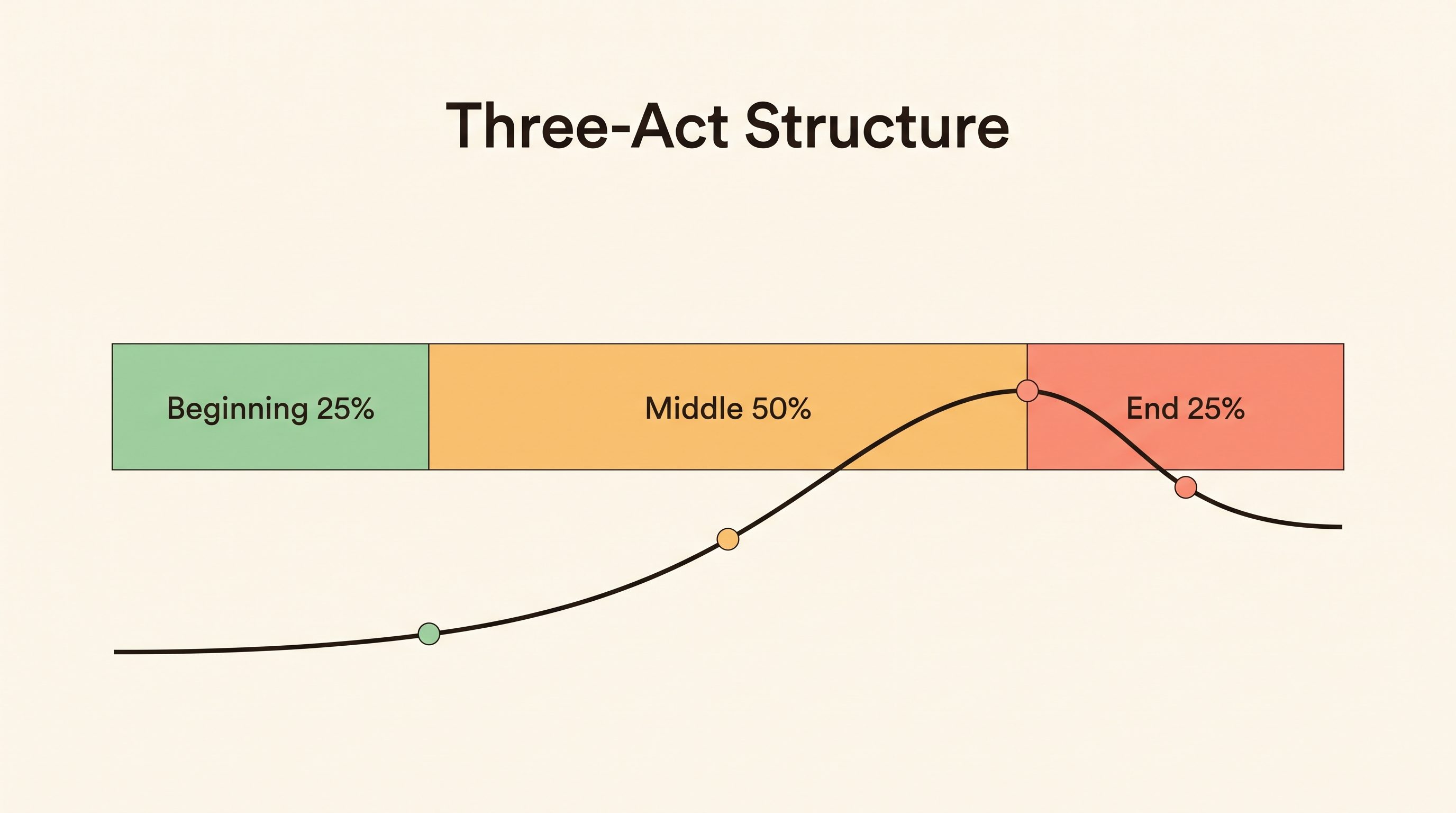
Beginning (Act 1)
~25%Introduce your character in their normal world. Then something happens (the inciting incident) that disrupts everything and launches the story.
Middle (Act 2)
~50%Your character pursues their goal, facing escalating obstacles. Midpoint twist raises stakes. Things get worse until the crisis point.
End (Act 3)
~25%The climax—your character faces the ultimate challenge. Resolution follows, showing the new normal after transformation.
This isn't a rigid formula. It's a pattern that works because it reflects how satisfying stories feel. Learn the rules before you break them.
Point of View: Whose Eyes?
POV determines how readers experience your story:
"She walked into the room and immediately regretted it."Pros
Flexible, allows distance when needed, most common
Cons
Still limited to one perspective per scene
Best for: Most fiction—it's versatile and familiar to readers
Beginner tip: For beginners, third person limited is often the best choice. It's forgiving and widely accepted in all genres.
Writing Dialogue That Works
Dialogue does heavy lifting in fiction. Good dialogue:
- Reveals character (how someone speaks shows who they are)
- Advances plot (conversations should have purpose)
- Creates tension (subtext—what's unsaid—matters)
- Feels natural (but isn't real speech—it's edited and purposeful)
"Hello, how are you today?" she asked.
"I am fine, thank you for asking," he replied.
"You look terrible," she said.
He shrugged. "Couldn't sleep."
"Again?"
Silence.
Tip: Read your dialogue aloud. If it sounds stilted, revise. Cut small talk unless it reveals character.
Show, Don't Tell (Sometimes)
You've heard this rule. It means using concrete details and actions rather than abstract statements. Instead of 'She was angry,' show the anger: clenched jaw, sharp words, slamming door.
Telling
John was nervous about the interview.
Showing
John checked his tie for the third time. His palms left damp prints on his trousers.
Important: But sometimes telling is better. 'Two years passed' is fine. You don't need to show every moment. Use showing for important emotional beats; use telling to move quickly through less important information.
Common Beginner Mistakes
Info-Dumping
Dumping backstory or world-building in large chunks. Instead, weave information naturally into scenes. Readers don't need to know everything immediately.
Fix: Ask: Does the reader need this now? Can it come out through action or dialogue later?
Passive Characters
Characters who have things happen to them instead of making things happen. Readers want to follow someone who acts, makes choices, and drives the story, like these dynamic character examples.
Fix: Give your character agency. Even when reacting to events, they should make active choices.
Overwriting
Using too many adjectives, adverbs, and purple prose. 'The luminous, ethereal moonlight cascaded majestically...' Often, simple is stronger.
Fix: In revision, cut unnecessary modifiers. Trust your verbs and nouns.
Head-Hopping
Switching between characters' thoughts within a scene without clear transitions. This confuses readers about whose experience we're following.
Fix: Stick to one POV per scene. If switching, make the break clear.
Forgetting Conflict
Scenes where characters chat pleasantly, explore beautifully, or think extensively—but nothing is at stake and nothing changes.
Fix: Every scene needs tension. Someone wants something, and something's in the way.
Practical Steps to Start Writing
Set Realistic Goals
500 words a day is achievable for most people. That's a full novel draft in six months. Don't aim for marathon sessions—aim for consistency.
Create a Writing Space
It doesn't need to be elaborate. A specific chair, time of day, or playlist helps your brain enter 'writing mode.'
Outline (or Don't)
Some writers plan extensively; others discover stories by writing them. Try both approaches to find what works for you.
Write Through the Middle
The middle is where most novels die. When excitement fades, keep writing. It's a craft, not just inspiration.
Finish Before Perfecting
Resist the urge to endlessly revise Chapter 1. A finished rough draft is infinitely more valuable than a perfect first page.
Using AI as a Writing Partner
AI tools can help beginners in specific ways without replacing your creative vision. If a blank page has you stuck, a story starter can hand you an opening to build from:
- Brainstorm plot ideas when stuck
- Generate character name options
- Get feedback on pacing and structure
- Overcome blank page paralysis with prompts
- Maintain consistency across chapters
Use AI as a tool, not a crutch. Your voice, ideas, and creative decisions make your story yours.
Your Next Steps
- 1Write your opening scene today—even if it's imperfect
- 2Commit to a small daily word count for one week
- 3Read widely in your genre of fiction, paying attention to technique
- 4Join a writing community for support and accountability
The Only Way to Become a Writer
You've now got the foundational knowledge. But knowledge without action produces nothing. Writers are made by writing, not by reading about writing. When you're ready for a full-length project, see how to write a novel step by step.
Open a document. Set a timer for 15 minutes. Write something—anything. That's how every novelist started. That's how you start too.