


Romance readers are among the most passionate and loyal in publishing. They read voraciously—often 3-5 books per week—and they know exactly what they want. This makes romance simultaneously one of the most accessible and most demanding genres to write. This guide covers everything from subgenre selection to publishing strategy, giving you the tools to write a romance novel that earns devoted fans.
The Two Promises of Romance
Every romance novel makes two promises to the reader: an emotionally satisfying love story at the center of the book, and an optimistic, emotionally satisfying ending (HEA or HFN). Break either promise and you lose reader trust. Everything else—subgenre, tropes, heat level—is flexible.
Romance Subgenre Explorer
Romance has dozens of subgenres, each with distinct conventions. Choosing your subgenre shapes your setting, tone, pacing, and audience. Explore the major categories below.
Contemporary Romance
Set in the present day with real-world settings. The most popular subgenre by market share. Stories focus on relatable, modern relationships with recognizable emotional challenges—career pressures, family dynamics, second chances, and personal growth.
Contemporary Romance — Reader Expectations
Authentic dialogue, modern sensibilities, relatable conflicts rooted in real life, settings readers can imagine visiting
Popular Tropes
Enemies to lovers, fake dating, second chance, workplace romance, small-town romance, forced proximity
Notable Examples
The Kiss Quotient by Helen Hoang, Beach Read by Emily Henry, The Hating Game by Sally Thorne
The Romance Story Structure
Romance novels follow a distinctive emotional arc. While you can be creative with plot, the underlying emotional beats are what readers crave. Here are the key turning points every romance needs.
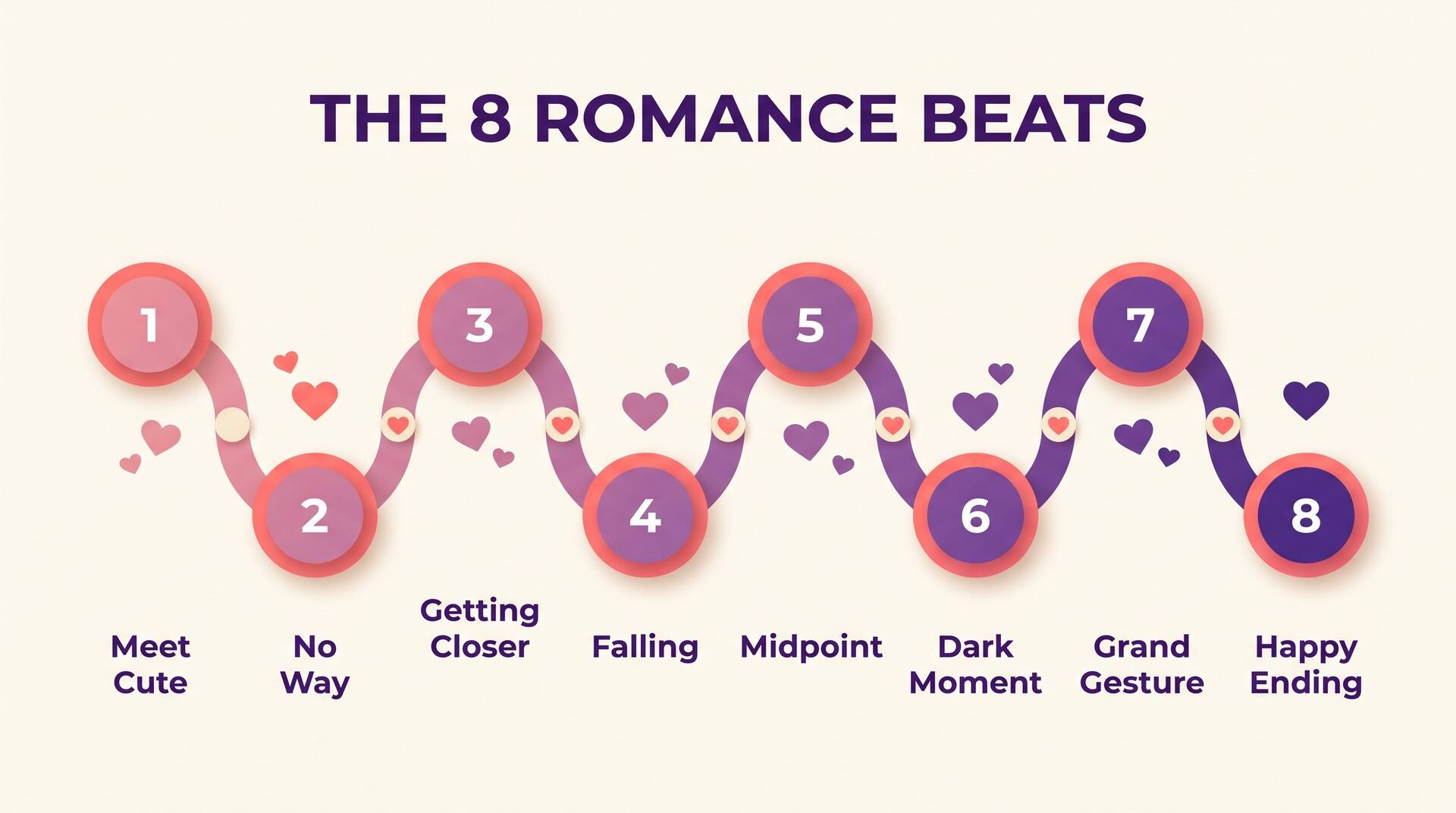
The Meet-Cute or Inciting Incident
The protagonists encounter each other in a way that sparks interest, tension, or both. This moment should hint at why these two people specifically are drawn to each other—and what will keep them apart.
Growing Awareness
Physical and emotional attraction builds through shared experiences, banter, and moments of vulnerability. The reader needs to feel why these characters are falling for each other despite their resistance.
The First Intimacy Milestone
The first physical or deep emotional connection. This doesn't have to be a literal kiss—it's the moment where the walls start coming down and both characters acknowledge, even briefly, what's between them.
Falling in Love
The relationship progresses. Characters share backstory, reveal vulnerabilities, and develop genuine emotional intimacy. This section builds the foundation that will be tested by the coming conflict.
The Crisis Point
The central conflict—internal fears, external obstacles, or both—threatens to destroy the relationship. This must feel organic to the characters, not manufactured. The best conflicts arise from who these characters fundamentally are.
The Black Moment
All seems lost. The couple separates or faces an obstacle that appears insurmountable. The reader should genuinely wonder how they can possibly find their way back. This is the emotional low point of the book.
The Declaration
One or both characters take a definitive action that demonstrates their growth and commitment. This isn't just saying 'I love you'—it's proving it through sacrifice, vulnerability, or both.
Happily Ever After
The emotionally satisfying conclusion. The couple is together, the reader feels the relationship will last, and the emotional journey feels complete. This can range from a wedding to simply holding hands—what matters is emotional resolution.
Creating Unforgettable Characters
Romance lives and dies by its characters. Readers need to fall in love alongside your protagonists.
Give Each Character a Wound
The best romance characters carry emotional wounds that directly affect their ability to love and be loved. A heroine who was abandoned by a parent may struggle with trust. A hero who failed someone he loved may avoid emotional commitment. The romance becomes the journey of healing.
Tip: The wound should directly create the internal conflict. If removing the wound wouldn't change the romance plot, it's decoration, not character development.
Create Complementary Opposites
Great romance pairs have qualities that balance each other. One is cautious, the other bold. One is emotionally open, the other guarded. These differences create friction that generates both conflict and growth—each character becomes better because of the other.
Tip: List your characters' core traits side by side. If they're too similar, there's not enough friction. If they have nothing in common, the attraction won't feel believable.
Distinct Voices and Goals
Each protagonist needs their own story, goals, and motivations beyond the romance. A character whose only purpose is to fall in love feels one-dimensional. Give both characters rich inner lives, friendships, careers, and personal stakes.
Tip: Cover the character name in dialogue. If you can't tell who's speaking, your voices aren't distinct enough.
Internal Conflict Drives the Story
External obstacles (family disapproval, distance, rival love interests) can complicate the plot, but the real conflict should be internal. What belief, fear, or flaw prevents this character from accepting love? That internal battle is what makes readers emotionally invest.
Tip: Ask yourself: if I removed all external obstacles, would these characters still struggle to be together? If yes, you have strong internal conflict.
Show Vulnerability Gradually
Characters shouldn't bare their souls on page one. Layer vulnerability like an onion—each reveal deepens the reader's connection and raises the emotional stakes. The moments when a guarded character finally opens up should feel earned and powerful.
Tip: Map out when each character reveals something personal. Space these moments across the book with increasing emotional weight.
Writing Chemistry & Tension
Chemistry between characters is what keeps romance readers turning pages. Here are the techniques that create that irresistible pull.
Master the Push-Pull Dynamic
Great romantic tension comes from characters being drawn together and pushed apart simultaneously. Every scene between the leads should have both attraction and resistance. A lingering touch followed by pulling away. A vulnerable confession followed by emotional retreat. This dance is the heartbeat of romance.
Use All Five Senses
Don't limit attraction to visual descriptions. How does the love interest's laugh sound? What cologne lingers after they leave? How does the accidental brush of their hand feel? Sensory details make chemistry visceral and immersive rather than abstract.
Subtext in Dialogue
The most charged romantic scenes often have characters saying one thing while meaning another. An argument about dishes is really about feeling unappreciated. A casual question about weekend plans is really asking 'do you want to spend time with me?' Let the unspoken crackle beneath the surface.
Delayed Gratification
Resist the urge to bring characters together too quickly. Almost-kisses interrupted, confessions swallowed, opportunities missed. Each near-miss increases the reader's anticipation. When the payoff finally comes, it hits harder because of the wait.
Emotional Intimacy Before Physical
Physical scenes without emotional foundation fall flat. Build moments of genuine connection first—sharing secrets, being vulnerable, seeing each other clearly. When the physical intimacy arrives, it should feel like a natural expression of emotional closeness.
Common Romance Writing Mistakes
Conflict Based on Miscommunication
If the entire plot would collapse if two characters had a simple conversation, the conflict is too thin. Modern readers especially find 'big misunderstanding' plots frustrating when a text message could resolve everything.
Fix: Root your conflict in genuine incompatibilities, real fears, or external pressures that can't be solved with a conversation. If miscommunication plays a role, make it stem from a deeper character flaw.
Neglecting the Non-Romance Plot
Romance should be central, but characters need lives beyond their love interest. A book where characters think about nothing but each other reads as obsession, not love. The external plot provides structure and context for the romance.
Fix: Give both protagonists meaningful subplots—career challenges, family issues, personal goals. These external elements should intersect with and complicate the romance.
Telling Emotions Instead of Showing Them
Writing 'she felt butterflies in her stomach' tells the reader about attraction. Showing her forgetting her words mid-sentence, straightening her shirt, or laughing too loudly at his joke makes the reader feel it alongside her.
Fix: Replace emotion labels with physical reactions, behaviors, and internal thoughts. Show how feelings manifest in action and body language.
Rushing the Emotional Arc
Characters declaring love by chapter three gives nowhere to go. Romance is a slow burn by nature—even fast-paced romances build emotional connection methodically. Readers want to savor the journey, not race to the destination.
Fix: Map your emotional milestones across the full manuscript. Ensure each stage of falling in love gets adequate page time and development.
Flat Secondary Characters
Best friends, family members, and rivals shouldn't exist just to give the protagonist someone to talk to about their feelings. Great secondary characters have their own motivations, offer genuine perspectives, and enrich the story world.
Fix: Give secondary characters their own wants. Let them challenge the protagonist's assumptions. Consider if any could carry their own book—that's the sign of a well-developed supporting cast.
Your Romance Novel Checklist
Publishing Your Romance Novel
Romance has more publishing paths than almost any other genre. Choose the one that fits your goals.
Traditional Publishing
Pros
Editorial support, advance payment, wider distribution, credibility with print retailers
Cons
Slower timelines, less creative control over covers and pricing, lower per-book royalties
Self-Publishing
Pros
Full creative control, higher royalties per book, fast time-to-market, ability to write to market trends quickly
Cons
Upfront investment in editing and covers, full marketing responsibility, steep learning curve
Kindle Unlimited
Pros
Massive romance readership on KU, page-read income supplements sales, discovery through KU algorithms
Cons
Requires Amazon exclusivity, income depends on page reads, algorithm changes affect visibility
Using AI to Write Your Romance Novel
AI tools can accelerate your romance writing process while keeping your creative vision intact:
- Outline and plot your romance arc with proper emotional beats and pacing
- Develop detailed character profiles with wounds, goals, and voice
- Generate dialogue variations to find the perfect banter and chemistry
- Draft scenes with consistent tone matching your chosen subgenre
- Design professional book covers that signal the right subgenre to readers
AI excels at structure and drafting, but the emotional authenticity of great romance comes from the writer. Use AI to handle the craft mechanics so you can focus on the heart of the story.
Write the Love Story Only You Can Tell
Romance is often dismissed as formulaic, but that misses the point entirely. The formula is a framework—two people find love despite the odds. What makes each romance unique is the specific characters, the particular obstacles, and the distinctive voice you bring to the page.
The world needs more love stories. Yours could be the book someone reads during a difficult time and finds hope in, the story that makes a reader laugh out loud on a train, or the novel that reminds someone what falling in love feels like. Start writing it today.