

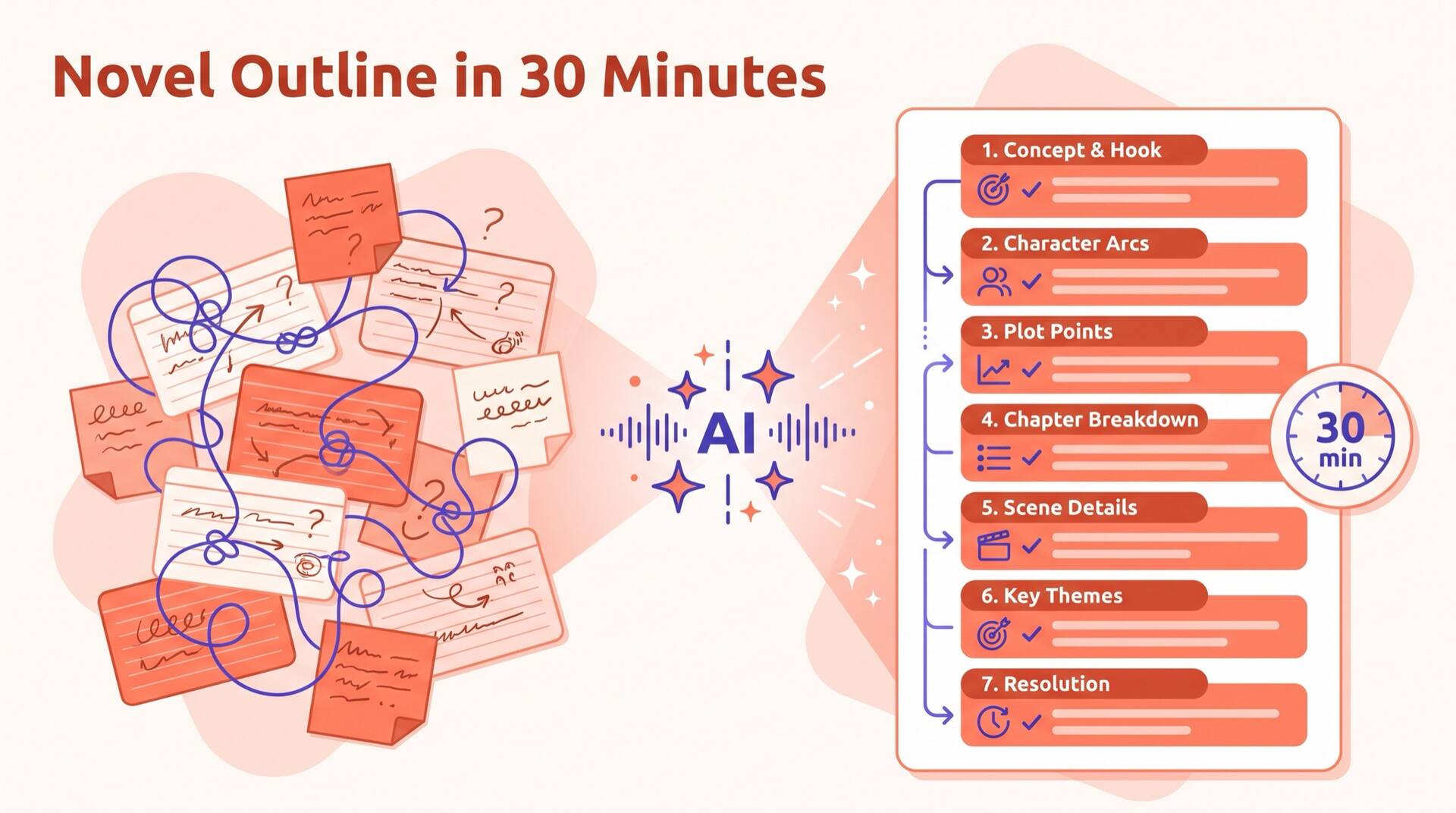
Why Outlines Matter More Than You Think
Most abandoned novels die in the middle. The writer runs out of steam around chapter eight because they have no roadmap. An outline is that roadmap. It does not kill creativity. It channels it.
Think of an outline like GPS navigation. You still choose the scenic routes, make spontaneous detours, and enjoy the journey. But you always know where you are heading and roughly how to get there.
Saves 40-60% of writing time
When you know what happens in each chapter, you spend your writing sessions actually writing instead of staring at a blinking cursor trying to figure out what comes next.
Prevents plot holes before they happen
Spotting that your villain has no believable motivation is much easier at the outline stage than after you have written 200 pages around that broken foundation.
Maintains momentum through the midpoint
The dreaded middle section of a novel is where most writers quit. An outline gives you a clear path through those challenging chapters between the exciting beginning and the satisfying ending.
The Outlining Debate: Planners vs. Pantsers
Writers have debated this for decades. Planners (also called plotters) outline everything before writing. Pantsers (also called discovery writers) prefer to write and see where the story takes them. Most successful authors land somewhere in between.
Planners
- Know the ending before writing chapter one
- Create detailed chapter-by-chapter breakdowns
- Track character arcs and subplots systematically
- Rarely face structural rewrites
Pantsers
- Discover the story as they write it
- Follow characters wherever they lead
- Thrive on surprise and spontaneity
- Often need significant structural revision
AI outlining bridges this gap. You can generate a structural foundation in minutes, then deviate from it freely as you write. You get the security of a plan with the flexibility to discover. Even committed pantsers benefit from spending 30 minutes with an AI outline generator before diving in.
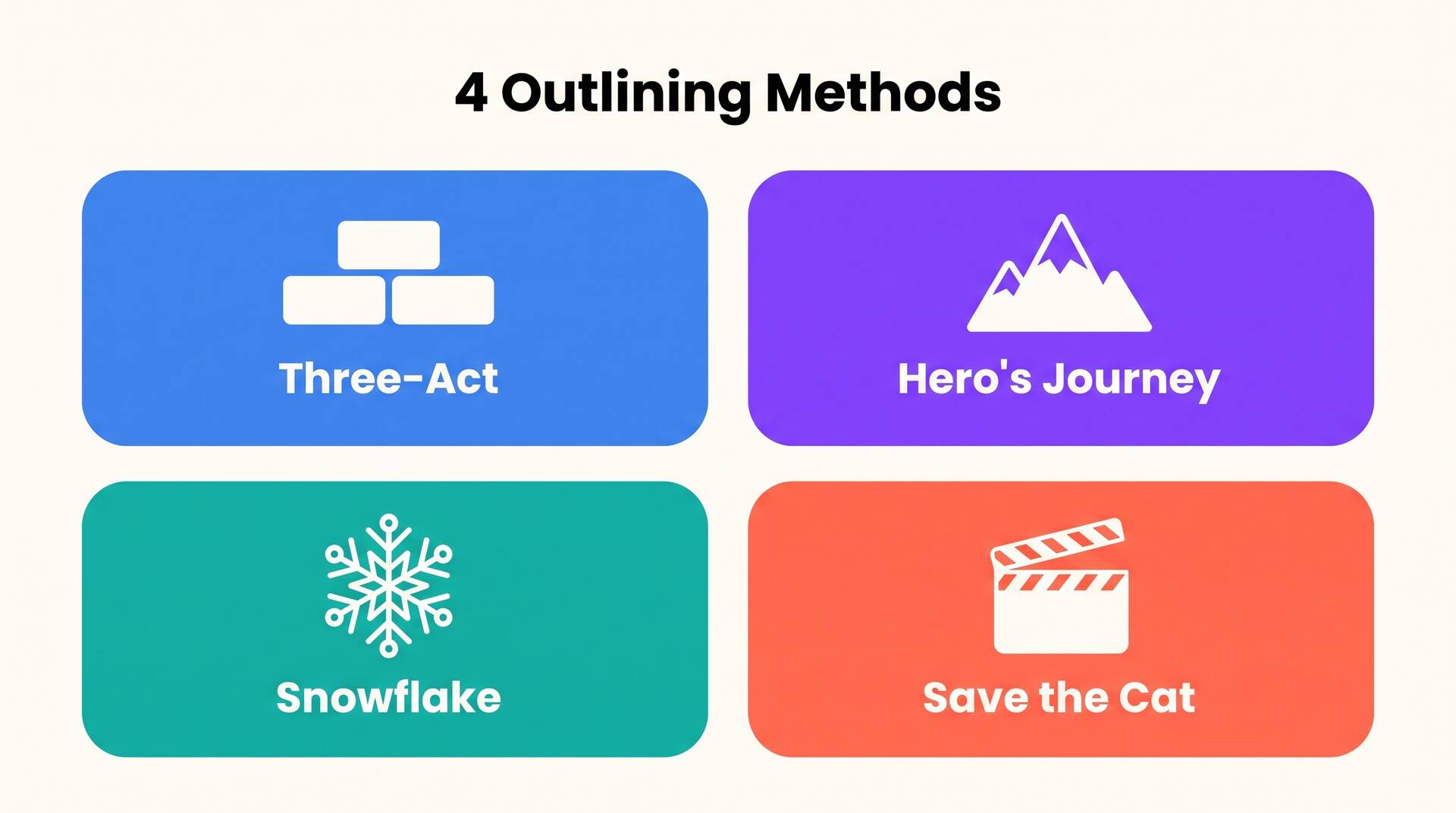
Four Proven Outlining Methods
Each method suits different genres and writing styles. Select one to see its structure.
Three-Act Structure
The most universal storytelling framework. Divide your novel into Setup (25%), Confrontation (50%), and Resolution (25%). This mirrors how satisfying stories naturally feel: introduce a problem, escalate it, then resolve it.
Introduce your protagonist in their ordinary world. Establish their goal, flaw, and what is at stake. End Act 1 with the inciting incident that forces them into the main conflict. The reader should understand who we are following, what they want, and why it matters.
How AI Changes the Outlining Game
Traditional outlining requires you to invent every plot point from scratch. AI outlining gives you a creative partner that can generate structural foundations in seconds, suggest plot developments you might not have considered, and help you stress-test your story logic before you commit months to writing it.
Speed
Generate a complete structural outline in minutes instead of days. Iterate through multiple versions quickly to find the right story shape.
Genre intelligence
AI has absorbed patterns from thousands of published novels. It understands genre conventions, reader expectations, and pacing norms for thrillers, romance, fantasy, and beyond.
Flexibility
Regenerate any section instantly. Swap out a subplot, change a character's motivation, or restructure the midpoint without starting over from scratch.
Subplot weaving
Managing multiple storylines is one of the hardest parts of outlining. AI can track how subplots intersect with your main plot and suggest integration points.
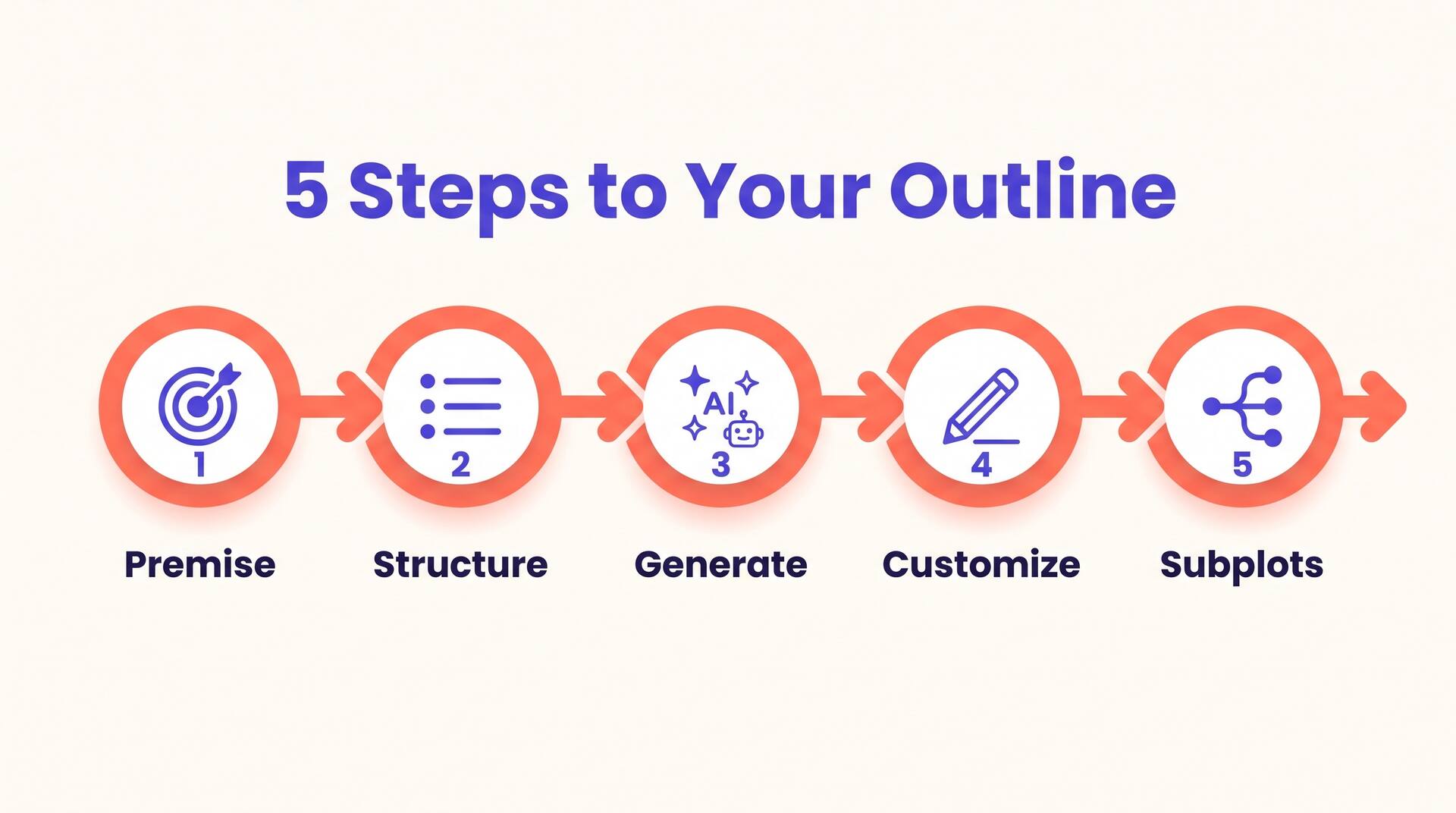
5-Step Process: From Idea to Complete Outline
Follow these steps to create your novel outline in about 30 minutes, or let our AI outline builder run the whole process for you.
Start with your premise
5 minutesWrite one sentence that captures your novel's core conflict. Use this formula: A [type of character] must [goal] before [stakes/deadline], but [obstacle]. Example: A retired detective must find her missing granddaughter before the kidnapper's 48-hour deadline, but the prime suspect is her own estranged son. This single sentence drives everything that follows.
Example Outlines by Genre
See how the same 5-step process produces different results across genres.
Thriller
A forensic accountant discovers her firm is laundering money for a cartel, and she has 72 hours to gather evidence before an internal audit erases the trail.
Setup: Introduce Maya Chen at her firm. She is meticulous, rule-following, recently divorced. She stumbles on anomalous transactions while preparing quarterly reports. Her boss dismisses her concerns too quickly. She digs deeper after hours.
Escalation: Maya copies files and contacts an FBI agent. Someone breaks into her apartment. Her colleague who also noticed irregularities disappears. The firm's security chief begins following her. Midpoint: She discovers her ex-husband's investment fund is connected to the laundering. Stakes become personal.
Resolution: Maya orchestrates a sting operation using the upcoming audit as cover. Climax in the firm's server room during a blackout she engineered. She secures the evidence but must choose between exposing her ex-husband or letting part of the network survive.
Common Outlining Mistakes to Avoid
Making it too rigid
An outline that dictates every scene down to the dialogue leaves no room for the happy accidents that make novels come alive. Your outline is a guide, not a prison. When a character wants to go somewhere unexpected during writing, let them.
Fix: Build flexibility into your outline. Note the key beats that must happen, but leave the spaces between them open for discovery.
Keeping it too vague
An outline that says 'stuff happens in the middle' is barely better than no outline at all. You need enough detail to actually know what to write when you sit down for each session.
Fix: Each chapter in your outline should have at least: the scene goal, the conflict, and what changes by the end. If you cannot state those three things, the chapter is not ready.
Ignoring character arcs
Plot-only outlines produce novels where things happen but characters feel flat. Your protagonist's internal journey, their fear, flaw, and growth, needs to be woven into the outline alongside the external events.
Fix: For each major plot beat, note the protagonist's emotional state and what they believe at that point. Track how those beliefs shift across the story.
Front-loading all the complexity
New writers often create intricate first acts packed with worldbuilding and backstory, then have nowhere to escalate. Your outline should build in complexity and stakes as it progresses.
Fix: Ensure your outline's second half contains bigger reveals, harder choices, and higher stakes than the first half. The reader's investment should compound, not plateau.
Pro Tips for Using AI Outlines
Generate multiple versions
Do not settle on the first outline AI produces. Generate three or four variations of your story, then cherry-pick the strongest elements from each. The best outline is often a hybrid.
Challenge the AI's suggestions
If a plot point feels predictable, push back. Ask for a version that subverts the genre convention. Ask what would happen if the opposite occurred at the midpoint. Use AI as a brainstorming partner, not an authority.
Add what only you know
AI cannot replicate your personal experiences, emotional truths, or unique perspective. After generating the structural foundation, infuse it with details from your life, observations, and the specific feelings you want readers to experience.
Use the outline as a living document
Update your outline as you write. When chapter twelve takes an unexpected turn, revise chapters thirteen through twenty-five to accommodate it. Your outline should evolve with your story, not constrain it.
Pair outlining with other tools
An outline is stronger when supported by character profiles, a story-starter premise, and plot twist ideas. Use complementary tools to build a complete creative foundation before you begin writing.
Continue Your Writing Journey
How to Write a Novel
The complete guide from first idea to finished manuscript
Create a Book Outline
Deep dive into outlining methods with ready-to-use templates
How to Write a Book with AI
The full AI writing workflow from outline to finished draft
Fiction Writing for Beginners
Essential skills and mindset for new fiction writers
Your Novel Outline Is 30 Minutes Away
You do not need weeks of planning to start writing with confidence. A solid outline built with AI gives you the structural foundation to write faster, avoid plot holes, and maintain momentum through the challenging middle chapters.
Pick your premise. Choose your structure. Generate, customize, and start writing. The story in your head deserves to exist on the page, and a good outline is the fastest way to get it there.