

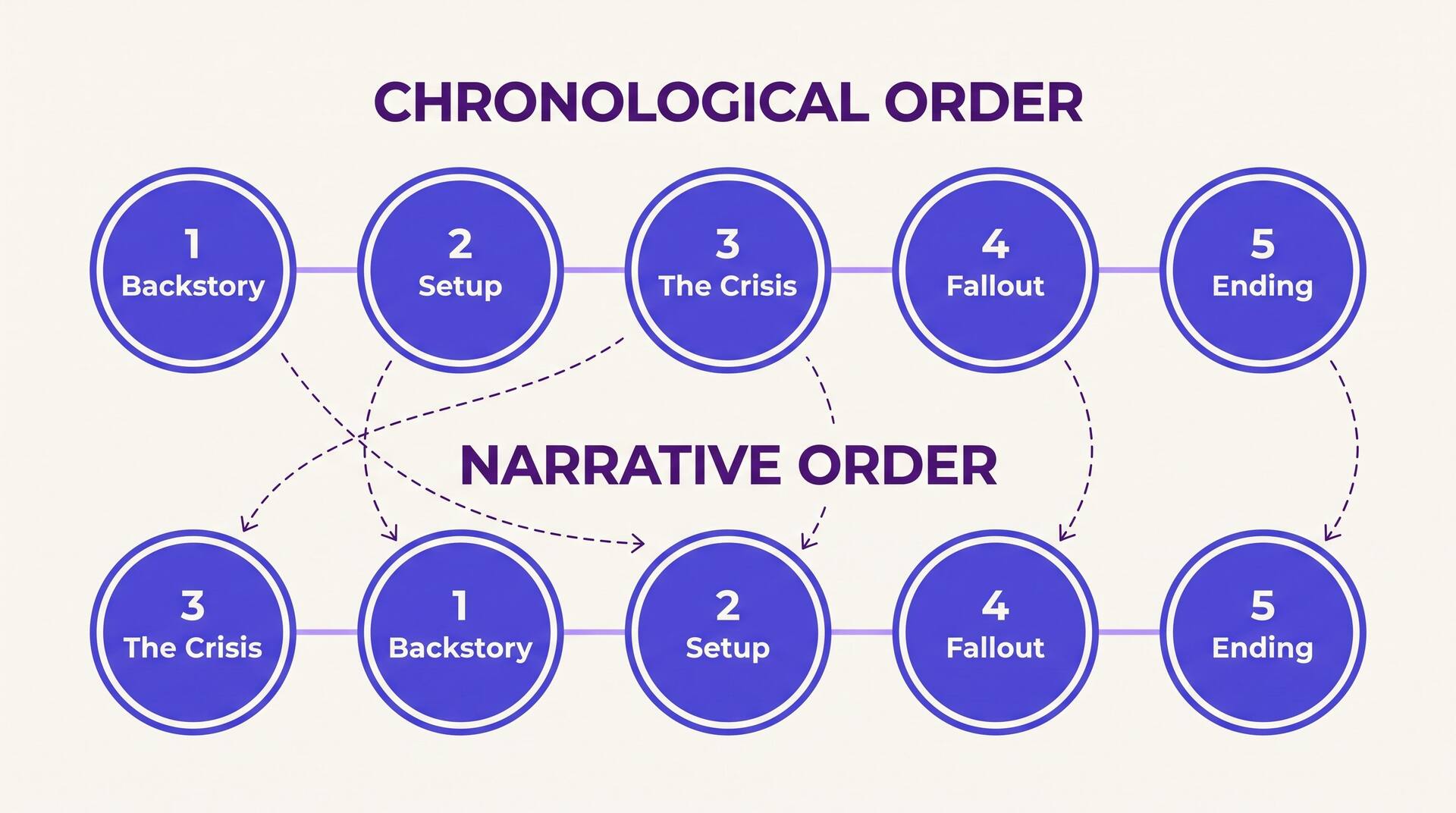
Every story has two clocks. One is chronological: the order events happened in the world of the book. The other is the narrative order: the order the reader receives them in. Beginning writers tend to assume these are the same clock, and most first drafts run them in lockstep — birth, childhood, the inciting problem, the escalation. In medias res is the decision to unhook them.
That is the whole technique. Not pace, not adrenaline, not a prologue with a knife in it. You pick a moment that is already loaded with consequence, start there, and accept a debt: the reader now knows less than they need, and you owe them the missing pieces before their patience runs out. Writers who understand the first half and ignore the second half produce the most common bad opening in slush piles — a vivid scene nobody can care about.
What it actually means
Definition
In medias res (Latin, "into the middle of things") is a narrative technique in which the story opens at a point well into its own chronology — during an action, a crisis, or a situation already under way — and the events that led there are supplied afterwards, through flashback, dialogue, or a narrator looking back.
Note what the definition does not say: nothing about explosions. The choice is structural. You can open in medias res on a marriage that has already quietly failed.
Where the phrase comes from
The term is Horace's. In the Ars Poetica, written around 19 BC, he praises Homer for refusing to begin the Trojan War story at its earliest possible cause — the egg from which Helen was born. Horace's contrast is between the poet who starts ab ovo ("from the egg") and the poet who hurries to the outcome and drops the audience into the middle of things as though they already knew the background. It is advice about selection, not about excitement.
He always hurries on to the outcome, and sweeps his hearer into the middle of things as though they were already known.
The Latin is semper ad eventum festinat et in medias res / non secus ac notas auditorem rapit. The phrase we use as a technical term is literally lifted out of a line of criticism about Homer.
Homer earned the compliment. The Iliad opens nine years into the siege of Troy — not at the abduction of Helen, not at the sailing of the fleet, but at a quarrel between Agamemnon and Achilles over a captured woman, a dispute that would be trivial except that it removes the best fighter in the Greek army from the field. The nine years of war are context. The quarrel is the story.
The Odyssey goes further. It opens in the tenth year after the fall of Troy, with Odysseus stranded on Calypso's island and his household in Ithaca already overrun by suitors — and it spends its first four books not with Odysseus at all but with his son. The famous adventures, the Cyclops and the sirens and the descent to the dead, arrive later, in Books 9 to 12, told by Odysseus himself at a Phaeacian dinner table. The most exciting material in the poem is delivered as retrospective after-dinner speech, because Homer needed us to care about the man before we heard the monsters.
Virgil copied the architecture deliberately. The Aeneid opens with Aeneas's fleet being smashed by a storm on its way to Italy, years after Troy has fallen; the sack of the city — the material every Roman reader was waiting for — is told in Books 2 and 3 as a story Aeneas recounts to Dido at a banquet. Same move: the entry point is chosen for pressure, and the backstory becomes something a character has a reason to say out loud.
Four flavours, and they behave differently
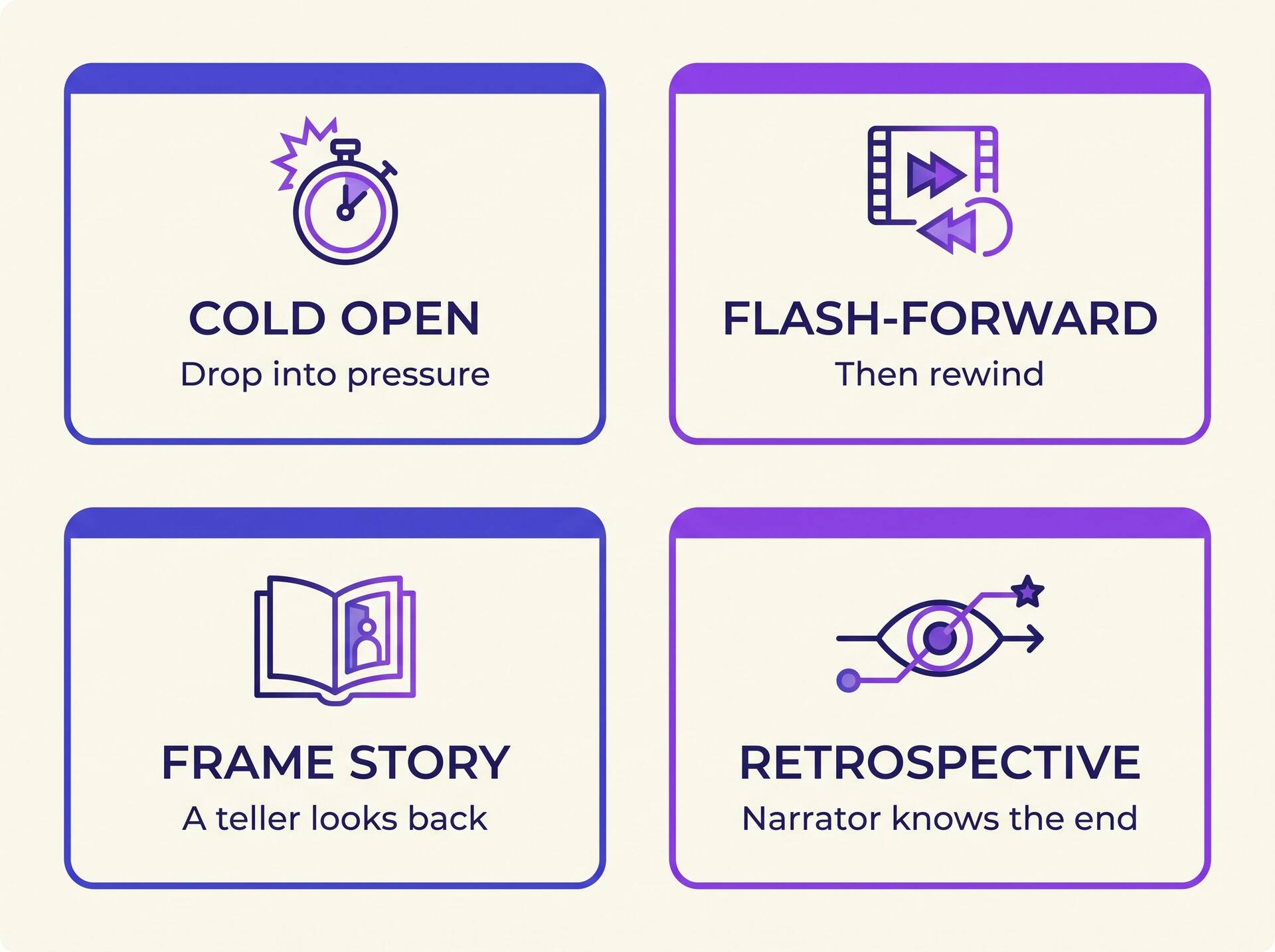
"In medias res" gets used as one label for four fairly different structures. They carry different risks, and choosing between them is a real decision rather than a matter of taste.
The cold open
You begin inside a moment of pressure and never announce that you have done so. There is no rewind, no frame — the story simply continues forward from there, and context leaks in through what characters already assume. This is the cleanest version and the hardest, because you get no structural signal to lean on. It works when the situation is legible without history: a man is negotiating with someone who intends to kill him. We do not need to know why to know what is at stake.
The flash-forward prologue
You show a scene from later in the story, then jump back and run the chronology forward toward it. Breaking Bad's pilot opens with an RV careening through the desert and a man in his underwear pointing a gun at nothing, then cuts to "three weeks earlier." The appeal is obvious: you borrow tension from a future you have not earned yet. The cost is equally obvious and mostly ignored — see the mistakes section.
The frame narrative
The book opens after everything has happened, with someone about to tell it. Frankenstein opens with Walton's letters and a wrecked man picked off the ice; Wuthering Heights opens with a tenant arriving at a house whose history has already curdled; Heart of Darkness opens on a boat on the Thames with Marlow starting to talk. The frame buys you an authorised narrator — someone with a reason to explain — which quietly solves the backstory problem before it appears.
The retrospective narrator
A first-person narrator tells the story from a position after its end, so the opening can begin anywhere and gesture at anything. Rebecca opens with a dream about a house that has already burned. Sunset Boulevard is narrated by a man floating dead in a swimming pool. And García Márquez does the compressed version in a single sentence: One Hundred Years of Solitude opens with a colonel facing a firing squad and remembering a childhood afternoon — a flash-forward and a flashback stacked in one clause, before the novel's chronology has even started.
Worked examples: what the opening scene is doing
It is easy to list books that start in the middle. It is more useful to name what each opening buys, because that is the part you have to reproduce.
| Work | Opens on | What the choice buys |
|---|---|---|
| The Iliad | A quarrel over spoils, nine years into the siege | Reduces a decade-long war to one man's withdrawal, so the epic has a protagonist and a clock |
| Hamlet | Sentries on a cold rampart, the murder already done | Puts the audience in the position of the guards — something is wrong here and nobody will say what |
| Beloved | "124 was spiteful" — a house already haunted | Makes the past a present pressure rather than an explanation; the reader feels the history before learning it |
| Star Wars (1977) | A ship already being boarded, mid-war | Establishes scale and menace in ninety seconds; the crawl handles the exposition the scene refuses to |
| Pulp Fiction | A couple deciding to rob the diner they are sitting in | Plants a scene the film will return to, so a conversation becomes a structural hinge |
| Fight Club | A gun in the narrator's mouth, at the end of the story | Licenses the narrator's digressive, out-of-order telling — he is explaining how he got here |
Notice how many of these are quiet. The Hamlet opening is two nervous men asking who's there. Beloved's is a sentence about a house. The energy comes from unexplained pressure, not from motion.
And notice a counter-example worth keeping in mind: Moby-Dick does not do this. "Call me Ishmael" begins at the beginning, with a man deciding to go to sea, and the novel is fine. Plenty of great books start at the start.
How to actually choose the entry point
The practical question is not "should I start in the middle" but "which middle." Four tests, applied to candidate scenes from your outline.
1. Find the first scene where the protagonist's ordinary strategy stops working
Not the first dramatic scene — the first scene where the character's habitual way of handling life fails. That is where a story becomes irreversible, and it is almost always later than writers think. If your chapter three does that and chapter one does not, chapter three is your opening.
2. Test whether the scene is legible without its history
Read the scene to someone who knows nothing about the book. If they can answer "who wants what, and what is in the way" — even wrongly, even in the crudest terms — the scene will hold. If their answer is "I don't know, something bad?", the scene needs its setup and you have picked too late an entry.
3. Check that the deleted material can be delivered later, by someone with a reason to say it
This is the test writers skip. Before committing, write one sentence naming who tells the reader each missing thing and why they would. Homer had a dinner party; Virgil had Dido asking. If your answer is "the narrator explains it in chapter two," you have not moved the exposition — you have relocated it and added confusion on top.
4. Decide how long the reader is in the dark, in pages, and write it down
Readers tolerate confusion in proportion to how interesting it is and how confident the prose sounds. In practice: a page or two of not knowing who these people are is intriguing, five is fine if the scene is gripping, and by roughly ten to fifteen pages the reader wants an anchor — a name, a relationship, a stake, a place. Set your own number in advance and treat it as a deadline rather than discovering at the copy-edit that the anchor never arrived.
Paying the debt: backstory without a dump
Starting late does not delete the setup; it converts it into a debt. There are three honest currencies to repay it in, and one dishonest one.
Dramatised flashback — a scene, not a summary, placed where the reader is actively asking the question it answers. Its cost is momentum, so it should carry its own small conflict rather than being a slideshow of information.
Withheld dialogue — characters referring to a shared past in the way people actually do: partially, unevenly, with something at stake in the telling. This is the cheapest currency, and the one Homer and Virgil use most.
Narrator's retrospect — available only if your narrator sits after the events. It is the reason the frame narrative and the retrospective first person are so popular for this structure: they make explanation a natural act.
The dishonest one: the chapter-two info-dump, where the story stops and a paragraph tells you everything the first chapter withheld. This is the same exposition you were avoiding, now delivered later and less gracefully, and it is the single most common way in medias res fails in practice.
One rule that solves most of it: never answer a question the reader has not yet asked. Confusion becomes curiosity only when the reader has formed the question themselves. Delivered too early, the same information is just noise; delivered at the moment they want it, it feels like a reward.
Five ways this goes wrong
- 1
Action with nobody to care about
A chase, a battle, a fire — and the reader has no stake in whether the running figure survives, because they met them eleven seconds ago. Danger to a stranger is not tension; it is choreography. Fix it by opening on pressure a character is choosing to walk into rather than on physical peril they are fleeing.
- 2
The prologue that spoils the book it introduces
Flash-forward to your climax and you have told the reader the protagonist survives to reach it, that the confrontation happens, and often who is present. Everything between the prologue and the catch-up point now runs with the tension partly discharged. If you use this shape, show a fragment that raises a question rather than a scene that answers one — and consider whether you need it at all. Our piece on what a prologue is and when it earns its place goes deeper on that call.
- 3
Hook first, story later
The opening scene is thrilling and then chapter two restarts the book with the protagonist waking up and going about their ordinary morning. Readers feel the bait-and-switch immediately. If your real story begins in chapter two, the first chapter is not in medias res — it is an advertisement for a book you have not started yet.
- 4
Confusion with no promise attached
Nine unexplained proper nouns in two pages is not mystery, it is admin. Each withheld fact should come with a visible shape — the reader should be able to sense that there is a specific thing they do not know. Unbounded vagueness reads as an author who has not decided.
- 5
Opening on a moment that turns out not to matter
You picked a dramatic scene rather than a load-bearing one, and by chapter six it is clear the book's real question began elsewhere. This is a structural problem, not a prose problem, and it is fixed at the outline stage — which is why it is worth checking your entry point against the shape of the whole story before drafting fifty thousand words. Our guide to rising action covers what a load-bearing early scene needs to do.
When not to use it
The technique is oversold. Three situations where beginning at the beginning is the stronger choice:
When the ordinary world is the point. If the book's meaning depends on the reader having felt what normal was before it broke — most quiet literary fiction, most fiction about grief, a great deal of historical fiction — then skipping the normal is deleting your own foundation. A Save the Cat opening image, showing the protagonist's life exactly as it stands before anything happens, earns its place precisely here.
In much of romance. Genre readers want to be present for the meeting; arriving after the relationship has begun forfeits the first beat the reader came for. Enemies-to-lovers and second-chance plots are the exception — those start with history on purpose.
When the story's tension is genuinely about anticipation. If the interesting part is the approach to an event, opening after that event has occurred spends the very thing you were building.
There is also a plain craft reason to hesitate: this structure is harder to hold together than a linear one, and a competent linear opening beats a fumbled clever one every time. If your book has a strong scene at its natural start, use it.
Getting it right before you have written 60,000 words
The expensive version of this mistake is discovering at the end of a draft that the book should have started at chapter four. The cheap version is testing entry points while they are still one-line summaries.
That is mostly an outline exercise. Lay out your chapters in chronological order, mark the first scene where the protagonist's usual approach fails, and see how much of what precedes it could survive as dialogue or a single flashback. Our free outline generator will turn a premise into an editable chapter-by-chapter structure in the browser, which makes that reordering a two-minute experiment instead of a rewrite.
If you want to test the opening itself rather than the structure, the first chapter hook tool drafts alternative opening paragraphs from your premise — genuinely useful here, because seeing the same story entered at three different moments tells you more than reasoning about it does.
And if you are writing the book on AIWriteBook, the outline builder keeps that decision attached to the draft: you approve or rewrite each chapter's plan before any prose is generated, so moving your entry point is a change to a plan rather than to thirty pages of finished text. When you do start drafting, the chapter writer works from that approved plan, and the chapter AI chat lets you rework an opening paragraph with accept-or-reject changes rather than regenerating the whole scene.
For the wider question of where the entry point sits inside the whole shape of the book, our guide to three-act structure is the map this decision is made on.
One more thing about openings that drop the reader into specialist work, a break-in, a trade, a laboratory: the detail has to hold up, and a structured course teaches that craft far faster than piecemeal searching does. A writer staging a hacking scene could take the best cybersecurity course in mumbai and come back knowing which three details make the scene ring true.
Questions writers actually ask
The short version
In medias res means unhooking narrative order from chronological order and starting the telling at a point already loaded with consequence. The classical poets did it because it gives the story a protagonist and a clock, and they paid the setup back through characters who had a reason to talk. The technique fails when writers copy the first half — the exciting entry — and skip the second, which is the harder and more interesting part of the craft.
Pick the scene where your protagonist's usual approach stops working. Decide, in pages, how long the reader waits for an anchor. Name who delivers each missing piece and why they would. Then write forward.
Because this is a structural choice rather than a stylistic one, it belongs in planning rather than revision. Our guide to writing a book covers where that decision sits alongside premise, outline, and drafting.