


Where rising action sits in a plot
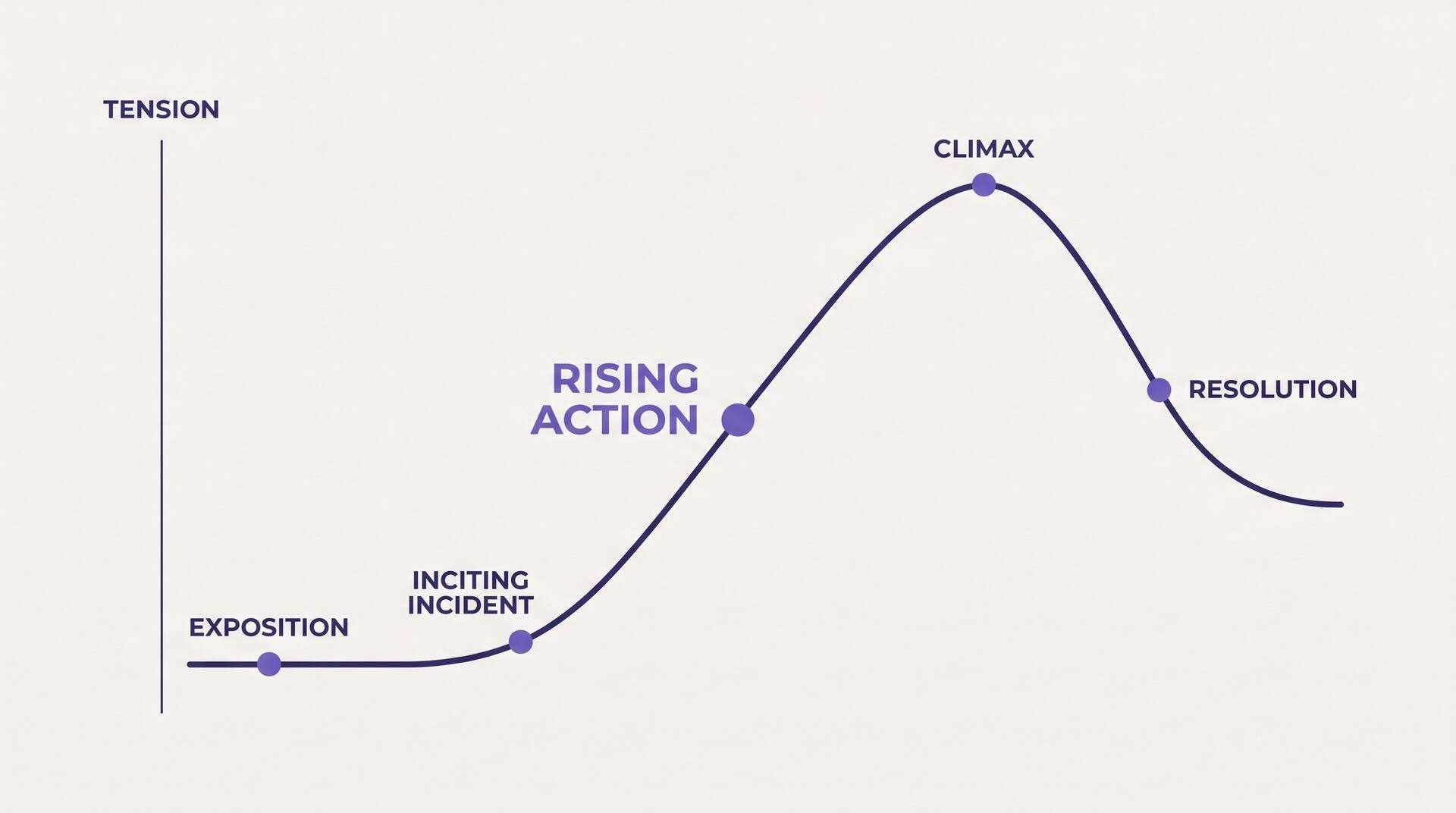
On the standard arc, exposition sets the world, the inciting incident breaks it, rising action carries the weight from there to the peak, and falling action cleans up after. In page count that is not an even split. Exposition and inciting incident together usually take the first tenth of a novel. The climax and everything after it take the last tenth. Rising action gets the other eighty percent.
That proportion is why the term matters more than most craft vocabulary. When readers say a book dragged, they almost never mean the opening was slow or the ending was weak. They mean that the enormous middle stopped rising. If you want the full map of how these stages fit together, the walkthrough of the plot diagram covers each stage in turn, and the guide to three-act structure shows the same territory divided by act instead of by curve.
One clarification that saves a lot of confusion: rising action is not a synonym for conflict. A character can fight on every page and the action can still be flat, because fighting repeatedly is not the same as fighting for higher stakes. Escalation is a change in what a loss would cost, not a change in volume.
Five engines that actually raise the action
Escalation is not a mood you write into a scene. It is one of five variables moving in one direction. Most strong novels run two or three of them at once and hand the reader a different one each time the pressure needs to go up.
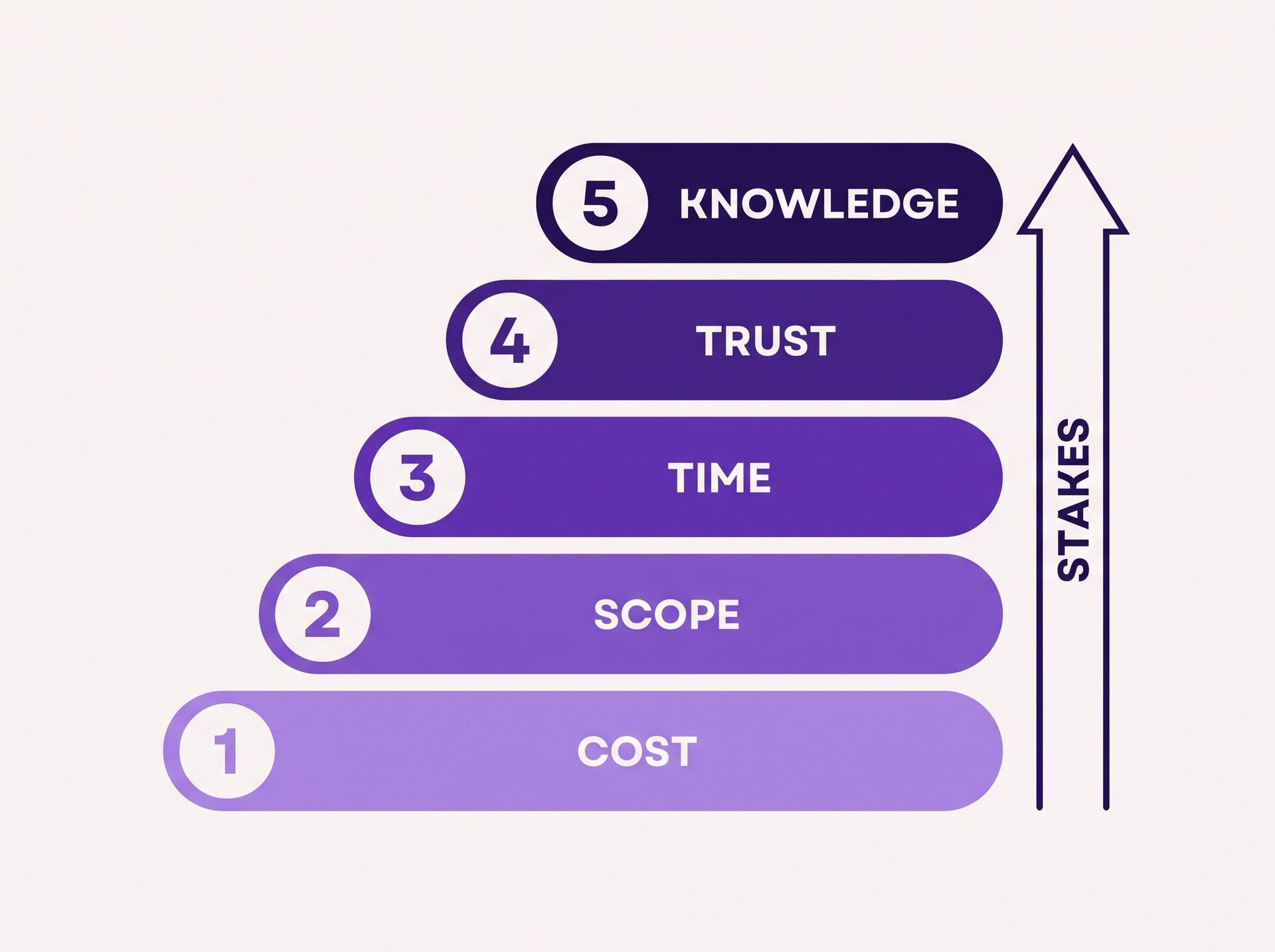
1. Cost — every attempt takes something the character cannot get back
The cheapest escalation is the one where a character tries something and simply fails. The real one is where the attempt succeeds and bills them for it. Once the price is paid it stays paid, so the next attempt starts from a weaker position.
The Hunger Games runs on this. Katniss survives the bloodbath, the fire, the tracker jackers and the alliance, and each survival costs a specific, unreturnable thing: her hidden position, her burnt leg, her hearing in one ear, and finally Rue. By the time she reaches the last night in the arena she is not the same competitor who climbed onto the plate, and the book never once lets her recover a loss.
2. Scope — the problem stops staying where you put it
A contained problem is a small problem. Escalation by scope means the trouble keeps outgrowing whatever boundary the characters draw around it.
Jurassic Park is a clean demonstration. It begins with one bad fence and a single missing animal, then the failure spreads outward in disciplined stages: one paddock, then the vehicle system, then the power grid, then the whole island, then the boat that could carry the animals to the mainland. Crichton never invents a new disaster. He keeps widening the one he started with.
3. Time — the window for a solution keeps shrinking
A deadline converts a vague difficulty into arithmetic the reader can do. It also lets you escalate without adding a single new event, because the same problem gets worse simply by aging.
The Silence of the Lambs uses a clock the reader can count on their fingers. Catherine Martin is alive in a pit, and Buffalo Bill's previous victims tell Clarice roughly how many days that lasts. Every interview with Lecter, every wrong turn in the investigation, is expensive because of a woman the detectives cannot see.
4. Trust — the protagonist's support base thins out
Removing allies is the most under-used escalation available, and it costs nothing to set up. Each person who stops believing the protagonist makes the next obstacle harder without changing the obstacle at all.
Gone Girl escalates almost entirely on this axis in its first half. Nick Dunne's problem barely changes — his wife is missing and he looks guilty — but his sister, the detectives, the neighbours and eventually the national audience peel away from him one at a time until the same accusation is unsurvivable.
5. Knowledge — each revelation narrows the possible futures
Information can escalate as hard as violence when every new fact removes an option the character was quietly relying on. This is the engine that works in quiet books, where nobody is chasing anyone.
Never Let Me Go is built from it. Kathy, Tommy and Ruth learn what Hailsham is, then what the donations are, then what the gallery was for, then what a deferral is worth. No event in the novel is loud. Every one of them shuts a door, and by the end there are none left to try.
Be a sadist. No matter how sweet and innocent your leading characters, make awful things happen to them — in order that the reader may see what they are made of.
The second clause is the part writers skip. Escalation is a revelation device, not a punishment. If a complication tells the reader nothing new about the character, it is filler with a raised voice.
Your middle sags — here is the actual cause
Nearly every sagging middle has the same underlying fault, and it is not pacing, word count or a lack of subplots. It is that the scenes are reversible. Something happens, the characters react, and afterwards the story could still go anywhere it could have gone before. Nothing has been spent, closed or ruled out.
You can find the exact place it starts in about twenty minutes, with no rewriting. List every scene in your middle in one line each. Next to each one, write the answer to a single question:
What is now impossible that was possible before this scene?
Answer honestly and in concrete terms. "She is more worried" is not an answer. "She can no longer go back to the apartment" and "the only person who could identify the body is dead" are answers. Then look at the column.
Reading the column
- Three or more consecutive blanks: that is your sag, precisely located. The scenes may be well written; they are not load-bearing.
- Answers that repeat with different nouns — she loses a friend, then another friend, then a third — mean you are running one engine into the ground. Switch engines from the list above.
- Answers that all concern the antagonist and none the protagonist mean the plot is escalating and the character is not. Readers feel that as noise.
The fix is almost always cheaper than the diagnosis suggests. Take the flat scenes and make one thing irreversible in each: destroy the object, spend the money, say the sentence that cannot be unsaid, let the deadline pass. You rarely need a new subplot. You need the scenes you already wrote to cost something.
If the flat stretch is where you planned a big reversal and it never landed, it is usually worth generating a few alternatives before committing to one. The free plot twist generator is useful here for exactly that: feed it your setup and read the options you did not think of, then throw most of them away.
An escalation beat map by percentage of book
These are not rules, and no novel hits them exactly. They are a check: if you are at the sixty percent mark and none of the changes below have happened yet, you know why the middle feels slow. Percentages refer to total word count, not chapter numbers.
| Position | Beat | What must change |
|---|---|---|
| 10–15% | Commitment | The protagonist chooses the story, and the ordinary life is no longer available to go back to. |
| 20–30% | First real price | A resource they were counting on is gone — money, an ally, a reputation, a safe place. |
| 30–40% | The plan fails on its own terms | The obvious method is off the table for good, not just postponed. |
| 45–55% | Midpoint reversal | New information reframes the goal; what they are fighting for is not what they thought. |
| 55–70% | Opposition moves first | The antagonist stops reacting and starts acting, and the protagonist is now behind. |
| 70–80% | The support goes | An ally leaves, betrays, or dies, and the protagonist faces the rest alone. |
| 80–88% | Lowest point | The last fallback is gone; the only remaining option is the one they refused in act one. |
| 88–92% | Entry to climax | Nothing is left to lose, so the confrontation becomes unavoidable rather than chosen. |
The 45–55% row is the one most drafts miss. A midpoint that only raises tension leaves you with forty percent of the book running on the same fuel as the first half — which is the single most common cause of a slow second act.
Four ways rising action goes wrong
Flat repetition
Three chases, three arguments, three narrow escapes, all pitched at the same intensity. The reader's attention does not measure how many obstacles appeared; it measures whether the last one was harder than the one before. Sequences at equal weight read as one long scene, however different the settings are.
False escalation
The events get louder while the stakes stay flat. A bigger explosion, a larger army, a higher body count among characters we have never met. If the protagonist risks the same thing in chapter twenty as in chapter eight, nothing escalated — the production budget went up.
Escalating the plot but not the person
The external situation deteriorates on schedule while the protagonist's beliefs, relationships and self-image sit exactly where they started. This is the version that most often produces a technically correct outline and a lifeless draft. Every hard beat should force a decision that reveals or changes something internal.
Rescuing the character too early
A convenient arrival, a forgotten skill or a lucky coincidence relieves the pressure a chapter before the climax should. This is the failure mode covered in the piece on deus ex machina endings — the mechanics are the same whether the rescue lands at the end or in the middle.
Planning escalation before you draft it
Diagnosing a flat middle after eighty thousand words is expensive. Catching it in the outline costs an afternoon. The practical method is the same one used above, applied in advance: for every planned chapter, write down what becomes impossible in it, then read the column top to bottom and check that the answers get heavier.
That is the shape our outline builder produces. It generates a chapter-by-chapter outline where each chapter carries its own events, locations, plot points and twists, and you can edit any of them or regenerate a single chapter without disturbing the rest. Because the whole outline is visible as one document, the flat stretch is obvious before it is written — three chapters in a row where the plot points restate each other are hard to miss on one screen.
If you are starting from a blank page rather than a manuscript, the free outline generator does the first pass without an account, and the chapter-count guide is worth a look while you decide how to divide the escalation up.
The short version
Rising action is not the part of the book where things happen. It is the part where things stop being possible. Every scene in the middle should remove an option, spend a resource, shorten a clock, cost an ally, or tell the reader something that cannot be untold. If you can point at what each scene closed, the middle rises. If you cannot, no amount of incident will save it.
Structure is one piece of a larger job — drafting, revising, formatting and publishing all follow. Our complete guide to writing a book covers the rest of that path from first idea to finished manuscript.