


A profitable niche isn't the one with the most readers or the least competition — it's the one where demand clearly outweighs the quality of what's already ranking. Big niches are crowded; tiny niches starve. The money lives in the gap: proven buyers, weak incumbents.
On this page
Why niche beats genre
"Romance" is a genre. "Small-town grumpy-sunshine holiday romance" is a niche. The genre is unwinnable for a new author — you're up against thousands of established names. The niche is a specific reader with a specific craving and far fewer books competing for it. Amazon's whole discovery engine — categories, keywords, also-boughts — rewards specificity, because a reader searching a narrow term is a reader ready to buy. The tighter and more real the niche, the easier it is to rank, and the more loyal the readers who find you.
The 7-step research method
Run every niche candidate through these seven steps in order. The early steps kill bad ideas cheaply; the later ones confirm the survivors.
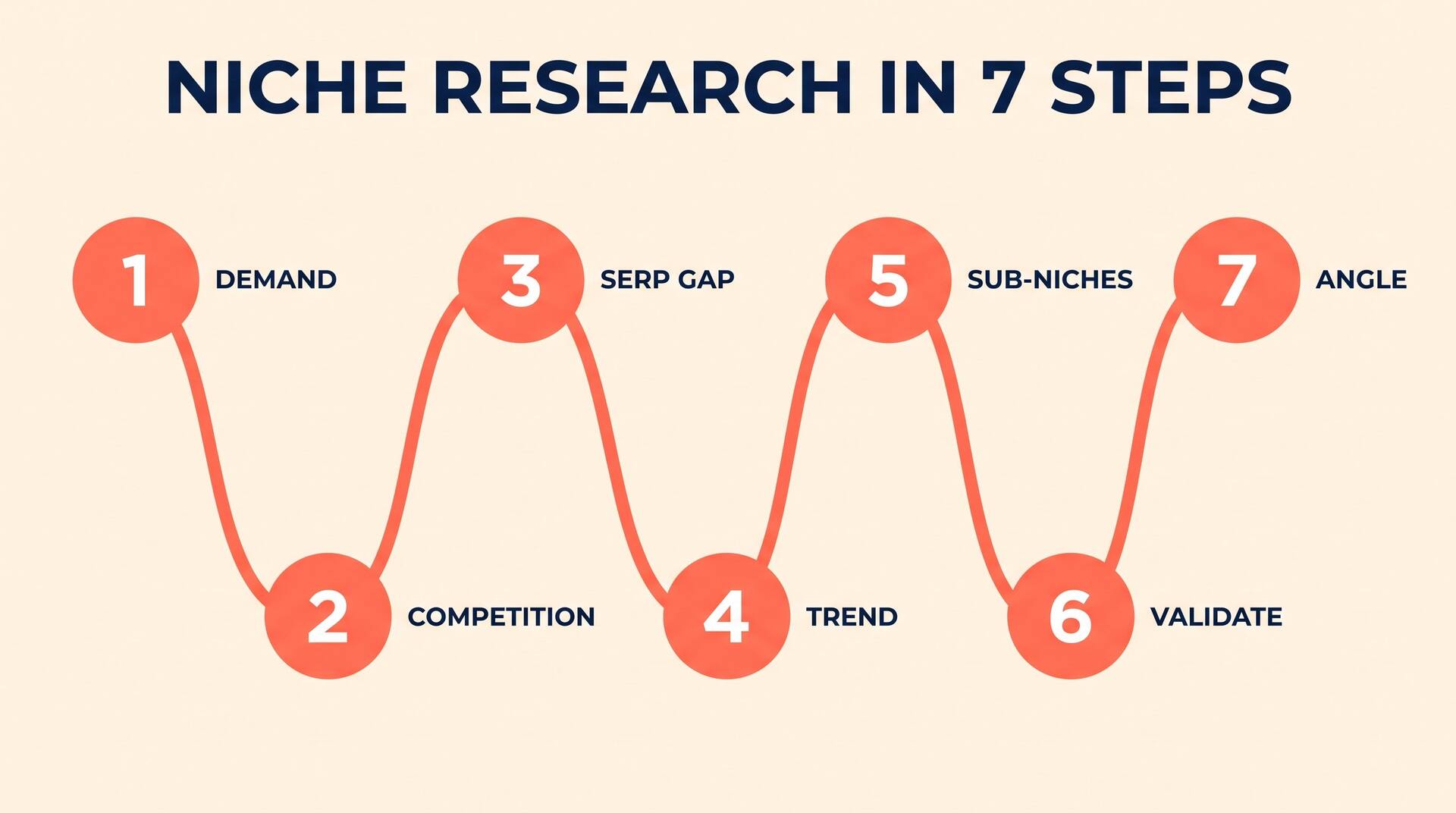
Read the demand signals
Before anything else, prove people buy here. Look for best-seller ranks that indicate steady sales, healthy review counts on top titles, and active also-bought chains. A niche where even the top books have sparse reviews and weak ranks is telling you the demand isn't there — walk away early.
Score the competition
Now weigh the difficulty. Open the top results for your niche and judge them honestly: are the covers professional, the descriptions sharp, the review counts in the hundreds? Strong incumbents mean a hard climb. If the top of the niche is full of amateur covers and thin blurbs, that weakness is your opening.
Run a SERP gap analysis
Compare what readers search against what actually ranks. Search your niche's key phrases and ask: does a book precisely match this query, or are readers settling for near-misses? A search term with real volume and no book that nails it is the clearest profit signal on KDP — an unmet, expressed demand.
Check the trend lifecycle
Distinguish a rising niche from a peaking fad. A niche climbing steadily has room; one that spiked on a trend is about to be flooded by everyone who saw the same video. You want to enter on the way up, not at the top. Evergreen niches beat viral ones for anything you want earning in two years.
Stack sub-niches
Narrow until it's winnable, then confirm it's not too narrow. "Journals" is hopeless; "gratitude journals for new dads" is specific enough to rank and still has buyers. Layer attributes — audience, occasion, style, format — until the competition thins but the demand survives. That layered intersection is where new authors actually win.
Validate before you commit
Sanity-check with a second data source before writing a word. Cross-reference keyword demand, category best-seller thresholds, and how fast the top books are selling. You're confirming the niche clears a minimum bar of buyers and that a well-made book could realistically reach the top of its subcategory.
Pick your angle
Finally, decide how your book will be visibly different and better than the weak incumbents you found in step two. A sharper hook, a better-fitted cover, a more useful structure. The niche gets you found; the angle gets you bought. Without a clear angle, you're just another book in the pile you were trying to beat.
Score a niche yourself
Rate a niche you're considering on the four factors that decide profitability. The score gives you a fast read on whether it's worth pursuing.
Demand — do the top books show steady sales and reviews?
Competition weakness — are the incumbents beatable?
Search gap — is there an unmet, searched-for need?
Longevity — will it still sell in two years?
Examples of winning niches
These aren't hot tips to copy — copying named niches is how they get saturated. They're patterns that illustrate what "specific demand, beatable competition" looks like in practice.
Occasion-specific low-content
Journals and planners tied to a life event — a new job, a recovery, a specific hobby milestone. The occasion supplies the demand and the gift intent, and most incumbents are generic.
Under-served sub-genres
A tightly defined fiction niche — a trope-plus-setting combination readers search for but few books nail. Loyal, repeat-buying readers who devour a whole series once they find it.
Practical micro-expertise
Non-fiction on a narrow, real problem — a specific skill for a specific audience that the big general books gloss over. Buyers with a clear need and a general market that isn't serving them.
Format-shifted niches
Taking a proven need and delivering it in a format the top results ignore — a workbook where everyone else wrote prose, or a large-print edition of a popular category with thin large-print supply.
The tools that speed it up
You can do all seven steps by hand, but the research collapses from hours to minutes with the right tools. Our free niche finder surfaces specific, winnable niche ideas to run through the method, the trend spotter shows you whether a niche is rising or peaking so you don't buy in at the top, and the competition analyzer scores how beatable the current top books really are. When you've settled on a niche, the KDP keyword research tool turns it into the exact search terms and categories your listing needs.
From niche to finished book, fast
Finding a profitable niche is only worth it if you can fill it before the window closes. That's the real edge of writing with AIWriteBook: once your research points to a winnable niche, you go from validated idea to a chapter-by-chapter outline and full draft in a fraction of the usual time, generate a fitted cover, and export a KDP-ready file. Speed is a competitive advantage in niche publishing — the author who ships into an opening first sets the also-boughts everyone else has to fight. Do the research, then publish faster than the crowd that's still outlining.
Found a niche? Fill it before the crowd does
Turn a validated niche into an outline, a full draft, and a cover fast — then export a KDP-ready file and get there first.
Frequently asked questions
The bottom line on niche research
Profitable KDP niches aren't secrets someone hands you — they're the reward for looking where others don't. The authors who win aren't writing in bigger genres; they're finding the specific corner where readers are searching and the existing books are weak, then getting there first with something genuinely better.
Run your ideas through the seven steps, score them honestly, and be willing to walk away from niches that don't clear the bar. The discipline of saying no to weak niches is what makes the yes profitable.