

On this page
The 35% vs 70% rule
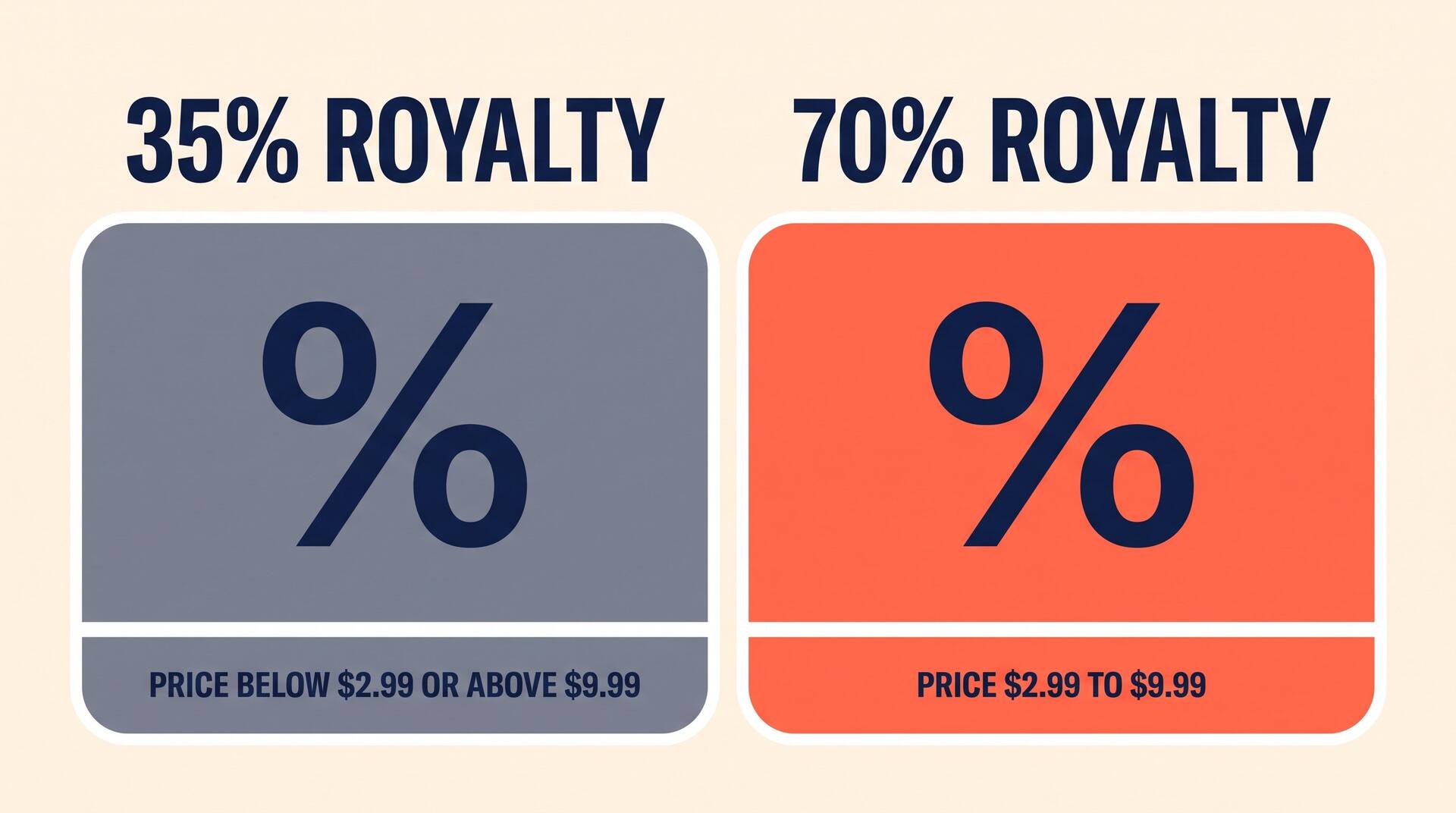
Every Kindle ebook pays one of two royalty rates, and you choose the rate yourself on the KDP pricing page. The 70% option comes with conditions: your list price must sit between $2.99 and $9.99 on Amazon.com, the book can't be public-domain content, and the sale has to happen in one of Amazon's eligible territories. Miss any of those and the sale pays 35% instead. The 35% option has almost no conditions — it accepts list prices from $0.99 up to $200 (with minimums that rise for files over 3 MB) and never charges a delivery fee.
The percentages hide an asymmetry worth staring at. 70% of $2.99 is about $2.09 before fees; 35% of $2.99 is $1.05. At the same price, the higher tier pays literally double. That's why nearly every self-published ebook lives inside the $2.99–$9.99 band — it's the only range where the doubled rate exists. Put differently: a $5.99 book at 35% earns roughly what a $2.99 book earns at 70%, so choosing the wrong tier means charging readers twice as much for identical income.
Decision rules
- 1Priced $2.99–$9.99, original content, mostly text? Take 70%. This covers the overwhelming majority of novels and nonfiction.
- 2Running a $0.99 launch promo or pricing above $9.99? Amazon forces 35% — treat it as a temporary or deliberate state, never a default.
- 3Selling mainly in Japan, India, Brazil, or Mexico? In those stores the 70% rate is only available to books enrolled in KDP Select.
- 4Publishing an image-heavy book — children's, coloring, photography? Do the delivery-fee math below before assuming 70% wins.
Delivery fees: the 70% tier's hidden tax
The 70% tier charges a delivery fee on every sale; the 35% tier never does. On Amazon.com the fee is about $0.15 per megabyte of your converted file, and it comes off the list price before your 70% is calculated. For a text-only novel this is trivia — a converted manuscript usually weighs well under a megabyte, so the fee is a few cents. For anything built from images, it becomes real money.
Worked example: a 2 MB ebook at $4.99
Delivery fee: 2 MB × $0.15 = $0.30
70% tier: 0.70 × ($4.99 − $0.30) = $3.28 per sale
35% tier: 0.35 × $4.99 = $1.75 per sale, no fee
The 70% tier wins by $1.53 — the normal case for text books.
Now run the same price on a 20 MB illustrated children's book. The delivery fee jumps to $3.00, so the 70% tier pays 0.70 × ($4.99 − $3.00) = $1.39 — while the fee-free 35% tier pays $1.75. The "lower" rate earns 26% more per copy. This is the single most common royalty surprise on KDP, and it's why the tier choice is a calculation, not a default. Amazon shows the delivered file size on your KDP bookshelf after conversion; use that number, not the size of the file you uploaded.
If you'd rather not do this by hand, plug your list price, file size, and marketplace into our free KDP royalty calculator — it runs both tiers side by side and shows exactly where they cross for your book.
Paperback royalty math, step by step
Print royalties run on one formula: 60% of list price, minus the cost of printing your specific book. There's no 35/70 choice and no delivery fee — the print cost plays that role instead. On the US marketplace, a standard black-ink paperback costs $0.85 fixed plus $0.012 per page to print. Here's a 300-page novel listed at $12.99:
1. Printing cost
$0.85 + (300 pages × $0.012) = $4.45
2. 60% of list price
0.60 × $12.99 = $7.79
3. Royalty per copy
$7.79 − $4.45 = $3.34
Notice that page count is a profit lever. The same novel formatted 40 pages tighter earns an extra $0.48 on every single copy — real money across a launch. Interior layout decides that count, and AIWriteBook applies it for you: every export sets the trim size, margins, justification, and hyphenation automatically, so you get a clean, KDP-ready interior without paying a formatter. Our KDP formatting guide walks through the choices that move the number.
Two caveats. KDP enforces a minimum list price — the point where 60% of list exactly covers printing — so loss-leader print pricing isn't possible. And if you opt into Expanded Distribution, where bookstores and libraries order through wholesale, the rate on those channels drops from 60% to 40%; on our example book that leaves roughly $0.75 per copy.
Hardcover: same formula, heavier print bill
Hardcover math is the paperback formula with a bigger fixed cost: 60% of list minus a US black-ink printing cost of $5.65 plus $0.012 per page. Our 300-page example costs $9.25 to print in hardcover, so at $24.99 it returns 0.60 × $24.99 − $9.25 = $5.74 per copy. That $5.65 base is why hardcovers only work at premium prices — this example needs a list price near $21 just to match the paperback's $3.34 — and why the format suits gift books and authority-building nonfiction far better than $12.99 genre fiction. One more limit: hardcovers aren't eligible for Expanded Distribution.
Know your numbers? Now finish the book
AIWriteBook takes you from outline to full draft to a KDP-ready export — priced right from day one.
Marketplace differences
The 70% band is not $2.99–$9.99 everywhere. Each marketplace sets its own price floors and ceilings, its own delivery fee, and in a few cases extra conditions. These are the long-established figures for the biggest stores — Amazon adjusts them occasionally, so confirm against your KDP pricing page before you hit publish.
| Marketplace | 70% price band | Delivery fee | Note |
|---|---|---|---|
| Amazon.com | $2.99 – $9.99 | $0.15 / MB | — |
| Amazon.co.uk | £1.99 – £9.99 | £0.10 / MB | Prices include VAT |
| Amazon.de / .fr / .es / .it | €2.99 – €9.99 | €0.12 / MB | Prices include VAT |
| Amazon.ca | CAD $2.99 – $9.99 | CAD $0.15 / MB | — |
| Amazon.com.au | AUD $3.99 – $11.99 | AUD $0.15 / MB | — |
| Amazon.co.jp | ¥250 – ¥1,250 | ¥1 / MB | 70% requires KDP Select |
Two practical takeaways. First, set each marketplace price manually instead of letting Amazon auto-convert from your US price: a $9.99 US book converts to roughly AUD $15, which lands above Australia's $11.99 ceiling — and every Australian sale quietly pays 35%. Second, in Japan, India, Brazil, and Mexico the 70% rate is reserved for books enrolled in KDP Select, so wide-distribution authors earn 35% in those stores at any price.
Kindle Unlimited page-read math
Enroll in KDP Select and your ebook also earns from Kindle Unlimited: subscribers read for free, and Amazon pays you per page read out of a monthly pot called the KDP Select Global Fund. The per-page rate — the KENP rate — is announced after each month closes and genuinely moves around; in recent years it has hovered roughly between $0.004 and $0.005 per page in the US store. Treat that as a planning range, not a promise.
Amazon counts pages with its own normalized measure, KENPC, which usually runs higher than your print page count. A novel with a 350-page KENPC read cover to cover earns roughly $1.40–$1.75 — call it 70–85% of what a $2.99 sale nets at the 70% rate. And page-read income compounds with length and with series: a reader who finishes book one and binges the next two triples the payout without a single additional "sale" appearing in your reports.
Whether the exclusivity is worth it is its own decision — Select locks your ebook to Amazon for 90 days at a stretch. We work through the full trade-off, including the going-wide opportunity cost, in our KDP Select pros and cons guide.
Pricing for maximum profit
Put the tiers, the fee, and the bands together and a pricing map appears. Here's the per-sale royalty for a typical 1 MB text ebook across common price points:
| List price | Tier | Royalty per sale |
|---|---|---|
| $0.99 | 35% | $0.35 |
| $2.99 | 70% | $1.99 |
| $4.99 | 70% | $3.39 |
| $6.99 | 70% | $4.79 |
| $9.99 | 70% | $6.89 |
| $12.99 | 35% | $4.55 |
| $19.99 | 35% | $7.00 |
The $10–$19 dead zone
Because crossing $9.99 drops you to 35%, a $12.99 ebook earns $2.34 less per copy than a $9.99 one. You'd need a list price around $19.70 at 35% just to match $9.99 at 70%. Practically: no ebook should be priced between $10 and $19 — stay at $9.99 or commit to $19.99 and up.
Break-even thinking helps you pick within the band. A $2.99 book must sell about 3.5 copies to earn what one $9.99 sale pays, so cheap pricing is a volume bet — it makes sense for the first book of a series or a genre where price is a browsing filter. Genre fiction typically settles at $2.99–$5.99; specialist nonfiction sustains $7.99–$9.99 because buyers pay for the answer, not the page count. And $0.99 is a promotion, not a price: 35 cents a copy is fine for a week of chart-climbing and corrosive as a permanent state.
Once you have actual sales data, compare what each title and format earns rather than relying only on per-copy estimates. Use Julius for AI data analysis to upload your sales and royalty spreadsheets, ask questions in plain English, and chart changes over time, for example: "Compare monthly royalties by title and show which formats account for the change."
The honest last word on maximizing profit: past a sensible price, the bigger lever is catalog size, not squeezing extra cents from one title. Per-copy differences are dwarfed by having three books instead of one — we run that full income math in our guide to actually making money on Amazon. And if drafting speed is what stands between you and the next book, AIWriteBook's chapter generator turns an outline into full draft chapters you then edit into your own voice.
The bottom line
KDP royalties reward authors who do twenty minutes of arithmetic. Choose 70% inside the $2.99–$9.99 band unless a heavy file or a forced condition says otherwise, subtract the real print cost before setting paper prices, set marketplace prices manually, and stay out of the $10–$19 dead zone.
None of this math is hard — it's just invisible until a royalty report surprises you. Run the numbers before you set the price, and the report becomes exactly what you predicted. Once royalties start landing, they behave like income with no fixed payday, which is a planning problem rather than a publishing one: Enrichest covers the personal-finance side of irregular earnings if budgeting around them is new to you.