

Yes — creating a KDP account and publishing an ebook, paperback, or hardcover costs $0 upfront. Amazon makes money by taking a cut of each sale, not by charging you to list. The costs that trip people up are optional and sit around the platform: a cover, editing, an ISBN if you want your own, and any advertising. You control every one of them.
On this page
What's genuinely free vs what costs money
The clearest way to answer "is Amazon KDP free" is to split the free platform mechanics from the optional quality spend around them.
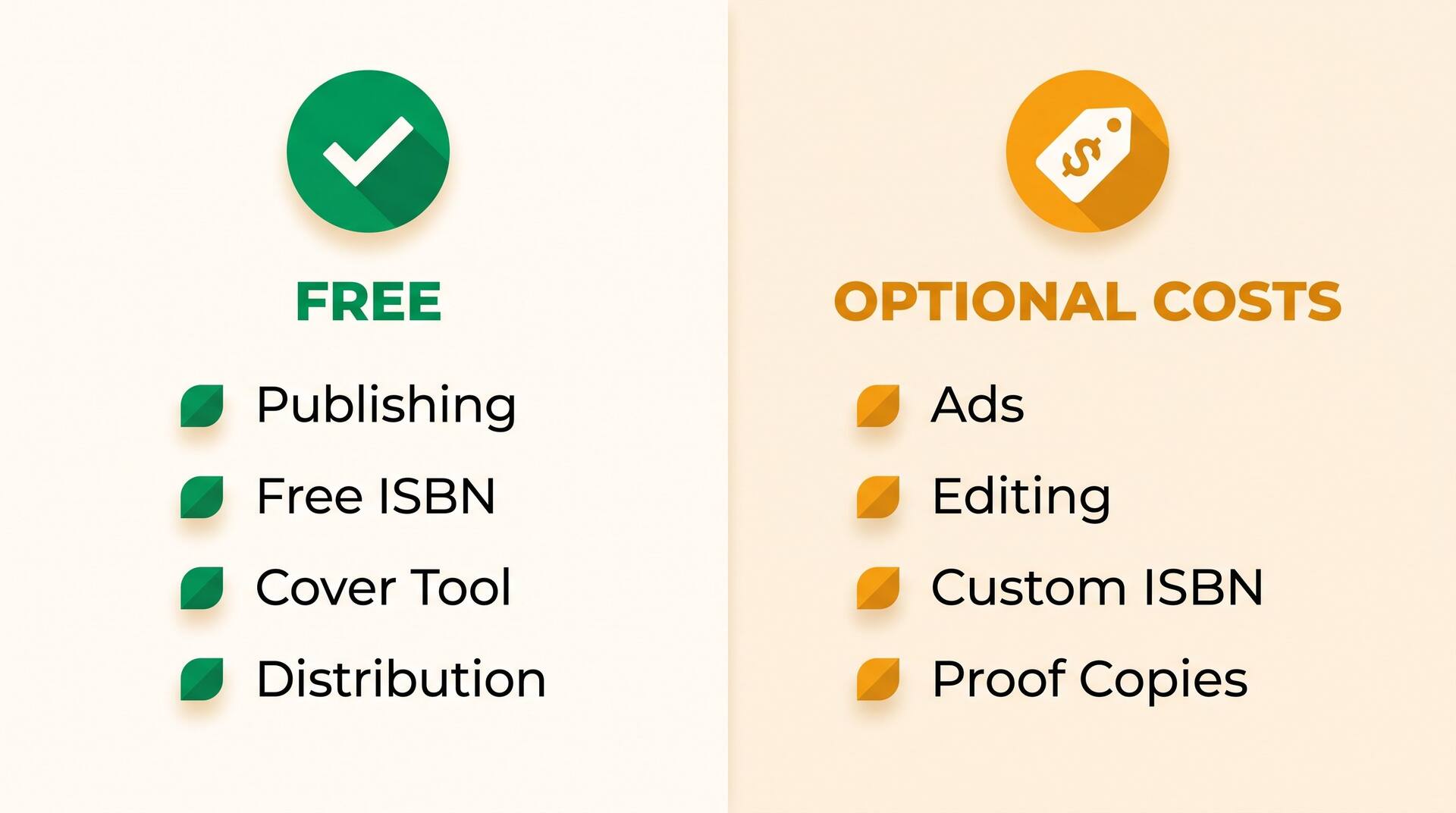
Free on KDP
- Creating and verifying your KDP account
- Publishing an ebook, paperback, or hardcover
- A free KDP-assigned ISBN for every print book
- Listing in every Amazon marketplace you select
- Unlimited edits, re-uploads, and price changes
- Basic cover creation with KDP's Cover Creator
Costs money (optional)
- Professional cover design, if you don't DIY it
- Editing and proofreading
- Your own branded ISBN, if you want one
- Formatting software or a formatting service
- Amazon Ads or other paid promotion
- Author copies (printed at cost plus shipping)
The ISBN reality check
This is where people assume a hidden fee that usually doesn't exist. KDP gives every print book a free ISBN automatically, and ebooks don't need one at all — they use Amazon's own ASIN. You only pay for an ISBN if you want your own, tied to your publishing imprint instead of "Independently published." For a first book, the free one is completely fine. If you're building a serious imprint and want the same ISBN to follow your book across retailers, buying your own is the reason to spend — otherwise, skip it.
Want the full picture on identifiers, imprints, and when to buy your own block? Our guide to getting an ISBN for a self-published book covers every path and cost.
Build your budget by tier
There is no single "cost of publishing on KDP" — it depends entirely on how much you outsource. Pick the tier that matches how you want to work.
The smart-minimum path
Roughly a modest one-time spend
You invest where it moves sales and DIY the rest. The two things worth paying for first are a cover that competes in your genre and a proofread that kills the typos reviewers punish. Keep the free ISBN and handle your own formatting with a proper tool. This is where most serious first-timers should land.
Cost line items, itemized
Here's how each optional cost actually behaves — what drives it up, and where you can safely spend less.
The single highest-leverage spend. A cover decides the click. Premium pre-made covers are cheap; fully custom art costs more. Skimp everywhere else before you skimp here.
Scales with depth. A proofread is the affordable floor; a full developmental edit is the expensive ceiling. At minimum, never publish without one careful proofreading pass.
Free from KDP for print. Only a cost if you buy your own — a one-time purchase, cheaper per unit in a block.
Free if you do it yourself with a template or an export tool. A one-time software purchase or a per-book service if you'd rather not.
The only ongoing cost. Fully optional, fully controllable — set a daily cap and stop any time. Treat it as fuel, not a fee.
How much for ads
Amazon Ads are the one recurring cost, and they're entirely optional — plenty of books sell on keywords and series pull alone. If you do run them, you set a daily budget and can pause instantly, so there's no way to overspend by accident. Start small, treat the first weeks as paid research to find which keywords convert, and only scale the ones that earn back more than they cost. Ads are an amplifier for a book that already converts — they won't rescue a weak cover or description, so fix those first.
New to it? Our beginner's guide to Amazon Ads for books walks through your first campaign without wasting money.
If you want the honest smallest spend that still produces a book capable of competing, it's this: pay for a cover that fits your genre, pay for one proofreading pass, and keep everything else free — the KDP ISBN, your own formatting, and no ads until the listing converts. That combination gets you a book that looks and reads professionally for a modest one-time cost. Everything above that is optimization; everything below it is where "free" starts costing you sales instead of dollars.
Where AI cuts the cost
The biggest hidden cost of a KDP book isn't a line item — it's the money and months spent getting from idea to finished, formatted manuscript. That's exactly where AIWriteBook compresses the budget. Instead of paying a ghostwriter or stalling for months, you turn an idea into a chapter-by-chapter outline and a full draft, generate a cover, and export a clean KDP-ready file — so the two most expensive parts of the traditional path, drafting and formatting, largely fold into the tool. You still edit it into your voice, but the upfront cost of simply having a book to publish drops sharply.
The cheapest way to a KDP book is to not stall on the writing
Start a draft free, get an outline, chapters, and a cover, and export a file ready to upload — the part that usually costs the most time and money.
Frequently asked questions
The bottom line on KDP costs
So, is Amazon KDP free? To join and publish, absolutely — there's no upfront fee and no gate. What isn't free is making a book that competes: the cover, the edit, and the discoverability work that Amazon leaves entirely to you. The good news is that every one of those costs is optional and under your control, and the smart minimum is genuinely modest.
Budget for the two things that move sales — a real cover and a clean proofread — keep the rest free, and you've published professionally for less than the price of a nice dinner. Spend nothing and you can still publish; you just trade dollars for a lower ceiling.
For everything else about publishing profitably on the platform, see our complete Amazon KDP guide.