


Memoir is one of the most read—and most attempted—genres in nonfiction. It is also one of the easiest to do badly, because writers tend to confuse 'I lived it' with 'it makes a book.' Living something gives you raw material; writing a memoir means selecting, shaping, and telling that material as a story. The good news: the craft of memoir is teachable, and the most powerful memoirs are written by ordinary people willing to be honest on the page.
The Promise of a Memoir
A memoir promises the reader two things: a true story you actually lived, and a meaning that justifies the telling. If a memoir delivers only the first, it reads as a journal. If only the second, it reads as a TED talk. The art is delivering both at once.
Memoir vs. Autobiography vs. Personal Essay
Most aspiring memoirists are actually trying to write one of three different forms. Pick yours before you draft.
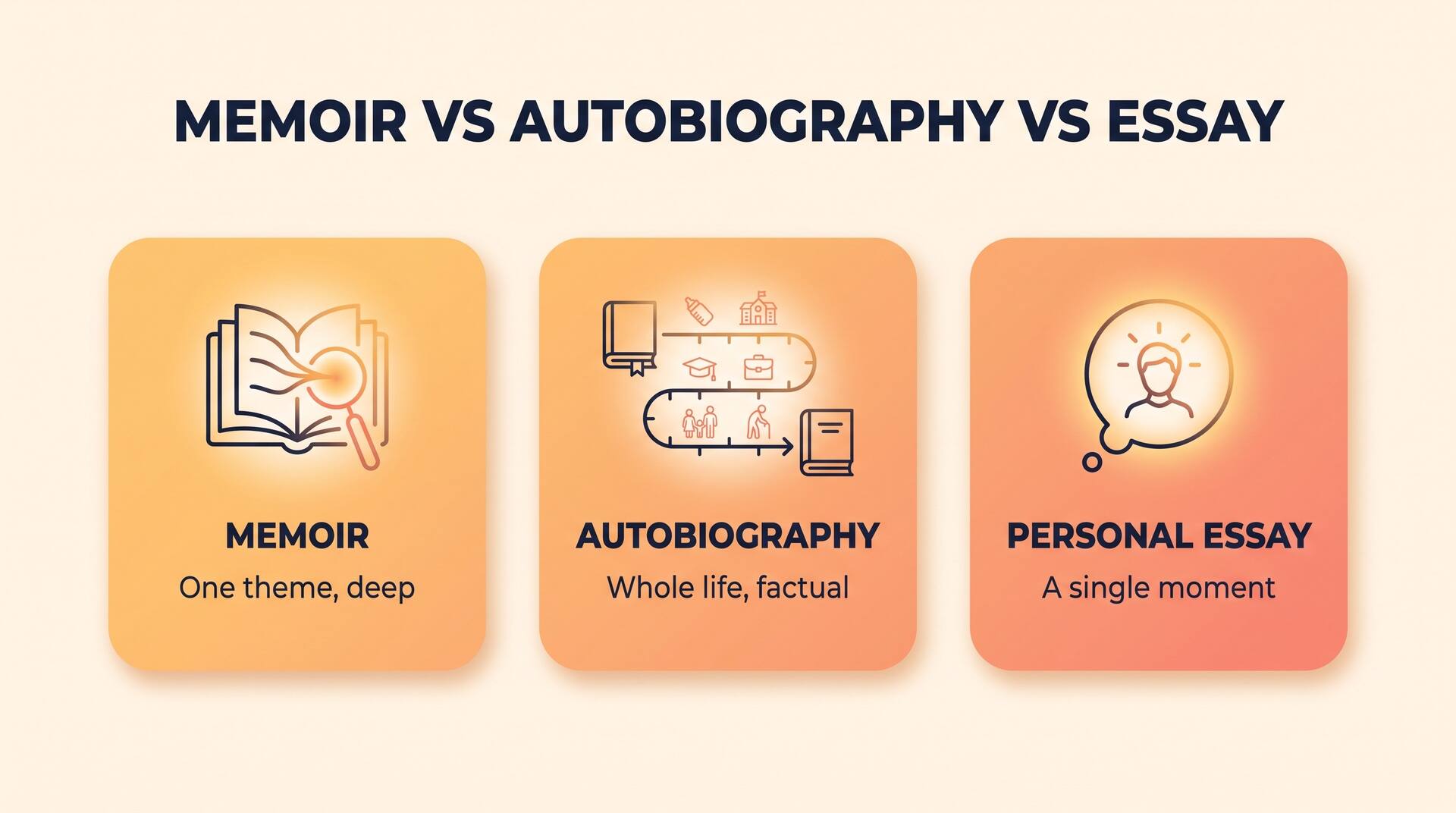
A single thematic slice of a life, shaped into narrative.
One angle, one question, one span of time.
Educated by Tara Westover (an upbringing without formal schooling), Wild by Cheryl Strayed (a hike that became a recovery).
If you're a first-time author and not already famous, write a memoir. The market for autobiographies of unknown authors is small. The market for sharply focused, well-told memoirs is enormous.
Finding Your Angle
The single hardest decision in memoir is what your book is about—not what happened, but what it means. The angle is the lens that turns events into story.
List Five Defining Experiences
Write five experiences from your life that still occupy mental space—events you replay, regret, miss, or are still trying to understand. These are your candidates.
Find the Question Underneath Each
For each experience, ask: what was I really trying to figure out? Was it about belonging? Power? Forgiveness? Identity? The question matters more than the events.
Identify the Reader's Curiosity
Which of those questions is also a question other people are asking? A memoir works when your specific story is a doorway into something universal. 'How do you leave the religion you were raised in?' connects far more readers than 'I had a strange childhood.'
Define the Time Frame
Most strong memoirs cover a defined period—a year, a relationship, a job, a journey. Resist the urge to span 30 years. The smaller the time frame, the deeper you can go.
Write the One-Sentence Pitch
When you can finish this sentence, you have an angle: 'This is the story of [the time], when [what happened], and what it taught me about [the universal question].'
Coaching and athletic memoirs are the clearest example of a time frame doing the work for you: a season already has a beginning, a middle, and an ending, and the coach usually has the whole shape sitting in a sports schedule app years before they think of it as a book.
Memoir Structure Options
Memoir is not bound by chronology. The shape you choose determines how the story lands. Click each option to explore it.
Linear
Tell events in the order they happened. Easiest to draft, most familiar to readers. Works when the narrative momentum of your story is naturally strong—a journey, a crime, a campaign.
Travel memoirs, illness narratives, single-event memoirs.
Truth, Memory, and the Honest Memoirist
Readers buy memoir believing they're reading a true account. Memoirists know memory is unreliable. Living in that gap honestly is one of the genre's central crafts.
Tell the Truth as You Remember It
Memoir is the truth as it lives in your memory, not a forensic transcript. You can—and should—use scene, dialogue, and sensory detail. What you cannot do is invent events that didn't happen, change outcomes, or fabricate quotes from real people that contradict who they actually are.
Reconstruct Dialogue Honestly
No one remembers conversations word for word. The memoirist's standard: write dialogue that captures what was said and what it meant, in the speaker's voice, even if the exact words are reconstructed. Most readers understand this contract; you can also acknowledge it briefly in an author's note.
Compress and Combine—Carefully
It is acceptable, with disclosure, to compress events (three similar weekends into one), combine minor characters (two coworkers into one), or change names to protect privacy. It is not acceptable to invent major events, change who did what, or create composite characters who alter the facts of the story.
Acknowledge the Limits of Memory
When memory fails or contradicts other accounts, say so on the page. 'This is how I remember it. My sister recalls it differently.' This honesty makes the rest of the memoir more trustworthy, not less.
Decide Where You Stand on Your Own Story
A memoir is not just about what happened—it's about what you make of what happened. Reflection, hindsight, and the wiser narrator's voice are the memoirist's superpower. Don't pretend you didn't learn anything; that's why anyone should read your story.
Using AI to Write Your Memoir
AI is unusually well-suited to memoir drafting because it removes the two biggest blockers: the blank page and revision fatigue.
Talk through your memories out loud, transcribe them, and use AI to convert raw recollection into scene-shaped prose you can revise.
Generate three different opening chapters that try the same scene from different angles—linear, in medias res, and reflective.
Test your structure: paste your chapter outline and ask AI to identify gaps, repetitions, or places the central question disappears.
Use AI as a sensitivity reader for scenes involving still-living people—it will flag passages a careful editor would flag.
Generate alternate titles and one-sentence pitches until you find the framing that captures what your book is really about.
AI can shape, structure, and polish—but the truth of your story is something only you have. Use AI to make the work easier; don't ask it to invent a life. The reader is buying you, not a model.
Writing About Real People
The hardest part of memoir is not what you remember. It is what other people in your life would prefer you forget. Five practical principles.
Write the Truth First, Edit for Privacy Later
Trying to protect everyone in the first draft will produce a fearful, vague book. Draft as if no one will ever read it. Then make privacy and consent decisions in revision, when you know what the book is actually about.
Change Identifying Details for Minor Characters
Names, jobs, locations, and physical descriptions can be changed for people whose role in the book is small but identifiable. Disclose composite or anonymized characters in your author's note.
Stick to What You Witnessed
You can write your direct experience of someone—what they said to you, what they did in your presence, how it felt. You cannot reliably write their interior life or motives. Stay on the side of the wall that you actually saw over.
Consider Showing Sensitive Sections
For sections involving still-living family or close friends—especially in painful or contested events—consider sharing the relevant pages before publication. You may not change anything, but the conversation often improves the work and prevents later rupture.
Understand Defamation, Briefly
Defamation requires a false statement of fact about an identifiable person that causes real harm. Truth is a defense. Opinion (clearly framed as opinion) is generally protected. If your memoir includes serious accusations of crime or misconduct, consult a publishing-savvy attorney before release.
Finding the Memoir Voice
Memoir voice is the second-hardest thing after angle. It's the felt sense of who is telling the story—and it's what makes a reader trust you.
Two Voices on the Page at Once
Every memoir has two voices: the person who lived it (younger, in the moment, knowing only what they knew then) and the person writing it (older, reflective, knowing what came after). The interplay between those two voices is where memoir gets its depth.
Honest Beats Wise
Readers don't need you to have figured everything out. They need you to be honest about what you have and haven't figured out. False wisdom—neat morals at the end of every chapter—is the most common voice failure in first-time memoirs.
Specific Beats Universal
Counterintuitively, the more specific your details, the more universal the resonance. Don't write 'we were poor.' Write 'I learned which gas station bathroom had the longest line so I'd know which one had toilet paper.' Specificity is the path to universality. When the details have gone soft, the fastest way to recover them is to go back to the place. If that means an open-ended stay abroad, an onward ticket is what satisfies the proof-of-onward-travel check at the gate when you have not picked a return date yet.
The Right Distance from the Material
Memoirs are usually best written at least a few years after the events. Closer than that and you can't see the shape of what happened. The right distance is when you can write about pain without performing it.
Five Common Memoir Mistakes
Trying to Cover an Entire Life▾
First drafts often try to span childhood, adolescence, marriage, career, and present in one book. The result feels rushed and shallow.
Fix: Pick one defined era. Cut everything that doesn't connect to your central question. The cutting is the writing.
Writing to Settle Scores▾
Memoirs written primarily to expose someone read as bitter and lose readers' trust. The reader can feel a vendetta from a mile away.
Fix: Wait until you can write the antagonist as a full human being—not as a villain. If you can't yet, the book isn't ready.
Confessing Without Reflecting▾
A memoir that lists hard things that happened—without examining them—reads as a long social media post. Confession without reflection is not memoir; it's diary. And if revisiting that material leaves you flat for days afterwards, take that seriously on its own terms rather than writing through it, and read up on how to treat high functioning depression.
Fix: After every scene of difficulty, ask on the page: what does this mean now? Even a sentence of reflection transforms the chapter.
Protecting Yourself on the Page▾
If you come out of every scene looking right, smart, and innocent, the reader stops believing you. Self-protective memoir is the most boring kind.
Fix: Find the place where you behaved worst, were most foolish, or hurt someone. Write that scene first. The rest of the book will calibrate to it.
No Stakes for the Reader▾
Things happened, then more things happened. Without a question driving the book—what am I trying to understand? what's at risk?—the reader has no reason to keep going.
Fix: On the first page, plant the question your memoir is trying to answer. Return to it at every act break.
Memoir Manuscript Checklist
Before submitting to agents or self-publishing, run your memoir through this checklist.
Tell the Story Only You Can Tell
Most people who plan to write a memoir never write one. The ones who do almost always say the same thing afterward: it changed how they understand their own life. Memoir is one of the only forms of writing where finishing the book is itself a transformation.
Your story is more interesting than you think, and less interesting than you fear. The world has room for it. Pick the year, pick the question, write the first scene this week.