


Most nonfiction books fail not because the author lacked expertise but because they treated 'I know a lot about this' as a finished plan. A book is a single, coherent argument delivered with structure, evidence, and voice. The work of a nonfiction author is to take what you already know and reshape it for someone who needs it. This guide is the playbook.
What a Nonfiction Book Promises the Reader
A nonfiction book promises a reader three things: a defined transformation (something they know, can do, or believe by the end that they didn't at the start), credible authority (you've earned the right to make that promise), and a reading experience worth their time (clear, structured, alive). Hit all three and you have a book that works.
The Five Major Nonfiction Categories
Picking your category early shapes everything that follows—voice, length, structure, marketing, even cover design. Click each to explore.
If you write in the self-help or business categories, the book is usually the front door to a practice, so it pays to have the client side ready before launch: software for coaching businesses handles the enquiries, scheduling, and follow-up that a book starts generating.
How-To & Practical
Step-by-step guidance to do something specific. Reader expects a measurable outcome by the end—a launched business, a renovated kitchen, a marathon finished.
Linear progression of actionable steps with worked examples and checklists.
Atomic Habits, Deep Work, The 4-Hour Workweek.
Positioning: The 1% That Matters
Before drafting a single chapter, finalize three sentences. Get these right and the book practically writes itself; get them wrong and no amount of writing fixes it.
The Reader Sentence
Who, exactly, is this book for? Not 'leaders' or 'creatives.' Specify: 'first-time engineering managers in their first 6–18 months.' If you can name your reader's job title, life stage, and current frustration, your book gets sharper instantly.
The Promise Sentence
What will the reader know, feel, or be able to do by the end? Concrete and bounded. 'Run a productive 1:1' is a promise. 'Become a great manager' is a wish.
The Differentiator Sentence
Why this book and not the dozen already on the shelf? Your differentiator might be a method only you've used, a constituency only you've worked with, a synthesis only you've made, or a perspective only you have. Name it explicitly.
How to Research a Nonfiction Book
Even an expert needs research. Books that fail are usually under-researched relative to their ambition.
Most of that research arrives as PDFs — industry reports, interview transcripts, old decks — and the fastest way to make it searchable is to run it through a document parsing api rather than spend another afternoon copying paragraphs by hand.
Read 20 Books in Your Space
Before drafting, read the 20 most-cited or most-recommended books adjacent to yours. Take notes on what each gets right, where it falls short, and where the gap is that your book fills. In technical subjects the competition is not only books: if your readers can already sit online IT certification courses covering the same material, your book has to offer what a syllabus cannot, such as judgment, sequencing, and the messy cases nobody examines you on. Reading widely in your field also means working through the certification material your readers study, so if you write on business analysis, sitting a set of CBAP practice questions shows you exactly which concepts trip people up. This single step doubles the quality of most first drafts.
Interview 10–30 People in Your Audience
Talk to actual members of your target audience. Ask: what's the hardest part of [your topic]? What advice did you wish you'd had? What did you try that didn't work? Their language becomes your subheadings. Their pain becomes your hooks.
Build a Living Source Library
Use a single tool—Notion, Obsidian, Zotero, or even a structured Google Doc—to capture every quote, study, anecdote, and framework you might use. Tag everything by chapter. By the time you're drafting, you're assembling, not searching.
Cite Primary Sources, Not Secondary
If a study is critical to your argument, read the actual paper, not the headline that summarized it. When the evidence is statistical, some grounding in data science and AI training makes the difference between quoting a results table and understanding it. A working familiarity with research methods also tells you when a sample size or study design is too weak to carry the claim you want to hang on it. Misquoted research is the fastest way for a nonfiction author to lose credibility—and once lost, it's gone.
Stop When You Have Enough
Researchers can research forever. At some point, the marginal study won't change your argument. When you have the structure, the evidence, and the stories, write. You can return for surgical research during revision.
Outlining a Nonfiction Book
The outline is the book. A great outline becomes a draft. A weak outline becomes 80,000 words of trouble.
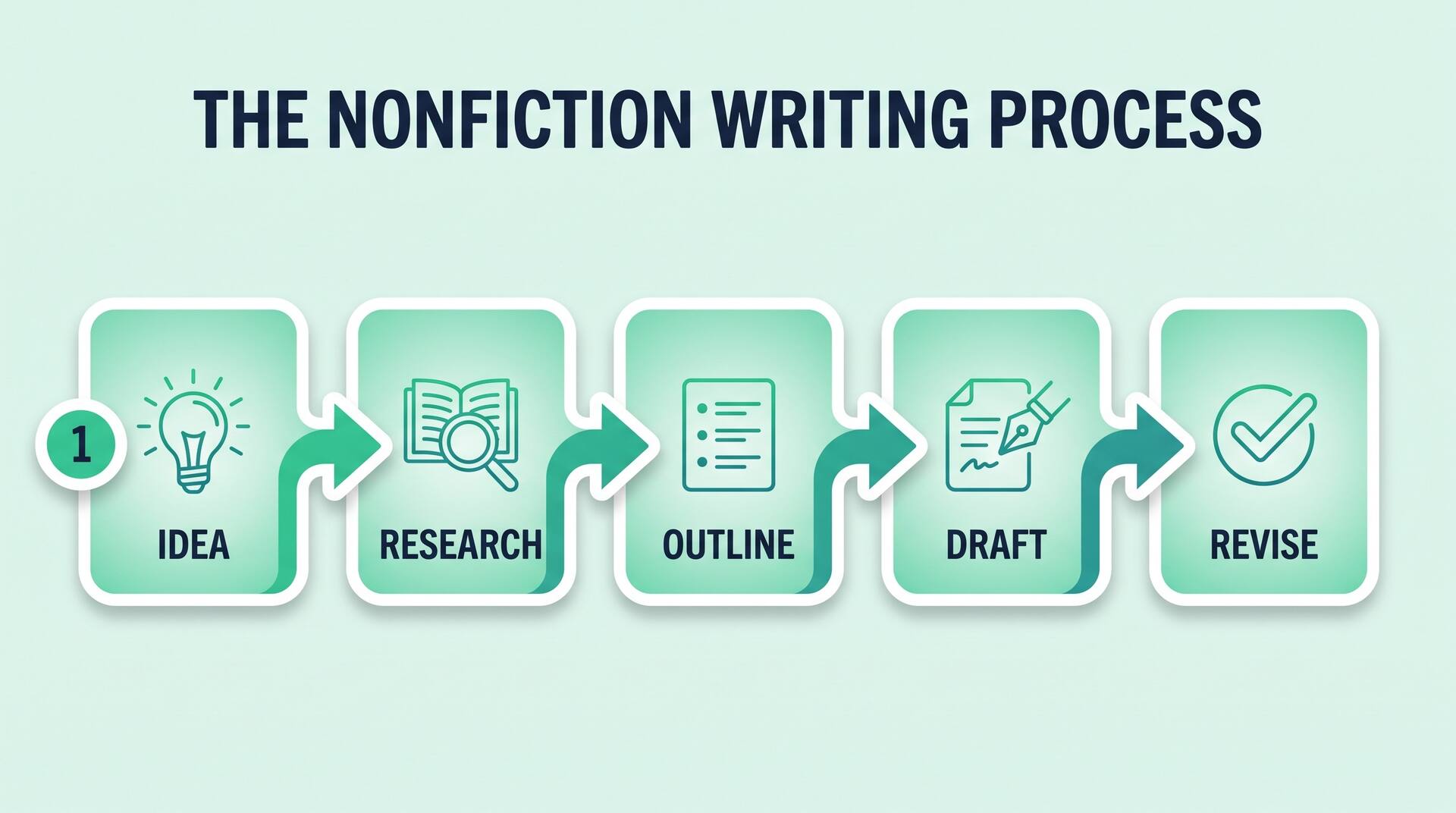
Step 1: One-Sentence Book Idea
Refine your positioning into one sentence: 'This book teaches [reader] how to [promise] using [differentiator].' Tape it above your desk.
Step 2: Chapter-Sized Promises
Break the book promise into 8–14 chapter-sized promises. Each chapter is one transformation, one move, or one frame. Resist the urge to make chapters about topics—make them about outcomes.
Step 3: Stress-Test the Order
Move chapters around until each one is the natural next thing the reader needs. Ask: does this chapter assume something I haven't taught yet? If so, it moves later, or the prerequisite moves earlier.
Step 4: Outline Each Chapter to the Section Level
Each chapter gets 4–8 sections. Each section has a one-line summary, the example or evidence you'll use, and the takeaway. Now you have a 200-line document that, when you fill it in, is the book.
Step 5: Write the Table of Contents First
If a smart stranger could read just your TOC and chapter summaries and say, 'Yes, I want to read this,' you have a book. If not, the book isn't ready to draft.
Using AI to Write Your Nonfiction Book
AI is genuinely transformative for nonfiction—not because it replaces your expertise, but because it removes the friction between knowing something and getting it on the page.
Talk through a chapter aloud, transcribe with AI, and generate a structured draft you can revise—turn raw thinking into prose in minutes.
Use AI to stress-test your outline: ask it to identify gaps, repetitions, and missing perspectives a target reader would notice.
Generate three different framings or chapter openings so you can choose the one that lands hardest.
Use AI as a research assistant for synthesis—then verify each cited source yourself before publication.
Get instant feedback on clarity, jargon, and audience fit by asking AI to read your draft as your target reader.
AI can't replace the lived experience that makes your book worth reading. Use AI to scaffold and accelerate. Bring the original case studies, frameworks, and stories that only you have.
Drafting Without Stalling
Most nonfiction books die in the drafting phase. Five tactics that move the book from outline to manuscript.
Write Out of Order
Start with whichever chapter you understand best, not chapter one. Momentum on a strong chapter generates momentum for everything else. Save the introduction for last.
Aim for Bad First Drafts
First-draft sentences should be ugly, repetitive, and approximate. The job is to surface the argument; the polish comes later. Writers who edit while drafting almost never finish.
Talk the Chapter Before You Write It
Record yourself explaining a chapter aloud—as if to a smart friend over coffee—then transcribe. Most nonfiction first drafts read better when they start as spoken language.
Write to a Schedule, Not a Mood
Pick a daily word count or daily time block. Five hundred words a day finishes a book in six months. Three thousand on inspired weekends usually finishes nothing, because there are not enough inspired weekends.
Use Placeholder Brackets
When research is missing or you can't find the right anecdote, write [STORY ABOUT MIDDLE MANAGER] or [STAT NEEDED] and keep moving. Trying to perfect every paragraph in real time is the most common cause of unfinished manuscripts.
The Structural Patterns That Work
Within nonfiction categories, a handful of chapter-level patterns earn their keep across most books. Choose deliberately.
Hook → Promise → Walkthrough → Proof → Recap
Open with an anecdote or question that earns attention. State what the chapter will deliver. Walk through the framework or method. Prove it works with examples or evidence. Close with a 3–5 line recap and the bridge to the next chapter.
Problem → Reframe → Tools → Application
Identify a problem the reader recognizes. Reframe it so the reader sees it differently. Provide the tools to act on the reframing. Show what application looks like in their life. Especially strong in self-help and business writing.
Story → Lesson → Generalization
Open with a fully scenic story (a person, a moment, dialogue, sensory detail). Extract the lesson. Generalize to your reader's situation. Strong in narrative nonfiction and leadership books.
Writing Engaging Nonfiction
Nonfiction does not have to be dry. The most-read nonfiction books use specific craft moves that fiction writers know cold.
Lead with Story Whenever You Can
A chapter that opens with two paragraphs of theory loses readers. The same chapter opening with a person, a moment, and a problem holds them. Almost any concept can be introduced through a scene first, theory second.
Name Your Frameworks
A named framework ('the Eisenhower Matrix,' 'OKRs,' 'the One-Minute Manager') is far more memorable than an unnamed one. Naming makes a concept portable, citable, and quotable. Don't be shy about naming your own.
Use Concrete, Specific Examples
Don't write 'managers struggle to give feedback.' Write 'Sarah, an engineering manager at a Series-B startup, had postponed the same conversation with her tech lead three weeks running.' Specificity is credibility.
Write Short Paragraphs and Short Sentences
Modern nonfiction reads on screens, on phones, in airports. Average paragraph length should be 2–4 sentences. Long paragraphs work occasionally for emphasis, not as default. The white space is part of the design.
End Every Chapter With a Forward Pull
The last paragraph of each chapter should make the next chapter feel inevitable. A question opened. A tool introduced but not yet used. The reader's interest curves into the next chapter rather than ending.
Establishing Authority Without Sounding Arrogant
Reader trust is the most fragile asset in nonfiction. Earn it without performing it.
That trust is also what makes a book the front door to a service business: a commercial finance broker who publishes a serious book on lending gets warmer business loan leads than any cold list produces, because the reader has already spent hours with their thinking before the first call.
Show Your Work
Don't just claim something works. Walk the reader through the path that led you there—what you tried, what failed, what you learned. The narrative of expertise is more persuasive than the assertion of it.
Acknowledge What You Don't Know
Confident books admit limits. The author who says 'this approach struggles in [these contexts]' reads as more trustworthy than the one who claims a universal silver bullet. Bound your claims and your readers will trust them.
Give Credit Generously
Cite the people whose ideas you're building on. Quote others where they've said it better. Generous citation makes you look stronger, not weaker—it positions you inside a serious conversation, not above it.
Anticipate the Reader's Pushback
When you make a strong claim, surface the reasonable objection in the next paragraph and address it. The reader who would have argued with you is now on your side, because you saw them coming.
Common Nonfiction Mistakes
Writing for Yourself Instead of the Reader▾
Authors get so close to their own thinking they forget readers don't have the prerequisites.
Fix: Hand your draft to two readers in your target audience. Highlight every place they got confused. Rewrite from there.
Confusing Topic for Argument▾
A topic ('leadership,' 'productivity,' 'marketing') is not a book. A book is a specific argument inside that topic.
Fix: Finish this sentence: 'I argue that...' If you can't, you don't have a book yet.
Padding to Hit Word Count▾
Padded chapters lose readers and reviews. Most nonfiction books would benefit from being 20% shorter.
Fix: If a chapter doesn't have a clear payoff for the reader, cut it. A 50,000-word book that respects the reader's time outsells an 80,000-word book that doesn't.
Skipping Stories Because 'It's a Serious Book'▾
The most serious books still use scene, character, and detail. Concept without illustration is a memo, not a book.
Fix: Every major idea gets a story or a worked example. No exceptions.
Releasing Without an Editor▾
Self-edited nonfiction has the highest correlation with one-star reviews. The errors you can't see are exactly the ones an editor catches.
Fix: Hire a developmental editor before launch—or, at minimum, three brutal beta readers from your target audience. Don't skip it.
Pre-Publication Checklist
Before sending your manuscript to a publisher or KDP, run it through this list.
Write the Book Only You Can Write
The world doesn't need another general book on leadership, productivity, or marketing. It needs the specific book you can write—the one informed by the actual people you've worked with, the actual problems you've solved, and the actual lessons you've earned.
Pick your reader. Pick your promise. Pick your differentiator. Write the table of contents this week. The rest of the book is just structured execution from there—and structured execution is exactly what you, as an expert, are already good at.