


Why a membership works for writers
Book sales are spiky: a launch, then a long tail. A membership pays every month, whether or not you released anything new. It also changes who you write for. Instead of chasing algorithms, you write for a few hundred people who already chose you.
The math is friendlier than it looks. Two hundred patrons at $5 a month is $1,000 before fees, every month. You do not need a huge audience, you need a committed one, and the people most likely to join are the ones already on your email list. If you do not have a list yet, start with a reader magnet.
What Patreon actually costs
Creators who published their Patreon page after August 4, 2025 pay a 10% platform fee on their earnings. Payment processing fees come on top and depend on the pledge size and currency, and payouts can carry a small transfer fee. Creators who published earlier may still be on an older 5%, 8% or 12% plan.
Plan your prices with that in mind: a $3 tier loses a bigger share to fixed processing costs than a $7 tier does.
Membership earnings calculator
Enter how many patrons you expect at each tier. The estimate subtracts Patreon's 10% platform fee; processing fees vary, so your payout will be somewhat lower.
Reader, about $3
Insider, about $7
Patron, about $15
Monthly pledges
$610
After 10% platform fee
$549
Per year after platform fee
$6,588
A three-tier structure that works
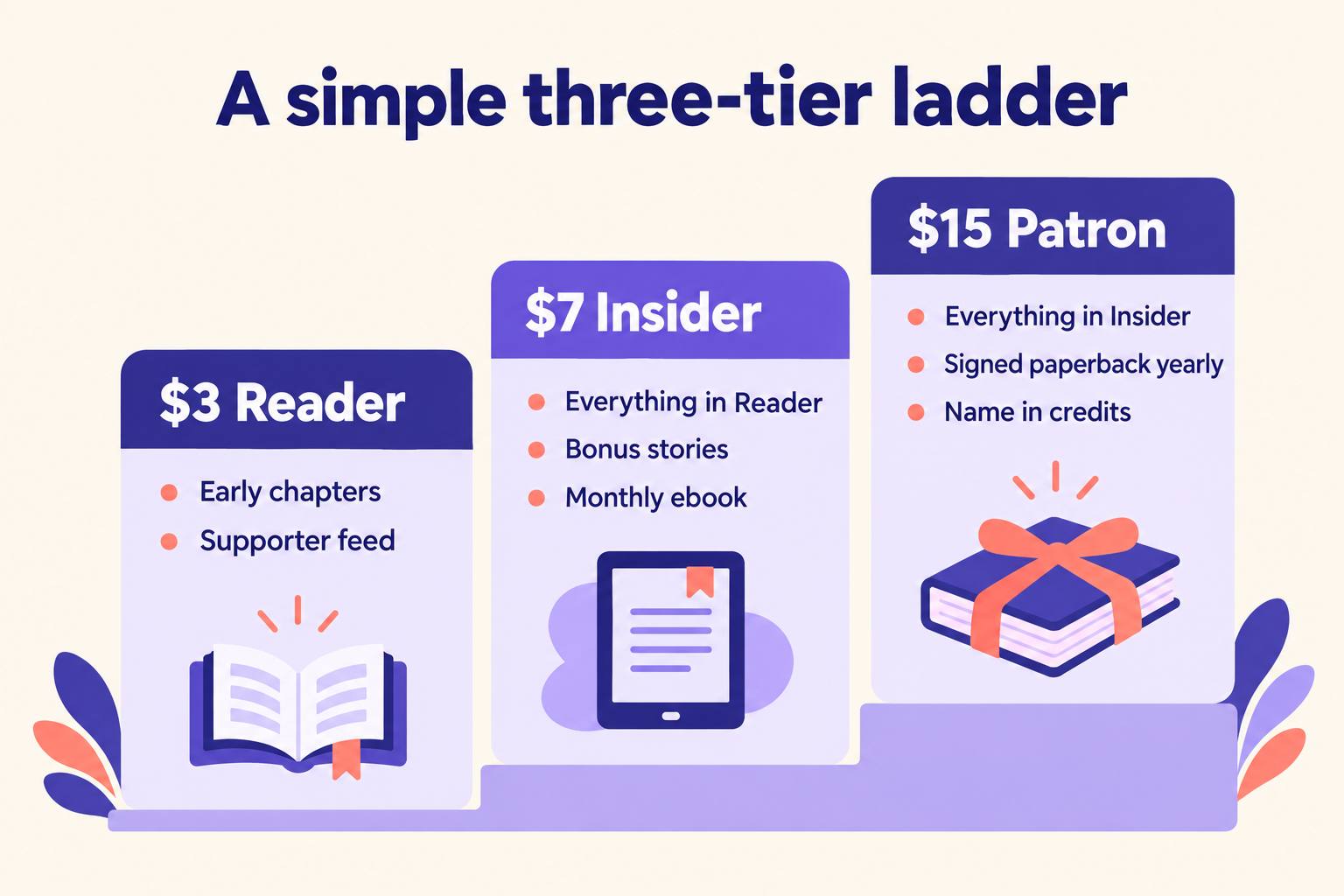
Most writers do best with three tiers. More choices slow people down, and each tier you add is another promise to deliver every month.
Reader, about $3
Early access to new chapters and a supporters-only feed. Cheap to deliver, because it is work you write anyway.
Insider, about $7
Everything above plus bonus short stories, deleted scenes or a monthly ebook. This is usually the most popular tier.
Patron, about $15
Everything above plus something personal and limited: a signed paperback once a year, your name in the acknowledgments, a vote on what you write next.
Launch in six steps
1
Pick a content rhythm you can keep
One chapter a week or two posts a month. Promise less than you can do; missed posts lose patrons faster than slow ones.
2
Bank a backlog first
Have four to six weeks of posts ready before you launch, so a bad month never breaks the rhythm.
3
Set up three tiers
Use the structure above. Write each tier's benefits as concrete, countable things.
4
Write a welcome post
New patrons should get something the moment they join: a free short story, the first chapters, or a behind-the-scenes post.
5
Announce it to your list
Your newsletter subscribers are your best prospects. Send a short launch sequence, then mention the membership at the end of every book.
6
Review after three months
Look at which posts get read and which tier people choose, then adjust benefits rather than prices.
What writers put behind the paywall
- Serial fiction
- A novel released chapter by chapter, weeks before the edited book comes out. Patrons pay for being first.
- Bonus material
- Short stories set in the same world, side characters' points of view, epilogues and deleted scenes.
- Process and craft
- Drafting diaries, outlines, cover reveals and writing advice. Nonfiction authors often lead with this.
- Community
- Polls on names and plot choices, live readings, Q&A sessions and a members-only chat.
Keeping up the pace with AI
The hard part of Patreon is not launching, it is the monthly rhythm. AIWriteBook helps on both sides of it. For the writing, the book series feature keeps your characters and world consistent across books, and chapter drafting in your own style lets you build a backlog of bonus stories faster. You review and edit every chapter before it goes out.
For the promotion, the free email sequence generator drafts your launch emails and the social post generator turns each new chapter into posts that point readers to your page.
Build a backlog of bonus chapters
Outline a series, draft chapters in your own voice and keep every character consistent from book to book.
Common mistakes
- Launching to nobody. Patreon does not bring you an audience; it converts the one you already have.
- Too many tiers. Five or six tiers confuse readers and multiply your workload.
- Physical rewards at low tiers. Shipping costs eat a $5 pledge quickly; keep physical items for the top tier and send them once a year.
- Promising a schedule you cannot keep. Consistency matters more than volume.
- Hiding the membership. Mention it at the end of every book, in your newsletter footer and on your author page.
Tier description templates
Copy these and replace the brackets with your own details.
Reader: Read every new chapter of [series name] [two weeks] before anyone else, and join the supporters-only feed where I share what I am working on.
Insider: Everything in Reader, plus a new bonus story from the world of [series name] every month and the ebook of each finished book on release day.
Patron: Everything in Insider, plus a signed paperback once a year, your name in the acknowledgments of my next book, and a vote on what I write next.
Start small, stay consistent
A writer's Patreon is not a lottery ticket; it is a small, steady relationship with your best readers. Launch with a backlog, three clear tiers and a rhythm you can keep, and let your newsletter do the selling. If you want a one-off funding push instead of a subscription, compare it with a Kickstarter book campaign.
Find more ways to reach readers in our book marketing guide.