


Why authors crowdfund
Kickstarter is not mainly a way to fund a book you have not written. It is a way to sell a premium version of a book to the readers who already love your work, at a margin no retailer will give you. A reader who pays $55 for a signed, sprayed-edge hardcover on Kickstarter is a reader you would earn a couple of dollars from on Amazon.
Kickstarter's 2025 report named several publishing projects that passed $1 million, more than in any previous year, including Matt Dinniman's Dungeon Crawler Carl special editions and Ali Hazelwood and Adriana Herrera's After the End. Every one of those authors brought a large readership with them. That is the pattern to learn from: the platform rewards an existing audience, it rarely creates one.
The realistic version for most authors is smaller and still worth doing. About two-thirds of all successful Kickstarter projects raised between $1,000 and $9,999. A $6,000 to $10,000 campaign that pays for a print run, a better cover and an audiobook, while adding a few hundred direct contacts to your list, is a strong result.
Funding goal math
Kickstarter is all-or-nothing. If you miss the goal, nobody is charged and you get nothing. If you hit it, Kickstarter takes a 5% platform fee and payment processing takes another 3% plus $0.30 per pledge for US projects (pledges under $10 are charged 5% plus $0.08). Your goal has to cover every cost after those fees, not before them.
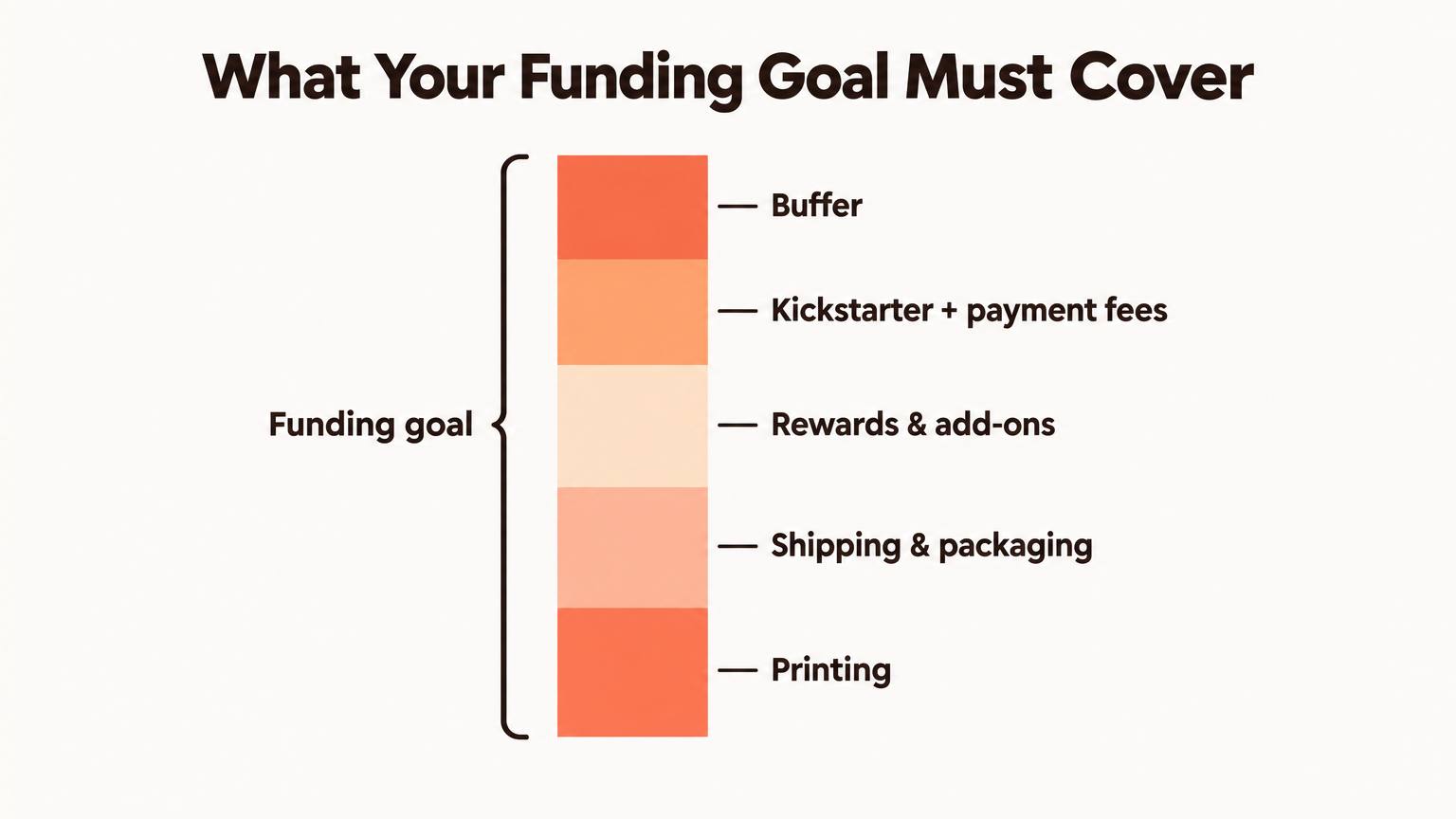
The safest goal is the smallest number that fully pays for producing and delivering the base reward. Stretch goals pay for the extras. Use the calculator with your own printer and postage quotes.
Minimum funding goal
$7,554
Of which fees
$679
Average pledge needed
$30
Formula: (fixed costs + orders × per-order costs) × (1 + buffer), plus $0.30 per pledge, divided by 0.92 to cover the 8% in fees.
With the defaults (250 orders, $2,500 of fixed costs, $15 per order in printing, postage and extras, and a 10% buffer) the minimum goal comes to about $7,550 and the average pledge has to be around $30. That is why a paperback-only campaign at $20 struggles: the price barely covers the book plus postage. Shipping charged to backers counts toward your goal and is subject to the same fees.
Reward tiers that sell
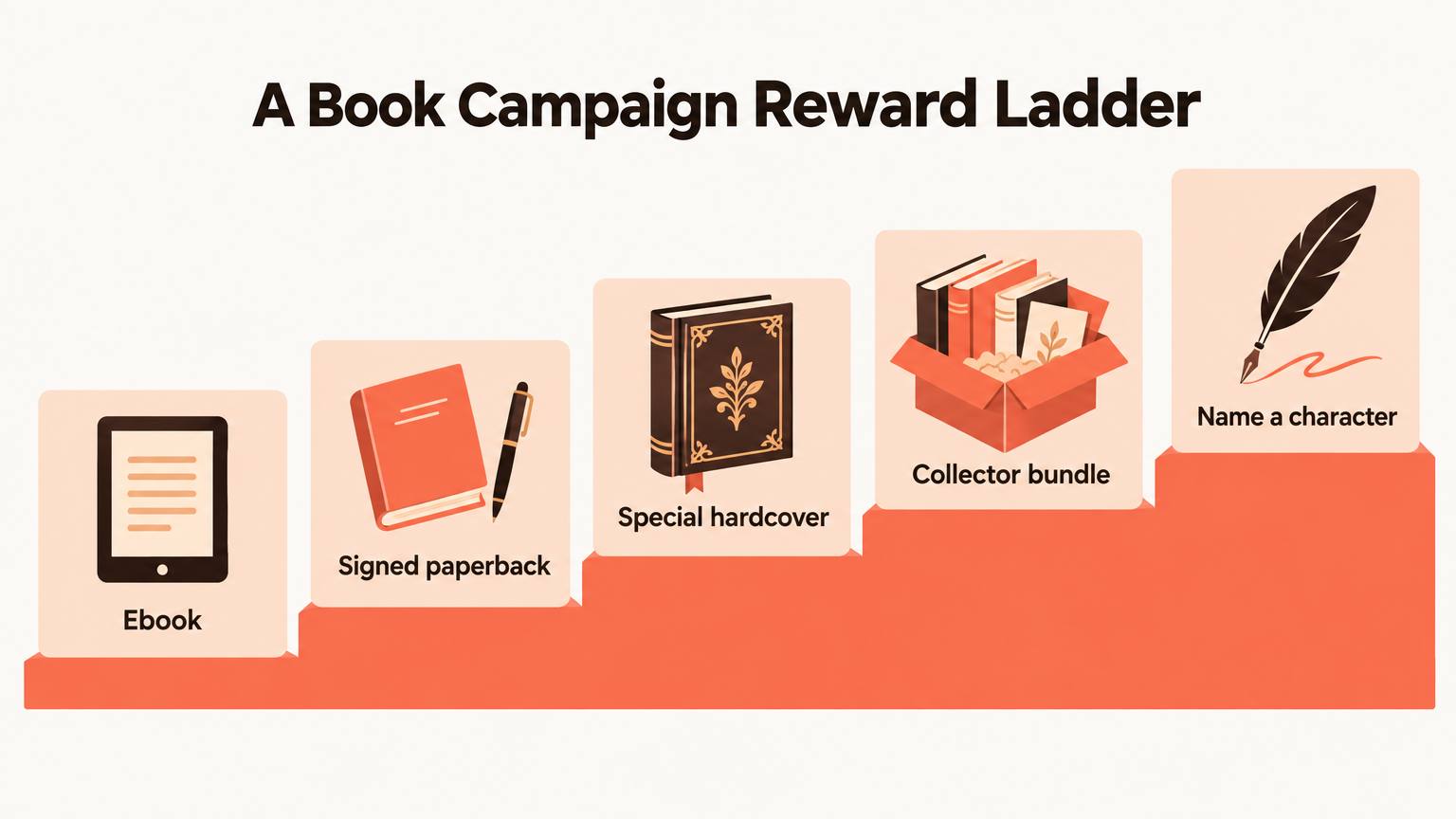
Backers choose between tiers in a few seconds, so fewer and clearer beats many. Five tiers cover almost every book campaign. Click a tier to see what it is for.
Example pledge
$45 to $70
The reason most book campaigns exist: foil, sprayed edges, endpapers, character art. Make it Kickstarter-exclusive and say so. This tier usually carries the campaign.
Add-ons sit on top of tiers: a second copy, the audiobook, a print, an enamel pin. They let backers raise their own pledge without you inventing a sixth tier.
Fulfillment costs nobody warns you about
Fulfillment is where profitable campaigns turn into unpaid hobbies. Get real quotes for everything below before you set prices.
| Cost | Why it bites | How to handle it |
|---|---|---|
| Printing | Offset printing is cheaper per copy but needs a minimum run and weeks of lead time. Print-on-demand has no minimum but costs more per copy, and special finishes are limited. | Get offset and print-on-demand quotes at two quantities, your goal and twice your goal. |
| Postage | International postage for a hardcover can cost more than the book. Rates also change mid-campaign. | Charge shipping per region at checkout, never offer free shipping worldwide. |
| Packaging | Mailers, corner protectors and boxes add up across hundreds of orders, and damaged books mean replacements. | Price packaging into the per-order cost and order 5% spare copies. |
| Taxes and duties | VAT and import duties can land on your backers' doorstep, and some countries charge on arrival. | State clearly who pays duties, or use a fulfillment partner inside the EU and UK. |
| Pledge manager and surveys | You need addresses, add-on choices and late pledges after the campaign ends. | Kickstarter's own pledge manager carries no upfront fee; the standard fees still apply to money it collects. |
| Your time | Signing, packing and answering emails for 300 backers takes days, not hours. | Count it, or pay a fulfillment house and price their fee in. |
One more cost is invisible until it bites: exclusivity. If your ebook is enrolled in KDP Select, it must stay exclusive to Amazon, so delivering it to backers during enrollment breaks the terms. Plan the campaign before you enroll, or after you leave Select. The trade-offs are covered in KDP Select: when exclusivity pays.
The pre-launch list is the campaign
The first 48 hours decide most book campaigns. Projects that fund a large share of their goal on day one get picked up by Kickstarter's own discovery pages and look like safe bets to strangers. Projects that open slowly rarely recover. That day-one money comes from people who already know you.
Kickstarter's pre-launch page lets readers click "Notify me on launch" before you go live. Treat that follower count as your best forecast, and assume only a fraction of followers will pledge. If your follower count multiplied by a cautious conversion rate and your average pledge does not reach the goal, delay the launch and keep building.
Your email list converts far better than social media. If you do not have one yet, start with a page readers can join: the AIWriteBook author page collects reader emails into a list you own and export, can gate a free chapter preview behind sign-up, and sends book launch broadcasts to subscribers. A sample chapter is the strongest reason a stranger gives you an email address before a campaign.
Then write the emails before launch day. The free launch email sequence tool drafts a sequence you can adapt to pre-launch, launch day and final 48 hours. For broader list-building ideas, see book marketing for self-published authors.
Campaign timeline
A realistic schedule for a first book campaign. Shorter campaigns tend to do better than long ones, and Kickstarter's own guidance notes that campaigns of 30 days or fewer succeed more often.
12 to 8 weeks out
Finish the manuscript and cover. Get printer and postage quotes. Draft tiers and the goal.
8 weeks out
Publish the Kickstarter pre-launch page. Share a sample chapter and cover reveal to start collecting followers.
4 to 1 weeks out
Make reward photos and mockups. Send two or three list emails building toward launch. Line up newsletter swaps with other authors.
Launch day
Email your list in the morning in your readers' time zone. Post everywhere. Reply to every comment.
Mid-campaign
Post an update every few days: art reveals, unlocked stretch goals, a backer milestone.
Final 48 hours
Kickstarter reminds people who tapped "Remind me". Send your own last-call email too.
After funding
Send surveys, open late pledges, place the print order, and post fulfillment updates until the last box ships.
Mistakes that sink book campaigns
Setting the goal at the dream number
A $25,000 goal that reaches 60% raises zero. Set the goal at what the base reward costs to make and ship, and let stretch goals carry the rest.
Free worldwide shipping
One hardcover to Australia can wipe out the margin on three US orders. Charge postage by region.
Twelve tiers instead of five
Choice paralysis is real. Fold variations into add-ons.
Stretch goals that cost more than they raise
A free bookmark for every backer, unlocked at $10,000, can cost $1,500 once you include postage weight. Price every stretch goal per backer.
Launching with no art
Backers fund what they can see. A finished cover, interior page spreads and photos of the reward items do more than any pitch text.
Promising a delivery date without a printer quote
Print runs slip, freight slips, and an unfinished manuscript slips most of all. Promise the date your printer gives you plus a month.
Forgetting KDP Select
Delivering an ebook that is enrolled in Select breaks its exclusivity terms. Check before you add an ebook tier.
The AI-assisted shortcut
A campaign is easiest when the book is finished before the pre-launch page goes up. If it isn't, AIWriteBook takes an idea through characters, outline and chapters in your voice, or imports the draft you already have and keeps writing in its style. The chapter AI chat shows every suggested edit as a diff you accept or reject.
For reward photos before anything is printed, the free 3D mockup generator renders your cover on a book, and the cover generator helps if you are still choosing a direction. When the campaign funds, book formatting exports print-ready PDF, EPUB and DOCX files for your printer and your ebook tier.
Stretch goals are easier to promise when you already know you can deliver them. The audiobook generator turns the manuscript into a narrated audiobook, and whole-book translation into 30+ languages makes a translated edition a realistic stretch goal rather than a five-figure gamble. For a series campaign, book series support carries characters and plot from earlier books into the next one so a collector bundle can include a new volume.
Templates to copy
Two starting points. Replace the bracketed parts and cut anything that does not fit your book.
Campaign page outline
[One-line hook: what the book is and why this edition is special]

VIDEO or animated cover reveal (under 2 minutes)

THE BOOK
[Two-paragraph pitch in the voice of the book. End on the question that makes readers want it.]

WHAT YOU GET
[Photo of each reward. Tier list with what is inside each one.]

THE SPECIAL EDITION
[Close-ups: foil, edges, endpapers, character art. Say it is Kickstarter-exclusive.]

STRETCH GOALS
[3 to 5 goals, each priced per backer before you list it.]

ABOUT THE AUTHOR
[Short bio, previous books, reader numbers if they help.]

TIMELINE
[Manuscript status, print order date, shipping window.]

RISKS AND CHALLENGES
[Honest notes on printing and shipping, and what you will do if dates slip.]
Launch-day email
Subject: It's live: the [Title] special edition

Hi [first name],

The Kickstarter for [Title] is live as of this morning.

[One sentence on what makes this edition different.]

The first 48 hours decide whether Kickstarter shows the campaign to new readers, so if you were planning to back it, today is the day that helps most.

→ [Campaign link]

The early tiers include [early bonus]. They close when the first [number] are claimed.

Thank you for reading,
[Your name]
Where to start
Start with arithmetic, not inspiration. Get printer and postage quotes, run the goal calculator, design five tiers, and build a pre-launch list until the follower count makes the goal look easy. The authors who raise six and seven figures followed the same steps with a bigger list.