

A writer can have plenty of experience, a carefully planned project, and even a detailed outline, yet still reach a point where every idea feels predictable. This is especially common when working on a long manuscript and repeatedly approaching the same characters, themes, or subject matter.
One simple way to break that pattern is to introduce an element of randomness.
For writers, an unexpected symbol, object, or visual prompt can become the starting point for a scene, character, conflict, or completely new story.
Why Randomness Can Improve Creative Thinking
Writing requires making connections.
A character might remind you of a place. A place might suggest a memory. That memory might become a conflict. A conflict can eventually turn into a story.
Random prompts interrupt the usual chain of thinking.
Instead of beginning with a blank page, you begin with something concrete and ask what it could mean.
That small change can make brainstorming feel less intimidating.
Use a Random Emoji Generator as a Writing Prompt
Emoji are particularly useful as creative prompts because they represent a wide range of objects, emotions, activities, places, and ideas.
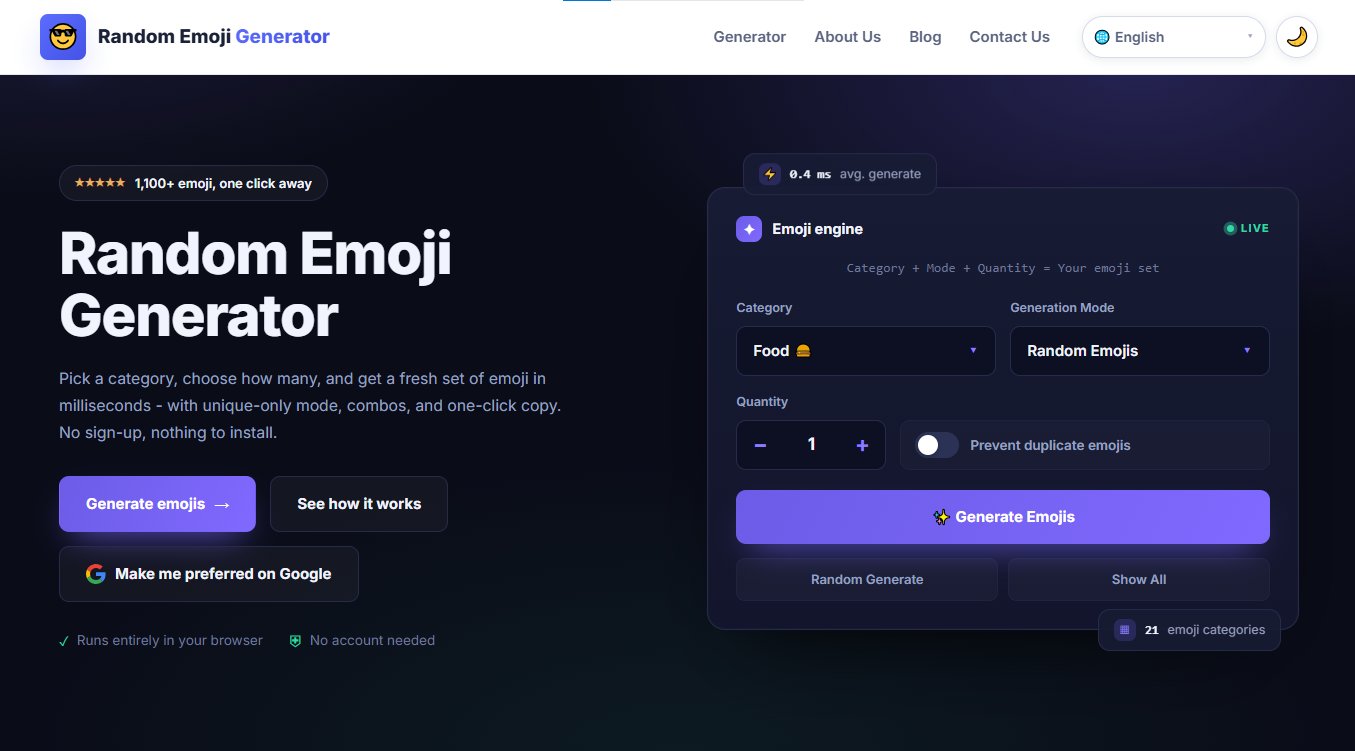
A random emoji generator can give writers an unexpected starting point without requiring them to decide what the prompt should be.
For example, imagine receiving a key emoji.
Rather than simply writing about a key, ask:
- Who owns it?
- What does it unlock?
- Why is the owner afraid of losing it?
- What happens when someone else finds it?
- Has it been hidden for years?
- What secret is connected to it?
Suddenly, one small visual prompt can create several possible directions.
The emoji itself may never appear in the finished story. Its purpose is to start the thinking process.
Turn One Prompt Into a Character
Random prompts can also help when a character feels underdeveloped.
Choose an emoji and imagine that it represents something important to the character.
For example, a camera could represent a character who is obsessed with documenting memories. A suitcase could belong to someone who is constantly running away. A locked object might suggest a person who keeps an important secret.
Ask questions such as:
- What does this object mean to the character?
- Where did they get it?
- Who else knows about it?
- What would happen if it disappeared?
- Would the character admit how important it is?
These questions can reveal personality traits that may not have appeared in the original character outline.
Create Short Writing Exercises
You do not need to use every creative prompt in your main manuscript.
Short exercises can be just as valuable.
Try giving yourself 10 minutes to write a scene based on one random emoji. Do not worry about editing, structure, or whether the scene is good enough to publish.
The objective is simply to produce something.
You can try exercises such as:
- One-minute description: Describe the emoji without naming it.
- Character exercise: Create a character who strongly dislikes whatever the emoji represents.
- Conflict exercise: Make two characters disagree about the meaning of the emoji.
- Mystery exercise: Make the emoji a clue in a crime or mystery.
- Dialogue exercise: Write a conversation where one character gives another the object represented by the emoji.
These exercises train creative flexibility.
Use Random Prompts to Explore Different Genres
A prompt can also help writers move outside their usual genre.
The same emoji can produce completely different stories depending on the type of book.
A crown could become:
- A symbol of power in historical fiction
- A clue in a mystery
- A magical artifact in fantasy
- A joke in a romantic comedy
- A metaphor for ambition in literary fiction
This makes random prompts useful for writers who feel that their ideas are becoming repetitive.
You are not trying to change your entire writing style. You are simply forcing yourself to consider possibilities you might not normally explore.
Don't Force a Bad Idea
Randomness is useful precisely because there is no guarantee that every prompt will work.
Some will produce nothing.
Others may seem useless at first but lead to an interesting thought several minutes later.
If a prompt is going nowhere, move on.
A productive brainstorming session might produce ten ideas and only one worth developing. That is completely normal. The goal is to create possibilities, not make every idea successful.
Combine Random Prompts With Your Existing Ideas
Random prompts become even more useful when combined with material you already have.
Suppose you are writing a novel and already have:
- A main character
- A setting
- A central conflict
- Several unfinished scenes
Instead of asking a random prompt to create an entirely new story, use it to challenge what already exists.
Ask:
- How could this emoji change the character's decision?
- Could it become an important object in the setting?
- Could it reveal something about another character?
- Could it create a new obstacle?
This approach keeps the exercise connected to your actual project.
Keep Your Best Prompts for Later
Not every idea needs to be used immediately.
Writers can keep a simple document containing interesting prompts, unusual combinations, character ideas, and unfinished scenes.
Over time, this becomes a personal idea bank.
When you experience writer's block, you do not have to start from zero. You already have dozens of possibilities waiting to be explored.
You can organize them into categories such as:
- Character ideas
- Story openings
- Conflicts
- Settings
- Objects
- Dialogue prompts
- Short-story concepts
Let the Writer Make the Final Decision
Creative tools should provide possibilities, not take control of the writing process.
A random prompt can suggest an idea, but the writer decides whether that idea is worth developing. The author's experience, imagination, personal perspective, and understanding of the intended reader still matter most.
That is particularly important when using AI and other digital writing tools.
Technology can help generate starting points, but the final work should still reflect the author's own judgment and voice.
Final Thoughts
Writer's block does not always require a complicated solution.
Sometimes, all you need is something unexpected to respond to.
A random emoji can become a character detail, a mysterious object, a conflict, a writing exercise, or the beginning of an entirely new story. The important part is not the emoji itself. It is the chain of questions and ideas that follows.
The next time a blank page feels impossible, stop asking yourself what the perfect idea should be.
Give yourself a random starting point and see where it takes you.