

On this page
What social media actually does for a book
Most authors open an Instagram account the week the book comes out, post the cover four times, and wonder why nothing sold. The problem is not the platform. Social media is slow, compounding trust, and a launch week is the worst moment to start building it.
Think of a feed as the top of a funnel with three jobs: help strangers discover that you exist, give them enough reasons to trust your taste, and move the interested ones somewhere you own, like an email list or an author page. Sales come out of the bottom of that funnel, usually weeks after the first view.
That framing matters because it changes what counts as a good post. A post that gets 40 likes and two newsletter sign-ups did more for your next launch than a post that got 400 likes and nothing else.
Rented vs owned
Followers live on someone else's server and an algorithm decides who sees you. Email subscribers and a page with your own domain are owned. Every platform strategy below ends with the same move: send the best followers to something you own.
Choosing your main platform
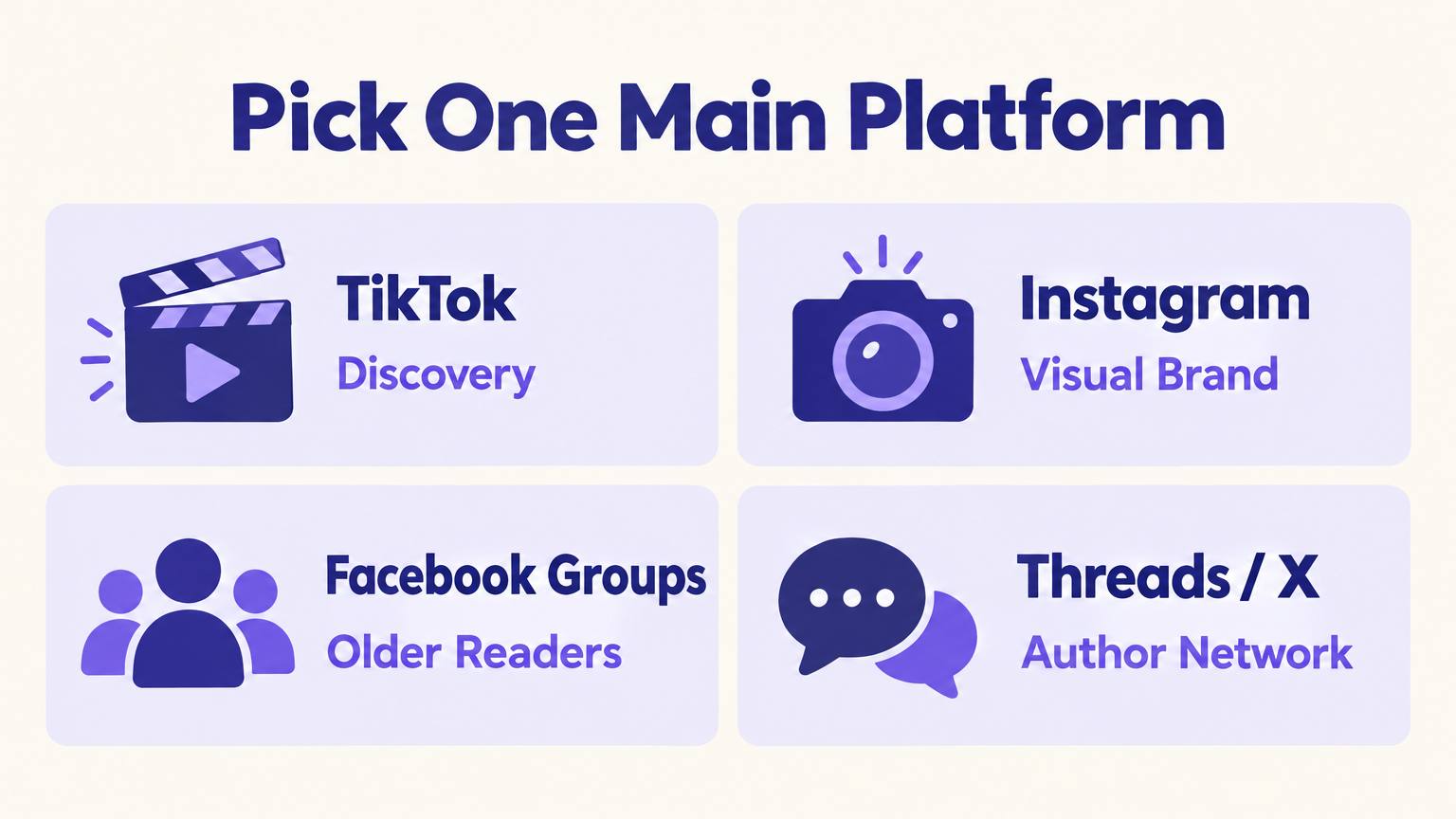
Pick one main platform and, at most, one secondary platform that reuses the same material. Running four accounts at half effort produces four dead accounts. The right main platform is decided by two questions, asked in this order.
Question 1
Where do readers of your genre already talk about books? Romance, fantasy and YA readers are concentrated on TikTok and Instagram. Thriller and cozy mystery readers skew older and gather in Facebook groups. Non-fiction buyers often find authors through LinkedIn, podcasts and newsletters rather than any book community.
Question 2
Which format can you produce every week without dreading it? If talking to a camera makes you freeze, a video-first platform will die by week three. Pick the format you would make even with no audience, because for the first few months you will not have one.
Platform by platform
Tap a platform to see who is there, what works, and a realistic weekly cadence.
Who is there
Readers in their teens to late thirties, heavy on romance, romantasy, fantasy, dark romance and YA. BookTok is the single biggest discovery engine for genre fiction right now.
What works
Fifteen to forty-five second videos that lead with a feeling or a trope, not with the book: the line that makes readers gasp, the trope list, the reaction a reader had. Text on screen does most of the work, so you do not need to show your face.
Realistic cadence
Three to five short videos a week, filmed in one sitting.
For hooks, trope formats and how BookTok picks winners, read our BookTok strategy guide.
What to actually post
Authors run out of ideas because they think the only content is the book. The book is the product. The content is everything around it: the world, the craft, the reactions and you.
Rotate four content pillars so the feed never becomes a billboard:
The story world
Character mood boards, a map, a short excerpt, the trope list, a 'which character are you' question.
Craft and process
How you plotted the twist, a deleted scene, the research rabbit hole, your word count this week.
Reader proof
Screenshots of reviews (with permission), reader art, the message someone sent you at 2 a.m.
You as a person
Your desk, your dog, what you are reading. People follow people, not catalogues.
A useful ratio: for every one post that asks for something (buy, pre-order, sign up), publish four that give something.
The fastest way to fill a week of posts is to mine the manuscript itself. One chapter usually holds a quotable line, a moment of tension, a character detail and a question for readers. Our free social media post generator turns a book description into ready-to-edit posts for each platform, which is a good starting point when you are staring at an empty caption box.
If the book is not finished yet, that is content too. Readers love watching a book get made. Inside AIWriteBook you can draft chapters, generate character portraits with the chapter illustration tool and export pages, so your 'work in progress' posts can show real images from the book you are writing instead of stock photos.
The 90-minute weekly batch
The authors who last on social media do not post daily in real time. They batch. One block a week, four steps, and the scheduler does the rest.
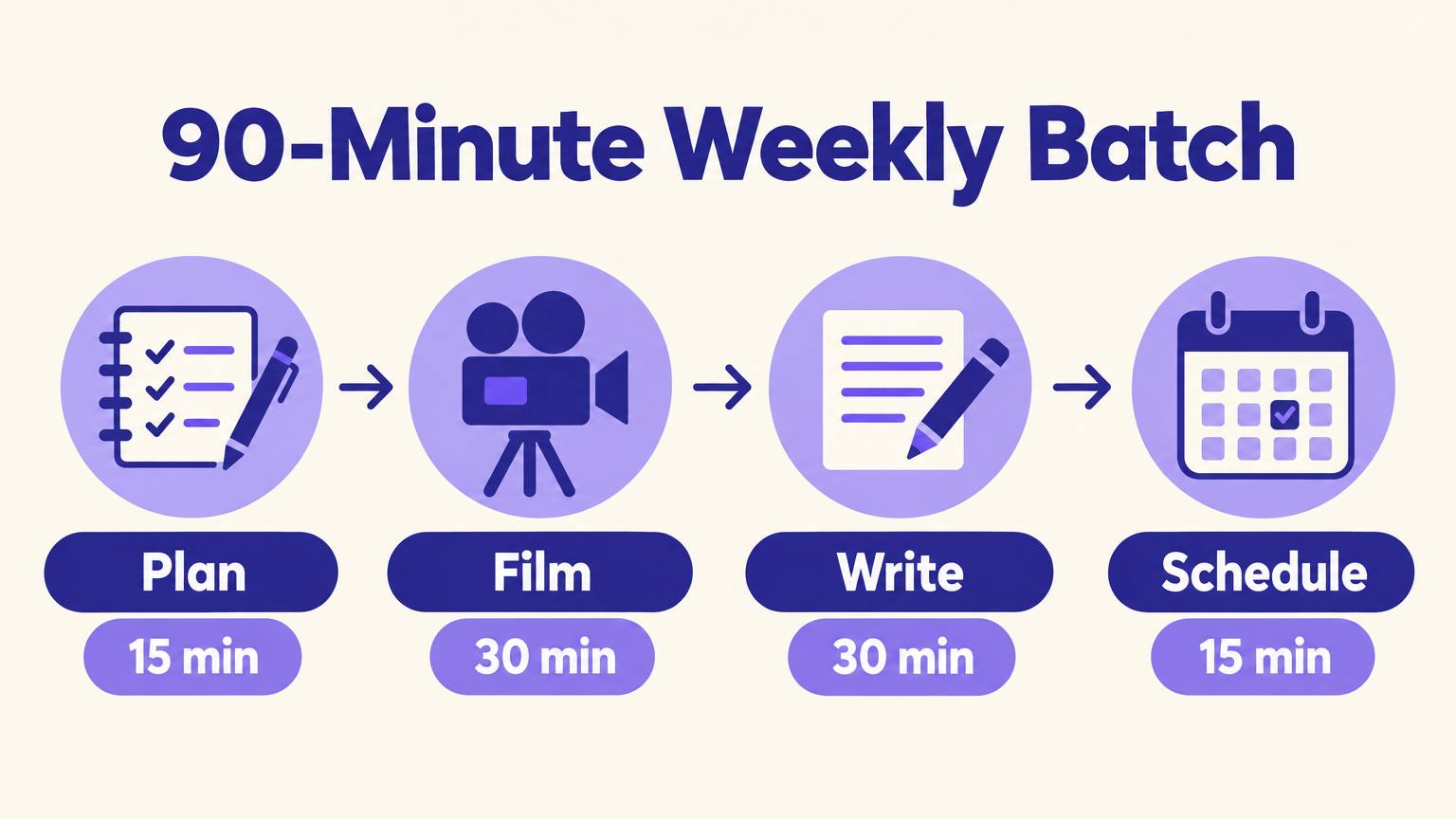
Plan, 15 minutes
Pick one pillar per post for the week. Write the hooks as a list before making anything.
Film or shoot, 30 minutes
Record all the short videos or photos in one go, same outfit, same light. Batching hides how little time it took.
Write, 30 minutes
Captions, on-screen text and one newsletter paragraph that reuses the best post.
Schedule, 15 minutes
Load everything into the native scheduler or a free tool. Then close the app and go write the book.
Daily engagement still matters, but cap it: ten minutes after you post, replying to every comment. Comments in the first hour are the signal most algorithms read.
Numbers worth tracking
Ignore follower count for the first three months. Track these instead, once a week, in a simple spreadsheet:
- Saves and shares per post. They tell you which content people want to keep, which is the strongest signal of trust.
- Profile visits to link clicks. If people visit but do not click, your bio and link are the problem, not your posts.
- New email subscribers per week. This is the number that will move your next launch.
- Which pillar wins. After eight weeks, double the pillar with the best saves and cut the weakest.
Your link should point somewhere you control. An AIWriteBook author page gives you book pages, chapter previews and a reader email capture in one place, so a follower who taps your bio lands on something that can collect their email instead of a bare store listing.
Your best content is inside your book
Write the book in AIWriteBook and you will have chapters, characters and illustrations to post about, plus a cover and an author page to send followers to.
Mistakes that waste months
- Starting the account the week of launch. Start at least three months before, ideally while you are still drafting.
- Posting only the cover and the buy link. That is an ad, and people scroll past ads.
- Following other authors instead of readers. Writers are lovely, but most of them are not your buyers.
- Spending more hours on content than on the next book. Your backlist is your best marketing; a second book makes every follower worth more.
- Quitting at week six. Most author accounts that work looked dead for the first two months.
The short version
Pick the platform where your readers already are and the format you can sustain. Post four helpful things for every ask, batch the work into one weekly block, and send every engaged follower to an email list you own.
Social is one channel in a bigger plan. For pricing, launches, ads and newsletters, keep going with our book marketing guide and the full playbook on book marketing for self-published authors.