

Which books BookTok actually moves
BookTok is not a general book-discovery engine. It is an emotional-recommendation engine, and it moves the categories where a reader can decide from a feeling rather than a summary. If your book can be described by what it does to the reader, it has a chance. If it can only be described by what it is about, the platform is a hard place to start.
That is not a soft rule about genre snobbery — it is about how the format works. A fifteen-second video has room for one promise. Romance, romantasy, dark fantasy, thrillers with a twist, upmarket sad-girl literary fiction and a narrow band of self-help all have promises that fit in one line. Regional history, technical nonfiction and most business books do not, and they are better served by a launch plan built around search and email.
Fit by category
| Category | Fit | Why |
|---|---|---|
| Romance and romantasy | Strongest | Tropes are a shared vocabulary — readers already search by them |
| Dark fantasy and horror | Strong | Atmosphere is visual, and a single unsettling line does the selling |
| Thriller and mystery | Good | One withheld question carries a whole video |
| Literary and book-club fiction | Mixed | Works when the emotional damage is nameable, not when the prose is the pitch |
| Memoir and narrative nonfiction | Mixed | Needs a specific, surprising personal stake, not a life summary |
| Technical and business nonfiction | Weak | Buying decisions are made by search and credibility, not by mood |
If you sit in the strongest band, your first job is naming your tropes accurately rather than aspirationally. Our breakdown of the romance tropes readers actually search for is a better source for that than your own blurb, and the enemies-to-lovers guide goes deeper on the single trope that carries the most BookTok traffic.
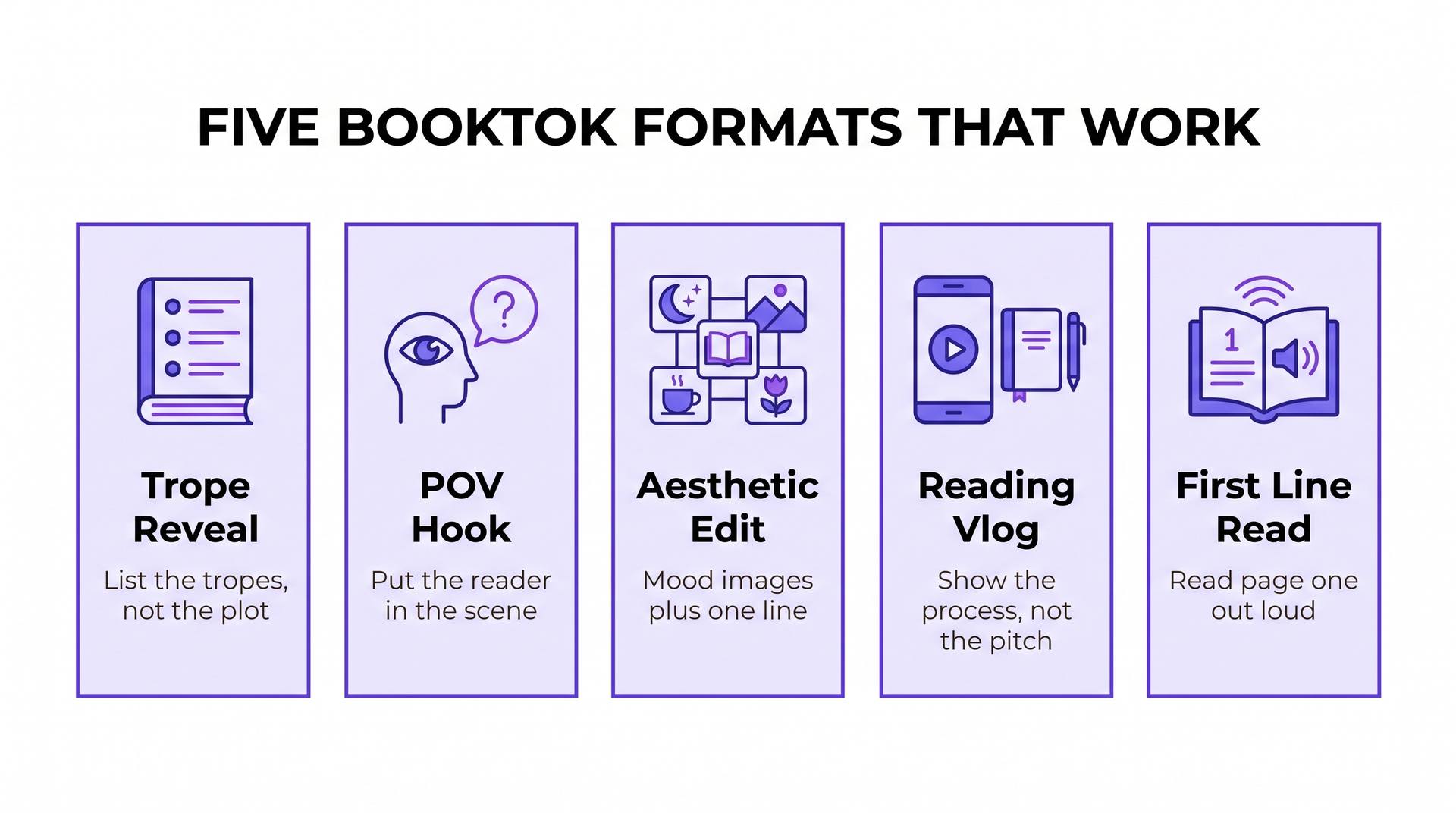
Five formats that work, and why
You do not need a content strategy with twelve pillars. You need five repeatable shapes you can film in ten minutes each, so that posting daily is a habit rather than a production.
The trope reveal
Text on screen, three to five tropes listed one per beat, no plot. This is the highest-converting format for genre fiction because it matches how readers already talk. The discipline is honesty: if you list a slow burn and deliver a kiss on page four, the comments will say so, and the algorithm reads that dissatisfaction.
The POV hook
A single second-person line that drops the viewer inside a scene — not a description of the scene. The difference between "POV: your rival just proposed to save your kingdom" and "my book is about an arranged marriage" is roughly the difference between a hook and an announcement.
The aesthetic edit
Four to six mood images cut to a track, with one line of text on the last frame. It is the cheapest video to produce and the easiest to make forgettable. It only works when the images are specific to your book's world rather than generic dark-academia stock. If you do not have a folder of footage yet, a text to video AI tool can generate a few mood clips to fill the gaps, but keep them anchored to details from your book rather than generic fantasy scenery. Giving each still a slow push or pan, which you can do when you turn photos into video, keeps the edit from reading like a slideshow.
The reading vlog and writing vlog
Show the making, not the product: the outline on the wall, the chapter that got cut, the proof copy arriving. These build the small loyal following that buys book two, which is the actual point of an author account. They rarely go viral and that is fine.
The first-line read
Read your opening lines aloud on camera. Brutally honest as a test, too — if your own opening does not hold you for eight seconds while reading it, it will not hold a browsing reader. If it wobbles, our free first-chapter hook tool will rewrite the opening a few different ways so you can hear which one survives being read out loud.
The two-second hook
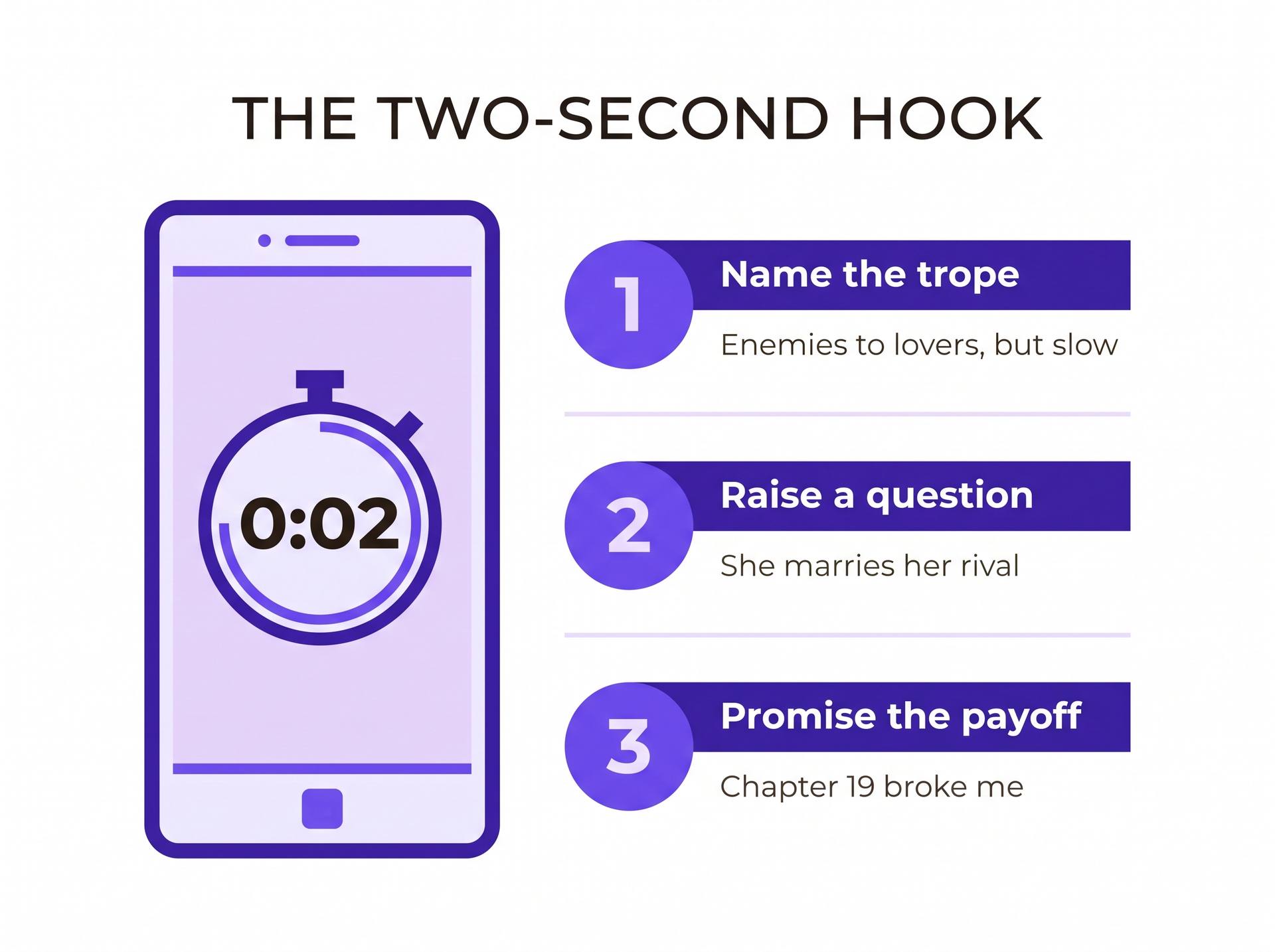
Nearly every underperforming author video fails in the same place: the first two seconds are throat-clearing. "Hi guys, so today I wanted to talk about my book" is two seconds spent earning nothing. The hook has to do one of three jobs immediately.
Name the trope
Give the reader the category they already want. Specific beats clever.
Raise a question
State a situation with an obvious missing piece and refuse to fill it in.
Promise the payoff
Point at a moment later in the book and say it costs something to reach.
Hook templates you can fill in tonight
Fill the brackets with your own book. If a template does not survive the fill, that is usually information about the book, not the template.
- If you like [trope] but you are tired of [common flaw in that trope], this one is for you.
- POV: [character situation in second person, present tense].
- Three things in this book: [thing], [thing], and one [emotional damage].
- I wrote a [genre] where [expected thing] never happens.
- Chapter [number] is the reason people message me at 2am.
- Say [trope] one more time and I will hand you this book.
Notice that none of them mention the title in the first line. The title goes on screen, in the caption, and in the comment you pin — not in the hook, where it costs you the two seconds that decide everything. The same compression skill pays off on your product page, and writing a book description that sells is the closest sibling craft to writing hooks.
Cadence, and a 30-day calendar you can actually keep
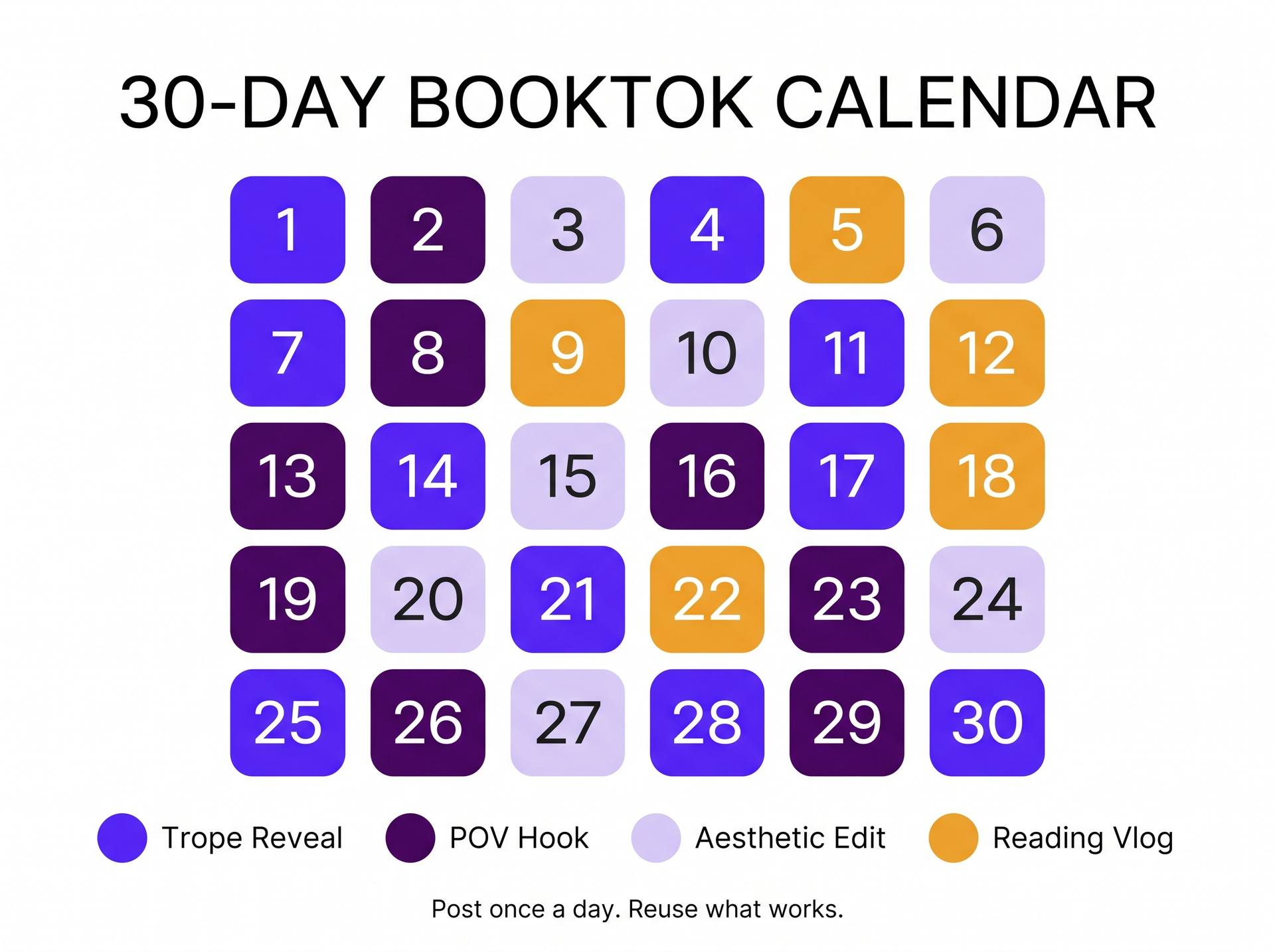
One post a day for thirty days beats three posts a day for a week and then silence. The reason is mechanical: each video is a separate test, and you need enough tests before you can tell a bad book-market fit from a run of bad hooks. Thirty posts is roughly the point where patterns become readable.
Batch on one day, post daily. Most authors who sustain this film six to eight videos in a single afternoon, keep them in drafts, and spend ten minutes a day posting and replying to comments. Replying matters more than filming — comment threads are where a lukewarm video turns into a saved one.
How the month splits
- 10 trope reveals — your highest-reach format, rotated across different trope combinations
- 8 POV hooks — one per major scene or character you can pitch in one line
- 7 aesthetic edits — built from your cover palette, setting and object motifs
- 5 vlogs — process, proof copy, edits, a chapter you cut, a reader's message
Do not plan month two until month one is finished. The point of thirty posts is that they tell you what month two should be.
Sounds, trends and TikTok Shop
Trending sounds are a distribution shortcut, not a creative strategy. Use a rising sound when its emotional shape matches your video; skip it when it does not, because a mismatched trending track reads as desperate and viewers can tell. The practical rule most consistent creators follow is to keep a running folder of sounds you have saved while scrolling, and to check whether a sound is climbing or already past its peak before building a video around it.
TikTok Shop changed the economics for indie authors who hold their own stock. It compresses the distance between a video and a purchase to a single tap, which is a real advantage over sending viewers off-platform to a retailer. It also means you are running a small fulfilment operation, with the returns, packing and margin questions that implies. If you print on demand and sell mainly on Kindle, an affiliate-style link in your bio remains the lower-effort route.
Wherever the tap goes, it should land somewhere you own. A single link that leads to a page with all your books, a chapter preview and an email capture will outperform a link to one retailer listing, because the traffic you get from one good video is the only asset that outlives the video. That is exactly what an author page is for — it holds every book, previews a chapter, and collects the email addresses you will still have when the algorithm changes its mind.
Working with BookTokers without wasting money
Paying creators is legitimate and often faster than building your own account. It is also where most author marketing budgets get burned. Four things separate a spend that works from a spend that does not.
Match the shelf, not the follower count
A creator with 8,000 followers who reads only dark romance will outsell a general book creator with 200,000. Read their last twenty videos and check whether your book would look at home there.
Send the book, not the brief
Prescriptive scripts produce videos that feel like ads and perform like ads. Give the trope list, the content warnings and one line about the vibe, then get out of the way.
Buy a series, not a post
One video from one creator is a coin flip. Three or four videos from three or four creators in the same two weeks is a signal that a book is circulating, and that is what makes viewers save it.
Agree on disclosure up front
Paid partnerships must be labelled. Unlabelled ads get creators in trouble and buy you a bad week — sort this out before money moves, not after.
Gifted copies to reviewers sit next to this work rather than replacing it: BookTok builds desire, and reviews convert it. If you have not run that side yet, our guide to getting reviews on Amazon covers the outreach that pairs with a BookTok push.
Mistakes that stall author accounts
Selling in every single video
An account that only pitches teaches the algorithm to show it only to people who already follow you. Roughly one in four videos should sell; the rest should be worth watching whether or not the viewer ever buys.
Filming a summary instead of a feeling
Plot summaries are the single most common author video and they almost never travel. Readers do not choose books by plot, they choose by anticipated feeling.
Deleting videos that underperform
Videos on this platform can resurface weeks later. Deleting them removes both the tail and the data you were supposed to learn from.
Ignoring comments after 24 hours
Late comments are where slow-burn reach happens. Answering them keeps a video circulating far longer than posting a new one does.
Rebuilding the account every six weeks
Changing name, niche and format because a month was flat destroys the only thing you were accumulating. Give a strategy the full thirty posts.
Measuring what matters
Views are the least useful number on the dashboard. Four others tell you what to do next.
Watch-through rate
The share of viewers who reach the end. Below roughly a third, your hook is fine but the middle sags. Cut length before you change anything else.
Saves
The closest thing to purchase intent on the platform. A video with modest views and heavy saves is a video to make three more of.
Comment sentiment
Not the count — the content. "What's it called" is buying. "This is so real" is entertainment. Both are good, but only one is a sale.
Profile-to-link taps
The only metric that connects the platform to your actual business. Track it weekly; it is the number that tells you whether any of this reached a book.
None of these numbers mean anything in isolation. Read them across a full thirty-post cycle, next to the rest of your self-published book marketing plan, and treat a single flat week as noise.
The AI-assisted shortcut
The bottleneck in BookTok is not filming. It is producing thirty distinct pitches for one book without repeating yourself by day nine. That is a language problem, and it is the one part of this you can genuinely automate.
Inside AIWriteBook, your book already exists as structured chapters, characters and an outline, so the marketing copy can be generated from the actual manuscript rather than from a vague memory of it. Practically: pull hook variations from your opening with the first-chapter hook tool, generate short-form pitch angles and a blurb with the blurb generator, and build the cover-matched images you need for aesthetic edits with the social posts and graphics tool. All three are free to use.
What none of this does is decide what your book is. That is still yours, and it is still the part that determines whether any of the thirty videos land.
BookTok questions authors actually ask
None. Reach on this platform is distributed per video rather than per account, which is why new accounts routinely out-perform established ones. Followers matter for book two, not for book one — a single video reaching the right readers can do more than a follower count built on unrelated content.
It helps but it is not required. Faceless accounts built on text-on-screen, aesthetic edits and voiceover perform well in fiction. What you cannot skip is a consistent voice — the reason to show your face is that it makes consistency easier, not that the algorithm demands it.
For narrative nonfiction and memoir with a specific personal stake, yes. For technical, business or reference nonfiction, your effort is usually better spent on search visibility, categories and email, because buyers of those books decide on credibility rather than mood.
Long enough to deliver one idea and no longer. Most trope reveals and POV hooks land between seven and fifteen seconds; vlogs can run to a minute when there is something genuinely happening. Watch-through rate is the number that tells you if you overshot.
Yes, and you should — the production cost is already paid. Export without the platform watermark, adjust the caption to each platform's habits, and accept that the same video will perform differently on each. If you're posting to all three platforms, an Instagram reel maker can help you resize and reformat the same footage for each without starting from scratch. The same logic applies across languages: authors can use VideoDubber.ai to dub their book trailer into other languages with AI voice cloning and lip sync. Do not let cross-posting become a reason to post less often on the platform that actually works for you.
The honest version
A BookTok strategy in 2026 is thirty ordinary videos, five formats, a hook that respects the viewer's thumb, and a link that leads somewhere you own. There is no shortcut past the volume, because the volume is the experiment. The authors who look lucky are almost always the ones who posted long enough to find out which two formats their book was built for.
Pick your five formats this week, batch the first eight videos on Saturday, and start. When you want the rest of the picture — pricing, ads, launch timing, reviews, email — the book marketing guide covers what happens off-platform, and the book launch strategy playbook is where to put a BookTok push inside a real launch calendar.