

Jump to a section
What is a simile?
A simile is a figure of speech that compares two different things using the words "like" or "as," drawing attention to a quality they share. "She's as brave as a lion." "The water was smooth like glass." The comparison is explicit — the reader is told, right there in the sentence, to hold the two images side by side and notice what connects them.
That explicitness is a simile's superpower. Because it never claims the two things are identical, only alike, a simile can be exact and surprising at the same time — you can compare a feeling to something wildly unrelated and the "like" keeps the reader oriented. It's the most beginner-friendly figurative device and, in the right hands, one of the most precise.
Simile vs metaphor
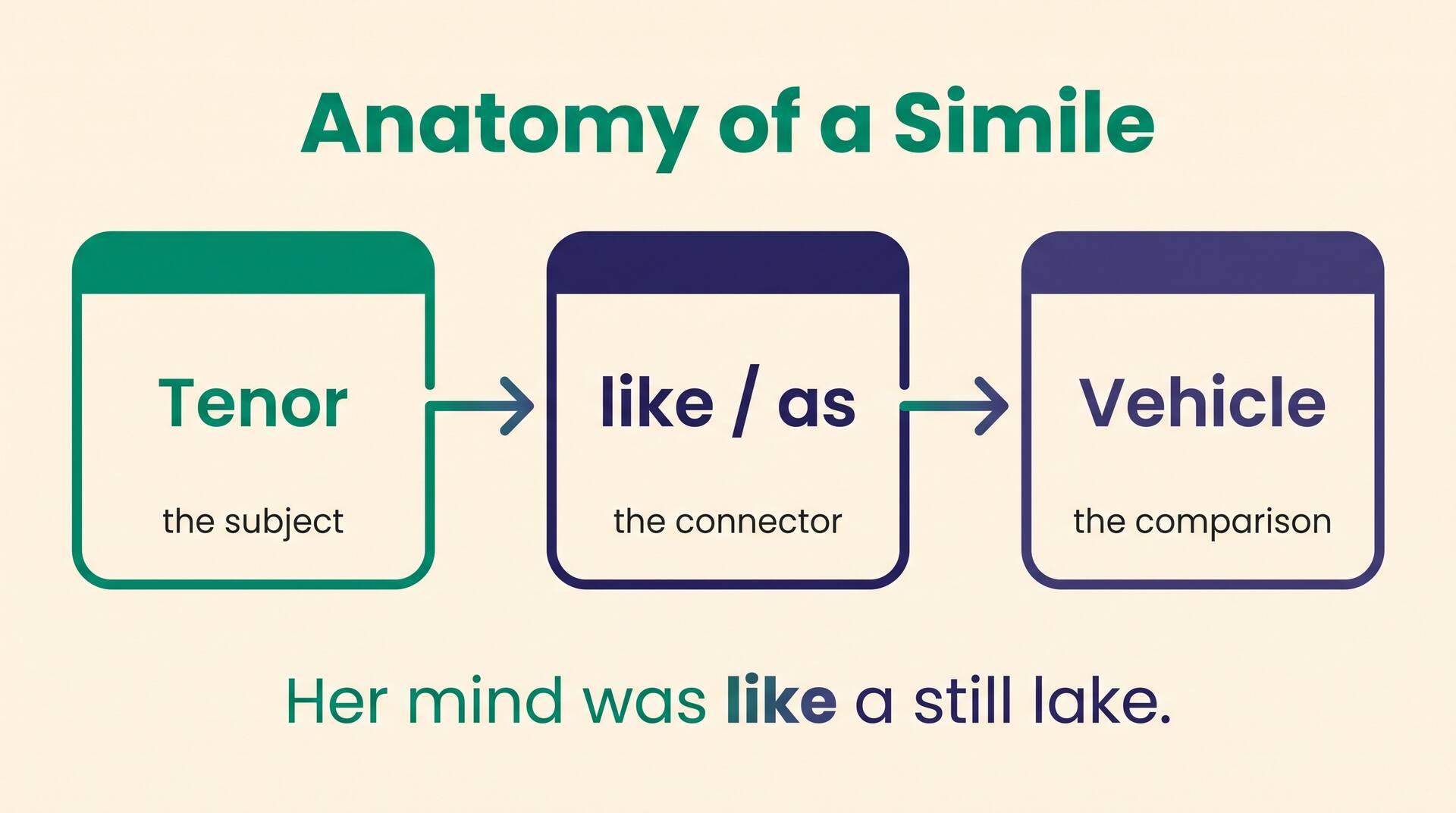
This is the comparison every writer wants nailed down, and it comes down to one word. A simile says A is like B: "her temper is like a lit fuse." A metaphor drops the "like" and says A is B: "her temper is a lit fuse." Same two images — the difference is the half-step of distance the simile keeps and the metaphor removes.
Practically, that distance changes the effect. A simile invites the reader to consciously weigh the comparison, which makes it feel considered, precise, and easy to extend across several clauses — that's why epic poetry runs on them. A metaphor fuses the two things and drops the reader straight inside the image, which hits harder and faster but leaves less room to elaborate. Use a simile when you want the reader to admire the accuracy of a comparison; use a metaphor when you want them to forget they're reading one.
Want the flip side of this pairing, with dozens of "A is B" examples and a breakdown of tenor and vehicle? Our companion guide is the other half of this toolkit.
Similes for describing people
Character description is where similes earn their keep — one sharp comparison can do the work of a paragraph. A few common building blocks, then a couple of literary ones that show what "sharp" really looks like:
Level up
The stock similes above are fine for speech but invisible on the page. Compare them to Nabokov's aging tourists "leaning on their canes, listing toward me like towers of Pisa" — the vehicle is specific, unexpected, and does double duty (age and instability at once). That's the target: not the first comparison that comes to mind, but the one only your character could produce.
Similes for emotions
Feelings are abstract, which is exactly why similes work so well on them — a comparison gives the reader something physical to hold:
Fear ran through her like ice water.
Cold, fast, involuntary — the vehicle carries all three.
Anger bubbled up like lava.
Slow pressure building toward an eruption, not a flash.
Grief sat on him like a wet coat.
Heavy, clinging, impossible to shrug off — and quietly original.
Her heart pounded like a fist on a locked door.
Panic plus the sense of being trapped, in one image.
Similes for settings and weather
Setting similes control mood. The same field can feel like peace or menace depending on the vehicle you pick:
The lake was as smooth as glass.
Stillness — and a hint of something you shouldn't disturb.
The snow lay over the town like a fresh bandage.
White and soft, but covering a wound — mood in one word.
The city glittered below them like a spilled circuit board.
Beauty rendered cold and mechanical.
The heat pressed down like a hand on the back of the neck.
Physical, faintly threatening, impossible to ignore.
Similes for action and movement
Action similes control pace. A well-placed one makes a moment feel faster, heavier, or more sudden without a single adverb:
The car shot off the line like a bullet.
Speed and violence, instantly.
He fell like a marionette with its strings cut.
Not just fast — boneless, out of control.
She moved through the crowd like a rumor.
Quiet, quick, and impossible to trace.
The crowd surged forward like a tide against a wall.
Mass, force, and the thing it's about to break.
Famous similes from literature
Four similes worth reading with a pen in hand. Notice how none of them settle for the obvious vehicle:
O my Luve is like a red, red rose that's newly sprung in June.
The most famous simile in English, and it survives because Burns keeps developing it — the rose is newly sprung, in June, specific enough to feel real rather than greeting-card.
As inconspicuous as a tarantula on a slice of angel food cake.
Chandler's hard-boiled trademark: an ironic simile where the vehicle is so vivid and absurd it lands as a joke and a description at once. The gap between the two images is the whole effect.
Men marched to the wall like a swarm of flies drawn to the milk pails in spring.
The Homeric simile — an extended comparison that runs for lines, briefly leaving the battlefield for a whole scene of its own. Proof that a simile's distance is what lets it stretch this far; a metaphor can't.
She was a girl who liked to sit still as a stone, watching.
A reminder that the plainest simile — "as X as a Y" — still works when the quality is exact and earns its place. Simplicity isn't the enemy; the tired, automatic version is.
Clichéd similes and fresher alternatives
Some similes have been used so often the reader's eye slides right past them. They're not wrong — they're just invisible, which is worse. Here's a working table: the tired version, why it's gone dead, and the move that revives it.
| Tired simile | Why it's dead | Fresher move |
|---|---|---|
| as busy as a bee | Pure autopilot — nobody pictures a bee. | Show what the person is actually doing too fast to finish. |
| as white as snow | Generic whiteness with no source. | Pick a whiteness that belongs to the scene: printer paper, bone, a hospital wall. |
| like a kid in a candy store | Tells the reader the emotion instead of showing it. | Name the specific delight and let the reader feel the greed. |
| slept like a baby | Cliché — and babies wake constantly. | Describe the actual stillness: slept without turning once, till the light woke her. |
| as brave as a lion | Labels the trait instead of proving it. | Show the brave act; let the reader supply the word. |
| fits like a glove | Dead on arrival from overuse. | Give the fit a concrete, surprising detail unique to the thing. |
The through-line: clichéd similes reach for a familiar vehicle; fresh ones reach for a precise one. When a line has gone stale and the better version won't come, drop it into the free and skim the alternatives — most will miss, but a near-miss often shows you the vehicle you were actually looking for. And when the tired simile is sitting in your opening line, our tool can help you rebuild the first sentence so the comparison earns the reader's attention.
Writing similes with AI — keeping them fresh across a whole book
One good simile is easy. The problem in a novel is the third "like a..." on the same page, and the way your favorite comparison quietly shows up in every chapter until the reader notices. Catching that is a revision job, and it's what AIWriteBook is built for. The works one chapter at a time and shows every suggested change as a diff you accept or reject — highlight a limp simile, ask for three sharper options tied to the actual scene, keep the one that fits, and reject the rest.
Because the editor learns your writing style from your own pages, the comparisons it suggests stay in your register rather than defaulting to the same stock similes every model reaches for. You keep authorship of the image; the tool just widens your options and flags the clichés you've stopped seeing after the tenth read-through.
Sharpen every comparison in your draft
Draft your chapters, then revise every tired simile into a fresh one with accept/reject diffs that stay in your voice — starting today.
Simile FAQ
A great simile is the one only your scene could make
Similes are the friendliest figurative device and the easiest to phone in — which is exactly why the good ones stand out. Sort them by the job you need done, borrow the rhythm of the literary examples, and above all trade the automatic vehicle for the precise one that belongs to your character, your weather, your moment.
Keep the common similes for dialogue and reach for the specific ones on the page. When in doubt, ask whether the reader could have guessed your comparison before reading it — if they could, it's a cliché; if they couldn't but it still fits, you've written a keeper.
Explore the full How to Write a Book guide for craft from first idea to finished draft →