


What's in this guide
What a metaphor actually is
A metaphor is a figure of speech that claims one thing is another to reveal a shared quality. Not like another — is another. When Shakespeare writes that Juliet is the sun, he isn't saying she resembles the sun; he's collapsing the two so completely that for a moment she gives off light, heat, and the power to make the rest of the sky disappear. That flat, confident equation is what separates a metaphor from its cautious cousin, the simile.
The word comes from the Greek metapherein, to carry across, and that's the exact mechanic: you carry the qualities of a vivid, concrete thing across to a subject that would otherwise stay abstract or dull. Done well, a metaphor doesn't decorate a sentence — it does thinking the literal words can't, letting a reader understand grief, time, or ambition through something they can actually picture.
The anatomy of a metaphor: tenor, vehicle, ground
Every metaphor has three parts. Name them once and you'll never look at a comparison the same way — and you'll be able to diagnose exactly why a weak one falls flat.
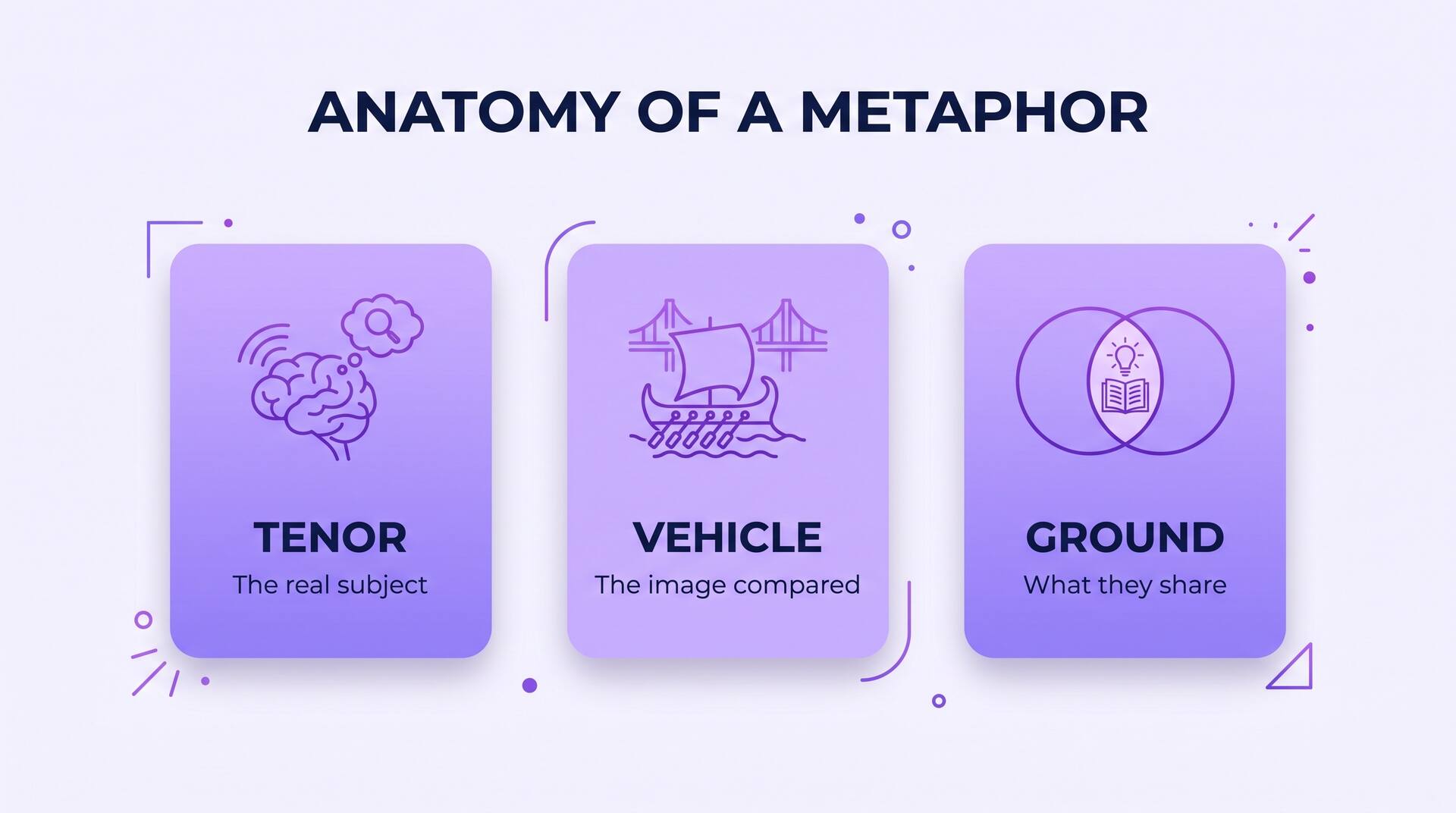
Tenor
The real subject you're describing — the thing the sentence is actually about. In "Juliet is the sun," the tenor is Juliet.
Vehicle
The image you borrow to describe it. In "Juliet is the sun," the vehicle is the sun. The vehicle carries the meaning across.
Ground
The shared quality that makes the leap work — the radiance, warmth, and life-giving pull the sun and Juliet have in common. When a metaphor feels random, it's almost always because the ground is thin or missing.
Test it on any line. "The classroom was a zoo": tenor = the classroom, vehicle = a zoo, ground = noise, chaos, animals out of control. The metaphor lands because the ground is instantly obvious. Swap the vehicle to something with no shared quality — "the classroom was a spreadsheet" — and the whole thing stalls, because there's no ground for the reader to stand on.
Metaphors in everyday speech
You speak in metaphor constantly without noticing. These are so woven into English that we process the meaning before we ever picture the image — which is exactly why they're useful for spotting the pattern:
Time is money.
He's a night owl.
She has a heart of stone.
The world is your oyster.
He's drowning in paperwork.
That exam was a breeze.
Her voice is music to my ears.
He's the black sheep of the family.
The whole city is a pressure cooker.
My memory is a sieve.
Notice that none of these use "like" or "as." That missing bridge is the tell: a metaphor states the identity outright and lets the reader supply the ground.
Metaphors in literature
The best novelists and playwrights reach for metaphor when literal language would drain the moment of feeling. Five that have survived because their ground is unforgettable:
All the world's a stage, and all the men and women merely players.
One equation opens a door to an entire worldview: if life is theater, then we have entrances, exits, and assigned roles — and the speech spends the next twelve lines walking the vehicle through the seven ages of a single life.
But soft, what light through yonder window breaks? It is the east, and Juliet is the sun.
The textbook metaphor. Romeo doesn't say Juliet is like the sun — he makes her the source of all light, which tells us more about his state of mind than any description of her face could.
Hope is the thing with feathers that perches in the soul.
Dickinson turns an abstraction — hope — into a small, stubborn bird you can almost feel shifting its weight. The whole poem is built on holding this single metaphor steady, an extended metaphor in miniature.
It's a metaphor, see: you put the killing thing right between your teeth, but you don't give it the power to do its killing.
A rare case of a character explaining his own metaphor on the page — the unlit cigarette — and it works precisely because the ground (a threat you control by refusing to activate it) reframes everything we thought we knew about the character.
Life for me ain't been no crystal stair.
A mother's whole hard life delivered in one vehicle. The rest of the poem stays inside the staircase — tacks, splinters, boards torn up, no light — proving how much narrative a single well-chosen metaphor can carry.
Metaphors in poetry and songs
Poets and songwriters lean on metaphor harder than any other writers, because they're trying to move a listener fast, in very few words. A metaphor that would feel showy in prose is the whole point in a lyric.
In poetry
- "The fog comes on little cat feet" — Carl Sandburg makes fog into a cat that sits, looks, and moves on, in six lines.
- "I'm a riddle in nine syllables" — Sylvia Plath opens Metaphors with a metaphor for pregnancy, then stacks eight more on top of it.
- "Because I could not stop for Death — He kindly stopped for me" — Dickinson casts Death as a courteous carriage driver, and the poem never breaks character.
In songs
- "Baby, you're a firework" — Katy Perry.
- "Life is a highway" — Tom Cochrane.
- "You are my sunshine" — Jimmie Davis.
- "Love is a battlefield" — Pat Benatar.
Metaphor rarely works alone in verse — it stacks with sound. If you're tuning the music of a line, our examples of and pair naturally with the imagery here.
Extended metaphors
An extended metaphor (sometimes called a conceit) sustains a single comparison across several lines, a scene, or an entire work — developing the vehicle instead of dropping it after one sentence. This is where metaphor stops being an ornament and starts doing structural work.
Sonnet 18 — Shakespeare
Begins by comparing the beloved to a summer's day, then spends fourteen lines arguing the beloved is better than summer: less brief, less prone to storms, never dimmed. The comparison is the poem's whole engine.
The seven ages of man — As You Like It
Having declared the world a stage, Shakespeare refuses to let go: infancy, schoolboy, lover, soldier, justice, old age, second childishness — each is a scene, each an exit. One metaphor, an entire theory of a human life.
The green light — The Great Gatsby
Fitzgerald returns to the light at the end of Daisy's dock again and again until it stops being a color and becomes Gatsby's whole reaching future. When a metaphor recurs across a book like this, it crosses into symbolism — we unpack that overlap in our guide to .
The craft lesson: an extended metaphor only holds if every new detail still fits the original vehicle. The moment you add a detail the image can't support, the reader feels the seam.
Metaphor vs simile
The line is simple, and it's the single most useful thing to get right. A metaphor states identity — A is B. A simile asserts likeness — A is like B, or A is as [quality] as B. "Her mind is a steel trap" is a metaphor; "her mind is like a steel trap" is a simile. Same image, different force.
Metaphor is the bolder move. By removing "like" or "as," it fuses the two things and pulls the reader inside the image with no half-step of distance. A simile keeps that half-step on purpose, holding both things in view at once so the reader consciously weighs the comparison — which makes similes gentler, often more precise, and much easier to extend. Reach for metaphor when you want immersion; reach for a simile when you want the reader to notice the comparison and admire its accuracy.
Neither is better — good writing runs on both. For the full companion catalog of like/as comparisons sorted by what they describe, see our guide.
Dead metaphors and clichés to avoid
Not every metaphor is working for you. Two kinds quietly drain your prose, and they're worth learning to spot.
Dead metaphors
A dead metaphor is one so absorbed into everyday language that nobody pictures the image anymore: the leg of a table, the mouth of a river, the hands of a clock, falling in love, running out of time. These aren't mistakes — they're just invisible. You use them the way you use any ordinary word, and that's fine. The trap is mistaking them for vivid writing. If you're reaching for imagery and you land on "the foot of the mountain," you haven't actually painted anything.
Clichés (and fresher moves)
A cliché is a metaphor that was once fresh and has been used to death. The reader's eye slides right over it. The fix is almost never "add a bigger metaphor" — it's to get specific and concrete about the actual thing in front of you:
She has a heart of gold.
Show the specific generous act — the coat given away, the double shift covered — and let the reader conclude it.
It's just the tip of the iceberg.
Name what's under the surface: the debt behind the missed rent, the six other emails he never answered.
A light at the end of the tunnel.
Give the hope a real shape belonging to this character — the paid-off card, the letter that finally came.
A diamond in the rough.
Point at the actual raw promise: the terrible demo with two perfect bars in it.
One more hazard: the mixed metaphor, where two images collide and cancel out — "we'll burn that bridge when we come to it," "it's not rocket surgery." Funny in speech, fatal in prose. Pick one vehicle and stay inside it. When a line has gone stale and you can't find the fresh version yourself, running it through the free will hand you a stack of alternatives to react against — most will be wrong, but the wrong ones point you at the right one.
Writing your own metaphors — without the clichés
Inventing one clever metaphor is easy. The real difficulty in a book is sustaining fresh imagery across 60,000 words without repeating your favorite vehicle or sliding into the tired ones your reader has seen a thousand times. That's a revision problem, and it's exactly where AIWriteBook is built to help. The drafts and rewrites one chapter at a time and shows every suggested change as a diff you accept or reject — so you can highlight a flat, literal line, ask it to find the vivid vehicle, keep the version that lands, and reject the rest.
Because the editor learns your writing style from your own pages, the imagery it proposes stays in your register instead of defaulting to the same stock similes every AI reaches for. You stay the author of the metaphor; the tool just widens the field of options and flags the clichés you stopped seeing.
Put fresh imagery into your actual chapters
Draft, then sharpen every flat line into a working metaphor with accept/reject diffs — starting with your own book, today.
Metaphor FAQ
The best metaphor is the one only your book could make
Metaphor is the closest writing comes to teleportation: it carries a reader from an abstraction they can't feel to an image they can't forget. Learn the three parts, borrow shamelessly from the masters, and — most of all — route around the dead ones and the clichés, because a tired metaphor costs you more trust than no metaphor at all.
Steal the everyday patterns, study how the literary examples hold their ground, and then write the one comparison that only your story, with its specific people and stakes, could ever produce.
Explore the full How to Write a Book guide for craft from first idea to finished draft →