

Call a man's ambition his Achilles' heel and you have moved four thousand years of story into five words. Nobody has to be told his mother dipped him in the Styx by one foot, or that an arrow eventually found the spot the river never touched. The phrase carries it. That compression is why writers use allusion — and why a badly aimed one lands with such a dull thud.
The hard part is not writing the allusion. It is predicting whether the reader will catch it, a question most craft advice skips entirely. This guide handles it directly.
Definition
An allusion is a brief, unexplained nod to a person, place, event, or work outside the text — so that a reader who recognises it imports its whole meaning into your sentence, and a reader who doesn't still gets a sentence that makes sense.
Both halves matter. The nod has to stay brief and unexplained or it stops being an allusion, and the sentence has to survive without it or you have written a puzzle instead of a story.
Allusion vs. reference vs. homage
These three get used interchangeably, and the difference is worth knowing because each asks something different of the reader.
Allusion
Brief and unexplained. Named in passing, never unpacked.
Asks for recognition — the reader supplies the context.
"He met his Waterloo in the third act."
Reference
Explicit. The source is named and its relevance stated.
Asks nothing. The text does the work.
"Like Napoleon at Waterloo, where his last army broke, he lost everything at once."
Homage
Sustained imitation of another work's style or structure.
Asks for familiarity across a passage, not a phrase.
A chapter rebuilt on the shape of a famous battle scene, never named.
The practical upshot: allusion is the only one of the three that can fail silently. A reference always communicates, a homage reads as ordinary prose to anyone who misses it, and a missed allusion leaves a small dead spot — a name that meant nothing. That risk is what you are managing every time you use one.
The four source-wells of allusion
Nearly every allusion in English draws from one of four wells, and knowing which one you are drawing from tells you immediately how wide your audience is.
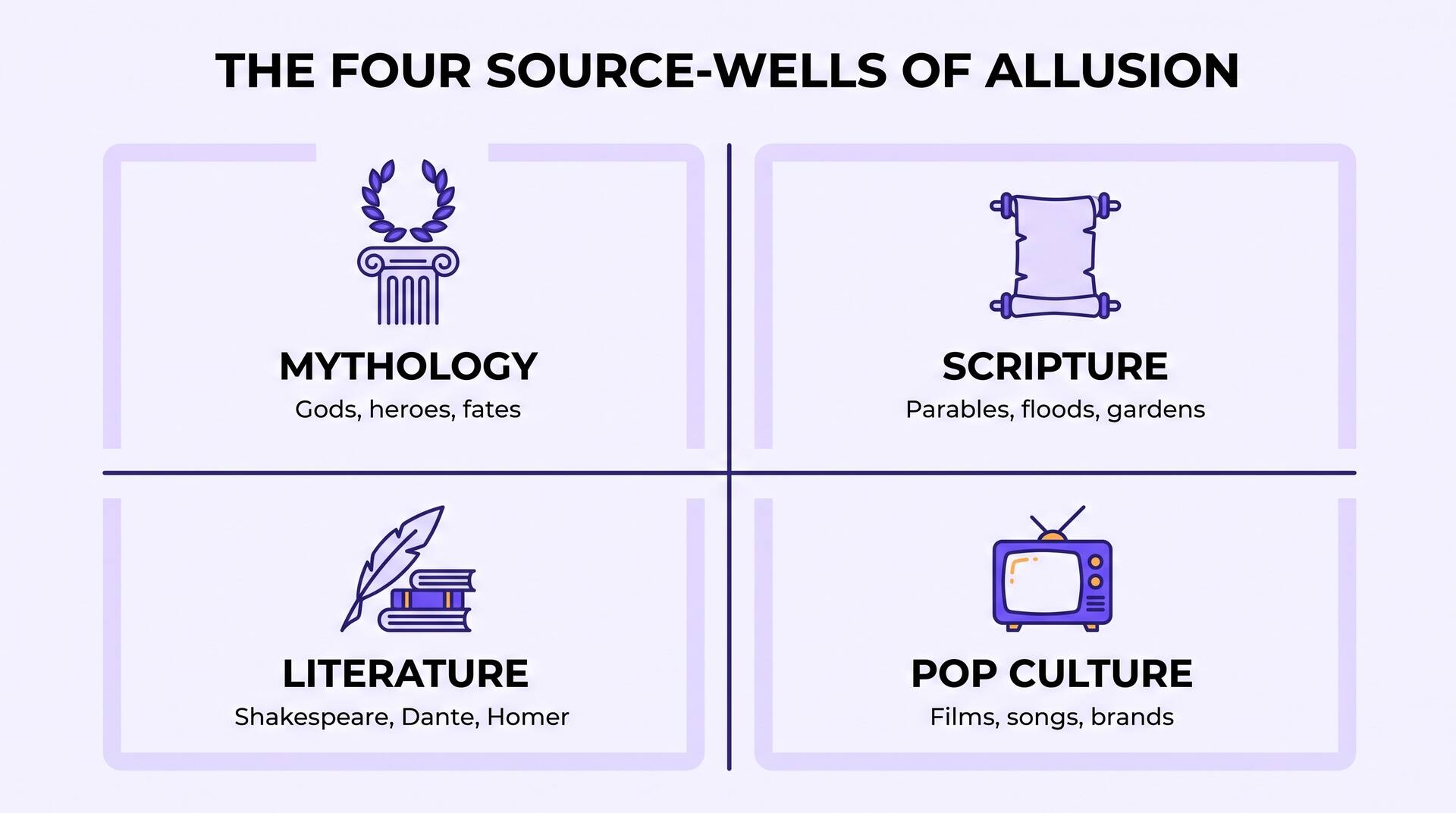
Mythology
The deepest well, because the names have leaked into ordinary English — odyssey, siren, titan, narcissist, mentor, panic, echo were all proper nouns first. Joyce built a whole novel on it: Ulysses maps one Dublin day onto Homer's Odyssey, with an advertising canvasser as Odysseus. Readable without the map, richer with it, which describes any good mythological allusion.
Scripture
The most portable well in Western writing: floods, gardens, betrayals for silver and prodigal sons circulate far beyond anyone's religious practice. Steinbeck ran Cain and Abel through three generations in East of Eden, keeping the brothers' initials at C and A each time — Charles and Adam, then Caleb and Aron.
Literature
The narrowest well and the most flattering to the reader who drinks from it. Huxley took Brave New World from Miranda's line in The Tempest, spoken by a girl who has never seen society. The novel turns her wonder into a flat joke, and readers who know the source hear the sarcasm before the plot supplies it.
Pop culture
The shallowest well and the fastest-acting. Everyone gets it now; almost nobody will in forty years. Fine if the point is that your characters live in this decade, a real problem if you want the book read in the next one.
Eight allusions, taken apart
Eight real examples, with the mechanic in each one named rather than admired.
- 1
Achilles' heel
So naturalised that most speakers use it without knowing they are invoking Homer. That is the fate of a truly successful allusion — it stops being one and becomes vocabulary.
- 2
Ulysses, James Joyce
Structural allusion. Hades is a funeral, the Sirens are barmaids. The book never states the parallel in the text; Joyce circulated the schema separately.
- 3
East of Eden, John Steinbeck
Sustained scriptural allusion, cued by the title and the repeated initials. The novel even stops to argue about the Hebrew word timshel — a writer explaining his own source and getting away with it.
- 4
Brave New World, Aldous Huxley
Ironic allusion. The source phrase is sincere wonder; the title turns it inside out. The gap between what the source meant and what the book means is itself the meaning.
- 5
The Sound and the Fury, William Faulkner
From Macbeth's "a tale told by an idiot, full of sound and fury, signifying nothing." The first section is narrated by a man with severe intellectual disability. The title hands you the reading strategy before page one.
- 6
Frankenstein, Mary Shelley
Subtitled The Modern Prometheus. Prometheus stole fire and was punished forever. Two words deliver the novel's entire moral argument before a sentence of story.
- 7
The Great Gatsby, F. Scott Fitzgerald
The eyes of Doctor T. J. Eckleburg watch the valley of ashes from an oculist's billboard. The text never calls them God; a drunk character says it once and the novel lets the reader carry it.
- 8
Harry Potter, J. K. Rowling
Remus Lupin is a wolf twice over, Sirius Black is the dog star, Draco is a dragon. Children read the names as sound, adults read them as spoilers — one text, two reading depths, which is the most commercially useful thing an allusion can do.
So we beat on, boats against the current, borne back ceaselessly into the past.
Not a nod to any single text but to a whole tradition of rowing-against-time imagery — which is why it still works on readers who have never traced it anywhere.
Notice the pattern: the allusion sits in a title, a name, or a passing phrase. Almost never in a paragraph of explanation. Explain it and you have converted it into a reference, giving up everything you were trying to buy.
Will your reader actually catch it?
Here is the test nobody writes down. Before you keep an allusion, ask what share of your specific readers — the ones who buy books in your genre, not readers in general — would recognise the source unaided. Then place it in one of three bands.
Above roughly 80 percent
Safe anywhere, including load-bearing positions. Achilles' heel, a Judas, opening Pandora's box. These have become idiom, which means they carry clarity but no surprise.
Roughly 30 to 80 percent
Where the good work happens. Place these so the sentence is complete without recognition and the recognition adds a layer on top. Faulkner's title does exactly this: read it never having met Macbeth and you lose nothing structural.
Below roughly 30 percent
Cut it, or convert it into a reference and let the text explain. An allusion nobody catches is not subtle, it is invisible — and no reader experiences depth they failed to notice.
Three rules for placement
- 01Never make an allusion load-bearing below the 80 percent band. If missing it means missing the plot point or the character's motive, you have built a door only some readers have a key to.
- 02Put the risky ones in titles, chapter headings, and character names — positions the reader re-encounters, with room to dawn on someone slowly.
- 03One allusion per source per book. Two nods to the same myth reads as a motif you now have to pay off. Three reads as a thesis. Don't accidentally announce a retelling.
The estimate is not science and doesn't need to be. It forces you to name your actual reader instead of an ideally-read one, and that alone kills most of the allusions that would have failed.
Mistakes that kill an allusion
- Explaining it in the next sentence. "His Achilles' heel — the weak spot that would destroy him" pays the cost of the allusion and refunds you the benefit.
- Stacking them. Three mythological names in one paragraph stops reading as erudition and starts reading as showing off.
- Alluding to something you haven't read. Readers who know the source spot a misremembered plot instantly, and it costs you their trust for the rest of the book.
- Mistaking a quotation for an allusion. Quoting Shakespeare in dialogue is your character being literary; shaping your title out of a Shakespeare line is you being literary.
- Letting it set a tone the scene can't carry. Invoking Lear at a dinner-party argument promises a scale of tragedy a dinner party won't deliver.
Writing allusions into an actual draft
Allusion is a revision technique far more often than a drafting one. Write the plain sentence first — it has to work anyway — then on a later pass find the two or three places where a name would do more than an adjective.
Two places to look on that pass. Character names are the cheapest carrier: free, re-read constantly, never interrupting the prose — our character name generator is a fast way to shake loose options with the right roots before you commit. The other is titles, where more famous allusions live than anywhere else, and where our book title generator is worth a few minutes of throwing source phrases at it.
Once a draft exists the work is targeted rewriting: swap one flat description for an allusive one and see whether the scene got sharper or just fancier. In AIWriteBook that is what the chapter AI chat is for — you ask for a change to a specific passage and get it back as a diff you accept or reject line by line, instead of a wholesale rewrite. The AI chapter generator page shows where that editing pass sits in the flow.
Worth saying plainly: any AI model will hand you allusions, and most will be the 90-percent kind — Icarus, Pandora, Achilles, already worn smooth. The interesting choices in the 30-to-80 band come from what you have actually read, and no tool supplies that.
The short version
An allusion is compression, and compression only pays if the reader can decompress it. Decide the band before you keep the line, keep the sentence working without it, never explain it, and never let one carry weight the reader might not be able to lift.
It sits alongside the rest of the figurative toolkit — closest to symbolism, since both ask the reader to carry meaning in from outside, and on a different circuit from metaphor, which builds its comparison entirely inside the text.
If you are working on a full manuscript rather than a single scene, our guide to writing a book covers where craft passes like this one belong in the drafting and revision order.