


What imagery actually is
Imagery is language that appeals to the senses. Instead of stating a fact about the world, it hands the reader the raw sensation and lets them build the picture — the crack of a crust, the tang of sour milk, the cold that gets under a collar. The word sounds visual, but imagery covers every sense, not just sight, which is exactly why so many writers under-use it: they describe what a scene looks like and forget it can also be heard, smelled, tasted, and felt.
It helps to separate imagery from figurative language, because the two overlap constantly. Imagery is any description that appeals to the senses. A metaphor or a simile is a specific comparison — and while those comparisons are often built from vivid images, plenty of powerful imagery uses no comparison at all. “Cold rain ran down the back of his collar” is pure sensory imagery with nothing figurative in it. Keep the distinction in your back pocket: all similes lean on imagery, but not all imagery is a simile.
The seven types of imagery
Imagery is usually split into seven types, one for each channel the body reads the world through. You rarely think about them by name while drafting, but knowing the full set is the fastest cure for sight-only description — it reminds you there are six other doors into a scene. Here is each type, defined, with a line from a writer who trusted it.
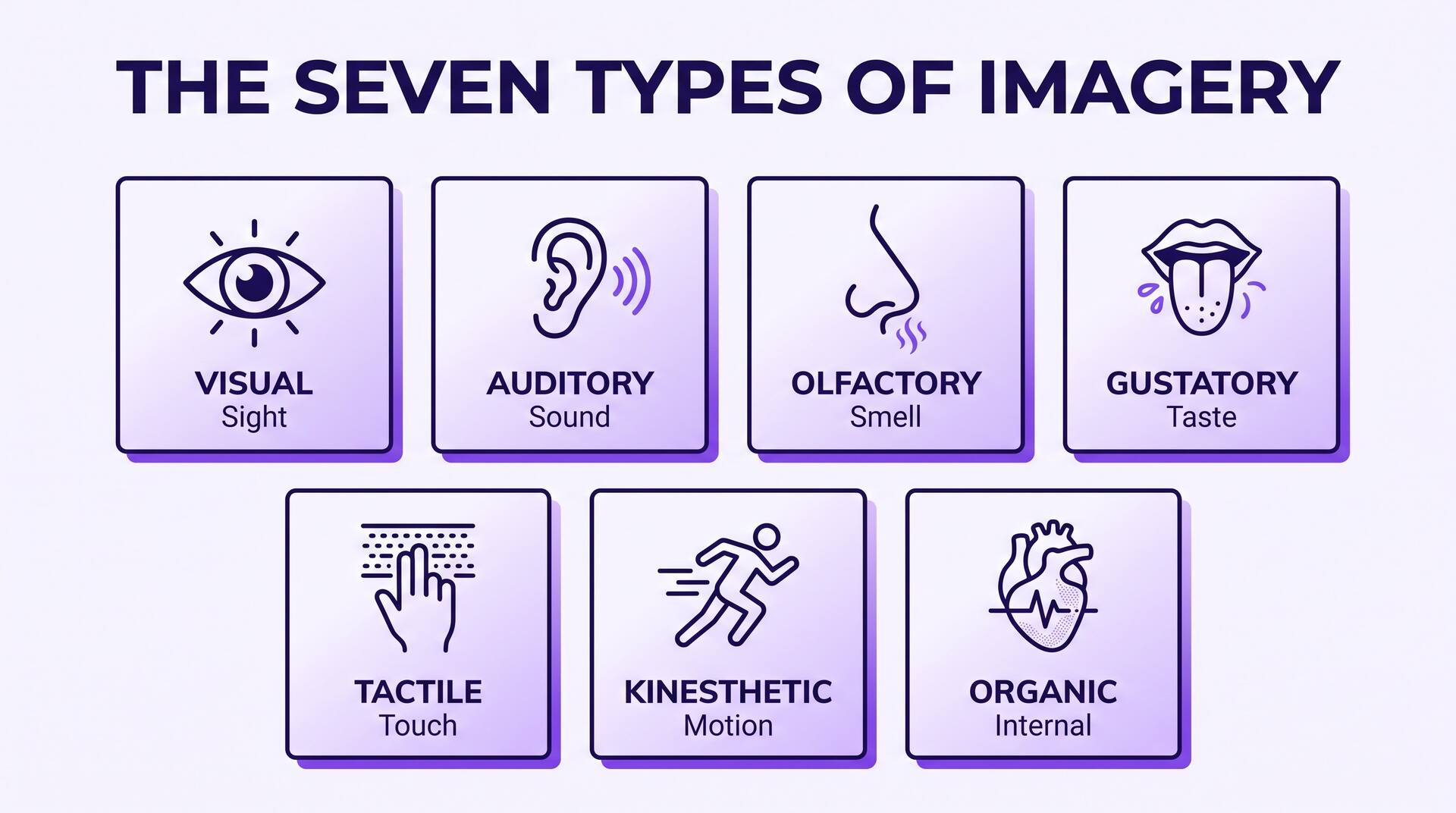
Visual
SightDescription of what can be seen — colour, light, shape, movement across space. The default and most common type, which is exactly why a striking visual image has to be specific to land.
“…nothing except a single green light, minute and far away, that might have been the end of a dock.”
one small point of colour across black water carries the whole novel's longing.
Auditory
SoundDescription of what can be heard — pitch, volume, rhythm, silence. Sound imagery sets mood almost instantly, because we react to noise before we've consciously named it.
“It cracked and growled, and roared and howled, / Like noises in a swound!”
four verbs of sound stack the noise of shifting ice until you can hear it.
Olfactory
SmellDescription of scent. Smell is the sense most tied to memory and emotion, so a single well-placed odour can date a scene, place a character, or trigger a flashback faster than a paragraph.
“The winter evening settles down / With smell of steaks in passageways.”
one smell drops you onto a cold city street at dusk more completely than a full description of it could.
Gustatory
TasteDescription of flavour — sweet, bitter, salt, sour, the texture of food in the mouth. The rarest type in most prose, and therefore one of the freshest when you reach for it.
“…jellies soother than the creamy curd, / And lucent syrops, tinct with cinnamon.”
the taste words make the midnight feast almost edible on the page.
Tactile
TouchDescription of physical contact and texture — heat, cold, pressure, roughness, weight. Touch imagery makes a world feel solid, and it can carry emotion the character would never say out loud.
“How like a winter hath my absence been … / What freezings have I felt, what dark days seen!”
'freezings' turns an emotional absence into something the skin can feel.
Kinesthetic
MotionDescription of movement and physical action — the sense of a body or object moving through space. Kinesthetic imagery is what makes action feel fast and a still scene feel poised.
“He clasps the crag with crooked hands … / And like a thunderbolt he falls.”
the whole poem holds still until that last line drops the bird through the air.
Organic
InternalDescription of internal, bodily sensation — hunger, thirst, nausea, exhaustion, a racing heart, the physical grip of fear. The least-known type and the most direct route into a character's inner state.
“And then a Plank in Reason, broke, / And I dropped down, and down—”
an internal collapse rendered as a bodily fall you feel in your own stomach.
Auditory imagery has a close cousin worth knowing by name: onomatopoeia, words like buzz, hiss, and crack that imitate the sound they describe. It's the most concentrated form of sound imagery there is, and a single one dropped into a plain sentence can do the work of a whole clause.
Layering the senses
The seven types are a menu, not a checklist. You almost never write one clean example of each in isolation; the most immersive passages stack two or three senses in the same moment, and sometimes drive a single image so hard it becomes the whole atmosphere. Look at how Dickens opens Bleak House:
“Fog everywhere. Fog up the river, where it flows among green aits and meadows; fog down the river, where it rolls defiled among the tiers of shipping…”
It is one image — fog — repeated until London itself feels smothered. But notice it is visual and tactile at once: you see the greyness and feel its damp, creeping cold. Dickens doesn't reach for variety; he reaches for saturation, letting a single well-chosen image accumulate weight across a whole paragraph before a character has spoken. That is the real lesson of layering — sometimes it means two senses in one line, and sometimes it means one sense pressed until the reader can't escape it.
This is also where imagery shades into music. When concrete sensory detail is paired with deliberate rhythm and repetition, plain description turns into something closer to song — the territory of a lyrical writing style, where how a line sounds matters as much as what it shows.
From flat to vivid: a revision method
Here is the part most guides skip: nobody drafts vivid prose on the first pass. Imagery is a revision move. You write the plain, true sentence to get the meaning down, then you go back and ask a single question — which sense would make the reader feel this? Watch three flat lines climb that ladder.
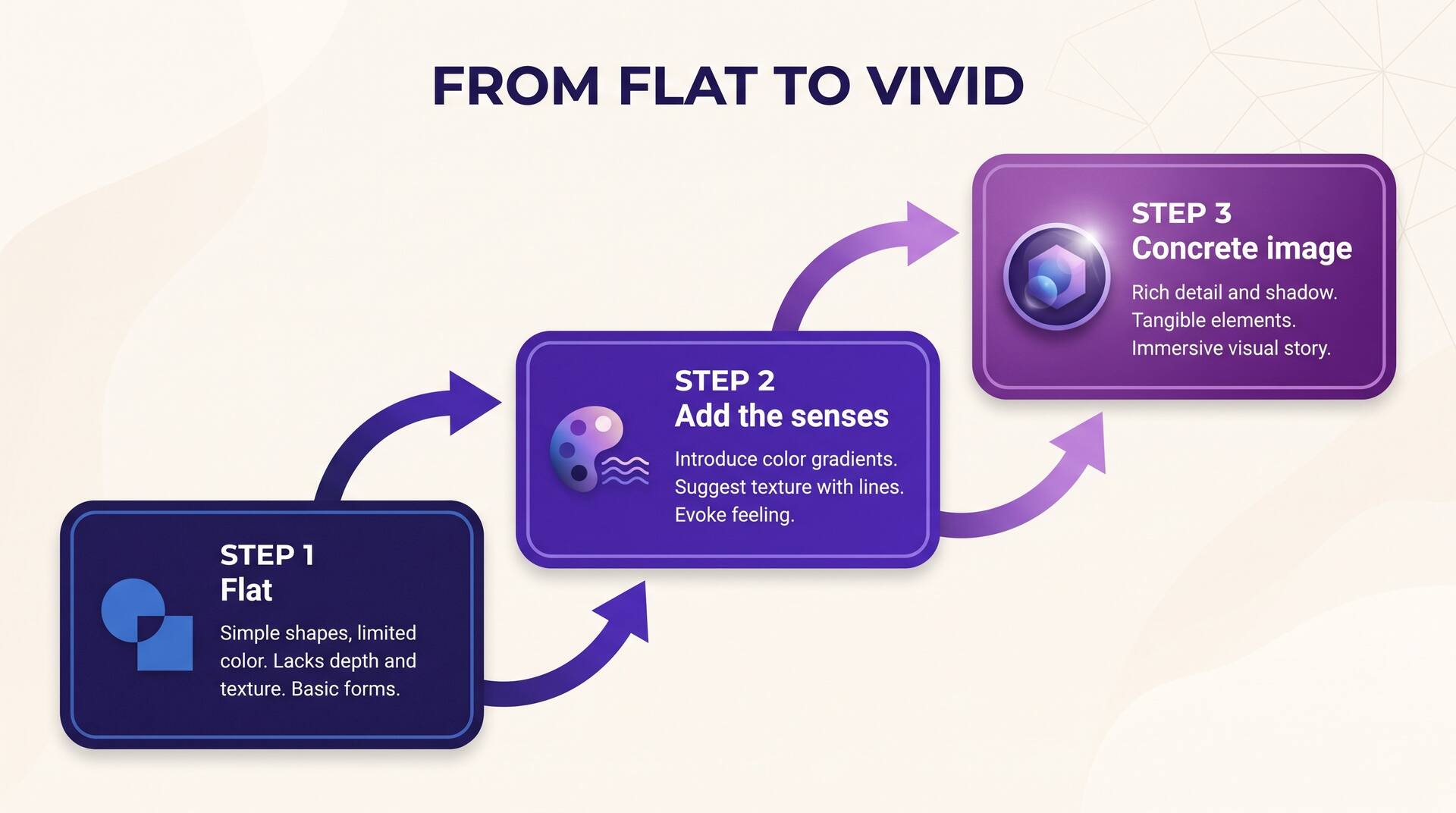
The kitchen was old and it smelled bad.
The kitchen was cramped, and a sour smell hung in the air.
Grease had darkened the corners of the ceiling, and the air carried the sour tang of milk left out too long.
The abstract judgments — old, bad — became concrete details a reader can actually see and smell. “Bad” tells you a verdict; “the sour tang of milk left out too long” makes you reach it yourself.
She was very nervous before the interview.
Her hands were cold and her stomach felt tight before the interview.
In the waiting room her palms went cold, and something in her stomach kept folding over itself like a fist.
This is organic imagery at work. “Nervous” names the feeling from the outside; the folding fist puts the reader inside the character's body, where the feeling actually lives.
The forest was beautiful in autumn.
The autumn forest was full of red and gold leaves and the smell of damp earth.
Red and gold leaves let go one at a time, and the path gave off the damp, mineral smell of earth after rain.
“Beautiful” is a verdict the reader has to take on trust. Specific colour, a hint of motion, and a real smell let them arrive at “beautiful” on their own — which is the only version that sticks.
The purple-prose problem
Used well, sensory language is the backbone of memorable prose. Pushed too far, it becomes purple prose — imagery that has stopped serving the story and started performing. The line between the two isn't about how rich the writing is; it's about whether each image earns its place. Four ways vivid writing goes wrong:
Sensory overload
Cramming sight, sound, smell, taste, and touch into a single sentence doesn't immerse the reader — it drowns them. One or two well-chosen senses per moment almost always do more than five. Pick the detail that carries the mood and cut the rest; the restraint is what makes the chosen image land.
Imagery that shows off
When the adjectives and comparisons start calling attention to themselves — “the resplendent, coruscating orb of the diurnal heavens” for “the sun” — the reader notices the writing instead of the world. If a line makes a reader admire your vocabulary rather than see the scene, it has crossed into purple.
Abstract intensifiers
Words like indescribably beautiful, unimaginable horror, and breathtaking are the opposite of imagery. They ask the reader to supply the picture you were supposed to paint. If a thing is beautiful, don't say so — show the one detail that makes it beautiful and let the reader draw the conclusion.
Imagery that fights the moment
A terrified character sprinting from a burning house does not pause to notice “the delicate lavender hue of the dawn sky.” Imagery has to match who is perceiving it and what they feel. Sensory detail filtered through the wrong mood or the wrong point of view breaks the spell instead of casting it.
When to lean in, and when to hold back
Reach for imagery when
- Establishing a setting the reader has never seen — ground it in two or three concrete senses, not a paragraph of sight-only description.
- Slowing down for an emotional beat you want the reader to feel in their body, not just follow on the page.
- Writing a moment of high sensory charge — food, weather, danger, desire — where the senses are the point.
- Anchoring something abstract — grief, memory, the passage of time — in a single physical detail the reader can hold.
Hold back when
- The scene needs pace — action and dialogue move faster with less description in the way.
- You've already established the setting; re-describing the same room stalls the story.
- The image would pull focus from what actually matters in the moment.
- A plain sentence is doing the job cleanly — not every line needs to sing, and the ones that do sing louder for the quiet around them.
Writing imagery with AI
Vivid settings are usually where a draft goes flat first — you can see the room perfectly in your head, but only “the kitchen was old” makes it to the page. When you're stuck, AIWriteBook's free scene builder takes a location and a mood and returns concrete, multi-sensory detail you can trim down and make your own. Treat it as a prompt for your own senses, not a replacement — keep the two images that fit your character's eye and drop the rest.
Because imagery is a revision move, it fits naturally into editing. Inside the book editor, AIWriteBook's chapter AI chat works one chapter at a time and shows every suggested edit as a diff you accept or reject — so you can ask it to lift a flat paragraph into concrete sensory detail, keep the lines that land, and reject anything that tips into purple. Your meaning stays put; only the picture sharpens.
The real risk with any writing help is generic imagery — the same golden light and crisp autumn air everyone else reaches for. AIWriteBook can write in your own style, learned from a sample of your prose or an imported manuscript, so the sensory language reads like you noticing a detail rather than a machine reaching for a cliche.
Turn “it was beautiful” into a scene readers can feel
Build vivid, multi-sensory settings, then sharpen every flat line into concrete detail with accept-or-reject diffs — starting with your own book, today.
Imagery FAQ
Imagery is descriptive language that appeals to the reader's senses — sight, sound, smell, taste, touch, and internal sensation — so a scene can be experienced rather than just understood. “The bread was fresh” states a fact; “the crust cracked and let out a curl of steam” is imagery.
Visual (sight), auditory (sound), olfactory (smell), gustatory (taste), tactile (touch), kinesthetic (movement), and organic (internal sensations like hunger, fatigue, or fear). Most vivid writing layers two or three of them in a single moment rather than using one at a time.
No. Imagery is any sensory description; a metaphor is a specific figure of speech that says one thing is another. They overlap — “the fog wrapped the city in wet wool” is both imagery and metaphor — but plain sensory detail like “cold rain ran down the glass” is imagery with no metaphor in it at all.
Organic imagery describes internal, bodily sensations rather than the five external senses — hunger, thirst, nausea, exhaustion, a racing heart, the tightness of fear. It is the most direct way to put a reader inside a character's body during an emotional moment, which is why it carries so much weight for so few words.
Choose the one or two senses that carry the mood, use concrete nouns and verbs instead of abstract adjectives, and cut any image that shows off instead of serving the scene. If a plain sentence does the job, let it — restraint is what keeps the vivid moments vivid.
Let the reader do the seeing
Imagery works because the mind can't help simulating what it reads — name a smell, a texture, a fall through space, and the reader supplies the experience for free. That's why “a single green light, minute and far away” outlives a hundred sentences that merely tell us a character is longing. The seven types are just seven doors into that simulation, and most memorable passages walk through two or three of them at once.
Start with the plain, true sentence. Then ask which sense would make a reader feel it — and stop before the image starts performing. Do that consistently and description stops being the part readers skim.
Explore the full How to Write a Book guide for more craft, from first outline to finished draft →