

Definition
An antagonist is the character or force whose goal stands in direct opposition to the protagonist's goal, and whose pursuit of that goal generates the story's central conflict.
Nothing in that sentence requires the antagonist to be evil, or even to be a person.
An antagonist is not the same thing as a villain
Start here, because almost every weak antagonist in an unpublished manuscript comes from confusing the two words. A villain is a moral judgement: someone who does wrong. An antagonist is a structural role: whoever is standing between the protagonist and what the protagonist wants. The overlap is real but partial. Sauron is both. Most memorable antagonists are only one.
The practical consequence is that you cannot make an antagonist stronger by making them nastier. Cruelty is not opposition. If your antagonist kicks a dog in chapter two but never actually blocks the protagonist's plan, the story has a villain and no antagonist, and readers will feel the slack without being able to name it.
Three antagonists who are not villains
The sympathetic antagonist
In Kazuo Ishiguro's The Remains of the Day, Miss Kenton opposes Stevens at every turn — she wants him to admit feeling, he wants to remain a perfect servant. She is the warmest, most generous person in the book, and she is the antagonist, because her goal cannot coexist with his.
The institutional antagonist
In Ken Kesey's One Flew Over the Cuckoo's Nest, Nurse Ratched is frightening precisely because she never breaks a rule. The opposition is the ward's machinery of order, and she is its most competent servant. Take her away and the institution still opposes McMurphy.
The protagonist as their own antagonist
In Fyodor Dostoevsky's Crime and Punishment, no external character seriously obstructs Raskolnikov. Porfiry circles, but the thing preventing Raskolnikov from getting what he wants — to be the exceptional man his theory describes — is Raskolnikov's own conscience. The opposition is internal and complete.
The antagonist is not the person you hate. It is the person who makes the thing you want cost something.
If removing a character does not change what the protagonist's goal costs, that character is not your antagonist.
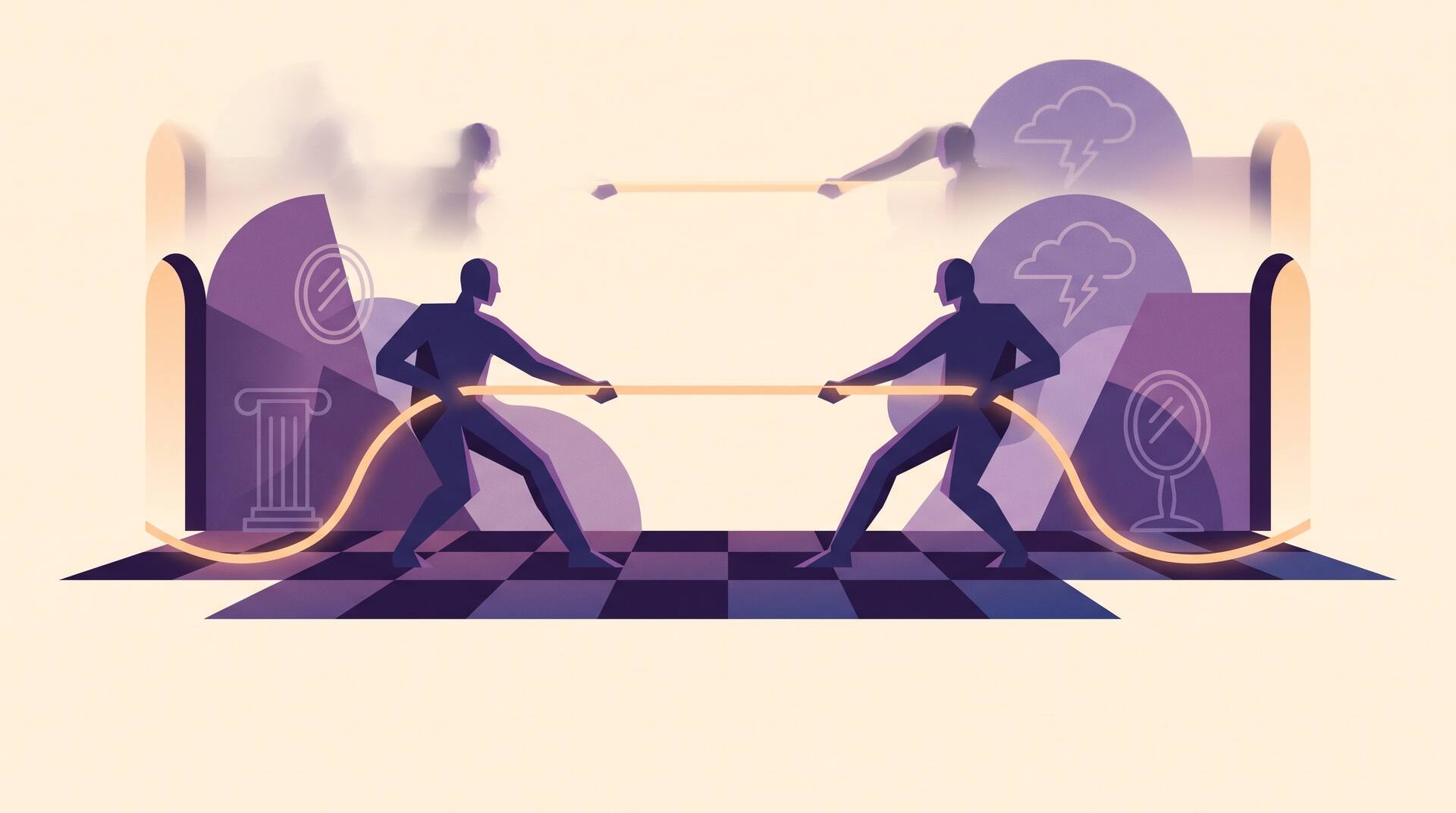
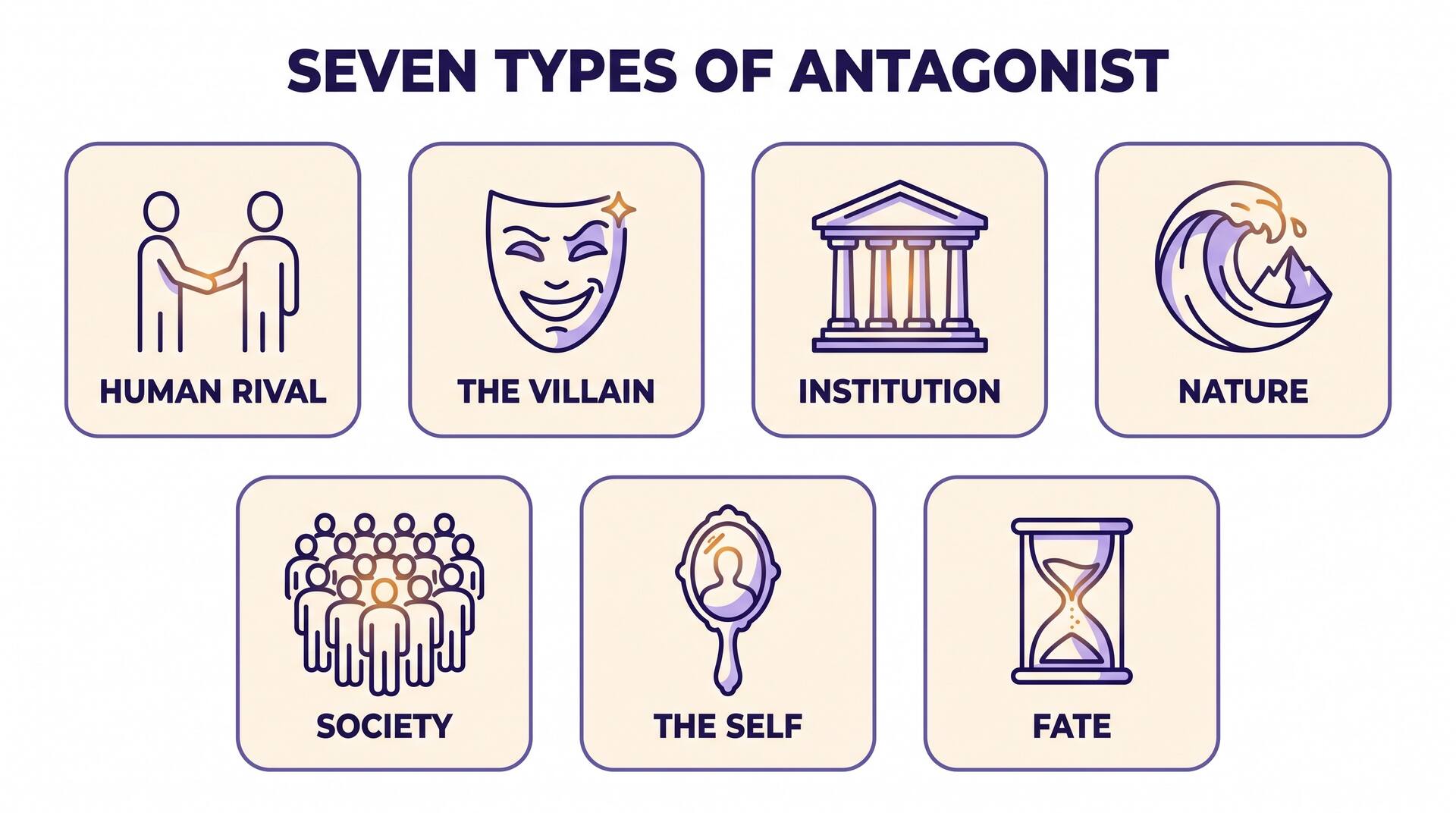
Seven types of antagonist, and the problem each one solves
Antagonist in literature covers a wider range than the word suggests. Each type below solves a specific structural problem, so pick by the problem you have, not by genre habit.
Human rival
Javert in Les Misérables
Solves the problem of an abstract conflict readers cannot see. A rival gives the theme a face, a schedule, and a voice that can argue back in dialogue.
The villain
Iago in Othello
Solves the problem of stakes. When the opposing goal is genuinely malicious, the cost of losing becomes obvious without being explained.
Institution or system
The Party in Nineteen Eighty-Four
Solves the problem of scale. A system cannot be defeated by winning one fight, which forces the protagonist toward strategy, compromise, or sacrifice.
Nature
The sea and the marlin in The Old Man and the Sea
Solves the problem of moral clutter. Nature has no motive, so every ounce of characterisation lands on the protagonist instead of being split.
Society
Maycomb's jury in To Kill a Mockingbird
Solves the problem of a hero who is obviously right. When the opposition is shared belief, being right is not enough to win, which is where real tragedy lives.
The self
Raskolnikov in Crime and Punishment
Solves the problem of a flat character arc. If the obstacle is inside, victory requires change, and change is what readers came for.
Fate or circumstance
The illness in John Green's The Fault in Our Stars
Solves the problem of a story about meaning rather than victory. Nothing can be negotiated with, so the drama moves to how the characters choose to spend the time they have.
Nature and fate are the two easiest to write badly. Because they cannot be argued with, they need a human proxy — a captain, a doctor, a rival survivor — to carry scenes, or the middle of the book turns into weather reports.
Most strong novels run two of these at once: an external antagonist that drives the plot and an internal one that drives the change. Frodo has Sauron and the Ring's pull on him. Which pairing you choose shapes the arc your lead can have — our guide to dynamic characters walks through what that change looks like scene by scene.
The antagonist's goal worksheet: five questions
Here is the part most guides skip. A flat antagonist is almost always an antagonist without a goal of their own — a character who exists only in reaction to the protagonist. Answer these five questions in writing, in full sentences, before drafting. If any answer is a single word, you have not finished thinking.
1. What does the antagonist want, stated as a goal they would say out loud?
Not "to stop the hero" — that is a reaction, not a want. Javert wants a world where the law is never wrong, because if it can be wrong he has spent his life on nothing. Write the sentence in their voice.
2. Why is that goal reasonable from inside their life?
Trace it to one concrete formative fact: a loss, a promotion, a promise, a humiliation. If you cannot name the fact, readers will feel the vacuum as arbitrariness.
3. What exactly makes both goals impossible to satisfy at once?
Name the scarce thing: the throne, the child, the truth, the last seat on the boat. If both characters can win, you do not have a plot — you have two subplots sharing a book.
4. What would make the antagonist stop?
Every real opponent has a price or a limit. Knowing it gives you your climax options and stops the third act from resolving by convenient death. If there is no limit, ask whether that is a choice or laziness.
5. What does the antagonist see clearly that the protagonist does not?
This is the question that separates good antagonists from good obstacles. Give them one true observation about the protagonist — one the reader recognises as accurate. From then on, every scene they share carries a second layer.
Worked example, one paragraph: a small-town mayor opposes a journalist protagonist. Goal in her voice: "I will keep the plant open until my daughter's generation can leave on their own terms." Formative fact: she watched the mill close in 1994 and half her graduating class leave. Scarce thing: the story runs or it does not; there is no half-publication. Limit: she stops if the plant's owner is proven to have lied to her personally. True observation: the journalist is chasing the story partly because he wants back into a newsroom that fired him. That last line alone gives you four scenes.
If you want to pressure-test these answers against your existing cast, our free character creator builds out motivation, history and voice from a short premise, and the plot twist generator is useful for finding the moment a stated limit gets broken.
Antagonist, protagonist, foil, anti-hero
Four terms that get used interchangeably and should not be.
- Protagonist
- The character whose goal drives the story and whose choices the plot follows. Defined by narrative position, not by virtue.
- Antagonist
- Whoever or whatever opposes that goal. Can be admirable, impersonal, or the protagonist themself.
- Foil
- A character who contrasts with another to illuminate them. Often not in opposition at all — Watson is Holmes's foil and his ally.
- Anti-hero
- A protagonist without conventional heroic virtues. Still the protagonist. Walter White is an anti-hero, and Hank is his antagonist even though Hank is the lawful one.
The test is mechanical. Ask which character's goal the plot follows: that is your protagonist. Ask whose goal blocks it: that is your antagonist. Everything else is characterisation — and if you want the vocabulary for that layer, the character archetypes guide covers the recurring shapes without reducing anyone to a template.
Four ways antagonists go wrong
The antagonist has no schedule
A strong antagonist is doing things on days when the protagonist is offscreen. Write their timeline separately, then interleave it. If every antagonist action is triggered by a protagonist action, the book has one moving part.
The competence gap is one-sided
Readers calibrate stakes by the two most recent things each side pulled off. If the antagonist's plans only ever fail, tension drains regardless of what the narration claims about their menace.
The motive arrives in a monologue
A late speech explaining childhood pain does not retroactively build a character. Plant two or three concrete, unexplained details early — an object, a habit, a name they avoid — and let the speech confirm rather than introduce.
The antagonist and the theme disagree
If your book argues that loyalty is a trap, the antagonist should be arguing the opposite convincingly. When the opposition is thematically irrelevant, the ending resolves the plot without resolving the book — and the usual patch is a rescue nobody earned, which is exactly the deus ex machina problem.
Building an antagonist you can actually draft against
Once the five answers exist, the work is keeping them consistent across eighty thousand words — which is exactly where handwritten notes fail. In AIWriteBook, characters are structured objects attached to the book, not a paragraph in a document, so the antagonist's motivation, background and voice stay in front of the model in every chapter it drafts. Contradictions get caught while you are writing rather than in revision.
Two places it genuinely helps. When you build the book's structure, the outline builder lays out chapters against the conflict you defined, so the antagonist's schedule gets its own beats instead of appearing wherever the plot needs pressure. Then the chapter AI chat lets you ask for a targeted rewrite — "give her a reason to walk away in this scene" — and shows the change as a diff you accept or reject, so your own sentences stay where they already work. Chapters can be drafted with Gemini or Grok depending on the voice you want.
For the pre-draft stage, the free scene builder is a fast way to test whether a confrontation actually has two goals in it, and the world builder helps when the antagonist is an institution and you need its rules to hold together.
Where to go next
Take the antagonist definition literally and it will do more work than any list of villain traits: the antagonist is whoever's goal makes the protagonist's goal expensive. Test your current draft against that one sentence. If the answer is a character who only reacts, spend an afternoon on the five questions before you write another chapter — it is the cheapest structural fix available.
For the wider build — premise, structure, drafting and publishing in order — the complete guide to writing a book covers the full sequence, and the antagonist work slots in right after you fix your premise and before you outline.