

What you'll learn
When a reader lands on your book page, the cover gets them to stop. The description gets them to buy. Yet most authors spend weeks polishing covers and 30 minutes writing descriptions. The result: covers selling for the wrong books because the description never closes the deal. This guide gives you the structural formulas, the genre-specific cues, and the actual copywriting moves that turn 'browse' into 'buy now'.
Why Descriptions Convert More Than Covers
Industry data from Amazon Author Central, BookBub, and indie publishing platforms tells a clear story.
1.7%
Click-through to description
Of readers who see your cover in browse, only 1-3% click through to your product page.
12-18%
Description-to-purchase
Of readers who read your description, 12-18% buy. The description is the actual sales conversation.
60%
Read first 2 lines only
Most readers skim the first 1-2 lines, then bounce. Hooking in the first sentence is non-negotiable.
40%
Read 'Read more' expansion
Of readers hooked by the opener, only 40% click 'Read more' to expand the description. Lead with your strongest material.
Anatomy of a High-Converting Description
Every great book description has the same five-part structure. Drop any part and conversion drops with it.
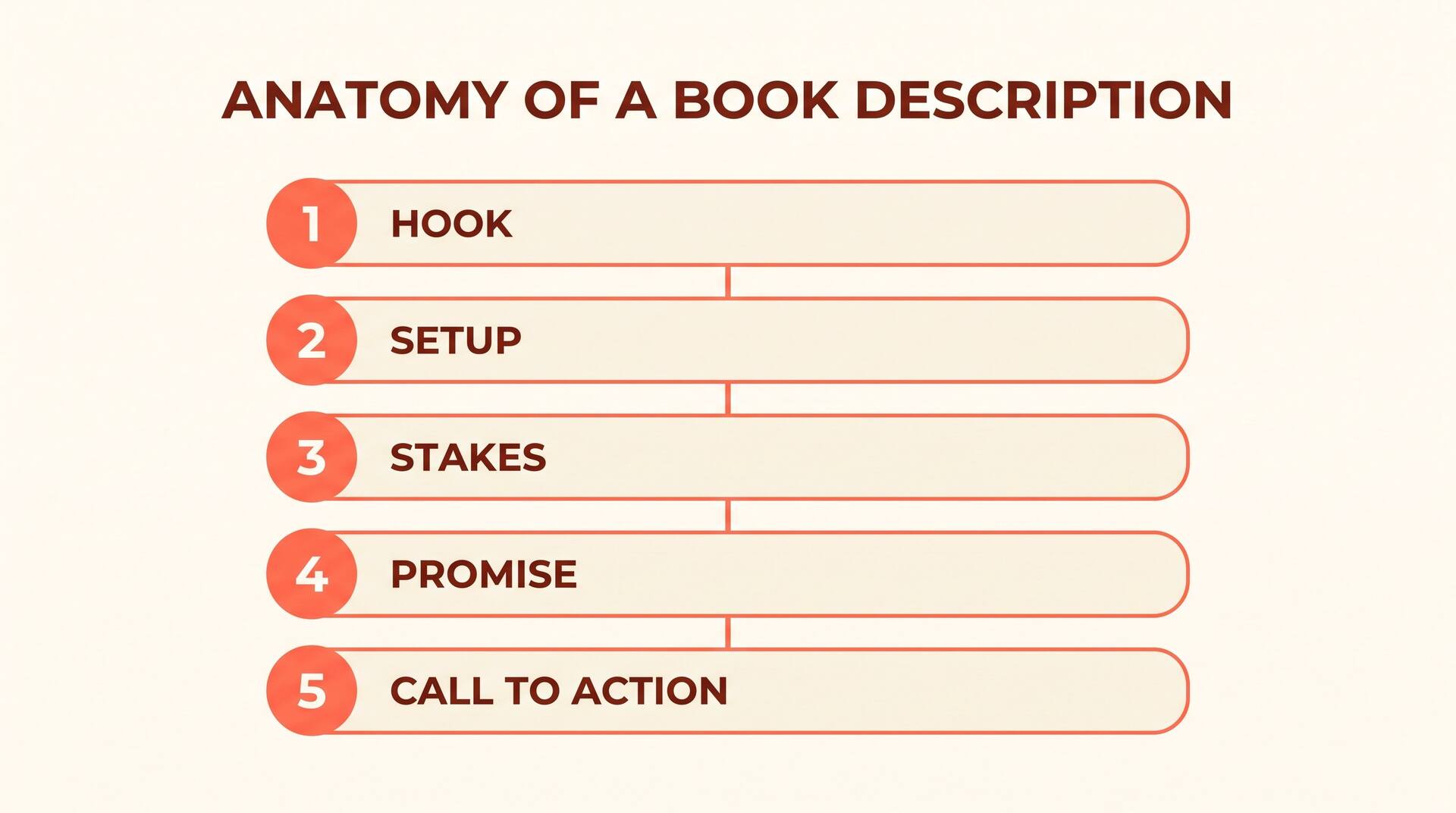
The Hook
Stop the scroll. Make the reader curious enough to read the next line.
Sarah has lived eight lives. In her ninth, the killer she has been chasing for centuries finds her first.
The Setup
Establish the protagonist, the world, and what makes this story unique. Avoid backstory dumps.
When Detective Sarah Mira wakes in 2026 with full memory of her previous lives, she knows the rules: find him, kill him, save the next eight years before the cycle resets. But this time, something is different.
The Stakes
What does the protagonist stand to lose? Make it personal, urgent, and irreversible.
He is hunting her in real time. He knows her face. And every minute she delays the confrontation, another woman dies wearing the next version of her life.
The Promise
Tell the reader what reading experience they will get. Genre conventions live here.
A breakneck supernatural thriller for fans of Blake Crouch and Mike Flanagan.
The Call to Action
Direct, simple, urgency-tinged. Some genres need this; literary fiction often skips it.
One-click now. The cycle is closing.
Genre-Specific Formulas That Convert
Different genres reward different structures. Use the formula that matches reader expectations for your category.
Romance
Formula
Heroine introduction → Hero introduction → Meet-cute hook → Complication → Stakes → Promise of HEA
Example
Maya Reyes does not date clients. Especially not arrogant tech billionaires who fire her on the first day. So when Daniel Cross shows up at her sister's wedding as the best man — to her maid of honor — she does what any sensible woman would do. She pretends not to know him. For nine days. In a beach house. With one bedroom. A grumpy/sunshine, forced-proximity romance perfect for fans of Tessa Bailey and Christina Lauren.
Tips
Lead with chemistry. Name a trope explicitly. End with a comp-author promise. Heat level signaling matters: 'steamy', 'sweet', 'closed door'.
Generate a High-Converting Description Now
AIWriteBook's blurb generator handles structure, hooks, and genre conventions. You edit for voice. Your description is ready to publish in 5 minutes.
Keywords Without Keyword Stuffing
Amazon's algorithm reads your description for relevance. Stuffed descriptions get penalized. Strategic descriptions rank for the right searches.
Use Long-Tail Phrases, Not Single Words
'Romantic suspense' beats 'romance'. 'Cozy mystery with cats' beats 'mystery'. Long-tail phrases match exact search intent and compete in less crowded fields.
Place Keywords in the First 200 Characters
Amazon weighs the opening of your description more heavily for search relevance. Get your most important search terms (genre + tropes + comp authors) into the first paragraph naturally.
Comp Authors as Keyword Vehicles
'For fans of Colleen Hoover' inserts a high-volume keyword while serving the reader's recommendation logic. Use 1-2 comp authors max — more reads as desperate.
Trope Keywords That Work
'Enemies to lovers', 'fated mates', 'unreliable narrator', 'dual timeline' — readers search these by name. If your book genuinely fits, the trope phrase doubles as both reader signal and search keyword.
Avoid Forbidden Patterns
Amazon penalizes descriptions that read as keyword stuffing: lists of unrelated genres, generic 'must-read' superlatives, repetition of the same keyword 5+ times. The line is: would a reader find this annoying? If yes, the algorithm will too.
A/B Testing Your Description
Most authors write a description and never change it. The authors who optimize for conversion test relentlessly, and the discipline is borrowed straight from website conversion optimization: change one element, measure, keep the winner.
Test the Hook First
Your first sentence determines whether anyone reads the rest. Run two versions for two weeks each. Compare conversion rate (sales / page views). The winning hook usually adds 1-3% to conversion.
Test Length
Some genres convert better with concise descriptions (under 150 words). Others convert better with long, immersive ones (300+ words). Try both. The winner is genre-dependent.
Test Comp Authors
If you have multiple plausible comp authors, test which combinations drive higher conversion. Surprising pairs sometimes outperform obvious ones.
Test the Call to Action
'Read now', 'One-click', 'Free in Kindle Unlimited', 'Begin the series' — different audiences respond differently. Match CTA to genre conventions.
Use Author Central or Independent A/B Tools
Amazon does not natively A/B test. Use authors' tools like PublisherRocket, K-lytics, or simply rotate descriptions every two weeks and compare ABSR-adjusted conversion. Track sample sizes — under 100 page views is too noisy to act on.
Real Description Teardowns
Two real (anonymized) book descriptions, one converting at 16% and one converting at 4%. Same genre, same launch month. The difference is craft.
Why It Works
Opens with a specific image, not a setup. Names the trope by the second paragraph. Stakes are personal and physical. Closes with comp authors and a series promise. Length: 187 words. Reads in 45 seconds.
Why It Underperforms
Opens with backstory: 'Set in the year 2042 in a near-future Boston where genetic editing is mainstream...' Reader bounces in line one. Stakes appear in paragraph four. No comp authors. Length: 412 words. Reads in 110 seconds. Most readers never get to the actual story.
AI Blurb Generators Compared
Several AI tools now generate book descriptions. Quality varies wildly. Here is what actually works.
AIWriteBook Blurb Generator
Best book-specific resultApproach
Trained on conversion-optimized indie fiction descriptions. Genre-aware structure with adjustable length and CTA style.
Output
Production-ready first drafts. Most authors edit lightly and ship.
ChatGPT (with prompt)
Workable with careful promptingApproach
Generic AI assistant. Quality depends entirely on prompt quality. Default outputs are too long, too generic, and lack genre conventions.
Output
Usable raw material for editing. Needs structural rewrites for genre fit.
Claude
Best for editing, not generatingApproach
Strong on prose quality and tone-matching. Less aware of book marketing conventions out of the box.
Output
Beautiful prose, but often missing the marketing structure (hook, stakes, CTA).
Sudowrite
Good for emotional language, weak structureApproach
Focused on creative fiction generation. Has a specific 'Brainstorm > Description' tool with mixed results.
Output
Creative and emotionally evocative. Often missing CTA and conversion structure.
Jasper / Copy.ai
Useful for hooks, weak overallApproach
Marketing-focused copy tools. Strong on CTA and hook. Weak on genre conventions and book-specific length.
Output
Crisp, conversion-focused — but reads like a product page, not a book.
Pre-Publish Description Checklist
Run this on every description before you save it
Description Mistakes That Kill Sales
Starting with Worldbuilding
'In a kingdom far away...' or 'Set in 2042 Boston...' makes readers click away within seconds. Open with a person, an action, or a question instead.
Writing in Third-Person About the Author
'In her debut novel, Jane Doe explores...' is biography copy, not selling copy. Speak from inside the story, not from the author's bio.
Describing the Plot in Order
Descriptions are not synopses. They are sales pitches. Front-load the most compelling tension, even if it occurs in chapter 12. Spoilers are okay if they sell the book.
Using 'You' for Fiction
'You will love this thrilling tale of...' breaks fiction immersion. Reserve second-person for nonfiction and self-help where you are speaking directly to the reader's situation.
Ending With No Direction
A description that ends with the protagonist's situation but no purchase nudge leaves the reader floating. Even literary fiction benefits from one closing line that signals 'this is the book for you'.
Descriptions Are the Highest-Leverage Copy You Will Ever Write
A great description sells your book again every single time someone lands on the page. It works while you sleep, while you write the next book, and for the entire decade-plus your book stays in print. The hour you spend rewriting and testing it pays back thousands of times over.
Use the structural formulas. Match your genre's conventions. Test ruthlessly. And revisit your description every six months — what worked at launch may not be what is converting in a market that has shifted. The authors who treat descriptions as a craft outperform the ones who treat them as an afterthought, every single time.