


What you'll learn
The difference between a flat launch and a bestseller launch is rarely the book. It is the campaign around it. Most indie authors think of launch as 'press publish and hope'. The authors who hit bestseller in their categories — and stay there for weeks — run a structured 90-day campaign with specific milestones, an ARC team, a launch week sequence, and post-launch follow-through. This guide gives you the complete framework, with real benchmarks at each stage.
The 90-Day Launch Timeline
Three phases, three distinct goals. Skip any phase and you leave momentum on the table.
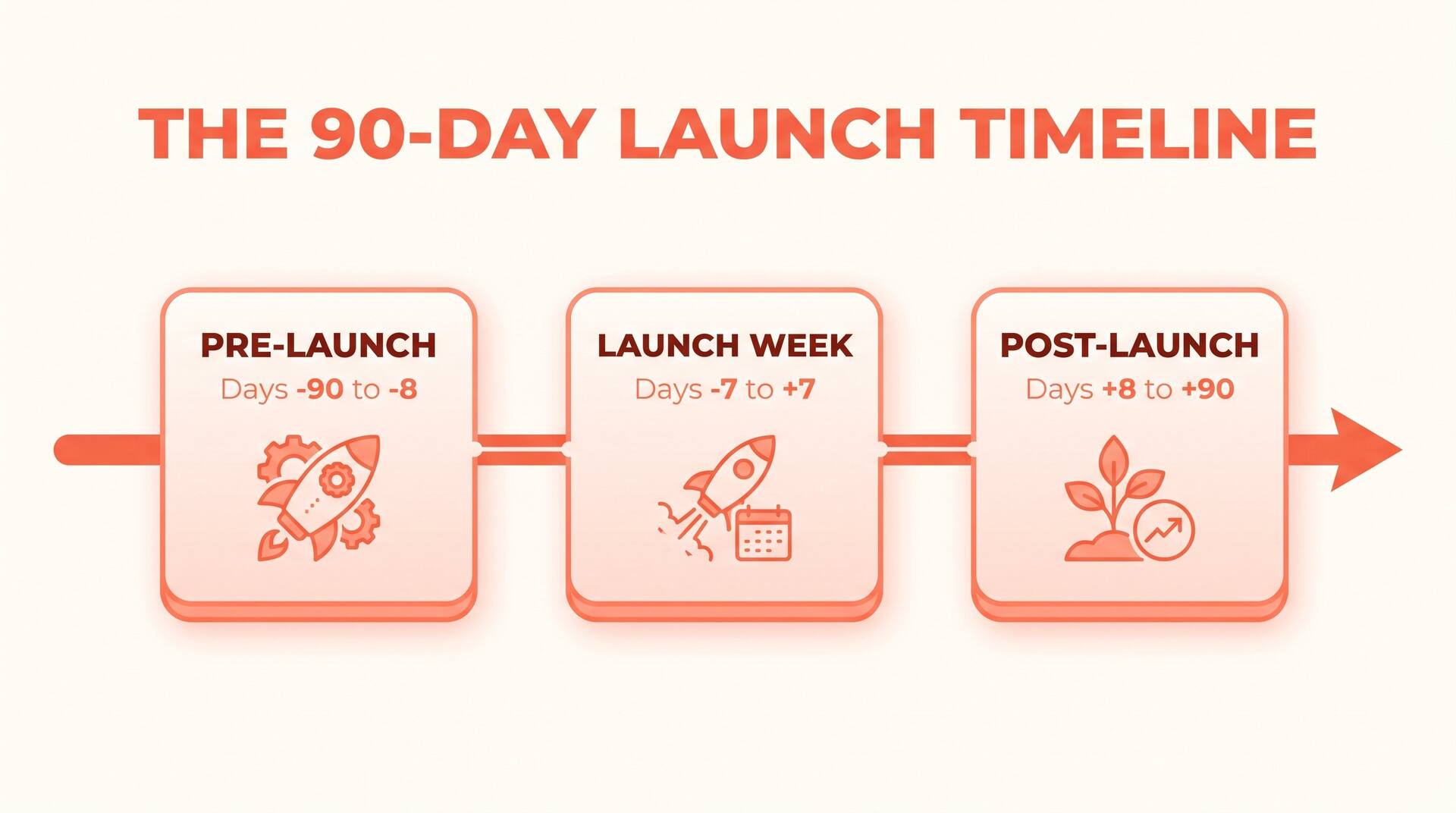
Pre-Launch (Days -90 to -8)
Goal
Build anticipation, secure ARC team, lock infrastructure
Activities
Cover reveal, blurb finalization, KDP categories researched, ARC team recruitment, email list growth, BookBub featured deal applied, paid promo booked, beta reader feedback integrated, audiobook production started.
Target Metric
300-500 newsletter subscribers, 30-50 ARC reviewers committed
Pre-Launch: Building Anticipation
Pre-launch is where most indie authors leave the most money on the table. Three months before launch is when you build the audience that decides if launch week succeeds.
T-90: Lock Your Cover and Description
Your cover and description need to be production-quality 90 days out so you can use them in promo. Run cover variants past your audience. Test description hooks. Lock both by Day -75.
T-60: Research Categories and Keywords
Use KDP keyword research and category analysis to lock your final placement. Get into KDP support to access deeper categories than the upload form allows. This is foundational — wrong categories make every other launch tactic 50% less effective.
T-45: Set Up Pre-Order
Open Kindle pre-order on Day -45. Pre-orders count toward Day-1 launch rank, which can bump you into top categories on release. Promote the pre-order link in your email list and ARC team channel.
T-45: Begin ARC Recruitment
ARC (Advance Review Copy) team is the biggest single factor in launch reviews. Aim for 50-100 readers committed. Use BookSprout, BookFunnel, or your own email list.
T-30: Cover Reveal Campaign
30 days out, do a coordinated cover reveal: Instagram, TikTok, Twitter, newsletter, BookTok creators. Build awareness, capture pre-order intent.
T-21: Send ARC Copies
ARC team needs 21+ days to read and review. Send them now with clear instructions: 'Reviews need to post on launch day, not before. Honest reviews only.' Don't promise gifts for positive reviews — that violates platform terms.
T-14: Book Paid Promotions
Book BookBub Featured Deal (if accepted), Fussy Librarian, Bargain Booksy, Free Booksy, ENT, Robin Reads. Ideally stack 2-3 promos on launch day or Day +1 for sustained velocity.
T-7: Final Pre-Launch Push
Email sequence to list (3 emails: tease, reveal, last call for pre-order). Daily social posts. Final ARC reminders. Test all your launch-day tech (links, redirects, ads paused/scheduled). If the list has not been mailed in months, run it through an email validator first, because a wave of bounces on launch morning is what drops the rest of the send into spam folders.
Generate Everything Your Launch Needs
Cover, blurb, ARC PDFs, KDP-ready files, audiobook narration — all in one place. Skip the tool stack and focus on running the launch.
ARC Team Strategy
ARC reviews are the difference between a flat launch and an algorithmically blessed one. Here is how to build a real ARC team.
Recruitment Channels That Work
BookSprout (paid, indie-focused), BookFunnel (subscription), your email list (highest quality), Goodreads ARC groups, BookTok creators (pitch them directly). Aim for 100 committed readers.
ARC Application Filter
Make readers apply with a 1-question form: 'What is the last book in this genre you read?' Filters out random subscribers and surfaces real fans. Approve readers who show genre familiarity.
Communication Cadence
Single welcome email + one mid-read check-in + launch day reminder. Use a Discord server or email group for community. Authors who over-communicate get unsubscribes; under-communicate get forgotten.
Review Conversion Rates
Industry baseline: 25-40% of ARC readers leave reviews. Strong author engagement gets that to 50-60%. 100 ARC readers should produce 30-50 launch-day reviews.
Legal and Platform Compliance
Reviews must disclose 'I received an ARC in exchange for an honest review' (FTC requirement). Cannot offer payment, products, or guarantees of positive reviews. Violations risk account suspension.
Launch Week: The Critical 7 Days
Amazon's algorithm rewards concentrated sales velocity. Launch week is your one shot at maximum visibility — make every day count.
Maximum Velocity
Email blast to full list, paid promos active (BookBub if accepted), social posts every 4 hours, ARC team posts reviews, podcast appearances if booked, Amazon Ads at peak budget. Target: Top 5,000 ABSR or better.
Sustain Velocity
Second-round paid promos. Newsletter swap with 1-2 author friends. Social posts continue. Reply to early reviews (where allowed). Target: Top 100 in primary category.
Build Review Volume
Follow up with ARC team for outstanding reviews. Ask early purchasers to leave reviews. Continue social and ad spend. Target: 30+ Amazon reviews.
Lock In Bestseller Flag
Push for #1 in cold categories where you are close. Final boost from email list. Schedule announcement for any milestone hit (top 100, bestseller flag). Target: Bestseller flag in 2-3 categories.
Launch Day Hour-by-Hour Playbook
Launch day momentum builds in waves. Here is the hour-by-hour pattern that maximizes algorithmic uplift.
12:00 AM PT
Book goes live on Amazon
Verify the listing is live, all categories applied, Look Inside enabled. Most KDP releases go live at midnight Pacific.
6:00 AM
Email blast to full newsletter
Subject: 'It's launch day' or similar. Direct purchase links. Mention paid pre-orders auto-deliver. Track open and click rates.
8:00 AM
Social media wave 1
Instagram, TikTok, Twitter, Facebook author page. Reels and stories where applicable. Schedule the post 30 days ago to remove launch-day stress.
10:00 AM
ARC team reminder
Single message: 'Book is live. If you finished, please post your review now.' Most reviews land in the next 24 hours.
12:00 PM
Mid-day push
Newsletter wave 2 to non-openers of morning send. New social wave (different content angle). Check Amazon Ads, increase bids if hitting budget cap.
5:00 PM
Evening engagement
Live stream or Q&A on Instagram/TikTok. Engage with all comments and tagged posts. Highest Amazon traffic hours are 6-10 PM.
9:00 PM
Review your numbers
Check ABSR, category ranks, review count. Take screenshots of any milestones. Plan adjustments for Day 2 (Ad bids, social angle, email follow-up).
Post-Launch: Sustaining Momentum
The first 30 days post-launch determine whether your book becomes a steady earner or a one-week spike that fades.
Day +14: First Optimization Pass
Review category performance. Replace categories that drove zero traction with research-based alternatives. Adjust Amazon Ads keywords based on what is converting. Survey early readers for review feedback.
Day +30: Second Promo Wave
Book second BookBub deal, Fussy Librarian, or other paid promo. Discount price temporarily if it fits your strategy. Goal: re-engage Amazon's algorithm with second sales spike.
Day +45: Audiobook Release
If you produced an audiobook, release 45 days post-eBook to capture readers who finished and want more. Cross-promote in your existing reviews and listings.
Day +60: Series or Newsletter Push
If this is part of a series, push backlist promo. If standalone, drive newsletter signups via reader magnet at the end of the book. Compound momentum into next launch.
Day +90: Launch Retrospective
Document what worked, what did not, ABSR trajectory, total reviews, total revenue, ARC team conversion rate. This becomes the playbook for your next book — refined with real data, not guesses.
Measuring Launch Success
These are the actual metrics that matter — not vanity counts, but indicators of whether the launch is working.
Day-1 ABSR
Good
Top 10,000
Great
Top 5,000
Exceptional
Top 1,000
Indicates initial sales volume. Top 5,000 = ~30 sales/day.
Day-7 Reviews
Good
10+
Great
30+
Exceptional
50+
Reviews compound visibility. 30+ unlocks Amazon Ads better targeting.
Day-7 Bestseller Flag
Good
1 category
Great
3-5 categories
Exceptional
All 10 categories
The orange Best Seller flag drives organic conversion lift.
Day-30 Total Revenue
Good
$500+
Great
$2,000+
Exceptional
$10,000+
True success metric. Reviews, ABSR, and rank are means; revenue is the end.
Newsletter Growth
Good
+50
Great
+200
Exceptional
+500
Launch-driven list growth funds the next launch. The number that determines compounding.
Mistakes That Kill Launches
Launching Without an ARC Team
Books with zero reviews on launch day struggle to get organic traction. Even 10 ARC reviews changes the algorithm's calculation of social proof. Skipping ARC is the single most expensive launch mistake.
Spending All Marketing on Launch Day
A single big spike on launch day drops the book on Day 2. Spread spend across launch week (and especially Day +30) for sustained ABSR. Amazon's algorithm rewards consistency, not single peaks.
Ignoring Categories Until Launch
Bad category selection kneecaps every other tactic. If your categories are wrong, even great launch promo sends traffic to a dead end. Do this work 60 days out, not 60 hours out.
Burning Out the Email List Pre-Launch
Authors who send 12 pre-launch emails train their list to ignore them by launch day. Three emails maximum: tease, reveal, last call. Save the rest for post-launch follow-up.
No Plan for Post-Launch
Authors who treat launch as a finish line lose 80% of the momentum within two weeks. The Day +30 promo wave is often more important than launch day for long-term ABSR.
Launch Readiness Checklist
Confirm each item before you press publish
A Real Launch Is a 90-Day Campaign
The authors who consistently hit bestseller status on launch are not the ones with magical books. They are the ones running structured, research-backed campaigns that span three months and treat every phase — pre-launch, launch week, and post-launch — as equally essential.
You do not need every tactic in this guide to succeed. You need a written plan that owns each phase, accountability for the daily actions, and the discipline to keep marketing for 30 days after the launch high. The compounding effect of getting this right means each subsequent launch starts from a higher baseline. That is how authors build careers, not single books.