


Why one sentence matters
Your logline does more work than any other sentence about your book. It opens your query letter, becomes the first line of your book description, answers "what's your book about?" at a party, and keeps you on track while drafting. Agents read hundreds of queries a week; a clear one-sentence hook decides whether they read the next paragraph.
Writing it early is also a diagnostic. If the sentence will not come together, the story usually has an unclear goal or missing stakes, and it is cheaper to find that out before chapter twenty.
The four-part formula
Almost every strong logline for fiction contains the same four parts. The order can change; the parts should not go missing.
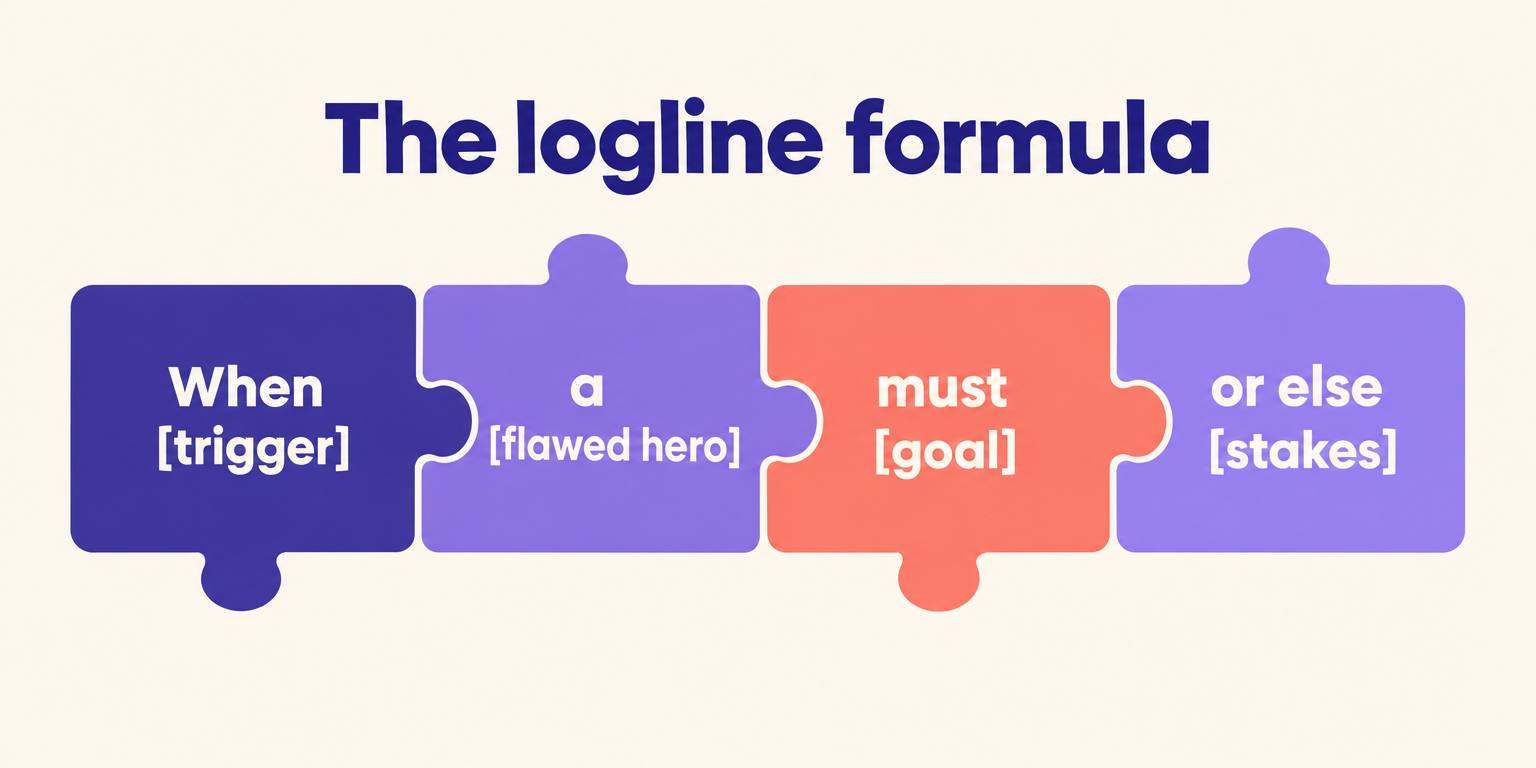
Trigger
The event that starts the story and breaks the hero's normal life.
Flawed hero
Not a name but a description with tension in it: a timid accountant, a disgraced detective.
Goal
The concrete thing the hero must do. Something we could picture on screen.
Stakes
What happens if the hero fails. The higher and more personal, the stronger the pitch.
Logline builder
Fill in the four parts and watch your logline assemble. Keep it under about 35 words.
When her sister is chosen for a deadly televised contest, a fierce, distrustful teenage hunter must survive the arena against 23 other fighters, or else die on camera while her family watches.
Loglines for famous books
Here are loglines we wrote for well-known novels using the formula. Notice how little plot they contain.
When a great white shark starts killing swimmers in a summer resort town, a police chief who is afraid of the water must hunt it down before it kills again and ruins the town.
Jaws by Peter Benchley
When his crew leaves him for dead after a storm on Mars, a wisecracking botanist must make his supplies last for years until rescue arrives, or starve alone on a planet with no food.
The Martian by Andy Weir
When his wife vanishes on their fifth anniversary, a charming but evasive husband must find out what happened to her before the police and the media decide he killed her.
Gone Girl by Gillian Flynn
When a wealthy, arrogant gentleman insults her at a country ball, a sharp-tongued young woman must see past her own prejudice before her family's prospects and her one chance at love are lost.
Pride and Prejudice by Jane Austen
Three lengths of pitch
The logline is the core. Expand it only as far as the moment allows.
The logline itself. Use it in conversation, social bios, the first line of a query and the top of your book description.
Common mistakes
- Leading with the world instead of the hero. Readers attach to a person first and a setting second.
- Listing subplots. A logline holds one story line; the rest belongs in the synopsis.
- Vague stakes such as "everything changes". Say what exactly is lost.
- Using the character's name. A name tells us nothing; a description with a flaw tells us a lot.
- Telling the ending. A pitch creates a question; it does not answer it.
Using AI to sharpen your pitch
Once your logline exists, it can seed every other piece of copy. AIWriteBook's free blurb generator expands it into a back-cover description, and our guide to writing a book description shows how to shape that for Amazon. For agents, drop the logline into the opening of our query letter template.
Inside AIWriteBook the book setup starts from a short premise, so a clear logline gives the outline builder a far better starting point than a paragraph of loose ideas. If you do not have a premise yet, the free book idea generator suggests several to test against the formula.
Turn your logline into a full outline
Start a book from your one-sentence premise and get a chapter-by-chapter outline you can edit before you draft.
Copyable templates
Swap the brackets for your story.
When [trigger], [flawed hero] must [goal], or else [stakes].
[Flawed hero] must [goal] before [deadline], but [obstacle] stands in the way.
[Title] is a [genre] about [flawed hero] who [goal]. It's [comp title] meets [comp title], for readers who [reader taste].
Elevator pitch FAQ
A logline is a single sentence stating hero, goal and stakes. An elevator pitch is the 30-second spoken version that adds a comparable title and what makes the book different.
One sentence, ideally 25 to 35 words. If it needs two sentences, it usually contains a subplot that can go.
Yes. Swap the hero and stakes for the reader and the problem: who the book is for, what it helps them do, and what changes for them afterward.
Yes, usually as the opening hook or the first line of the pitch paragraph, followed by a fuller description of the story.
Write the sentence first
A logline takes ten minutes to draft and months to get right, and it is worth every revision. Once you can say your book in one sentence, the blurb, the query and the conversation at the party all get easier.
See more ways to get your book in front of readers in our book marketing guide.