

Writers treat the query letter as paperwork. Agents treat it as the sample. If you cannot make 300 words about your book interesting, the reasoning goes, 90,000 is unlikely to fix that. So the letter is doing two jobs at once: it describes the novel, and it demonstrates that you can write.
That is the whole difficulty. Everything below is built around it.

What an agent actually does with your query
Understanding the reading conditions changes what you write. Your query arrives in a queue with hundreds of others, most of them read in batches, on a phone, in a gap between calls. The first pass is not a judgement of your talent. It is a triage: is this a genre I represent, is the word count sane, is there a story here I can picture selling, and does the writing hold up for a paragraph.
A query survives that pass or it does not, and the decision usually happens in the first three sentences. Nothing further down the page rescues an opening that gave the reader no reason to keep going. That is why the personalization line has to be short and the hook has to come almost immediately.
It also explains the form's odd rules. Agents ask for the ending because they need to know whether the plot resolves. They ask for word count because it signals whether you know your category. They ask for comps because their next conversation is with an editor who will ask "what does it sit next to?" You are not filling in a form. You are handing over the pieces of the pitch they will have to repeat to someone else. Industries that bid for a living formalised the same idea decades ago: the shipley proposal process exists precisely because a winning document is assembled from what the evaluator has to be able to repeat, not from what the author most wants to say.
The six parts, and what each one is for
Almost every successful query is the same six moves in the same order. The order matters more than most writers expect: it front-loads the story and pushes everything administrative to the end.
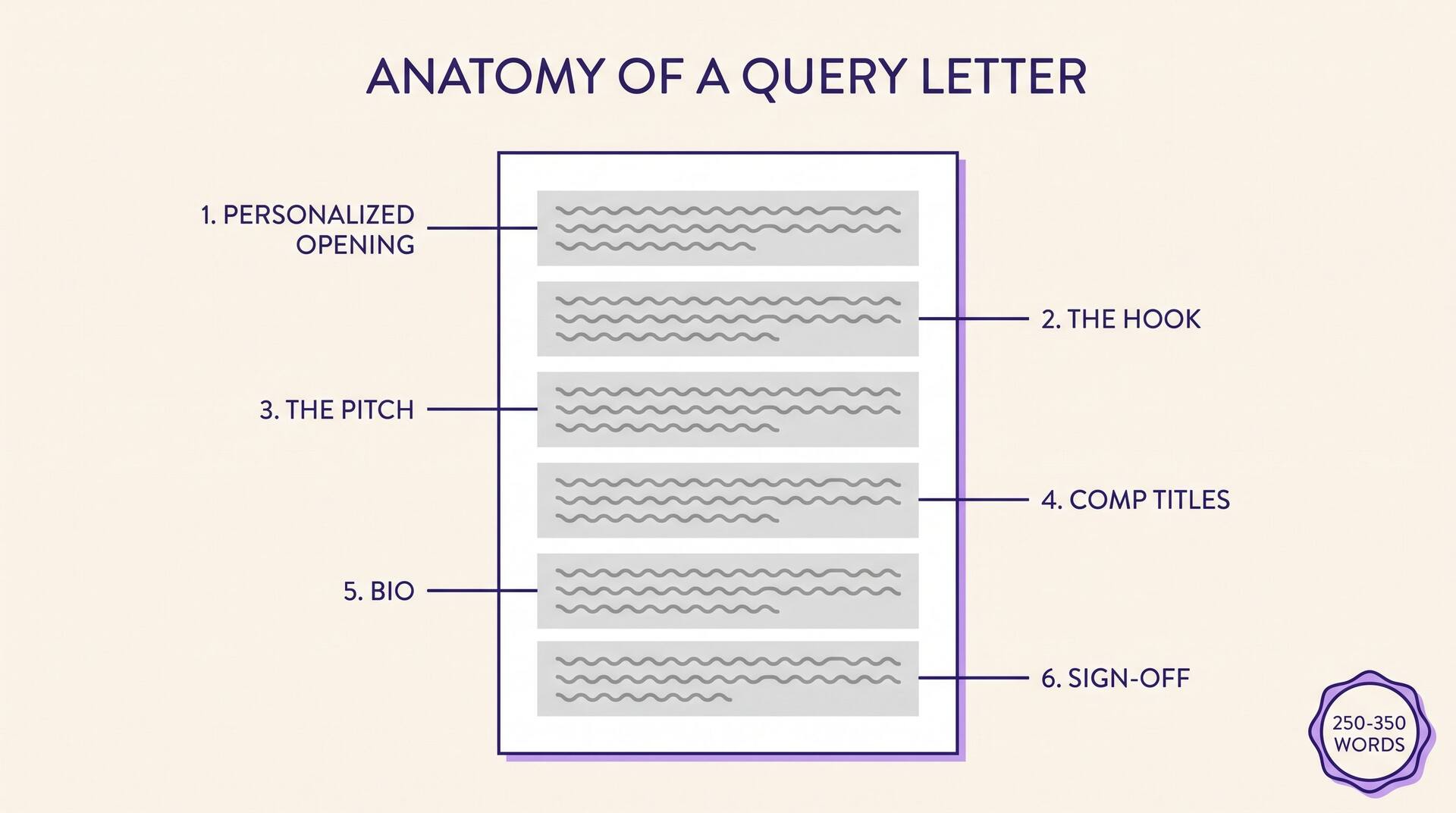
1. The personalized opening (one or two sentences)
Name the agent and give one specific, verifiable reason you are writing to them: a client whose book yours sits beside, a manuscript wish list post, an interview where they said what they were hunting for. "I am seeking representation" is not personalization. Neither is flattery about their agency's reputation. If you genuinely have no reason beyond "you represent this genre," say that plainly in half a sentence and move on — a thin honest line beats a fabricated connection.
2. The hook (one or two sentences)
The premise in its most compressed form, usually including the protagonist, the situation, and the thing that makes this book not the other book. Many writers put the housekeeping line here instead — title, word count, genre — and that also works. What does not work is spending your first paragraph explaining how long you have been writing.
3. The pitch (150-250 words)
One to three paragraphs of stakes-driven summary, written in present tense, third person, in the voice of the book. This is a jacket blurb with one crucial difference: it must reveal the ending. Introduce the protagonist, the want, the obstacle, the cost of failing, and the choice the story forces. Name two characters at most. Skip subplots entirely. If your summary needs a proper noun glossary to make sense, it is describing the world instead of the story.
4. Comp titles (one sentence)
Two recent books that share your book's readership, framed as a positioning statement rather than a claim of equal quality. The formula "X meets Y" is fine but tired; "for readers of X and Y" does the same work without the arithmetic. More on choosing them below, because this is where most queries quietly go wrong.
5. The bio (one to three sentences)
Only what is relevant: publication credits, relevant expertise, an MFA if you have one, a platform if you are pitching nonfiction. If you have none of that, write one short human sentence and stop. No agent has ever rejected a debut novel for the absence of credits, and every agent has read a paragraph of apology for it.
6. Housekeeping and sign-off (one or two lines)
Title in capitals or italics, exact word count rounded to the nearest thousand, genre and category, and a note that the manuscript is complete. Thank them, state that you have included whatever their guidelines asked for, sign with your real name and contact details.
The template, ready to copy
Replace everything in brackets. Keep the paragraph breaks — they are the reason the letter is scannable on a phone. Total length should land between 250 and 350 words including the housekeeping; if you are over 400, the pitch paragraph is carrying subplot weight it should not.
Query letter template
Subject: Query: [TITLE] — [GENRE], [WORD COUNT] words

Dear [Agent First Name] [Agent Last Name],

[One specific reason you are querying them: a client, a wish-list post, an interview. One sentence.] I hope [TITLE], a [WORD COUNT]-word [GENRE/CATEGORY], might suit your list.

[HOOK: one or two sentences. Protagonist, situation, and the element that makes this book distinct.]

[PITCH PARAGRAPH ONE: who your protagonist is, what they want, and the event that takes it away. Present tense, third person, in the voice of the book. Roughly 80 words.]

[PITCH PARAGRAPH TWO: what stands in their way, what it will cost them, and how it ends. Yes, actually say how it ends. Roughly 100 words.]

[TITLE] will appeal to readers of [COMP TITLE ONE] by [AUTHOR] and [COMP TITLE TWO] by [AUTHOR].

[BIO: one to three sentences of relevant credits, expertise, or a single human line. No apologies.]

The manuscript is complete at [WORD COUNT] words. Per your submission guidelines, I have included [the first ten pages / a synopsis / whatever they asked for] below. Thank you for your time and consideration.

Best regards,
[Your Name]
[Email] | [Phone, optional]
[Website or social handle, if relevant]
One note on the subject line: only use that format if the agency has not specified one. Many list an exact subject string in their guidelines, and using theirs instead of yours is the single easiest filter to pass.
Two worked examples
Both letters below were written for this article as illustrations. They pitch books that do not exist, and the agent names are placeholders. Read them for shape and rhythm, not as templates to lift verbatim.
Example one — upmarket crime fiction
Dear Ms. Okafor,

You mentioned on your wish list that you are looking for crime novels where the investigator has more to lose than the victim did. THE QUIET HOURS, a 92,000-word upmarket crime novel, was written on exactly that premise.

For eleven years, Nadia Emms has run the night desk at a suicide prevention helpline in Leeds — twelve hours of anonymous voices, no names, no follow-ups, no way of knowing who lived. Then a caller describes the inside of her own kitchen.

Nadia is certain she recognises the voice. She is also certain that saying so would end her career, because the man she suspects is the volunteer who trained her, and the helpline's records are, by design, unrecoverable. Working alone and off the books, she starts logging the calls she is not permitted to log, building a case out of material that cannot legally exist. The evidence accumulates. So does her certainty that she has the wrong man. By the time she understands that the caller is not describing a murder but rehearsing one, she has already handed the police a file that will convict an innocent colleague — and the only way to stop it is to admit, in court, to four months of illegal recordings.

THE QUIET HOURS will appeal to readers of Jane Harper's THE DRY and Chris Whitaker's WE BEGIN AT THE END. I spent six years as a crisis line volunteer, and this is my first novel.

The manuscript is complete at 92,000 words. Per your guidelines, the first ten pages follow below. Thank you for your time.

Best regards,
Eleanor Vance
e.vance@example.com
Why it works: the personalization is one line and cites something concrete. The hook is a single sentence with a physical detail in it. The pitch paragraph reveals the ending, including the cost — a public confession — which is what makes it a story rather than a situation. The bio is one clause of relevant experience and no apology for the absence of credits.
Example two — narrative nonfiction
Dear Mr. Halloran,

I am querying you because you said in a recent interview that you are hunting for narrative nonfiction about the invisible systems that keep the world running, and my book is about the most invisible one I know.

Every day, thousands of the world's shipping containers end up somewhere they were not supposed to go. THE MISROUTED, a 78,000-word work of narrative nonfiction, follows four of them.

Starting with a container of children's shoes that spent nineteen months circling the Mediterranean, the book traces how the physical layer of global trade actually behaves when the software says one thing and the port says another. I follow a Rotterdam scheduler who keeps a paper ledger because she does not trust the system, a Manila salvage crew that makes its living on customs abandonments, and the small industry of people whose job is to find things that a database has already declared delivered. The final section examines what happens as automated routing removes the humans who currently catch these errors — and argues, using the industry's own incident data, that the errors do not disappear, they simply stop being noticed.

THE MISROUTED is for readers of Marc Levinson's THE BOX and Rose George's NINETY PERCENT OF EVERYTHING. I have covered logistics for trade press since 2017, my reporting on port automation was cited in two industry white papers, and I have sailed on three container vessels as an embedded journalist.

A full proposal, chapter outline, and two sample chapters are ready on request. Thank you for considering it.

Best regards,
Daniel Reyes
d.reyes@example.com
Why it works differently: nonfiction queries lead with the argument and the evidence, not the plot, and the bio does heavy lifting because platform and authority are part of what is being sold. Note also that the manuscript does not have to be finished — for nonfiction, a proposal and sample chapters are the standard ask, which is the one place the "finish it first" rule does not apply.
How to choose comp titles without sinking your own query
Comp titles are the fastest way to signal that you understand your market, and the fastest way to prove you do not. Three rules cover almost every case.
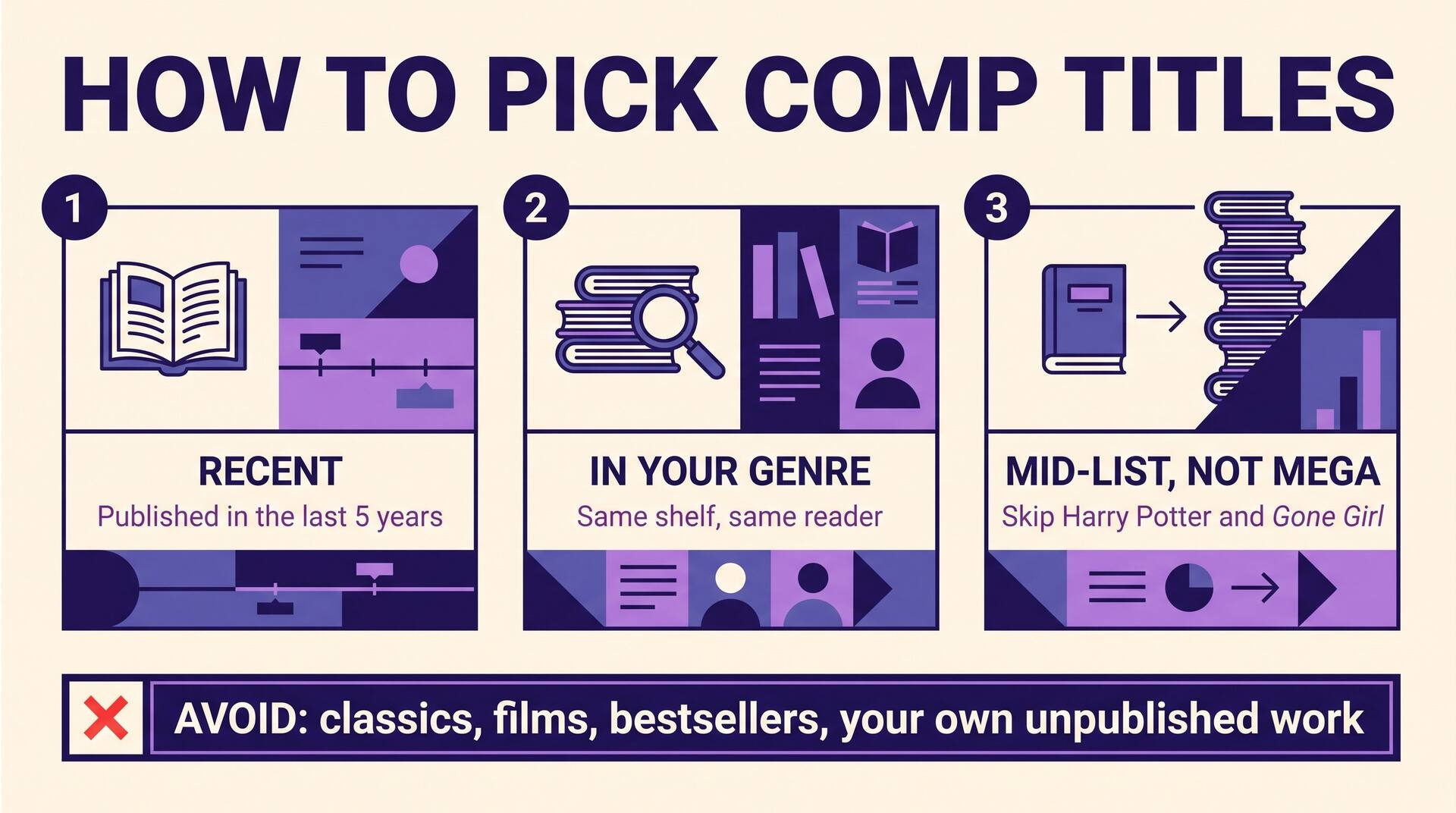
Recent
Published in roughly the last three to five years, and the more recent the better. Comps are market evidence, and a book from 1998 tells an editor nothing about what is selling now. A twenty-year-old comp reads as "I do not read in my own genre."
In your genre and category
Same shelf, same reader, same age bracket. A YA fantasy comped to an adult literary novel makes the agent do the positioning work you were supposed to do. If you genuinely straddle two, comp one from each and say so.
Successful, not stratospheric
Comping to Harry Potter, Gone Girl, or Where the Crawdads Sing reads as either naivety or a sales projection nobody can honour. Aim for solid mid-list titles that sold well without becoming cultural events — books an editor recognises but does not consider untouchable.
Two further traps. Do not comp to films or television unless you pair them with at least one book; agents sell books, and a purely screen comp suggests you have not read in your field. And do not comp to unpublished work, your own or anyone else's, which happens more often than you would think in queries that reference a previous manuscript in the same series.
If you are struggling to find comps, that is diagnostic information rather than a formatting problem. Either the book is genuinely unusual — rare — or you have not read enough recently published work in your category. The fix for the second is a fortnight in the new releases section of your genre, which is also the fastest way to learn what your own book's category actually is. Our free niche finder is a decent shortcut for mapping which subgenres are currently crowded and which are thin, and the category finder will show you what the shelf beside yours looks like in practice.
Formatting and submission mechanics
None of this wins you a request. All of it can lose you one. First, note that a growing share of agents no longer take email queries at all — they use a submission form, usually QueryManager, with separate boxes for the letter, the pages, and the synopsis. The letter is the same either way; the delivery is whatever their guidelines say, checked on the day you send, because agents open and close to queries without warning.
- One agent at a time per agency, unless their guidelines explicitly say otherwise. Most agencies treat a rejection from one agent as a rejection from the house.
- For email queries: plain text in the email body. No attachments unless asked, no PDF letters, no coloured fonts, no images, no letterhead. Many agencies strip attachments automatically and you will never know.
- Where guidelines ask for sample pages by email, paste them below the letter as plain text unless the agent specifically requests an attachment. Fancy formatting arrives as garbage.
- Follow their subject line exactly. If the guidelines say "QUERY: Title - Genre," use that string and nothing else.
- Query in batches of eight to ten, not fifty. If the first batch returns nothing but form rejections, you have learned something about the letter before you burned the whole list.
- Track what you sent, to whom, and when — a spreadsheet works, and QueryTracker (which most querying writers already use to find agents) does it for you and shows each agent's real response patterns. Response times run from days to never, and re-querying an agent who already passed is a bad look you can avoid with two columns.
On timing: most agents state a response window in their guidelines, and many operate a "no response means no" policy. Nudging before the stated window closes is the most common self-inflicted wound in querying.
The mistakes that end a query in the first ten seconds
These come up in every agent interview on the subject, and each one is entirely avoidable.
Opening with a rhetorical question. "What would you do if you woke up with no memory?" invites the reader to answer "stop reading," and it is the single most recognisable tell of a first query.
Hiding the ending. "Will she survive? You'll have to read to find out" is the opposite of a pitch. Agents need to know the plot resolves, and coyness reads as an author who has not worked out the third act.
A word count that does not match the category. A 40,000-word adult fantasy or a 190,000-word debut thriller signals that the manuscript needs work no agent has time to explain. Check the norms for your genre — our breakdown of how many chapters a book should have and the free word counter will get you honest numbers in a minute.
Mass BCC or a mail-merge that leaks. "Dear Agent" is a decline. So is "Dear Ms. Okafor" in a letter addressed to Mr. Halloran, and it happens constantly.
Querying before the manuscript is finished. For fiction, this is absolute. If an agent asks for the full and you need six weeks to write it, the request is gone. Nonfiction is the exception, on proposal.
Comparing yourself to famous authors. "Fans of Stephen King will love my voice" is a claim about quality that only a reader can make.
Explaining the theme instead of the plot. If your pitch paragraph is about what the book means rather than what happens in it, rewrite it around a character who wants something.
Pre-send checklist
Run this before every batch. Tick as you go — your progress is saved in this browser.
When a query letter is the wrong tool entirely
Querying is the entrance to traditional publishing, and traditional publishing is one route of several. It is worth being honest about what you are queuing for: an agent, who then submits to editors, who may acquire — a process that routinely runs eighteen months to three years from first query to a book on a shelf, with attrition at every stage.
There are books for which that is plainly the wrong path. A tightly niched nonfiction title with a small, reachable audience will often earn more self-published than it would as an advance. A fast-cadence genre series — romance, cozy mystery, LitRPG — where readers expect three books a year does not fit a publishing calendar built around one. And if you want to keep your rights, set your own price, and publish in six weeks rather than three years, no query letter is going to give you that.
None of which makes querying wrong. Bookstore distribution, an advance, and a professional editorial team are real advantages that self-publishing does not replicate. But the decision belongs before the query, not after fifty rejections. If you are leaning toward doing it yourself, our guide to self-publishing on Amazon KDP covers the mechanics end to end, and the piece on whether KDP is actually worth it is the honest version of the maths.
You can also do both, in order: query for a year, and publish yourself if the answer is no. Plenty of authors have. What you cannot easily do is query a book you have already self-published, so run that sequence the right way round.
Where AIWriteBook fits in this
AIWriteBook does not send queries, and it does not have an agent's inbox. What it does is fix the two things that most often make querying premature.
The first is the unfinished manuscript. Rule five above is the one writers break most, usually because the book has been at 40,000 words for two years. AIWriteBook builds a book from a premise outward — you approve a chapter-by-chapter outline before any prose exists, then generate and edit chapter by chapter with Gemini or Grok, keeping the voice and structure under your control through the chapter chat, where you accept or reject each suggested change as a diff. The point is not that the machine writes your book. The point is that a complete draft you can revise beats a brilliant partial you cannot query.
The second is the pitch itself. The pitch paragraph is a blurb with the ending restored, and blurb-writing is a distinct skill from novel-writing. Our free blurb generator will produce several stakes-first versions of your premise you can cannibalise for the query's middle paragraphs, and the first chapter hook tool is useful in the other direction — if your opening pages cannot be described in one compelling sentence, the query is telling you something about the chapter.
One honest caveat: do not send an agent a query you have not rewritten yourself. Generated copy is a starting draft for a letter whose entire job is to prove you can write. Use it to break the blank page, then make every sentence yours.
Query letter questions
The short version
Personalize in one line, hook in two sentences, pitch in 200 words with the ending intact, comp to two recent in-genre titles, keep the bio to what is relevant, and send it as plain text to one agent at a time. Then send the next batch. The letter is a craft object you will rewrite ten times, and the tenth version is the one that gets read.
The thing that makes all of it possible is a finished manuscript, which is the step most queries are quietly missing. Our guide to writing a book covers the route from premise to complete draft, which is the part that has to happen before any of this matters.