

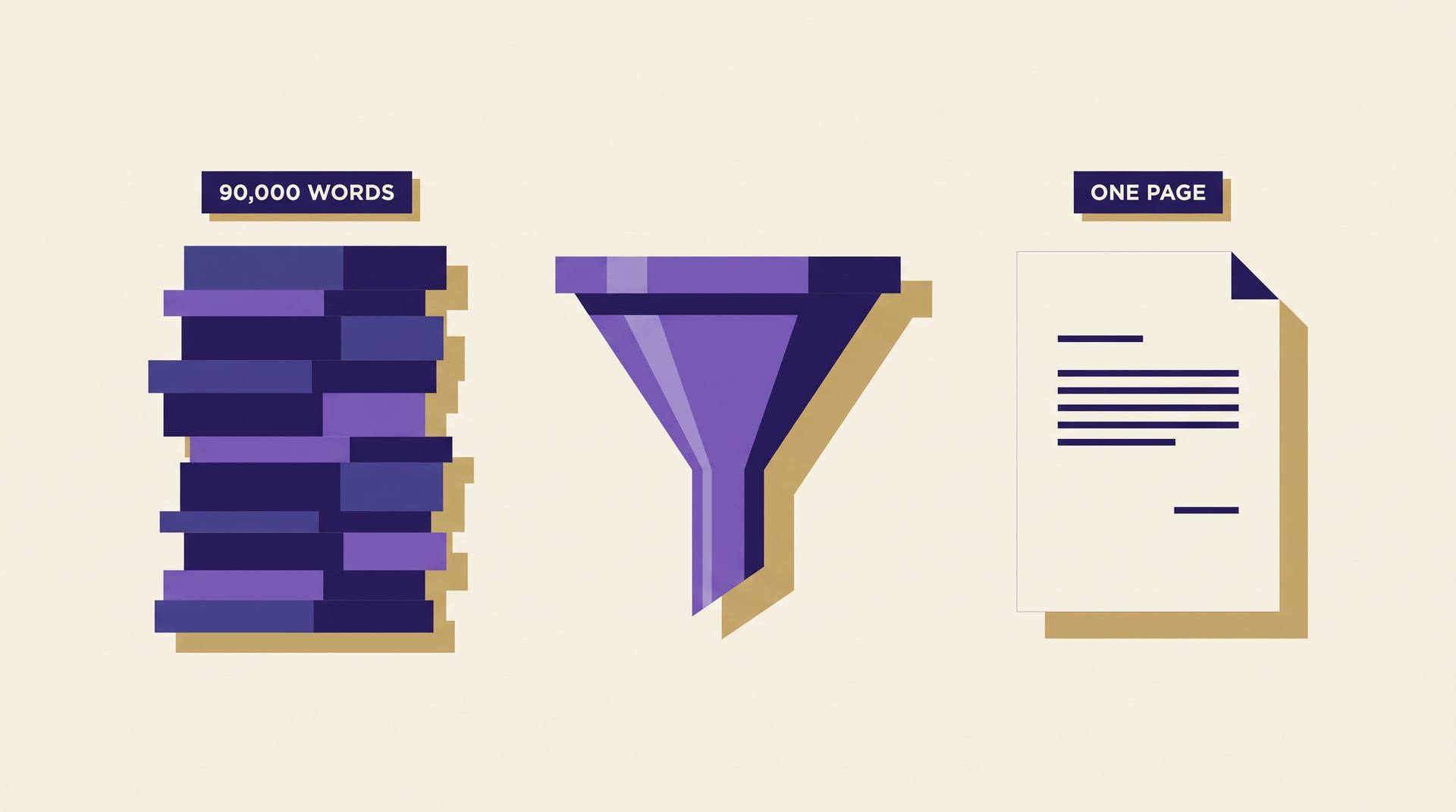
Somewhere between finishing a manuscript and submitting it, every writer hits the same wall: an agent's guidelines ask for a one-page synopsis, and the instinct is to write something enticing. Something that makes them want to read on. That instinct produces a back-cover teaser, the agent reads it, learns nothing about whether the book works, and moves to the next envelope.
A synopsis is a diagnostic document, not a sales document. Its reader is a professional deciding whether your plot holds together, whether the ending earns itself, and whether the story is the kind of thing they can sell. They cannot answer any of that from a teaser. Give them the whole machine with the casing off.
This guide covers what belongs in one, a template you can fill in block by block, a complete worked example of a one-page novel synopsis, and the errors that get a submission rejected before the second paragraph.
What a synopsis actually is
Definition
A synopsis is a compressed, spoiler-inclusive prose summary of a finished book — usually one to two pages — that tells the whole story in order, including the ending, so a professional reader can judge the plot without reading the manuscript.
Three words carry the weight: compressed, spoiler-inclusive, and in order. Drop any one of them and you have written something else.
Synopsis, blurb, query letter, outline: four different jobs
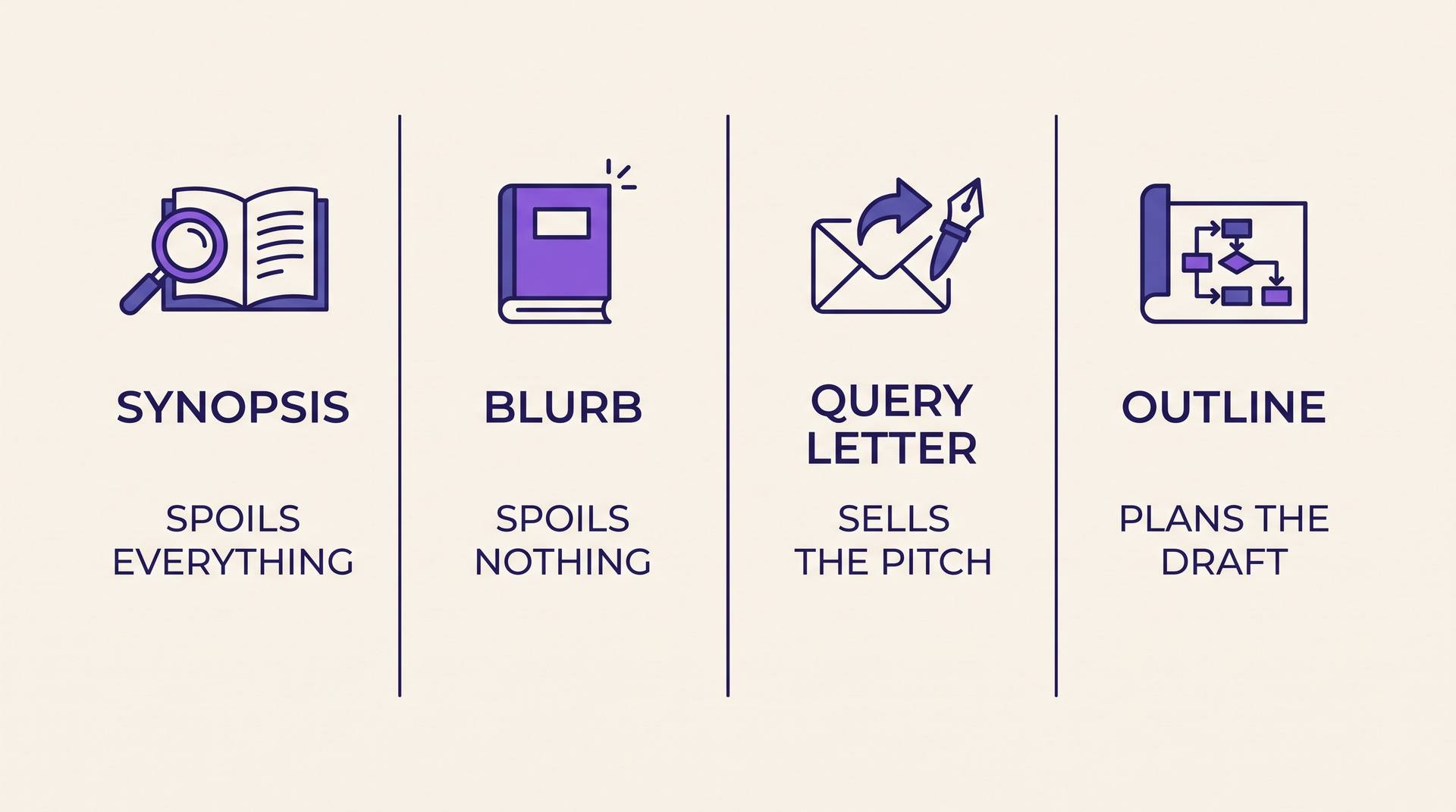
These four documents get confused constantly, and mixing them up is the single most common reason a submission package reads as amateur. They are written for different readers, at different moments, with opposite rules about spoilers.
| Document | Who reads it | Length | Reveals the ending? | Its job |
|---|---|---|---|---|
| Synopsis | Agent, editor, contest judge | 1–2 pages | Always | Prove the plot works from beginning to end |
| Blurb | A browsing reader | 100–200 words | Never | Create enough curiosity to buy |
| Query letter | Agent | One page, mostly pitch | No | Get them to open the pages you attached |
| Outline | You | Anything from a page to twenty | Yes, if you know it | Plan or rebuild the draft itself |
The practical consequence: never paste your back-cover copy into the synopsis slot. If you have already written strong marketing copy — or want to, once the synopsis is done — the blurb generator handles that job separately, and our guide to writing a book description explains why the two documents pull in opposite directions.
The query letter is the other half of the submission package, and it is the one most writers underestimate. If you are assembling both this week, our query letter template with two worked examples is the companion piece to this one.
Who asks for a synopsis, and what each one actually wants
The word means slightly different things depending on who is asking. Read the guidelines you were given before you read any advice, including this — a specific instruction always beats a general rule.
Literary agents
Usually one page, single-spaced, attached or pasted below the query. They are reading for structural competence: does the protagonist drive the story, does the midpoint change the problem, is the ending set up rather than sprung. An agent who likes your pages but finds a broken third act in the synopsis will pass, and you will never know why.
Acquiring editors
Often two to three pages, sometimes with a chapter breakdown alongside. They are reading commercially: where this sits on a shelf, what the comparable titles are, whether the hook survives compression.
Contest and award judges
Length is dictated by the entry form, often strictly, and going over is a disqualification rather than a demerit. Judges read hundreds in a sitting, so front-load the distinctive element in the first two sentences.
You, mid-draft
The most underrated use. Writing a synopsis of an unfinished book forces you to state the ending you have been avoiding. If you cannot summarise your own third act in four sentences, that is not a synopsis problem.
For self-publishers the picture is different: nobody at Amazon will ever ask for a synopsis. It is still worth writing one, because a book whose plot cannot survive a one-page compression usually has a structural problem that reviews will find later.
The synopsis template
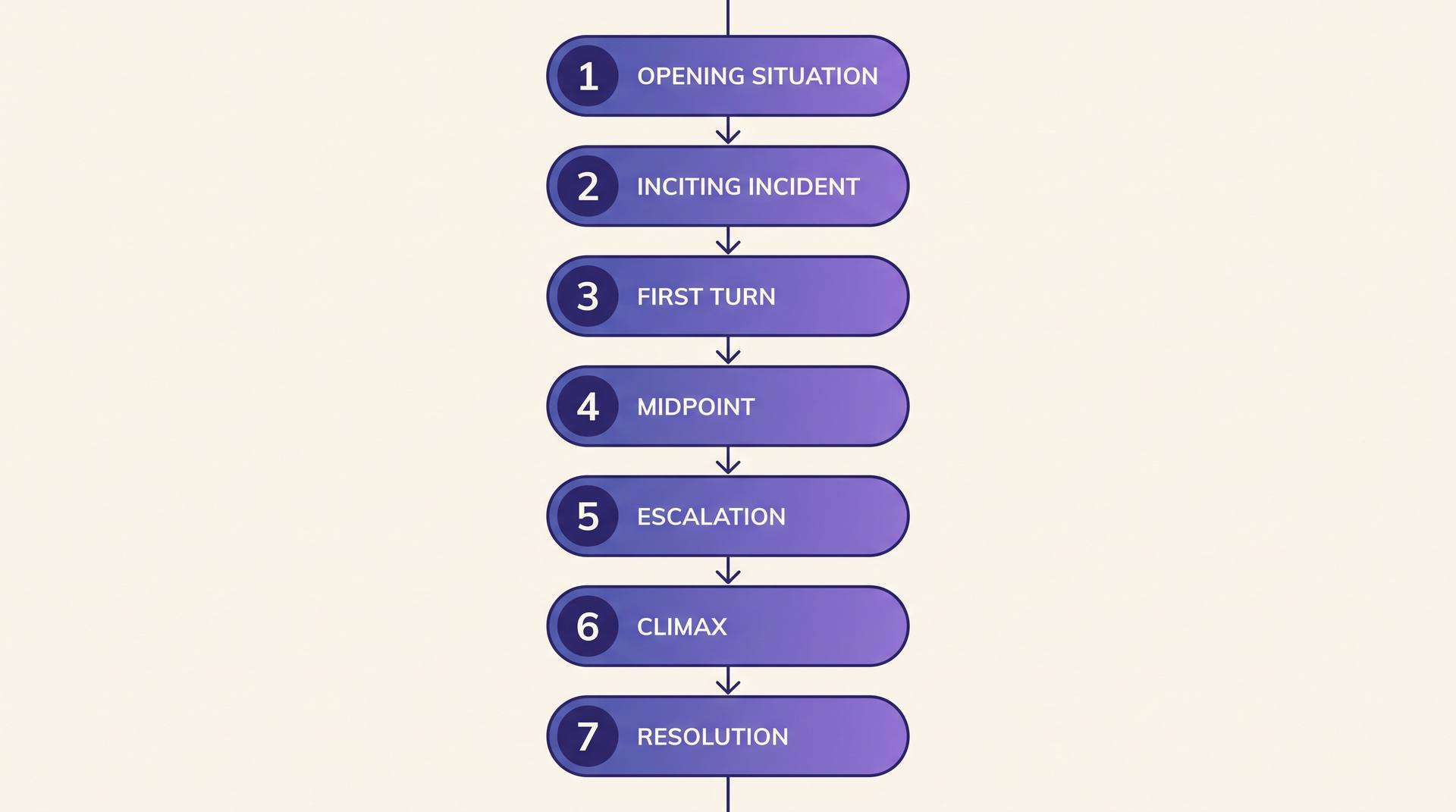
Work through these seven blocks in order and write one to three sentences under each. Do not write elegantly on the first pass — fill the blocks, then cut. A one-page synopsis is roughly 500 to 600 words, so seven blocks at three sentences each lands you close before any trimming.
1. Opening situation
Write:
Name your protagonist in capitals on first mention, give their age or role, the world they are in, and the thing that is already wrong before the story starts.
Watch for:
Two sentences maximum. Setup is where synopses bloat and die.
2. Inciting incident
Write:
The specific event that makes the old situation impossible to continue, and what the protagonist decides to do about it.
Watch for:
It must be an event with a date-stamp quality, not a mood. "She grows restless" is not an inciting incident.
3. First turn
Write:
The protagonist commits: they take the job, cross the border, accept the deal. State the goal in a single clause and the cost of failing.
Watch for:
If your protagonist is still being acted upon here, the agent will notice.
4. Midpoint reversal
Write:
The new information or defeat that changes what the story is about. What the protagonist wanted at block three should no longer be quite the right thing to want.
Watch for:
A synopsis with no midpoint reads as a list of events. This is the block that proves it is a plot.
5. Escalation and lowest point
Write:
Compress the second half into cause and effect: because of the midpoint, this; because of that, this. End on the moment the protagonist loses the most.
Watch for:
Use "because" and "so" as your connective tissue. If you find yourself writing "then, then, then", the causality is missing.
6. Climax
Write:
The confrontation, the choice the protagonist makes, and what it costs them. Name the antagonist's counter-move.
Watch for:
The protagonist must act. A climax resolved by coincidence, rescue or revelation-from-nowhere is exactly what the reader is checking for.
7. Resolution
Write:
How the world and the protagonist are different, in two sentences, and any thread deliberately left open for a sequel.
Watch for:
Never write "you'll have to read it to find out". It reads as evasion, and it is an instant rejection at some agencies.
Two structural notes. Subplots earn a mention only if they change the main plot's outcome — one clause, folded into the block where they intersect. And secondary characters get named only if they appear more than once; everyone else is "her brother" or "the detective".
If the blocks reveal that your midpoint and climax do the same work, or that block five has no causal chain, you have found a manuscript problem rather than a summary problem. The three-act structure guide is the right place to go next, and what actually makes a climax land covers the block six failure specifically.
A full worked example
Here is a complete one-page synopsis for an invented literary thriller, written to the template above. It runs 480 words. Notice how many sentences begin with a character doing something, and how the last paragraph gives away the entire ending without apology.
The Salt Line — literary thriller, 92,000 words
MAREN VOSS, thirty-four, is the only hydrologist left at a state water board that has spent a decade quietly approving extraction permits it cannot justify. She has kept her head down since her mentor was pushed out for objecting to one.
When a sinkhole opens under a school gymnasium in Calder County, killing a janitor, Maren is assigned to write the report that will blame drought. In the field data she finds the permit her mentor refused to sign, approved eleven months later under her own forged signature.
Rather than resign, Maren decides to finish the report honestly and force the board to reject it in writing. She begins collecting the sign-off records, telling her supervisor she needs them for the drought model.
Halfway through, the records lead her to her mentor, who is alive, well paid, and consulting for the extraction company. He signed the permit himself; the forgery was cover for a deal he took, and he expects Maren to understand why. What she thought was institutional cowardice was a transaction, and the person she has been avenging does not want avenging.
Because the report is now worthless as leverage, Maren goes to a regional reporter, who wants the mentor's testimony rather than her data. Because she refuses to trade him, the reporter stalls. The board, warned, suspends her and seals the Calder County file. Her access revoked and her mentor threatening a defamation suit, Maren spends a night deleting her own copies of the data in a panic, then recovers only part of it.
At the board's public hearing, Maren testifies without the sealed records, using the partial data and the one thing nobody thought to seal: eleven years of her own field notebooks, which document the aquifer's decline in her handwriting from before the permit existed. Her mentor, called to rebut her, chooses to corroborate her rather than perjure himself, and destroys his own consultancy doing it.
The permit is revoked. Maren is not reinstated — the board settles quietly and she takes the payout. She ends the book teaching hydrology at a community college in Calder County, and the last scene has her walking a class out to the fenced sinkhole. The extraction company's replacement permit application, filed under a different subsidiary, sits unopened on someone else's desk.
Two things that example does deliberately. The midpoint is not a bigger threat but a reframe — it makes the protagonist's original goal wrong, which is what a midpoint is for. And the resolution refuses tidiness: she loses the job, keeps the truth, and the system is only dented. An agent reading that knows what kind of book it is by the fourth paragraph.
Every scene must do two things: reveal character and advance the action.
A synopsis is the compressed proof that your scenes were doing both. Where the summary reads as a list of happenings, the underlying chapters usually are too.
Eight mistakes that sink a synopsis
Almost every rejected synopsis fails in one of these eight ways, and most of them are fixable in an afternoon.
- 1Withholding the ending. It is not a spoiler, it is the point. A synopsis that hides the climax is unreadable for its actual purpose.
- 2Naming twelve characters. Readers cannot hold a cast list in one page. Name three or four; describe the rest by role.
- 3Writing back-cover copy. Rhetorical questions, "but everything changes when…", and one-line paragraph hooks belong on the blurb, not here.
- 4Chronology by chapter instead of by cause. A chapter-by-chapter list is a different document; the synopsis follows the causal spine, and subplots get folded in where they touch it.
- 5Summarising theme instead of plot. "It is a meditation on grief and belonging" tells an agent nothing they can sell. Events first; the theme will show through them.
- 6Losing the protagonist. If the middle third of your synopsis is about the world, the war, or the antagonist, the manuscript probably has the same imbalance.
- 7Present-tense drift. Starting in present tense and slipping into past halfway is the most common mechanical error, and it reads as carelessness.
- 8Ignoring the stated format. If the guidelines say one page, single-spaced, twelve point, a two-page synopsis in ten point is read as an inability to follow instructions.
One more that is harder to see: emotional flatness. A synopsis is compressed, but it is not a police report. When Maren refuses to trade her mentor to the reporter, the summary says she refuses — the choice itself carries the feeling, and no adjectives are needed to prop it up.
Tense, voice and formatting
The conventions are narrow and non-negotiable enough that breaking them signals inexperience before anyone reads a word of your plot.
- Present tense throughout, regardless of the manuscript's tense. "Maren finds the permit", never "Maren found the permit".
- Third person, even for a first-person novel. The synopsis is written about the book, not inside it.
- Protagonist and major characters in FULL CAPITALS on first mention only, then normal case. Some agencies ask for capitals with an age in brackets.
- Your name, the title, the genre and the word count at the top. Nothing else in the header.
- Single-spaced with a blank line between paragraphs for a one-page synopsis; double-spaced only if a longer one is requested.
- No dialogue, no scene-setting description, no chapter numbers, no headings inside the body.
On word count: a one-page synopsis in twelve-point Times with normal margins is about 500 words, and a two-page one about 1,000. Draft long, then cut to fit rather than writing to the limit from the start — the word counter is quicker than reformatting a document to check.
One page, two pages, five pages
The same story needs three versions, and they are not simple truncations of each other.
The one-page synopsis
Seven blocks, roughly 500 words, no subplots except where they change the outcome. This is the default for agent submissions and the version you should write first, because every longer version is this one with material added back.
The two-page synopsis
Around 1,000 words. Add the one or two subplots that carry real weight, give the antagonist a paragraph of their own motive, and let the midpoint breathe. Most editors requesting "a synopsis" after a full request want this length.
The three-to-five-page synopsis
Requested mostly for non-fiction proposals, series pitches and some contests. Here you can go section by section and include the emotional arc explicitly. Do not simply pad the one-pager — rebuild from the blocks with more room per block.
Keep all three in the same file. Guidelines vary agency by agency, and the writer who can send the requested length in ten minutes submits to more agents than the writer who rewrites each time.
Writing yours faster
The hardest part of a synopsis is not prose, it is compression — deciding what the causal spine of your own book is when you know every scene by heart. Two things help: writing the blocks out of order, starting with block six, and having the structure in front of you rather than in your memory.
If your book was planned in AIWriteBook, the material is already there. The outline builder holds the beat-by-beat structure of the book, which maps almost directly onto the seven blocks — block four is your midpoint beat, block six your climax beat. Reading the outline back is usually faster than reconstructing the spine from the manuscript.
Starting from nothing instead, the free outline generator will produce a structural skeleton you can then compress, which is a reasonable route if you are synopsising a messy draft that was never outlined. And once the synopsis is done, it makes excellent input for the marketing copy: the plot spine is exactly what a description needs, minus the ending.
One caution about drafting a synopsis with any AI, ours included: a model summarising your manuscript will produce something fluent and structurally plausible, and it will quietly smooth over the places where your plot does not actually connect. Those places are the whole reason an agent asked for the document. Use the machine for compression and the tense conversion; make the judgement call about what the causal spine is yourself.
Questions writers ask
Yes, always, with no exception in commercial fiction. The agent is not a reader you are trying to entertain; they are assessing whether the ending is earned. A synopsis that hides it fails at the one task it was requested for, and many agencies treat it as an automatic pass.
One page, roughly 500 words, unless the guidelines say otherwise — and the guidelines override everything here. Keep a two-page version ready as well, since editors requesting a synopsis after a full manuscript request usually want the longer one.
A blurb is marketing copy for a reader deciding whether to buy, it runs 100 to 200 words, and it deliberately withholds the ending. A synopsis is an assessment document for a professional, runs one to two pages, and reveals everything including the last page. Opposite readers, opposite rules.
Yes, present tense and third person, whatever the manuscript uses. Drifting into past tense partway through is the most common mechanical error, so read the finished document once looking only at verbs.
Only when a subplot changes the main plot's outcome, and then in a single clause folded into the block where it intersects. A romance subplot that shifts the climax earns a mention; one that runs alongside without touching the spine does not.
You can and it is a genuinely useful exercise, because it forces you to commit to an ending. Just do not submit it as if the book were finished — for debut fiction the manuscript must be complete before you query.
No platform requires one. It is still worth writing, both as a structural stress test of your own plot and because the compressed version is a strong starting point for a book description, series page copy and ad copy.
Three or four at most on a single page. Everyone else is identified by role — "her supervisor", "the reporter" — because a reader cannot hold a large cast in a document this short and the names crowd out the plot.
Write the ugly version first
The fastest route to a good synopsis is a bad one. Fill the seven blocks with plain, graceless sentences, get to the end, then cut to length and fix the verbs. Writers stall on this document because they try to write the polished version in one pass, and a compressed summary is almost impossible to write and edit at the same time.
And take the diagnosis seriously. If block five has no causality and block six is resolved by someone other than your protagonist, you have learned something worth far more than a submission. That is a manuscript conversation, and it continues in our guide to writing a book.