

Writing a book with AI and selling it is legal. No country bans it, and Amazon, Apple, and every major retailer accept AI-assisted books. What varies is copyright: purely machine-generated text often can't be copyrighted, but a book you meaningfully author, edit, and arrange with AI as a tool generally can. The risks that matter aren't about legality of use — they're plagiarism, undisclosed content where disclosure is required, and copyright you assumed you had but don't.
This article is general information, not legal advice. Laws around AI and copyright are evolving quickly. For a specific situation — especially anything commercial or contested — consult a qualified attorney in your jurisdiction.
On this page
Is it legal to write a book with AI?
Start with the plain answer, because the internet muddies it: there is no law anywhere that makes it illegal to use AI to write a book, and no retailer prohibits selling one. People conflate three separate questions and end up scared of the wrong thing. "Can I use AI to write?" — yes, everywhere. "Can I sell the result?" — yes, on every major platform. "Can I copyright it?" — that's the only one with a nuanced answer, and it hinges on how much of a human author's creative judgment shaped the final book.
Using AI to draft, outline, or edit a book: legal in all major markets
Selling an AI-assisted book on KDP, Apple, Kobo, and others: allowed
Copyrighting it: depends on meaningful human authorship, covered below
The US Copyright Office position
The US Copyright Office has been the clearest voice on this. Its guidance draws a line at human authorship: material generated purely by a machine, with no meaningful human creative control, is not eligible for copyright. But that is not the same as "AI books can't be copyrighted." When a human provides the creative expression — selecting, arranging, revising, and shaping the work so the final result reflects their authorship — that human-authored contribution is protectable. In practice, a book you outline, direct, heavily edit, and arrange with AI as a drafting tool sits in very different territory from one where you typed a single prompt and published the raw output untouched.
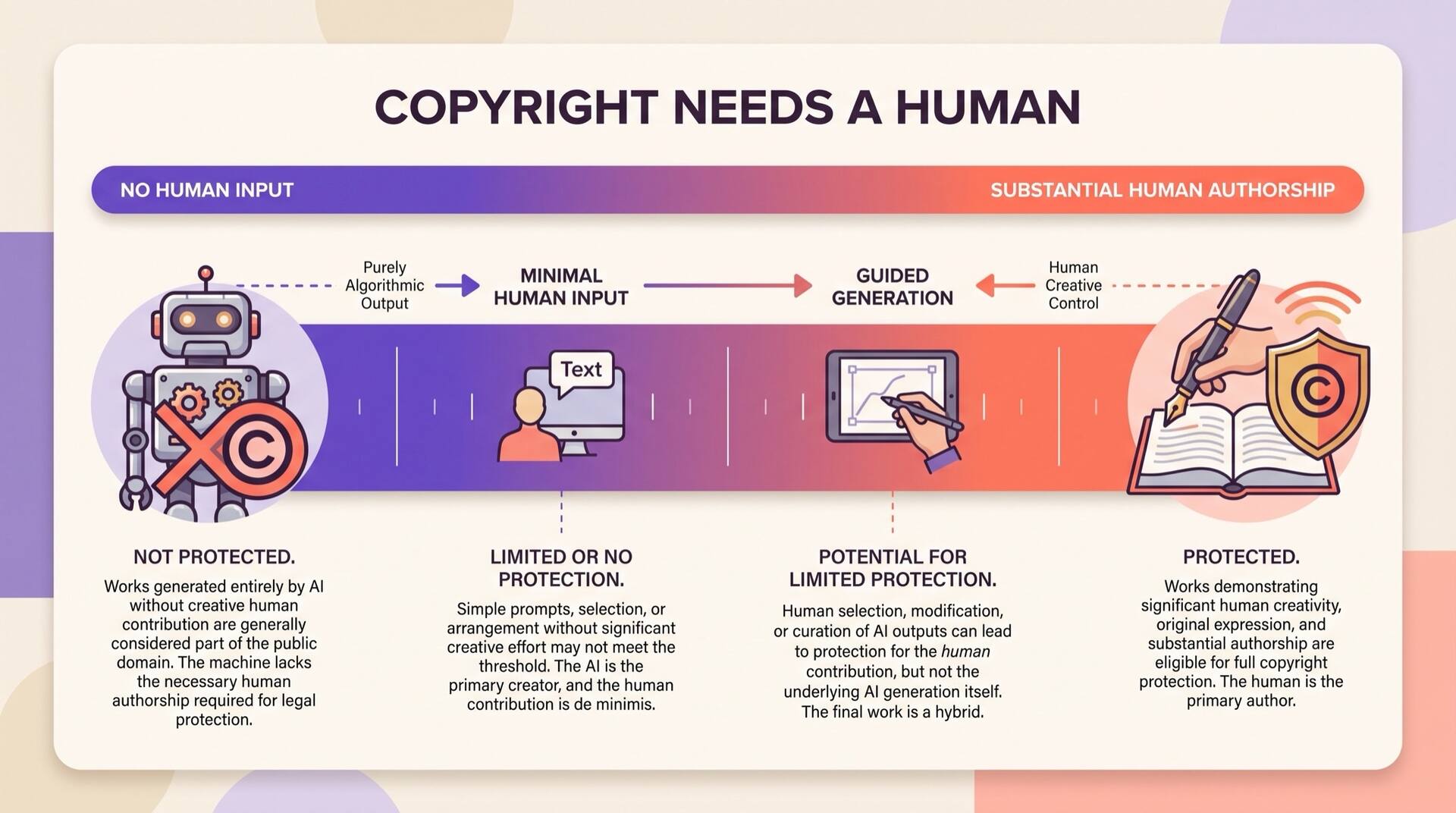
The safe posture: be the author, not just the button-presser. The more your judgment shapes structure, voice, and revision, the stronger your claim — and the better the book.
Amazon's disclosure requirements
Amazon KDP draws a distinction that trips up a lot of authors, so it's worth getting exactly right. KDP separates "AI-generated" from "AI-assisted" content. AI-generated means the AI created the text, images, or translations and you kept it with little or no change. AI-assisted means you created the content yourself and used AI to edit, refine, or brainstorm. During publishing, KDP asks you to declare AI-generated content — but explicitly does not require you to disclose AI-assisted work. Crucially, this declaration is private to Amazon; it is not printed on your book or shown to readers. Answer it honestly, keep your own record of how the book was made, and you're compliant.
AI-generated (declare it)
Text, images, or translations the AI produced that you kept largely as-is.
AI-assisted (no declaration needed)
Content you authored, using AI to edit, refine, suggest, or research.
Plagiarism and infringement risk
This is the risk that actually bites, and it has nothing to do with whether AI is allowed. Two failure modes matter. First, plagiarism: an AI can occasionally reproduce distinctive phrasing close to existing text, and if you publish it unchecked, you own that problem regardless of the tool. Second, trademark and factual traps: AI can invent fake quotes, misattribute facts, or drop in a real brand or living person's name in a way that creates liability. Neither is a reason to avoid AI — they're a reason to verify. Run your manuscript through a plagiarism check before publishing, fact-check any claim you'd stand behind in print, and treat AI output as a draft to be vetted, not a finished product to be trusted.
Before you publish, run the full manuscript through a plagiarism checker — it catches the rare overlap that turns into a real problem after launch. If a flagged passage is worth keeping, a plagiarism remover can rephrase it, and a quick reread afterwards keeps the new wording in your own voice.
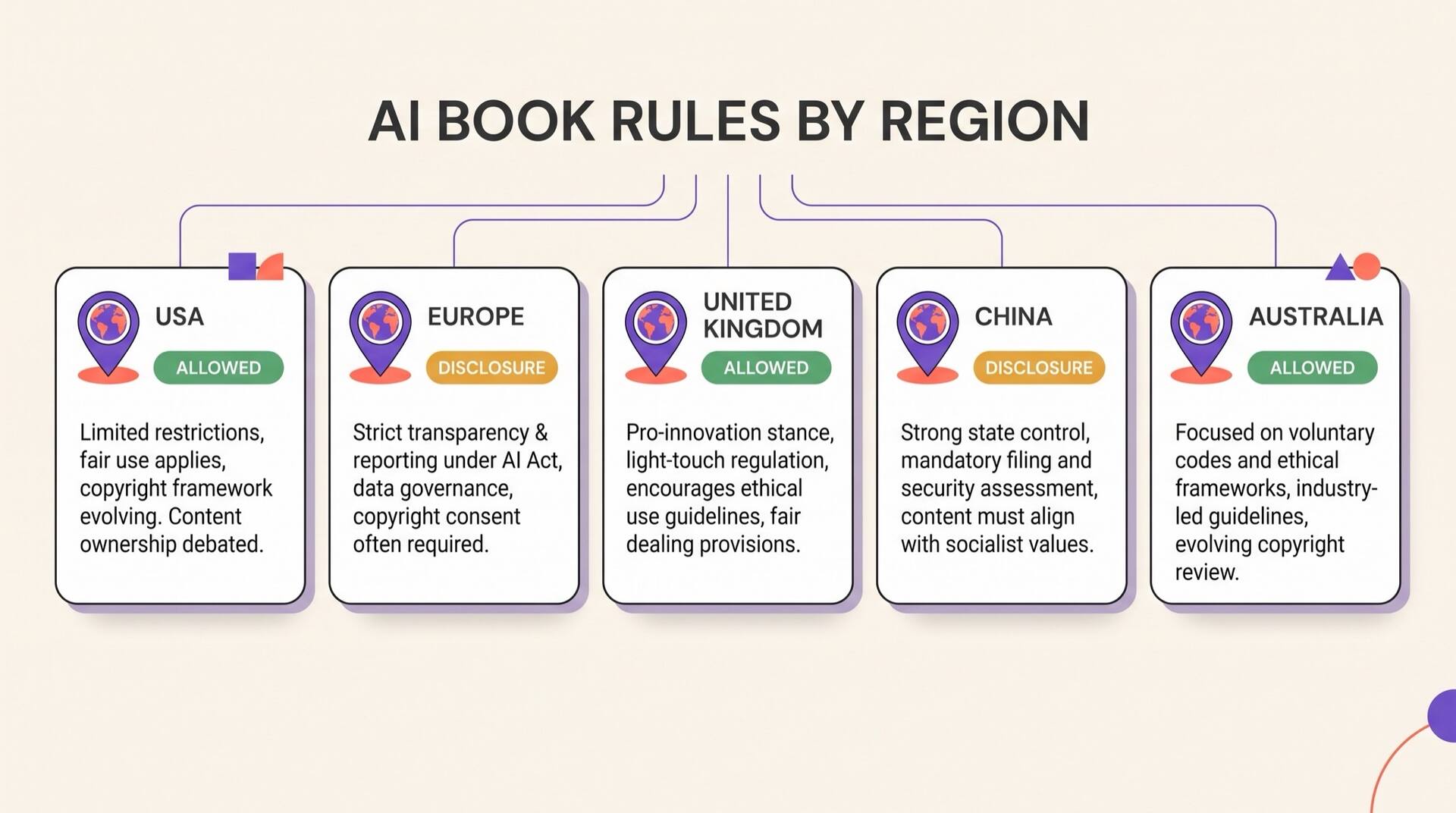
Country-by-country status
The headline is the same everywhere — using AI to write is legal — but disclosure norms and copyright treatment differ. Here's where the major markets stand.
Best practices to stay clear
You don't need a lawyer on retainer to publish safely. These habits keep you on the right side of every rule that actually matters.
How AIWriteBook keeps you protected
The safe way to write with AI maps exactly onto how AIWriteBook is built to work. It treats AI as a drafting collaborator, not a vending machine: you set the outline and direction, and the chapter AI chat lets you revise line by line with accept-or-reject control over every change — so the finished book genuinely reflects your authorship, the thing copyright rewards. Writing-style controls keep the prose in your voice rather than generic model output. And our free plagiarism checker and AI content detector let you verify originality before you ever hit publish. The result is a book you authored with a tool, vetted for originality — which is precisely the posture every jurisdiction above treats most favorably.
Write a book that's genuinely yours — legally and creatively
Start a draft free, shape every chapter with accept-or-reject editing, keep it in your voice, and check it for originality before you publish.
Frequently asked questions
The bottom line
Can you legally write a book with AI? Yes — unambiguously, in every market that matters. The fear online conflates legality with copyright and with quality, but they're separate. Using AI to write and sell is legal; copyright rewards the human authorship you bring; and the risks that can actually hurt you are plagiarism and unverified content, both of which you control.
The safe path and the good-book path turn out to be the same one: be the author. Outline, direct, edit, verify, and publish something that genuinely reflects your judgment. Do that, and you're on solid legal ground and holding a book worth reading.
For the bigger picture on writing with AI the right way, see our full AI writing assistant guide.