

Amazon's Official AI Content Policy
Amazon first added AI fields to the KDP publishing flow in September 2023, and as of August 2026 the rule in the KDP Content Guidelines is unchanged: when you publish a new book or edit an existing one, you must tell Amazon whether it contains AI-generated content. Disclosed AI-generated books are allowed. They are held to exactly the same content, quality and intellectual property standards as everything else on the store. The disclosure goes to Amazon, not onto your product page.
Amazon's guidelines: if you created the content yourself and used AI-based tools to edit, refine, error-check or otherwise improve it, that is AI-assisted, not AI-generated. Brainstorming with AI and then writing the content yourself is also AI-assisted. Amazon states plainly that it is not necessary to inform them of this kind of tool use.
What You Must Disclose
The disclosure lives inside the KDP upload flow itself, on the book details step, and it reappears when you edit a published title. It is internal to Amazon: readers do not see it on the detail page, and Amazon has not tied it to royalties or eligibility. Here is exactly what falls inside and outside the requirement.
Text Content Disclosure
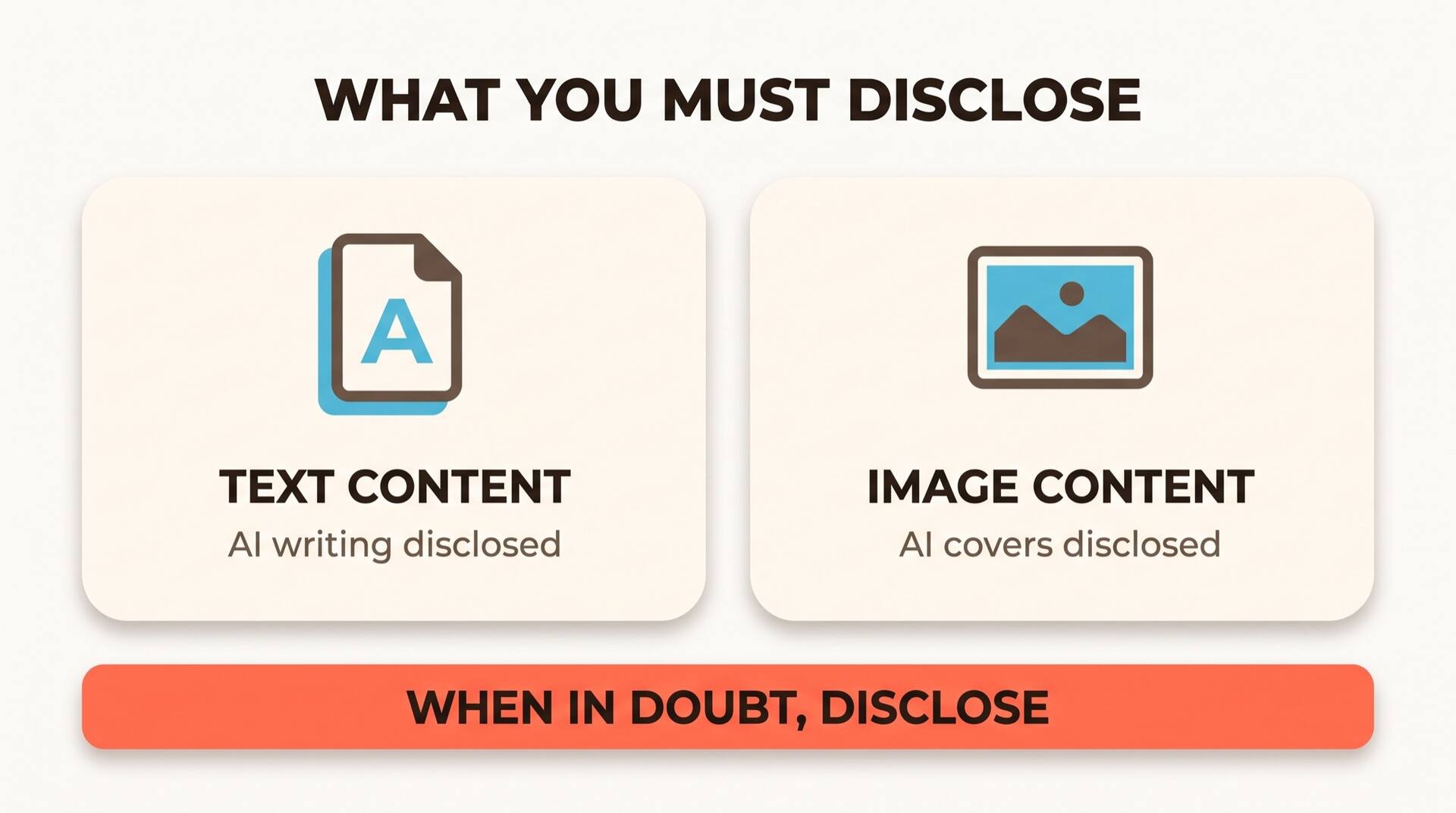
You must indicate whether AI tools were used to create, generate, or assist in writing any part of your book's text content. This includes using ChatGPT, Claude, or AI writing tools from an AI development company for drafting chapters, generating dialogue, or creating descriptions.
Image Content Disclosure
Separately, you must disclose whether AI was used to generate any images in your book, including the cover. This applies to tools like Midjourney, DALL-E, Stable Diffusion, and any AI-based image generation platform.
What Counts as AI Use
Narrower than most authors assume. Content the model produced counts: drafted chapters, generated images, machine translations. Work you did yourself with AI in a supporting role does not: brainstorming, grammar and spelling checks, developmental feedback, tightening your own prose. The practical test is whether the words or pixels in the finished book came out of the model or out of you.
Consequences of Non-Disclosure
Undisclosed AI-generated content breaches the KDP Terms and Conditions. Amazon can block the title at review, remove it after publication, or take action on the account itself, up to termination for repeat or large-scale abuse. Disclosing costs you nothing, so the risk is entirely one-sided.
Copyright Law and AI-Generated Content
Copyright is the most complex area for AI-assisted authors. The legal landscape is evolving rapidly, and understanding the current state helps you protect your work and stay on the right side of the law.
Where US Copyright Law Now Stands
Purely AI-generated material with no human creative input cannot be registered. The US Copyright Office set this out at length in Part 2 of its Copyright and Artificial Intelligence report on 29 January 2025, the DC Circuit affirmed it in Thaler v. Perlmutter on 18 March 2025, holding that the Copyright Act requires every work to be authored in the first instance by a human, and the Supreme Court declined to review that ruling on 2 March 2026. This is settled ground now, not an open question.
What Human Contribution Actually Counts
The Copyright Office's 2025 report is specific: you hold copyright in your own expression that is perceptible in the output, in your creative selection, coordination or arrangement of AI material, and in your creative modifications of it. It is equally specific that prompting alone is not enough. Detailed prompts that took real effort still function as instructions conveying unprotectable ideas. The Office also confirmed that using AI as a tool inside a human creative process does not make the whole work uncopyrightable, and that it will judge sufficiency case by case rather than under a separate AI framework.
Practical Implications for Authors
The more human creative effort you invest in directing, editing, and refining AI output, the stronger your copyright claim becomes. Authors who simply prompt an AI to write a complete book and publish the raw output have the weakest copyright position. Authors who use AI as a starting point and extensively revise have the strongest position.
International Considerations
Copyright law varies by country, and the human-authorship rulings above are US law. The EU, UK and other jurisdictions are developing their own approaches to AI-generated content. If you sell through Amazon's global marketplaces, your protection may differ market by market.
Learn the complete process of writing books with AI — Learn the complete process of writing books with AI
Amazon's Quality Crackdown
From late 2023 onward Amazon layered on measures against low-quality mass-published AI content, and they are all still in force in 2026. Understanding them is what separates AI-assisted books that sell from ones that get pulled.
Daily Publishing Limits
Announced on 27 September 2023 and still in place: a standard KDP account can create three new titles per day. Amazon framed it as lowering volume limits to protect against abuse, and it was aimed squarely at content farms. If you publish a few considered titles, you will never touch the ceiling.
Enhanced Content Review
Amazon expanded its content review team and implemented AI detection tools. Books flagged as potentially AI-generated undergo additional scrutiny. Content that appears to be unedited AI output, contains repetitive patterns, or lacks substantive value is more likely to be rejected or removed.
Reader-Reported Issues
Amazon now takes reader complaints about AI-generated content more seriously. Multiple negative reviews mentioning robotic writing, repetitive content, or misleading descriptions can trigger a review of your book. This reinforces the importance of quality over quantity.
AI Book Publishing Compliance Checklist
Check off each item before publishing your AI-assisted book on Amazon
The Do's and Don'ts of AI Book Publishing
Do's
Use AI as a writing assistant
Treat AI as a collaborative tool that helps you draft faster, overcome writer's block, and explore ideas. The best AI-assisted books feel indistinguishable from traditionally written ones because the author invested real effort in shaping the output.
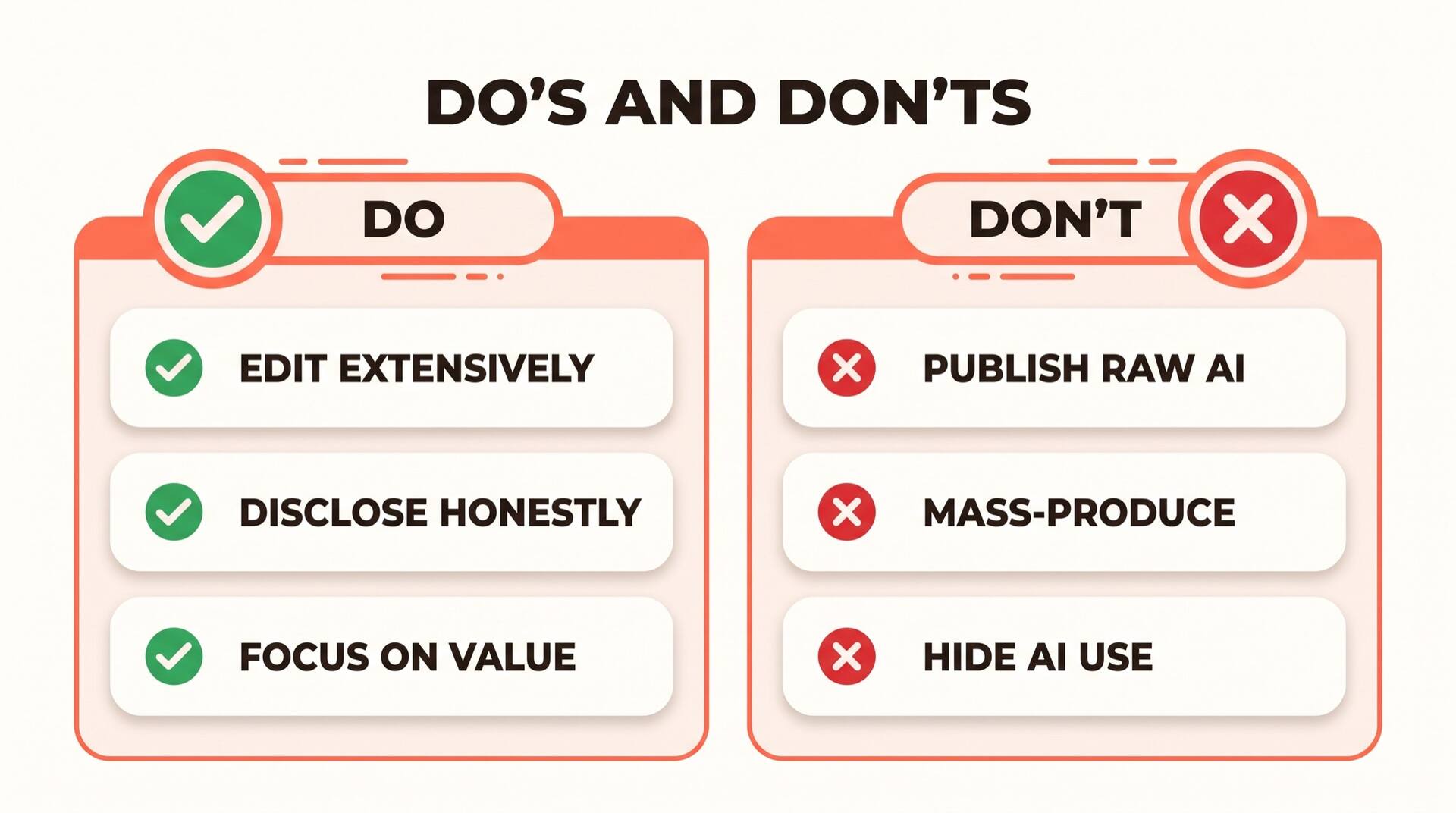
Edit extensively
Every piece of AI-generated text should go through multiple rounds of human editing. Add your unique voice, fix inconsistencies, deepen character motivations, and ensure the logic flows naturally. This is what separates published authors from prompt-pushers.
Disclose honestly
Full transparency with Amazon and your readers builds trust and protects your account. Many successful AI-assisted authors openly discuss their process, and readers appreciate the honesty. Disclosure does not hurt sales when the quality is there.
Focus on value for readers
Ask yourself: would a reader feel they got their money's worth? AI-assisted nonfiction should contain accurate, well-researched information. AI-assisted fiction should have compelling characters and engaging plots. Value is the ultimate defense against any quality review.
Keep records of your creative process
Document your prompts, editing process, and creative decisions. This documentation strengthens your copyright position and provides evidence of human authorship if your work is ever challenged.
Don'ts
Publish raw AI output
Unedited AI text is detectable by both readers and automated systems, and running your draft through an AI checker before you publish is a quick way to see what those automated systems would flag. It often contains telltale patterns: overuse of certain phrases, generic descriptions, and a flat tone that lacks personality. Raw output will get your book flagged and damage your author reputation.
Mass-produce low-quality titles
The era of publishing 50 AI-generated books a month to make passive income is over. Amazon's three-book daily limit and enhanced review processes specifically target this approach. Focus on fewer, higher-quality titles instead.
Hide AI involvement
Attempting to conceal AI use from Amazon violates their terms of service and risks account termination. AI detection technology is improving rapidly, and the consequences of being caught far outweigh any perceived benefit of non-disclosure.
Impersonate real expertise
Using AI to write a medical guide while posing as a doctor, or a legal guide while claiming to be an attorney, is both unethical and potentially illegal. If your AI-assisted book covers specialized topics, make your actual qualifications clear.
Ignore reader feedback
If readers complain that your content feels generic or robotic, take it seriously. These reviews can trigger Amazon's quality review process. Use feedback to improve your editing process and deliver better content in future editions.
An Ethical Framework for AI-Assisted Publishing
Beyond legal compliance, building a sustainable AI-assisted publishing business requires an ethical foundation. A publishing house carries that reputation on behalf of its authors, so a writer who signs with an independent press such as Mayfair Publishers inherits its standards along with its distribution. Publish on your own and you are the standard. Authors who take the ethical high road build stronger reader relationships and more resilient businesses.
Transparency First
Be open about your process. Some of the most successful AI-assisted authors write blog posts, social media content, and even author notes explaining how they use AI. Readers are increasingly curious about AI in creative work, and transparency turns skeptics into supporters.
Value Over Volume
The authors earning the most from AI-assisted publishing are not the ones who publish the most titles. They are the ones who use AI to create better books, not just more books. One well-crafted, thoroughly edited AI-assisted book will outperform ten hastily generated ones in long-term revenue.
Respect the Reader
Your readers are paying for an experience: education, entertainment, or inspiration. If AI helps you deliver that experience more efficiently, that benefits everyone. If AI is simply a shortcut that produces a worse experience, you are taking your readers' money under false pretenses.
Continuous Improvement
AI tools are improving rapidly, and so should your process. Stay updated on best practices, invest time in learning better prompting techniques, and always look for ways to add more human value to your AI-assisted workflow.
How Successful Authors Use AI Ethically
Thousands of authors are using AI tools to publish profitable, well-received books on Amazon. Here are the patterns that separate successful AI-assisted authors from those who struggle.
The Outliner
70%+ human-written contentUses AI to generate detailed book outlines and chapter structures, then writes the actual content themselves. AI saves hours of planning time while the human voice comes through in every sentence. This approach has the strongest copyright position.
The Editor
3-5 editing passes per chapterGenerates initial drafts with AI, then spends significant time rewriting, restructuring, and infusing personal experience and expertise. The final product is substantially different from the AI's original output. Most successful AI-assisted nonfiction authors use this approach.
The Researcher
All facts independently verifiedUses AI to synthesize research, find connections between ideas, and organize information. The author then verifies every claim, adds original analysis, and presents findings in their own voice. Particularly effective for business, self-help, and educational books.
Key Milestones in AI Publishing Policy
Where AI Book Publishing Is Heading
The intersection of AI and publishing is evolving faster than almost any other creative industry. Understanding the trajectory helps you position your publishing business for long-term success.
Stricter Disclosure Standards
Expect more detailed disclosure requirements from both Amazon and regulatory bodies. The trend is toward greater transparency, not less. Authors who proactively disclose now will be ahead of the curve when new requirements arrive.
Quality as the Differentiator
As AI makes it easier for anyone to produce a book, quality becomes the primary differentiator. Readers and algorithms will increasingly reward well-edited, genuinely useful content and penalize generic AI output. Investment in quality editing will yield higher returns.
The Remaining Copyright Question Is Degree, Not Principle
Whether AI output alone can be copyrighted is answered: it cannot. What is still being worked out is how much human contribution is enough, which the Copyright Office decides case by case and which further litigation will keep sharpening. Authors who document their prompts, edits and creative decisions are positioned well whichever way those lines land.
Frequently Asked Questions
Is it legal to sell AI-generated books on Amazon?
Yes. Amazon's KDP Content Guidelines expressly permit AI-generated books, and there is no law against selling them. Amazon's only condition is that you inform them of AI-generated content when you publish a new book or edit an existing one, and that the book meets the same content, quality and intellectual property standards as any other title. Undisclosed AI-generated content, by contrast, breaches the KDP Terms and Conditions and can get the book blocked or the account terminated.
Do I have to tell Amazon that I used AI?
Only if the AI produced content that ended up in the book. Amazon defines AI-generated as text, images or translations created by an AI-based tool, and that classification holds even if you applied substantial edits afterwards. If instead you wrote the content yourself and used AI to edit, refine, error-check or brainstorm, Amazon calls that AI-assisted and states it is not necessary to inform them. So: an AI first draft you rewrote is disclosed, your own draft that AI proofread is not.
Do readers see the AI disclosure on my book's page?
No. The disclosure is made to Amazon inside the KDP publishing flow and is not displayed on your product detail page, and Amazon has not tied it to royalties or eligibility. Telling readers directly is an ethical choice rather than an Amazon requirement, and many authors who work openly with AI find that transparency builds trust rather than costing sales.
Can I copyright a book written with AI?
You can copyright the human authorship in it, not the parts the machine produced on its own. The US Copyright Office's January 2025 report on copyrightability, the DC Circuit's March 2025 decision in Thaler v. Perlmutter, and the Supreme Court's refusal to review it in March 2026 all point the same way: a work needs a human author. Your own expression, your creative selection and arrangement of AI material, and your creative modifications of it are protectable. Prompts alone are not, however detailed they are.
How many AI books can I publish on Amazon per day?
Three. Amazon capped new title creation at three per day per standard account on 27 September 2023 to curb mass publishing abuse, and the cap is still in effect in 2026. It is not an AI-specific rule and it does not affect authors publishing at a normal pace.
Will Amazon reject my book for being AI-generated?
Not for being AI-generated as such, provided you disclosed it. Books are rejected or removed for failing the content guidelines: poor quality, unedited output, misleading descriptions, duplicated or infringing material. Amazon reviews titles before and after publication and takes reader complaints about low-quality content seriously, so the deciding factor is how good the finished book is, not which tools produced the draft.
The Bottom Line
As of August 2026, selling AI-generated books on Amazon is legal, expressly permitted by the KDP Content Guidelines, and can be profitable. Two facts do the heavy lifting. Disclose anything the model actually wrote, drew or translated, even after heavy editing, and skip the disclosure for work you wrote yourself with AI helping you edit. Then meet the same quality bar every other book on the store has to meet.
On copyright, the rule is settled: no human authorship, no protection, and prompting on its own does not count as authorship. The more of your own judgment, structure and rewriting that lives in the finished book, the stronger your claim. Disclose honestly, edit thoroughly, keep a record of your process, and put readers first. That formula has survived every policy change since 2023.