

So, can ChatGPT write a book?
Yes, technically. People are doing it every day. You can ask ChatGPT for an outline, then ask it to write Chapter 1, then Chapter 2, and keep going until you have a manuscript. With GPT-5.5 the output is fluent, sometimes genuinely good, and almost always grammatically clean.
What ChatGPT cannot do on its own is remember your book. It will happily contradict itself across chapters, drift in tone, and forget that your antagonist already revealed their motive. A book is a long, internally consistent artifact. ChatGPT is a chat assistant with a finite context window. Those two shapes do not fit perfectly.
Most authors who finish a book with ChatGPT either spend significant manual effort keeping it consistent, or they pair it with a tool that does that work for them. The interesting question in 2026 is not whether ChatGPT is capable — it clearly is — but whether using it raw is the right way to spend your time.
What GPT-5.5 changed for book writing
GPT-5.5 launched on April 23, 2026 and shifted what is realistic to expect from ChatGPT for long-form writing:
- Longer context window: you can paste in a full novella worth of prior chapters and ChatGPT will actually use it, instead of quietly forgetting the middle.
- Better long-arc reasoning: plot threads laid down in Chapter 2 are referenced more reliably in Chapter 12, as long as they are in context.
- More restrained voice: the cheerful, hedge-heavy ChatGPT tone is far less intrusive in creative writing, especially when you give it style examples.
- Improved dialogue: characters sound less like the same narrator in different costumes, particularly with named voice profiles in the system prompt.
- Stronger refusal handling: it pushes back less on dark themes in fiction when the framing is clearly creative.
None of this changes the underlying architecture, though. Memory still resets between chats unless you explicitly use ChatGPT's memory or Projects feature, and even those are not designed around the structure of a 90,000-word novel.
What ChatGPT genuinely does well for book writing
It is worth being specific about where ChatGPT actually earns its place in a book-writing workflow, because there are several:
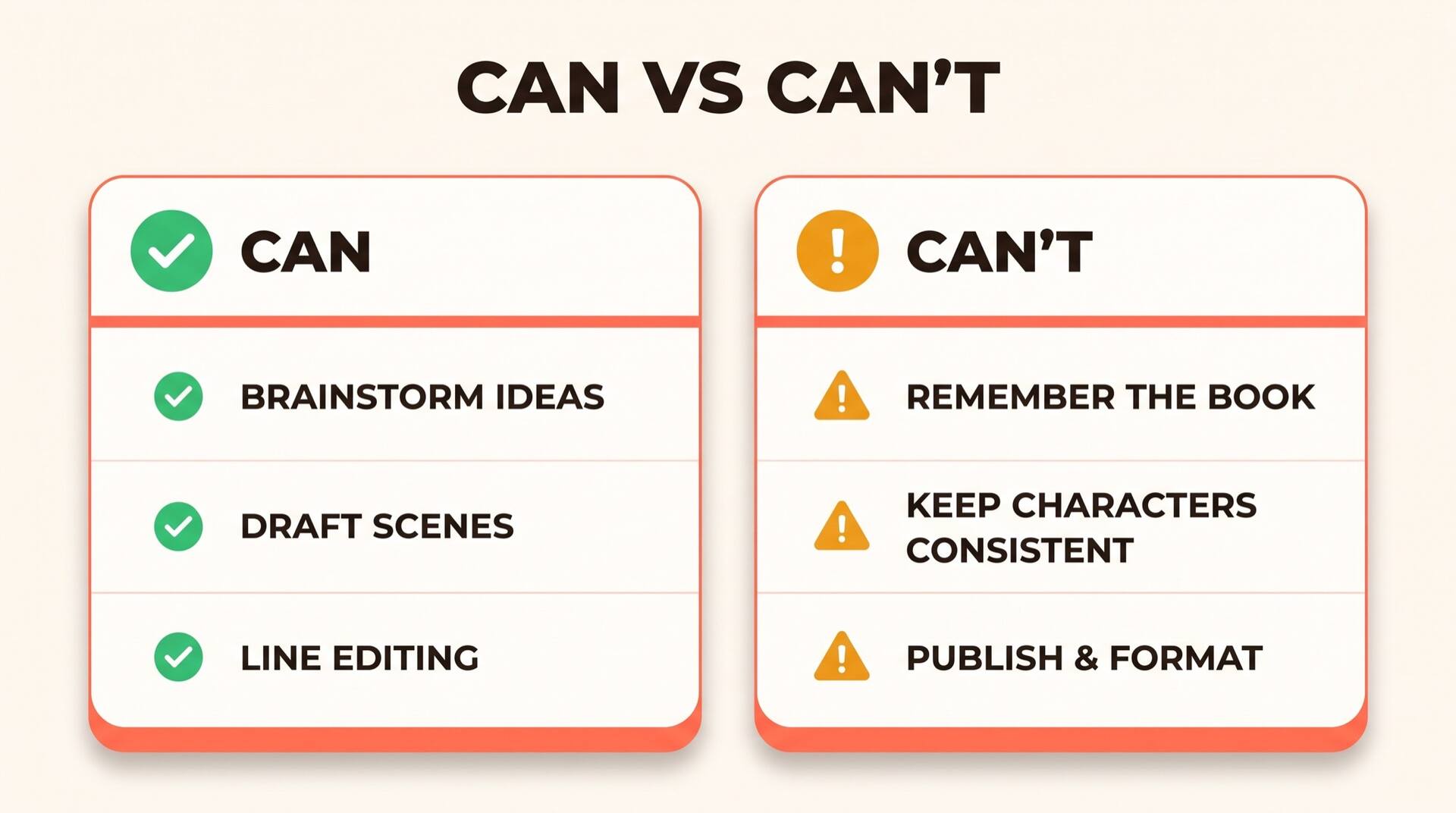
Brainstorming and ideation
Premises, log lines, character names, plot twists, twenty alternative endings. ChatGPT is excellent at generating options. For pre-writing it is hard to beat.
Drafting single scenes
Give it the setup, the characters, the goal, and the desired tone, and ChatGPT can produce a scene draft that is often 70-80% of the way to usable prose.
Research and explanation
Need to know how a 19th-century courtroom worked, or how a small startup raises a Series A? ChatGPT compresses background research into something usable. Always sanity-check the specifics.
Line editing and polish
Paste a paragraph and ask for tighter prose, sharper verbs, or a more consistent point of view. GPT-5.5 is a strong, fast line editor.
Marketing copy
Book descriptions, A+ content blurbs, author bios, ad headlines. The same things that make ChatGPT a good copywriter make it useful for the publishing side of your book.
Where ChatGPT still struggles with a full book
These are the gaps that show up the moment you try to take a manuscript past 20,000 words:
Persistent memory across the project
ChatGPT does not natively know your book exists. Memory and Projects help, but neither tracks chapters, character profiles, or world-building as structured data. You end up pasting the same context over and over.
Character consistency across long arcs
Eye color, speech patterns, internal logic — small details drift. Readers notice. The further apart two chapters are in the chat, the more likely something will quietly contradict.
No integrated publishing pipeline
ChatGPT can write a chapter but cannot generate a print-ready cover, format a KDP-spec interior, produce an audiobook, or export to EPUB. Each of those becomes a separate tool and a separate workflow.
Amazon KDP AI disclosure
Since 2023 Amazon has required publishers to disclose AI-generated content at upload. That has not gone away — it has been formalized. Using ChatGPT for substantial portions of your book is fine, but you must declare it on the KDP form.
No project structure
Outlines, chapter lists, character sheets, scene notes — ChatGPT treats all of this as conversation. Reorganizing a manuscript means manually copying text around. There is no source of truth for the book itself.
A realistic ChatGPT-only workflow for writing a book
If you are determined to write your book in ChatGPT alone, here is the workflow that actually works. It is more work than people admit, but it is doable:
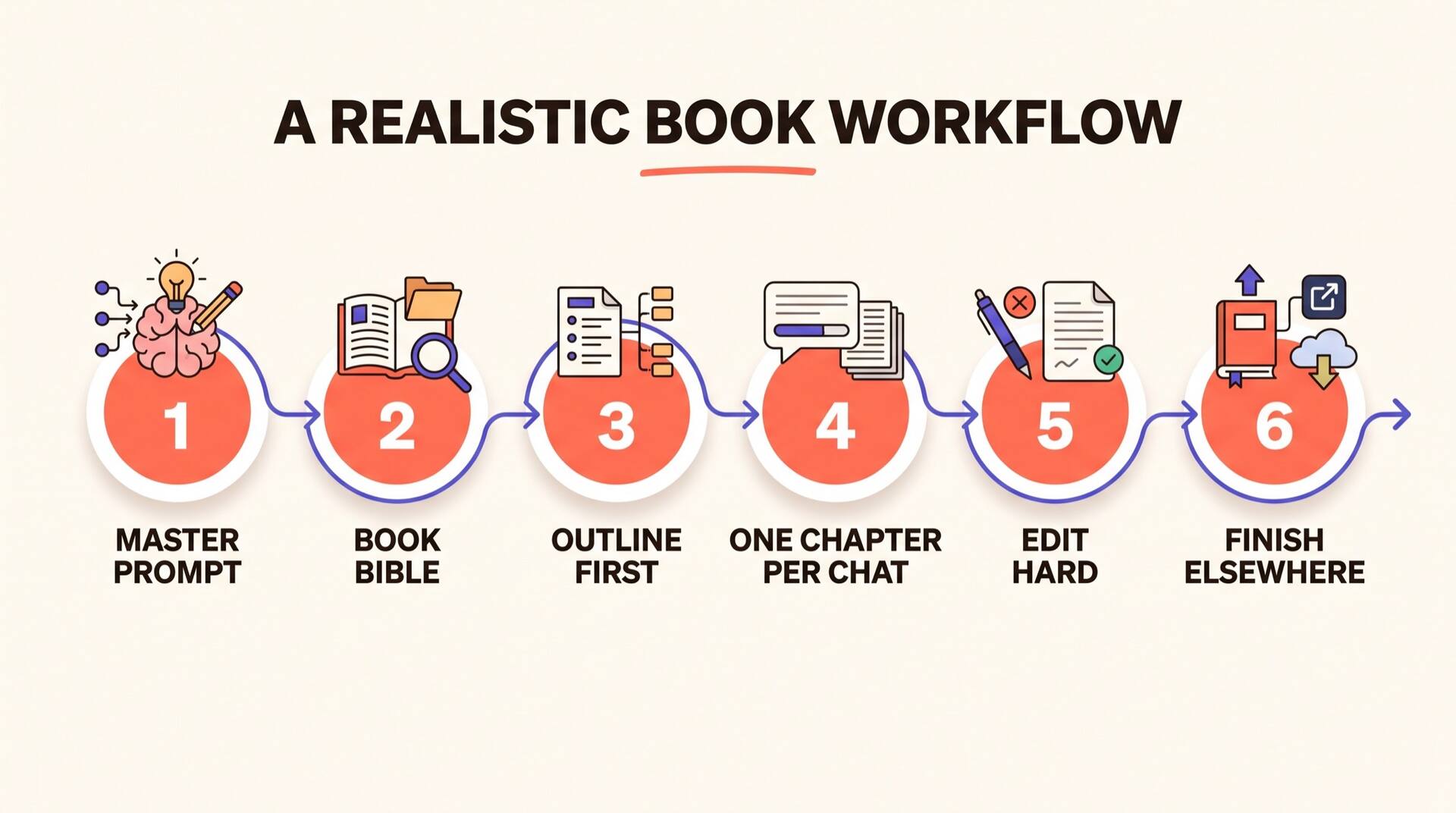
Build a master prompt
Write a long, structured system prompt describing your premise, narrator voice, point of view, tone, and main characters. Save it. Paste it at the start of every new chat.
Maintain an external book bible
Keep a separate document — Notion, Google Doc, even a text file — with character profiles, timeline, world rules, and a running plot summary. Update it after every chapter.
Generate the outline first
Have ChatGPT produce a full chapter-by-chapter outline before you write any prose. Refine it until it actually tells a story, then freeze it.
Write one chapter per chat
Start a fresh chat per chapter. Paste your master prompt, the current state of the book bible, and the relevant outline section. Ask for a draft.
Edit aggressively
Treat the output as a fast first draft, not a final manuscript. Tighten prose, fix character voice, cut filler. Update the book bible with anything new the chapter introduced.
Finish elsewhere
Once the manuscript is written, you still need a cover, formatting, possibly an audiobook, and a KDP-ready file. None of that lives in ChatGPT.
What about Amazon KDP and AI disclosure?
If you plan to sell your book on Amazon, KDP requires you to disclose AI-generated content during the publishing form. The rule covers text, images, and translations created with generative AI tools — including ChatGPT.
The disclosure does not block you from publishing. Books written with significant AI assistance are sold on Amazon every day. It does mean you should be honest about how the book was made, both with Amazon and with your readers. Misrepresenting AI-generated work as fully human-written can get the listing pulled.
Practical takeaway
Write whatever you want with ChatGPT, declare it on the KDP form, and treat the AI as a co-writer in your back-cover copy if it is genuinely a co-writer. Hiding it is the only thing that gets people in trouble.
Can ChatGPT write a novel specifically?
Short fiction — under 20,000 words — ChatGPT can handle in a small number of chats with reasonable consistency. Plenty of self-published novelettes have been written this way.
A full-length novel of 70,000 to 100,000 words is a different problem. The book has to hold together across hundreds of pages. That means a protagonist who behaves like one person from start to finish, foreshadowing that pays off, and a tone that does not wander between chapters. ChatGPT can produce any single section of a novel at high quality. Holding the whole thing in mind is what it cannot do alone.
This is also the most common reason authors who started in ChatGPT move to a dedicated book-writing tool. The chat interface is fundamentally the wrong shape for a novel.
ChatGPT vs a dedicated book-writing tool
| Aspect | ChatGPT (GPT-5.5) | AIWriteBook |
|---|---|---|
| Project memory | Memory and Projects, manual | Persistent per-book |
| Character tracking | You maintain it | Built-in character profiles |
| Full-book outline | Generated, not enforced | Free outline generator, used during writing |
| Cover design | Separate tool | KDP-spec cover designer (1600×2560) |
| Audiobook | Not available | 25 verified audiobook voices |
| KDP export | Manual formatting | One-click KDP export |
| Generation speed | Chapter at a time | ~30 minutes for a 20-chapter book |
Frequently asked questions
Is ChatGPT good for writing books in 2026?
For drafting, brainstorming, and editing — yes, very good. For managing a full book end to end — not on its own. It is a strong component in a workflow, not the whole workflow.
Can ChatGPT write a full novel?
It can produce every word of a novel, but it cannot hold a novel together in its head. You will need either disciplined manual project management or a dedicated tool to keep the book consistent.
Will Amazon ban my book if I use ChatGPT?
No. Amazon allows AI-assisted and AI-generated books on KDP as long as you disclose during upload. Hiding it is the violation, not using it.
How long does GPT-5.5 take to write a book?
A few weeks at a steady pace if you are doing it chapter by chapter in ChatGPT with manual review. A dedicated tool that orchestrates chapter generation can compress that to hours.
Do I still own the copyright to a book written with ChatGPT?
In most jurisdictions you own the human-authored selection, arrangement, and editing of an AI-assisted book. Purely AI-generated text with no human creative input is harder to copyright in the US. Consult a local lawyer if this matters to your business.
Our verdict
ChatGPT in 2026 is a genuinely powerful writing partner. GPT-5.5 closed a lot of the gaps that made earlier versions frustrating for fiction. If you have never written a book before, ChatGPT lowers the wall enough that you can actually get to a finished draft.
What it does not do is replace the structural work of writing a book. Outlines, character bibles, consistent voice, cover design, audiobook, KDP-ready files — that is most of the work of publishing, and ChatGPT handles none of it natively.
Use ChatGPT for what it is best at, and use a dedicated book-writing tool for everything that wraps around it.
Where AIWriteBook fits
AIWriteBook is the wrapper. It uses a multi-model frontier AI stack — including the same class of models that power ChatGPT — but it organizes the writing around an actual book: characters, outline, chapters, cover, audiobook, KDP export, and translation, all in one place. You write the book once, instead of pasting context into a chat hundreds of times.
The free tier gives you the full character system, the full outline generator, .docx import of an existing draft, and one chapter of your first book written for free. If you are coming from ChatGPT, this is the cheapest possible way to see whether a structured tool changes how the work feels.