


What a character arc actually is
An arc is a change in belief, not a change in circumstance. A character who starts poor and ends rich has a plot. A character who starts believing money will make her safe and ends knowing it will not has an arc. The two often run together, and readers remember the second one.
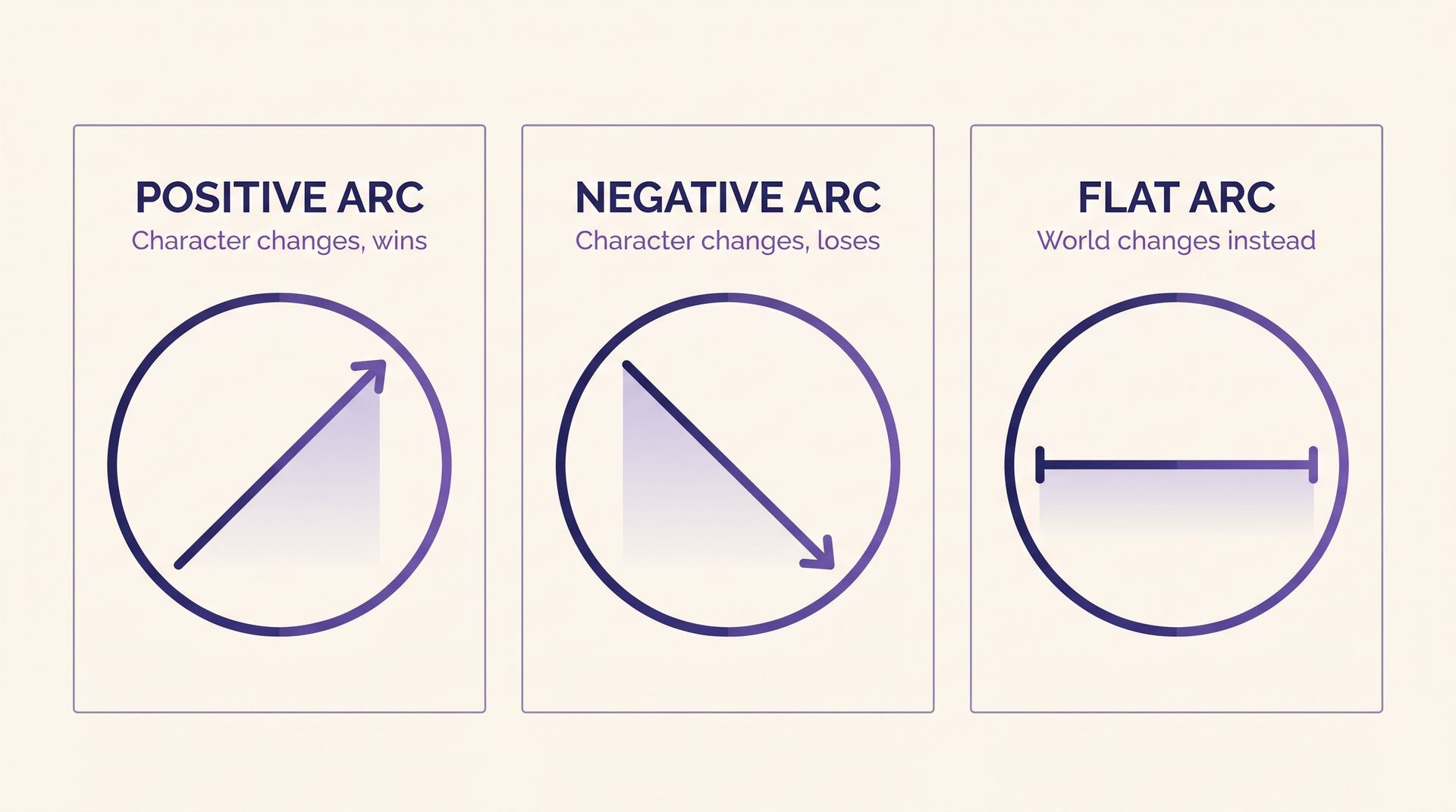
The useful craft shorthand is a triangle: the character has a want (the goal they pursue and can state out loud), a need (the thing that would actually fix their life), and a lie (the false belief that keeps them chasing the want instead of the need). The arc is what happens to the lie under pressure. Break it and you have a positive arc. Let it win and you have a negative one. Leave it intact because it was never a lie and you have a flat arc.
This is also why arcs cannot be bolted on at the end. The lie has to be visible in chapter one, ideally in a decision rather than a paragraph of backstory, or the ending has nothing to land against.
State it in one line before you draft
"At the start she believes ___. By the end she believes ___, because ___." If the third blank is a scene you can name, the arc is real. If it is a feeling, it is not written yet.
The three arc types
Every arc in every novel you have read is one of these three, or a deliberate hybrid. Pick a type to see what it demands and which famous characters run it.
The positive change arc
The character believes a lie, the story forces them to abandon it, and they end more whole than they began.
What it demands
The lie must cost them something on the page before they drop it. A character who simply grows nicer as chapters accumulate has not changed; they have aged. The turn needs a scene where holding the lie and getting what they want become incompatible.
Runs in
Ebenezer Scrooge, Elizabeth Bennet, Huckleberry Finn, Edmund Pevensie, Neville Longbottom, Eliza Doolittle.
Hybrids exist and are often the most interesting: Katniss Everdeen survives and wins, but the trilogy ends with her diminished rather than healed, and Frodo completes the quest and cannot go home. Both are honest about cost in a way a clean positive arc cannot be.
The six-beat arc map
This is not a plot structure — it sits underneath one. Run your draft against these six and the missing beat is almost always number three or number five. Tick them off as you find them in your own manuscript.
Tick a beat once you can point to the scene in your draft that carries it.
0 / 6 beats found in your draft
15 character arc examples
Grouped by type, each with the lie at the start, the turn, and the belief at the end. Several of these characters are also textbook dynamic characters — that term describes whether they change at all, while an arc describes the shape of the change.
Ebenezer Scrooge
Positive changeA Christmas Carol, Charles Dickens
Lie: other people's suffering is not his concern and generosity is waste. The three spirits attack it from three directions — what he was, what he is ignoring, what it will cost him. Ends buying the largest turkey in the shop, which is the proof beat done perfectly: an action, not a speech.
Elizabeth Bennet
Positive changePride and Prejudice, Jane Austen
Lie: her first reading of a person is reliable, and her wit is judgement. Darcy's letter is the cost; her refusal to accept it immediately is the refusal beat; rereading it until she sees Wickham clearly is the turn. Ends able to be wrong out loud.
Huckleberry Finn
Positive changeAdventures of Huckleberry Finn, Mark Twain
Lie: the morality he was raised inside is the real one, and helping Jim escape is theft and sin. The choice under pressure is the letter he writes and then tears up, deciding he would rather be damned than betray his friend. The arc's whole force comes from the fact that he never stops believing he is doing wrong.
Edmund Pevensie
Positive changeThe Lion, the Witch and the Wardrobe, C. S. Lewis
Lie: he is owed more than his siblings give him, and someone who flatters him is an ally. The cost arrives fast and physically. His post-rescue arc is deliberately quiet — Lewis gives him competence and silence rather than a speech about having learned.
Neville Longbottom
Positive changeHarry Potter, J. K. Rowling
Lie: he is the least capable person in any room and courage belongs to other people. Built across seven books rather than one, which is why it lands: the boy who stood up to his friends in book one is the man who stands up to everyone in book seven, and the shape rhymes.
Eliza Doolittle
Positive changePygmalion, George Bernard Shaw
Lie: the accent is what stands between her and a life. She acquires it and discovers the transformation nobody planned for is the one that matters — she can no longer be owned by Higgins or by the flower market. Shaw refuses the romantic ending precisely to protect the arc.
Jane Eyre
Positive changeJane Eyre, Charlotte Brontë
Lie: she must choose between being loved and being her own. She walks away from Thornfield with nothing rather than accept love on terms that erase her, and only returns when the terms have changed. An arc about self-possession rather than self-improvement.
Why arcs feel unearned
Four failures account for nearly every arc that a beta reader calls flat, sudden, or unconvincing.
The free epiphany
The character changes because a wise secondary character explains something to them. Insight that arrives by conversation costs nothing. Make the realisation arrive through a consequence they cannot argue with.
The one-scene turn
A belief held for thirty years does not break in four pages. Real arcs have at least one relapse after the turn. Let the character reach for the old behaviour once more, fail, and notice.
The announced change
"I understand now that I was wrong about my father." If a character can summarise their own arc, the reader has been robbed of doing it. Convert every such line into an action the old version of the character could not have performed.
The arc with no plot connection
The internal change and the external events run in parallel and never touch. The strongest arcs make the climax unwinnable until the character has changed — the new belief is what makes the final action possible.
Choosing the right arc for your story
Genre expectation does most of the work here, and fighting it costs you readers. Romance and commercial upmarket fiction carry positive arcs almost without exception, because the promise is that change is possible. Literary tragedy and crime fiction take negative arcs comfortably. Series fiction — cosy mystery, thriller, most detective work — wants a flat lead, because readers return for a person they already know.
Length matters too. A negative arc needs room for the reader to keep sympathising through decisions they disapprove of, which is why the cleanest examples are novels rather than short stories. A flat arc, by contrast, works at any length and is the safest choice for a first book, since the craft demand shifts onto plot and supporting cast.
And in an ensemble, do not give everyone the same shape. A flat-arc lead surrounded by characters who change is the structural engine of a great deal of fiction, and it solves the pacing problem of a cast all having their epiphany in the same act.
Tracking arcs with AIWriteBook
The hard part of an arc is not inventing it; it is holding it steady across forty chapters written over six months. That is a continuity problem, and it is where the tooling actually helps.
- Write the lie, the want and the need into the character definition before drafting, so every generated chapter is working from the same starting belief instead of quietly resetting it.
- Use the free outline generator to position the six beats across your chapter list, so the first real cost and the choice under pressure land at structurally useful points rather than wherever the draft wanders.
- In the chapter AI chat, ask for the scene to be revised so the change shows in action rather than dialogue — the edits come back as a diff you accept or reject line by line, so the voice stays yours.
- For a series, carry the cast forward into book two with the arc's endpoint intact, so book one's changed character does not silently revert to their opening belief.
The honest limit: a language model's default instinct is the announced change — mistake three above. It will write the character explaining their own growth unless you ask for the proof beat specifically. Read the last chapter of every arc yourself.
Frequently asked questions
Positive change (the character abandons a false belief and ends better off), negative change (the character adopts or entrenches a false belief and ends diminished), and flat or steadfast (the character already holds the truth and changes the world around them instead). Hybrids are common, particularly arcs where the character wins the external goal but pays an internal price.
The takeaway
Pick the shape before you draft, write the lie into an action in your first chapter, and give your protagonist one scene where they cannot have both the want and the need. That single scene does more for an arc than any amount of reflection, and it is the one most drafts are missing.
Then check the last chapter for the proof beat: something small the opening version of this person could not have done. Our complete guide to writing a book shows where the arc work sits alongside outlining and drafting.