

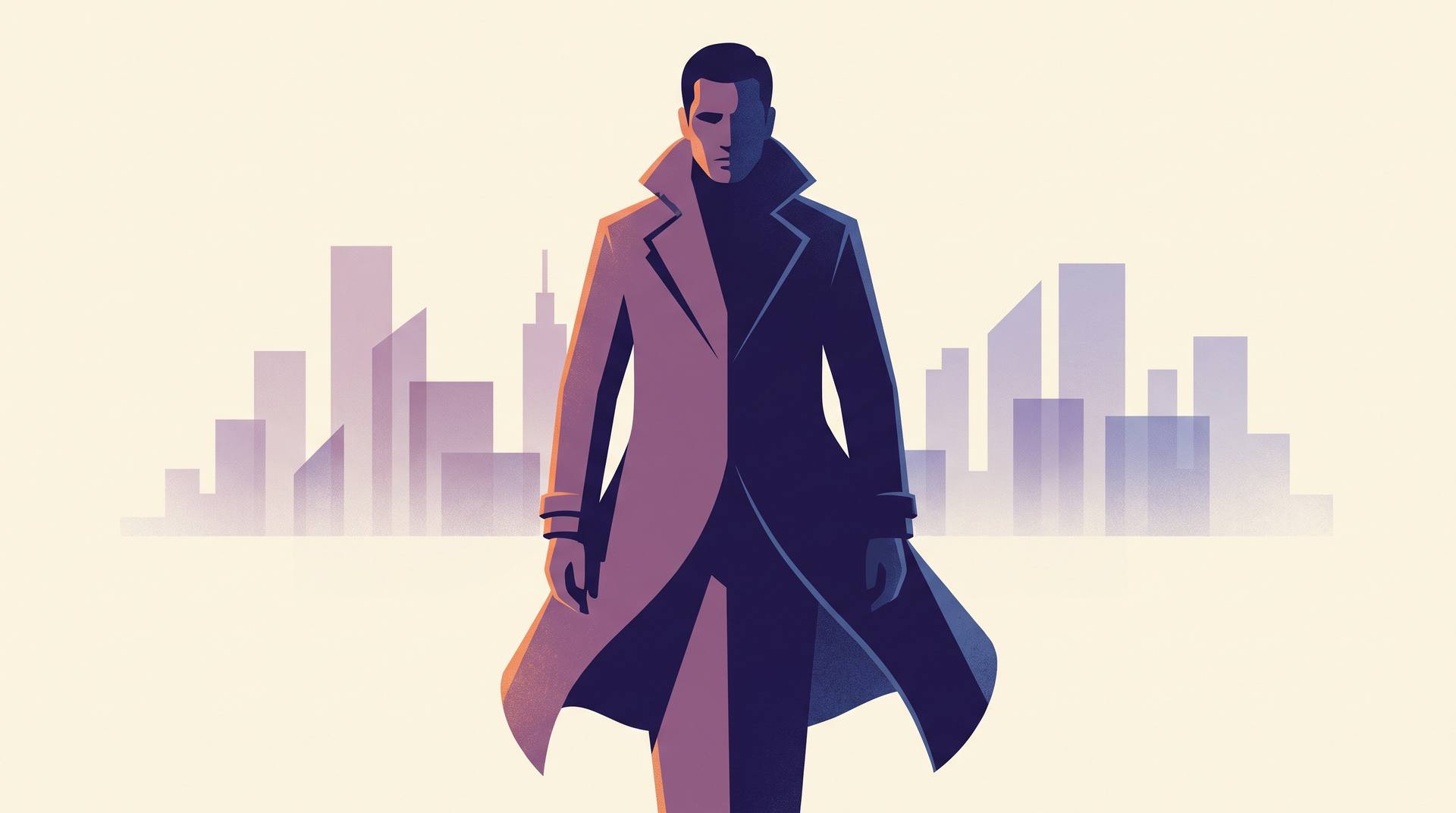
Almost every list of anti hero examples makes the same mistake: it treats "anti-hero" as a synonym for "dark protagonist." It is not. A brooding assassin with a tragic past who saves the orphanage in chapter thirty is a hero wearing black. An anti-hero is something structurally different, and the difference is what makes readers argue about them for a century afterwards.
Below: a working definition, a spectrum you can place your own character on, a dozen real examples from the 1840s to prestige TV, and the failure modes that turn an intended anti-hero into either a saint or a bore.
What an anti-hero actually is
Anti-hero definition
An anti-hero is a protagonist who occupies the story's hero position — we follow them, we want them to succeed — while conspicuously lacking the qualities that position usually requires: courage, honesty, decency, or moral conviction.
The term is structural, not moral. It describes where the character sits in the machinery of the story, not how bad they are.
The load-bearing word is "conspicuously." A flawed hero has weaknesses the story treats as obstacles to overcome. An anti-hero has qualities the story treats as who they are. Sherlock Holmes is rude and drug-dependent, but the narrative never asks us to weigh those against his worth; he is a hero with texture. Humbert Humbert in Nabokov's Lolita is charming, erudite, and a child rapist, and the entire novel is built around the reader's discomfort at how well he writes.
That discomfort is the point. An anti-hero puts the reader in a position they did not consent to — rooting for someone they would cross the street to avoid. If your reader never feels that pull, you have written a villain we watch from outside. If they never feel the resistance, you have written a hero. The antihero in fiction lives in the friction between the two.
The five degrees of anti-hero
"Anti-hero" covers a wide range, and most arguments about whether a character qualifies are really arguments about where on that range they sit. Five useful stations, from mildest to darkest:
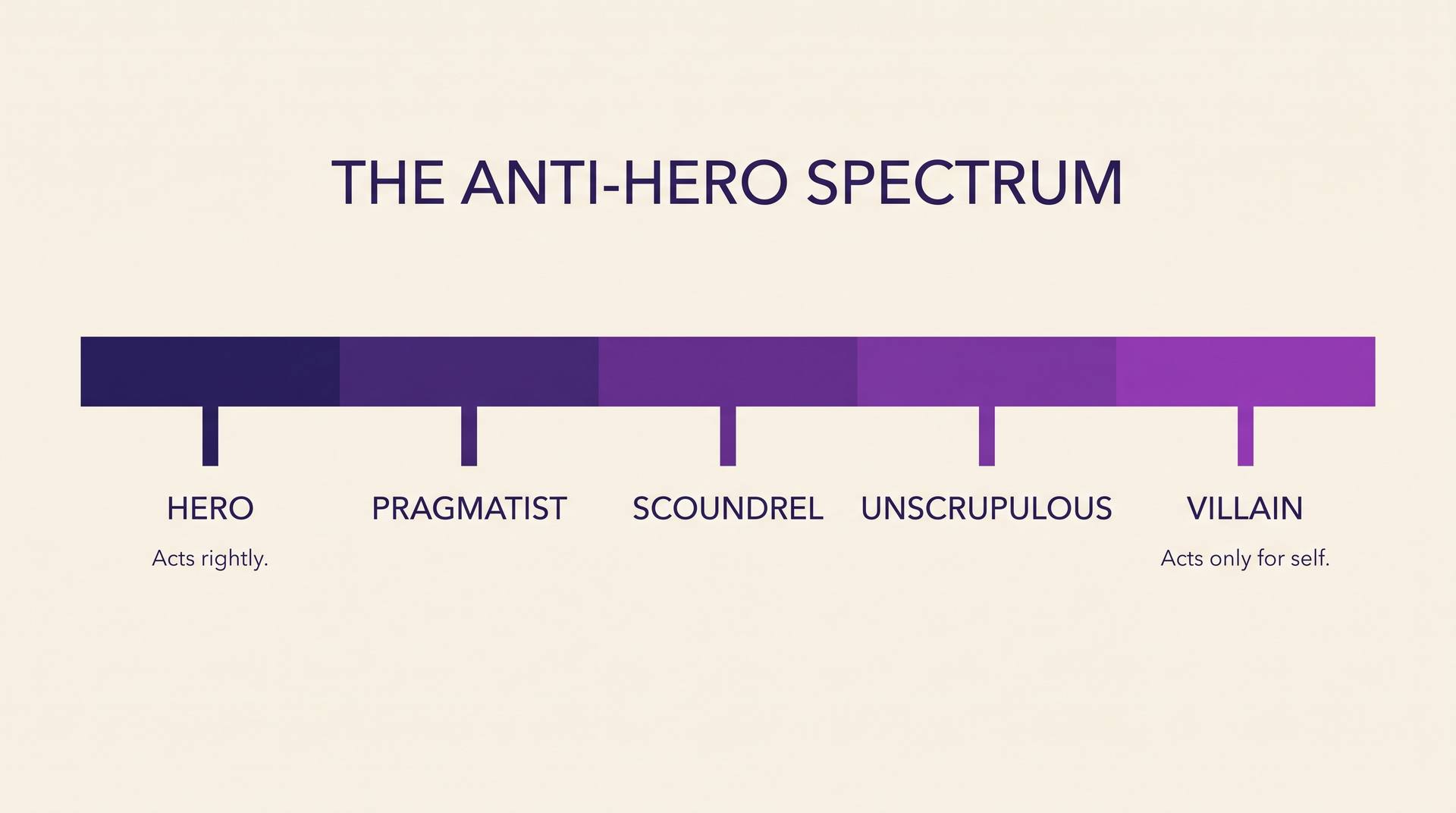
The pragmatist
Shares our goals, breaks small rules to reach them, and never pretends otherwise. Han Solo in the 1977 Star Wars shoots first, works for a gangster, and leaves the rebels before returning. Barely an anti-hero by modern standards — which is exactly how much the bar has moved.
The scoundrel
Motivated by self-interest, capable of decency when it costs little. Rick Blaine in Casablanca spends most of the film insisting he sticks his neck out for nobody, and the plot exists to disprove him.
The disillusioned
Wants the right thing but has lost faith that anything can deliver it. Yossarian in Catch-22 is called a coward for the sane conclusion that people he has never met are trying to kill him. Holden Caulfield spends The Catcher in the Rye diagnosing phoniness in everyone including, briefly and painfully, himself.
The unscrupulous
Pursues a goal we can name with methods we reject outright. Becky Sharp climbs Regency society through flattery, forgery of affection, and abandonment of her child. Amy Dunne in Gone Girl engineers her own disappearance and frames her husband for it.
The damned
Crosses into acts the story cannot recuperate, and stays the protagonist anyway. Raskolnikov murders a pawnbroker in the first act of Crime and Punishment and spends five hundred pages inside the consequences. Michael Corleone ends The Godfather having ordered his brother-in-law's death and lied about it to his wife.
The useful move is not picking a label but noticing which way your character is travelling along the line. Michael Corleone starts near the pragmatist end and finishes past the damned; Walter White does the same across five seasons. Movement is the story. A character parked at one station for four hundred pages is a portrait, not a plot.
Anti-hero examples in books
Six from the page, each doing a different job with the same basic device.
Becky Sharp — Vanity Fair (1847–48)
Thackeray subtitled the novel "A Novel without a Hero" and meant it. Becky is poor, brilliant, and entirely willing to manufacture affection for whoever can lift her a rung. What keeps her sympathetic is context: every honest route she might have taken was closed to a governess with no dowry. The novel indicts the ladder, not just the climber.
Raskolnikov — Crime and Punishment (1866)
Dostoevsky's move is to make the murder happen early and badly. The theory that some men are permitted to kill collapses within hours of being tested, and the remaining four fifths of the book is a man discovering he is not the exception he needed to be.
Jay Gatsby — The Great Gatsby (1925)
Often filed as a romantic hero, which the text does not support. Gatsby's fortune comes from bootlegging and bond fraud, his identity is invented, and his grand love is a fixation on a married woman he knew for a month five years earlier. Nick's narration keeps admiring him anyway, and that admiration is the novel's real subject.
Humbert Humbert — Lolita (1955)
The extreme case, and the clearest lesson in technique: the prose is beautiful precisely so the reader notices themselves being seduced by it. Nabokov gives a monster the best sentences in the book and lets the gap between style and content do the moral work.
Yossarian — Catch-22 (1961)
An anti-hero by inversion. He refuses to fly more missions, fakes illness, and tries to get himself declared insane — all conventionally cowardly acts that the novel presents as the only rational responses available.
Lisbeth Salander — The Girl with the Dragon Tattoo (2005)
Hacks, steals, and takes brutal private revenge on her guardian. Larsson never asks the reader to approve; he asks them to notice that every institution that should have protected her failed first, which is a different and more durable kind of sympathy.
A Novel without a Hero
Written in 1847, and still the shortest available description of what an anti-hero-led novel is doing to its reader.
Notice how none of the six are redeemed on the last page. Redemption is available to anti-heroes, but it is a choice with a price: the more completely you redeem them, the more the book retroactively becomes a conventional hero's arc with a longer runway.
Anti-hero examples in film and TV
Television changed the form. A novel gets three hundred pages to make you complicit; a series gets sixty hours, which is long enough for the audience to stop noticing what they have agreed to.
Michael Corleone — The Godfather (1972)
The structure is a hero's journey run in reverse. He begins as the war-hero son who wants no part of the family business and ends as its most ruthless head, and the film gives him a competence we admire at every step of the descent.
Travis Bickle — Taxi Driver (1976)
The film's ending treats a bloodbath as heroism because the press does, and leaves the audience holding the question of whether they agree. Almost no other film trusts its viewers with that little guidance.
Tony Soprano — The Sopranos (1999–2007)
The innovation was the therapy room. Giving a mob boss a language for his own feelings made him legible without making him better, and every subsequent prestige anti-hero borrows from it.
Walter White — Breaking Bad (2008–2013)
The cleanest anti-hero engine ever built for television: an unarguable motive in season one, incrementally worse methods, and a final admission that he did it because he was good at it and it made him feel alive. Each season moves him one station along the spectrum.
Don Draper — Mad Men (2007–2015)
A stolen identity, serial infidelity, and a talent so genuine that his colleagues keep forgiving him. The show's discipline is refusing to make the talent an excuse.
Fleabag (2016–2019)
Proof the form is not gendered or grim. She is selfish, sabotages the people who love her, and speaks to camera to keep the audience on her side — a direct-address trick that is the screen equivalent of Humbert's beautiful prose.
How they work inside a story
Strip the examples down and the same three-part mechanism appears in all of them. It is worth stating plainly, because a character missing any one part reads as broken.
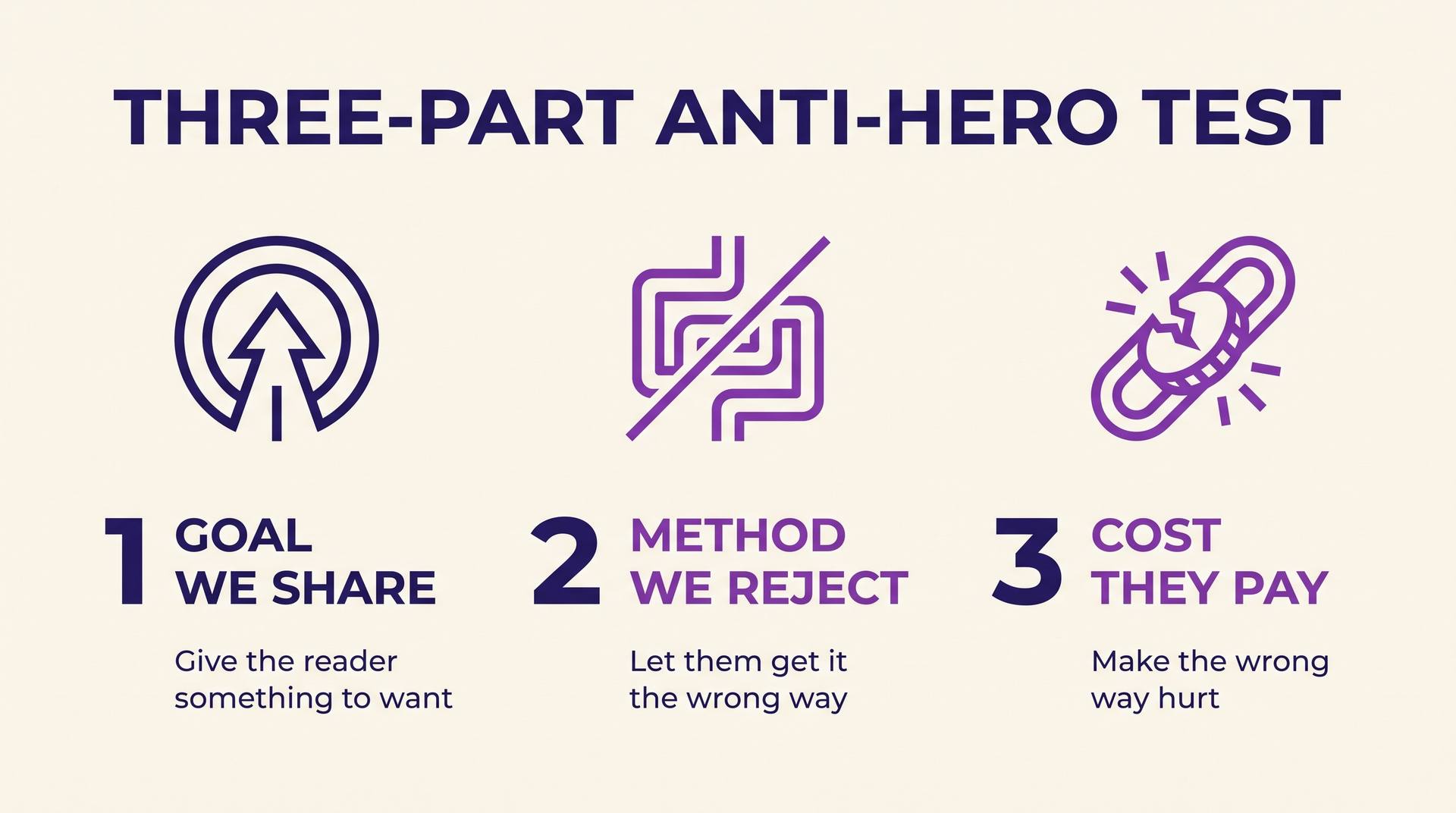
1. A goal the reader can share
Not a good goal — a legible one. Walter White wants his family provided for. Becky Sharp wants out of poverty. Raskolnikov wants to prove a theory that would make his own suffering meaningful. The reader has to be able to complete the sentence "of course they want that."
2. A method the reader rejects
The gap between the wanting and the doing is the entire device. If the method is acceptable, there is no anti-hero — just a protagonist under pressure. Make the reader wince at the how while still tracking the why.
3. A cost the character actually pays
This is the part most drafts skip. Consequence is what separates an anti-hero from wish fulfilment. Michael loses his wife and his soul, Walter loses his family and his name, Becky ends respectable and hollow. Without the bill, the story is arguing that the method works.
There is a fourth, quieter requirement that only shows up in the good ones: a single unbreakable line. Tony Soprano's ducks, Lisbeth's protection of other women, Rick's fatal inability to be neutral. One thing they will not do, or will not stop doing, tells the reader they are a person rather than an appetite. Our guide to character archetypes maps how that line differs across the classic role set.
It is also worth keeping the antagonist distinct in your head while you draft. An anti-hero is a protagonist — the story's centre of gravity — while an antagonist is whoever opposes that centre. They are answers to different questions, which is why a story can have an anti-hero and a wholly sympathetic antagonist at the same time, as Breaking Bad does with Hank.
Five mistakes that kill an anti-hero
In manuscripts, the failure is almost never "too dark." It is one of these:
- 1Redeeming them at the first opportunity. Chapter three rescue of a kitten to reassure the reader that they are secretly nice. This is the single most common draft instinct, and it dissolves the tension the character exists to create. Hold the discomfort longer than feels safe.
- 2Confusing rude with morally compromised. Sarcasm, leather, and a bad attitude are surface. If the character never makes a choice the reader disapproves of, they are a hero with an edge.
- 3Letting the method work without cost. If lying, stealing, and killing produce clean wins for four hundred pages, the book stops being a moral drama and becomes a competence fantasy — which is a fine genre, but it is not this one.
- 4Giving them no interiority. Books can hear thoughts; readers need to. The reason Crime and Punishment survives is that we are inside the rationalisation as it is being built and watch it fail from within.
- 5Cushioning the victims. Making everyone the anti-hero harms unlikeable, deserving, or conveniently offscreen. The moment the collateral damage is cardboard, the transgression is free, and free transgression is not interesting.
A quick diagnostic while revising: find the three moments where a reader would most want to close the book on your protagonist. If you cannot find three, the character is not an anti-hero yet. If you find them and each one is immediately followed by an apology scene, you are flinching.
When not to write one
Anti-heroes are fashionable, which makes them the default choice for the wrong reasons. Two honest cases against:
| Situation | Better choice | Why |
|---|---|---|
| Category romance, cosy mystery, most middle grade | Flawed hero | Genre contracts promise the reader a protagonist they can rest with. Breaking that is not bold, it is a one-star review about likeability. |
| Series where the lead must carry ten books | Scoundrel end of the spectrum | The damned end burns fuel fast. A character who pays a real cost every book runs out of things to lose by book three. |
| Message-driven or inspirational non-fiction narrative | Ambivalent hero | An anti-hero refuses to resolve. If the book needs a conclusion the reader can act on, the refusal fights the purpose. |
| Literary fiction, crime, thriller, dark fantasy, satire | Anti-hero works | These genres expect the reader to do moral work. The discomfort is a feature their audience has already paid for. |
One more consideration, purely commercial: anti-heroes are harder to blurb. "A grieving chemistry teacher starts cooking meth" only sounds compelling because you already know how it went. Test your logline on someone who does not know the book — if their face falls, the pitch needs the goal foregrounded and the method held back.
Drafting one without losing the thread
The practical difficulty with anti-heroes is consistency across a long manuscript. A hero can be re-derived from their values on any page; an anti-hero is a running tally of what they have done, what it cost, and how much sympathy the reader has left. Lose the tally around chapter eighteen and the character quietly turns into whoever the scene needs.
So keep the sheet before you draft. Goal, method, price, unbreakable line, and a one-line note per chapter on which way they moved along the spectrum. If you would rather build that sheet interactively, our free character profile generator produces a full profile — motivation, contradictions, wounds, voice — from a couple of lines of premise, and it is a fast way to pressure-test whether the goal is legible before you commit ninety thousand words to it.
Inside AIWriteBook the same information is structural rather than a document you maintain. Characters you define carry into the plot and outline generator, so when a scene calls for your protagonist to act, the draft is working from the profile you approved instead of a generic notion of a brooding lead — which is exactly the drift that produces chapter-three kitten rescues. The chapter AI chat then lets you push a scene harder in the direction you want, with per-change accept and reject, so you can ask for a colder version of a betrayal without rewriting the surrounding pages.
For the moment-to-moment work of making the cost land, the character development guide covers arc mechanics in more depth, and the free scene builder is useful for staging the specific beats — the confession, the refusal, the point of no return — where an anti-hero either becomes real or collapses into a costume.
Questions writers ask
Position, not morality. An anti-hero is the protagonist — the story follows them and organises itself around their goal. A villain opposes the protagonist. A character can be more destructive than the book's villain and still be the anti-hero, which is roughly the situation in Breaking Bad after season three.
Yes, and many are, but redemption costs you the ambiguity. If you want the reader still arguing after the last page, either withhold the redemption or make it partial and expensive. Full redemption converts the book into a hero's arc that took a longer route.
No, though they often travel together. Unreliable narration is a technique about how the story is told; an anti-hero is a fact about who the story is about. Humbert Humbert is both. Michael Corleone is only the second.
They need to be interested, which is a lower bar and a harder one. Competence, wit, a clear goal, and genuine interiority all buy interest without requiring approval. Likeability is optional; legibility is not.
No. Comedy is full of them — Fleabag, Basil Fawlty, most of Curb Your Enthusiasm — because selfishness generates the same plot pressure whether the tone is bleak or funny. What genre actually decides is how much cost the ending has to charge.
Where to take this next
The anti hero examples above span a hundred and seventy years and four media, and they run on the same three parts: a goal you can name, a method you would not use, and a bill that comes due. Get those right and the darkness takes care of itself. Get them wrong and no amount of trench coat, cigarettes, or tragic backstory will make the character read as anything but decoration.
If you are working out where this character sits in a book you have not built yet, the wider how to write a book guide covers the surrounding decisions — premise, structure, first act — and the protagonist primer is worth reading alongside this one, because most anti-hero problems are really protagonist problems wearing better clothes.