


Most lists of character flaws are inventories. You scroll them, you pick something that sounds interesting, you write it into the character sheet, and three chapters later the flaw has quietly vanished because it never had anything to do with what the character was trying to achieve.
The problem is a category error. Writers reach for flaws when what they have written is a set of quirks. A quirk is a texture — he hums when he is nervous, she never finishes her coffee. A flaw is a liability. It has a price, and the story is where the bill comes due. If your character can carry the trait through the whole book without losing anything they care about, it is decoration.
Minor, major, fatal: three sizes of flaw and what each one is for
Flaws are not interchangeable. They come in three structural sizes, and each does a different job. A cast that is all one size feels flat — everyone equally damaged, or everyone equally harmless.
Minor
Texture and credibilityImpatience in queues, a sharp tongue with waiters, chronic lateness. These cost the character a little social capital and nothing else. They exist so the reader believes the person is real before the story starts charging them. Give minor flaws generously — to side characters especially, where they do the work of characterisation cheaply.
Major
Recurring obstacleA flaw that produces a bad decision at least three times across the book, each time more expensive than the last. Jealousy that loses a friendship in act one and an alliance in act two. This is where most protagonists should live: the flaw is survivable, the character can change, and the arc is the record of them learning what it costs.
Fatal
The ending itselfThe flaw the character cannot put down, which therefore writes the final chapter. Ahab's monomania in Moby-Dick is not a personality note; it is the plot's destination. Reserve this for tragedy or for a character you intend to destroy. If you hand a protagonist a fatal flaw and then let them survive unchanged, the reader will feel the promise being broken even if they cannot name it.
One practical use: decide the tier before you decide the flaw. "I need a major flaw for my detective" is a solvable problem. "I need a flaw for my detective" is a shopping trip.
The list: 108 character flaws in five families
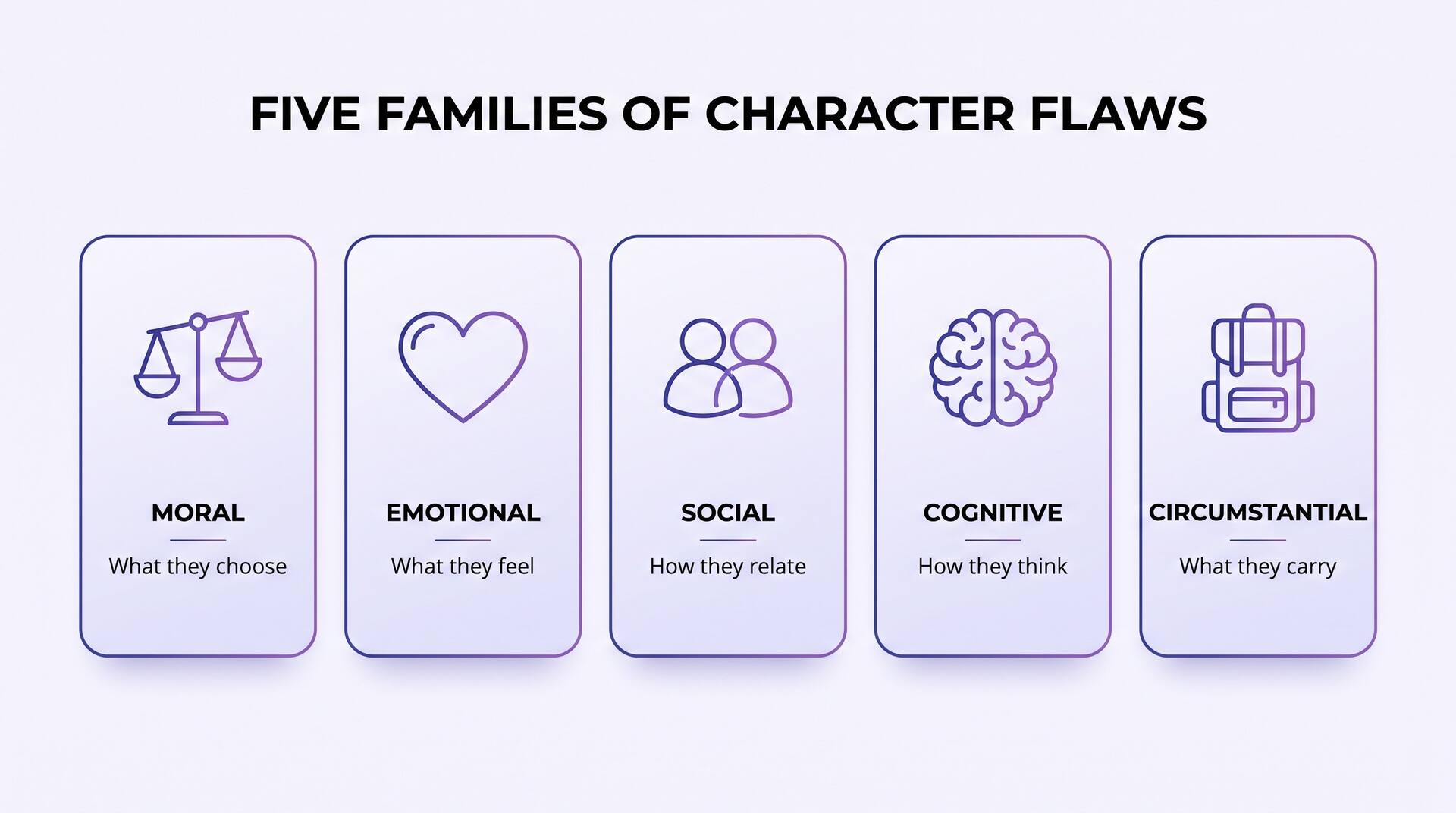
Sorted by what part of a person the flaw lives in, because that determines what kind of trouble it causes. Read the one-line note above each group before you shop it — the group tells you what the flaw will do to your plot, which is more useful than the word itself.
Moral flaws
What the character chooses. These generate plot directly: a moral flaw makes the character do something, and the story becomes the consequence. They are the easiest to escalate and the hardest to redeem.
- Greed
- Cruelty
- Dishonesty
- Hypocrisy
- Vengefulness
- Disloyalty
- Cowardice
- Ruthlessness
- Corruptibility
- Selfishness
- Manipulativeness
- Bigotry
- Zealotry
- Treachery
- Sadism
- Opportunism
- Nepotism
- Vindictiveness
- Callousness
- Exploitativeness
- Self-righteousness
- Petty theft
- Broken promises
- Moral cowardice
Emotional flaws
What the character feels before they think. These generate scenes rather than plots — they surface under pressure, in rooms with other people, and they make the character unreliable exactly when reliability matters most.
- Jealousy
- Insecurity
- Volatile temper
- Self-loathing
- Bitterness
- Melancholy
- Neediness
- Emotional numbness
- Chronic guilt
- Shame
- Anxiety
- Paranoia
- Unprocessed grief
- Sentimentality
- Envy
- Hopelessness
- Mood swings
- Emotional repression
- Addiction
- Obsessiveness
- Fear of abandonment
- Martyr complex
- Living in the past
- Emotional dependence
Social flaws
How the character relates. These cost the character allies, which is the cheapest way to raise stakes: every social flaw you assign is a future scene where nobody helps them.
- Arrogance
- Aloofness
- Bluntness
- Snobbery
- Possessiveness
- Codependence
- People-pleasing
- Withdrawal
- Gossiping
- Attention-seeking
- Condescension
- Recklessness with hearts
- Controlling behaviour
- Passive aggression
- Distrustfulness
- Social clumsiness
- Boastfulness
- Judgmentalism
- Domineering
- Conflict avoidance
- Tactlessness
- Cliquishness
Cognitive flaws
How the character thinks. These produce the most satisfying reversals, because the reader can see the mistake forming a page before the character does — dramatic irony is a cognitive flaw wearing a formal suit.
- Stubbornness
- Naivety
- Impulsiveness
- Overthinking
- Perfectionism
- Denial
- Rigidity
- Gullibility
- Absent-mindedness
- Superstition
- Tunnel vision
- Overconfidence
- Indecisiveness
- Literal-mindedness
- Pedantry
- Poor memory
- Bad judge of character
- Analysis paralysis
- Incuriosity
- Wishful thinking
Circumstantial and physical flaws
What the character carries and cannot set down. These are not moral failings, so they cannot be cured by growth — which makes them useful for constraint rather than arc. Use them to close doors, not to explain a personality.
- Poverty
- Crushing debt
- Chronic pain
- A pronounced limp
- Failing eyesight
- Hearing loss
- Insomnia
- A criminal record
- A ruined reputation
- No legal status
- A conspicuous scar
- Physical frailty
- Illiteracy
- A stammer
- Being too young
- An audible accent
- A dependent relative
- A recognisable face
That is 108, and you should use exactly one of them properly.
The collision test: how to pick the one flaw that matters
Here is the test, and it is a single question. Does the flaw make this character's specific goal harder to reach?
Not harder in general. Harder at this goal, in this book. A flaw that would inconvenience anyone is a personality trait. A flaw that is precisely the wrong thing to carry into this particular pursuit is a plot engine, because every step toward the goal is also a step deeper into the character's weakness. The two things are on a collision course, and the book is the collision.
Worked example: the same character, two flaws
The character
Yusuf, a pharmacist in a small river town, has proof that the plant upstream has been dumping into the water for a decade. His goal: make it public and make it stick.
Badly chosen flaw
Vanity
Yusuf is vain. He checks his reflection, he is precious about his good coat, he resents being photographed from the left. Now write the book. He gathers documents, he approaches a journalist, he testifies. At no point does his vanity make any of that harder. You will end up inventing scenes whose only purpose is to remind the reader he is vain, and those scenes will feel like they were bolted on — because they were.
Well chosen flaw
He cannot bear to be disliked
Yusuf needs to be liked. He is the man who remembers your mother's prescription, who stays open late, whose entire self-worth is built on being the town's good neighbour. Now write the same book. Every document he releases costs him a friendship. The plant employs four hundred people, and half of them are his customers. His goal requires him to become the most hated man in town; his flaw makes that unbearable. He will hesitate, he will soften the story, he will let one person talk him into waiting another month — and the delay will cost something irreversible. You do not have to invent a single scene. The flaw generates them.
Run the test on your protagonist right now. Write their goal in one sentence, write the flaw in one word, and ask whether the flaw is standing in the doorway. If it is standing off to the side looking interesting, swap it. The list above has 108 doors — one of them opens onto your book.
The test also explains why a supporting cast built from the same list feels different: side characters do not need flaws that collide with their own goals, only with the protagonist's. A mentor whose caution collides with a reckless hero is doing structural work even if the mentor never changes. If you are assembling a full ensemble, our character archetypes guide covers how to distribute those frictions so no two characters obstruct the plot the same way.
Flaw, wound, lie: how one weakness becomes a whole arc
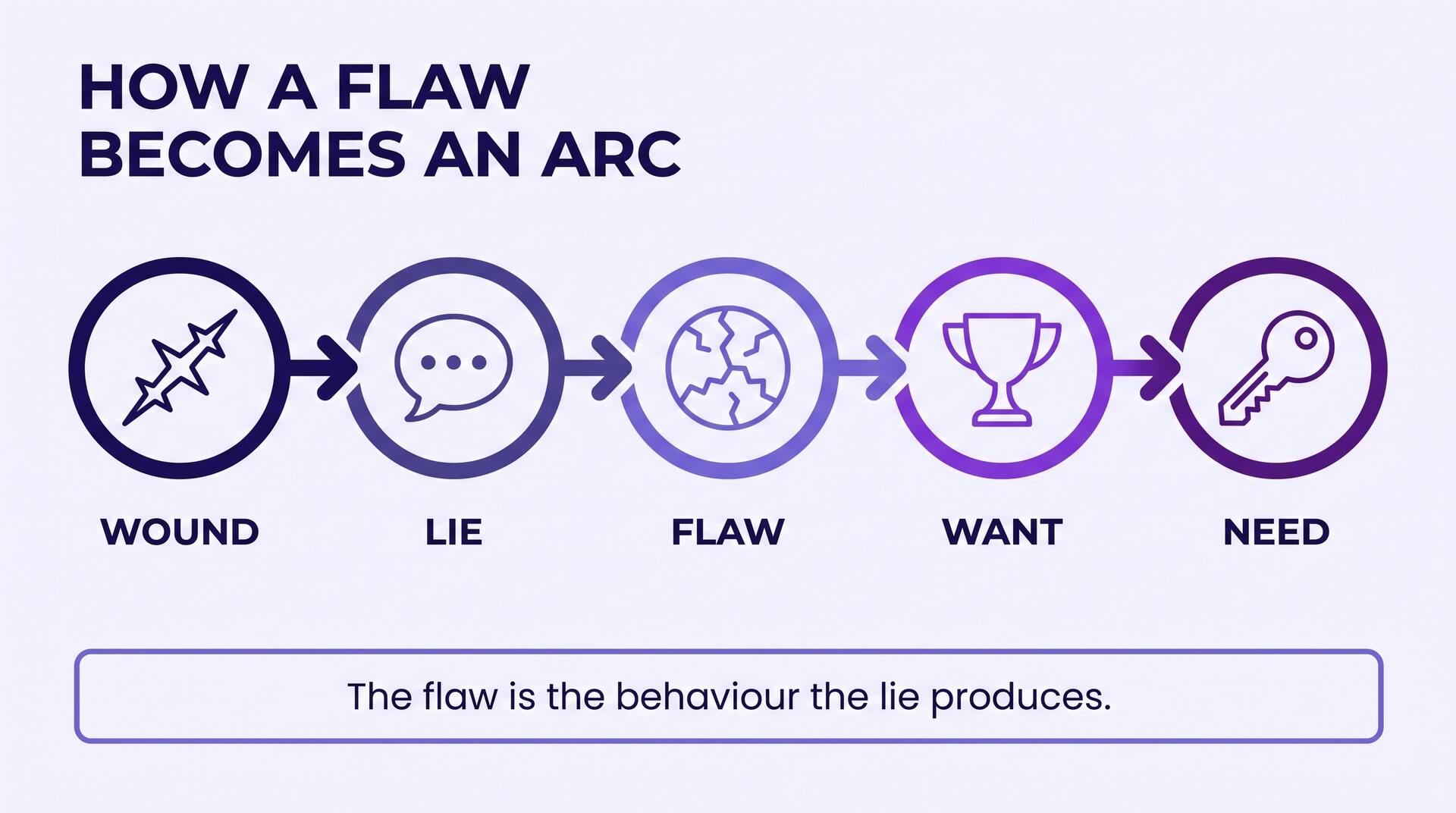
Once the flaw is chosen, it has to come from somewhere and lead somewhere. The chain most working novelists use has four links, and it stays useful as long as you keep it concrete instead of abstract.
The wound
A specific past event, with a date and a room. Not "he was neglected" but "at eleven he told the truth about his uncle and the family stopped speaking to him for two years." If you cannot picture the room, the wound is not written yet.
The lie
The conclusion the character drew from the wound and now believes about the world. "Telling the truth destroys the people you love." Note that it is a sentence the character would actually say out loud, not a diagnosis a therapist would write down.
The flaw
The behaviour the lie produces under pressure. Here it is conflict avoidance — the flaw is simply the lie in motion. This is why flaws picked from a list without a lie behind them feel arbitrary: you have the symptom without the cause.
Want versus need
The want is the goal the character can name — expose the plant. The need is what the lie has been hiding — that some truths are worth being hated for. The climax is the moment they can have one or the other, and their choice is the arc. Give it to them and you have a positive arc; let them choose the want and keep the lie, and you have written a tragedy on purpose.
A man who is not eminently good and just, yet whose misfortune is brought about not by vice or depravity, but by some error or frailty.
Written roughly 2,350 years ago about tragic heroes, and still the tightest definition of a usable flaw: not villainy, but a specific error the character is built to make.
The reason to build the chain backwards from the flaw rather than forwards from the wound is that the flaw is what the reader actually sees. Nobody reads a backstory; they read a man who will not say the sentence that would fix everything. For a longer treatment of how those choices accumulate into visible change, our piece on dynamic character examples works through several published arcs beat by beat.
It is also worth saying which flaws do not produce arcs. Anything in the circumstantial group — the limp, the debt, the criminal record — cannot be cured by insight, and treating it as a wound to be healed is where a lot of well-meaning fiction goes wrong. Those belong in the plot as constraints. The character does not overcome the limp; the character wins anyway, or does not.
Three ways writers waste a good flaw
The adorable non-flaw
Clumsy. Talks too much. Cares too deeply. Works too hard. These survive on the page because they let the writer claim a flaw without ever making the character look bad. The tell is simple: if the flaw makes the reader like the character more, it is a compliment in a costume. Real flaws cost sympathy at least once, and the story has to earn it back.
The flaw that never sends a bill
Stated in chapter one, mentioned in chapter twelve, and in between it never once causes a decision to go the wrong way. Audit it: list the three worst decisions your protagonist makes, and check that the flaw is the reason for at least two of them. If it is the reason for none, you have written a label, not a character.
The one-scene cure
The character is stubborn for two hundred pages, has a conversation on a beach, and is no longer stubborn. Change that cheap reads as false because it is. A flaw should relapse at least once after the character has apparently learned better, ideally at the worst possible moment — the relapse is what convinces the reader the change was real when it finally holds.
Keeping the flaw alive across a whole draft
The practical difficulty is not choosing a flaw. It is remembering, in chapter nineteen at eleven at night, that this character avoids conflict and would not simply say the thing that resolves the scene. Continuity is where flaws die.
When you build a book in AIWriteBook, the character sheet carries dedicated fields for motivation, internal conflict, external conflict, stakes and arc — not as notes you keep somewhere else, but as fields the chapter writer reads before it drafts a scene. Fill in the internal conflict as a sentence the character would say and the drafts push back against themselves the way they should. You can generate a starting cast in the character creator, then bring the ones that survive into a real book.
The other half is scheduling. A major flaw needs to detonate three or four times at rising cost, and that belongs in the outline rather than in your memory — the outline builder lets you write those collisions into specific chapters as events and twists, so the flaw has appointments rather than good intentions. If you want a structural frame for where those appointments should land, three-act structure is the plainest map.
Pick one, and make it expensive
A list of 108 flaws is only useful for about ten minutes — the time it takes to find the one that stands between your character and the thing they want. After that the work is entirely in the pricing: what does this cost, how often, and how much more each time.
If you are still assembling the pieces around your protagonist, the wider guide to writing a book walks through everything that has to be standing around them — outline, structure, chapters and the publishing end.