

Can you publish a book written by ChatGPT?
Yes. Amazon KDP has accepted AI-generated books since 2023 and formalized the disclosure rule in September of that year. There is no rule that says "no ChatGPT books" and there is no public daily cap on how many AI titles a single account can publish. What Amazon does have is a content guidelines policy that says any book, AI or not, has to meet quality and originality standards, and a separate disclosure step that asks you to label AI content honestly.
Authors get into trouble in three predictable ways: they declare an obviously AI-generated book as AI-assisted, they upload near-duplicate AI books in volume hoping to flood a niche, or they publish in categories where their book competes with a trademarked title or copyrighted text the model regurgitated. None of those are ChatGPT problems. They are author behavior problems.
The KDP AI Content Form, Field by Field
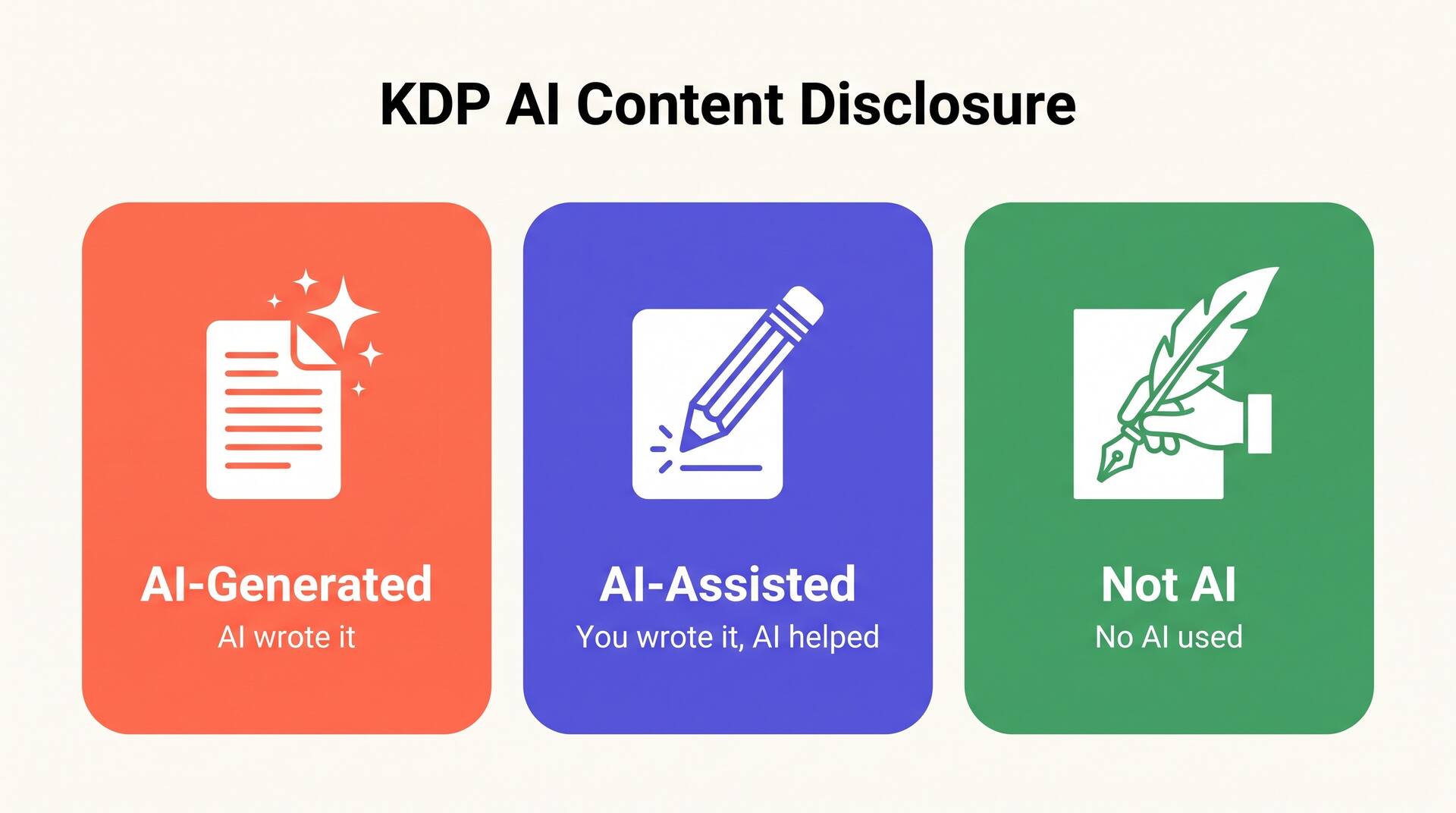
When you click publish, Amazon now asks an AI content question in the manuscript step. You see three options for each part of the book (text, images, and translation), and you have to answer for all three.
AI-Generated
Use this if AI tools created the content, even if you applied substantial edits afterward. A ChatGPT draft you rewrote line by line still counts as AI-generated under Amazon's definition. So does a chapter from AIWriteBook, a Sudowrite expansion, or a Claude-drafted section. The threshold is who produced the initial text, not how much polishing happened after.
AI-Assisted
Use this if you wrote the content yourself and used AI to edit, refine, fact-check, brainstorm, or otherwise improve work you authored. Running your manuscript through ChatGPT for proofreading is AI-assisted. Asking it for three title ideas before you picked one is AI-assisted. Asking it to write Chapter 5 from your outline is not.
Not AI
Use this only if no AI tool touched that component. If you wrote the text by hand, painted the cover yourself, and translated nothing, this is the right answer. Amazon does not punish you for choosing AI-generated or AI-assisted, but they do enforce against authors who pick this option when the truth is otherwise.
What Actually Triggers Rejection
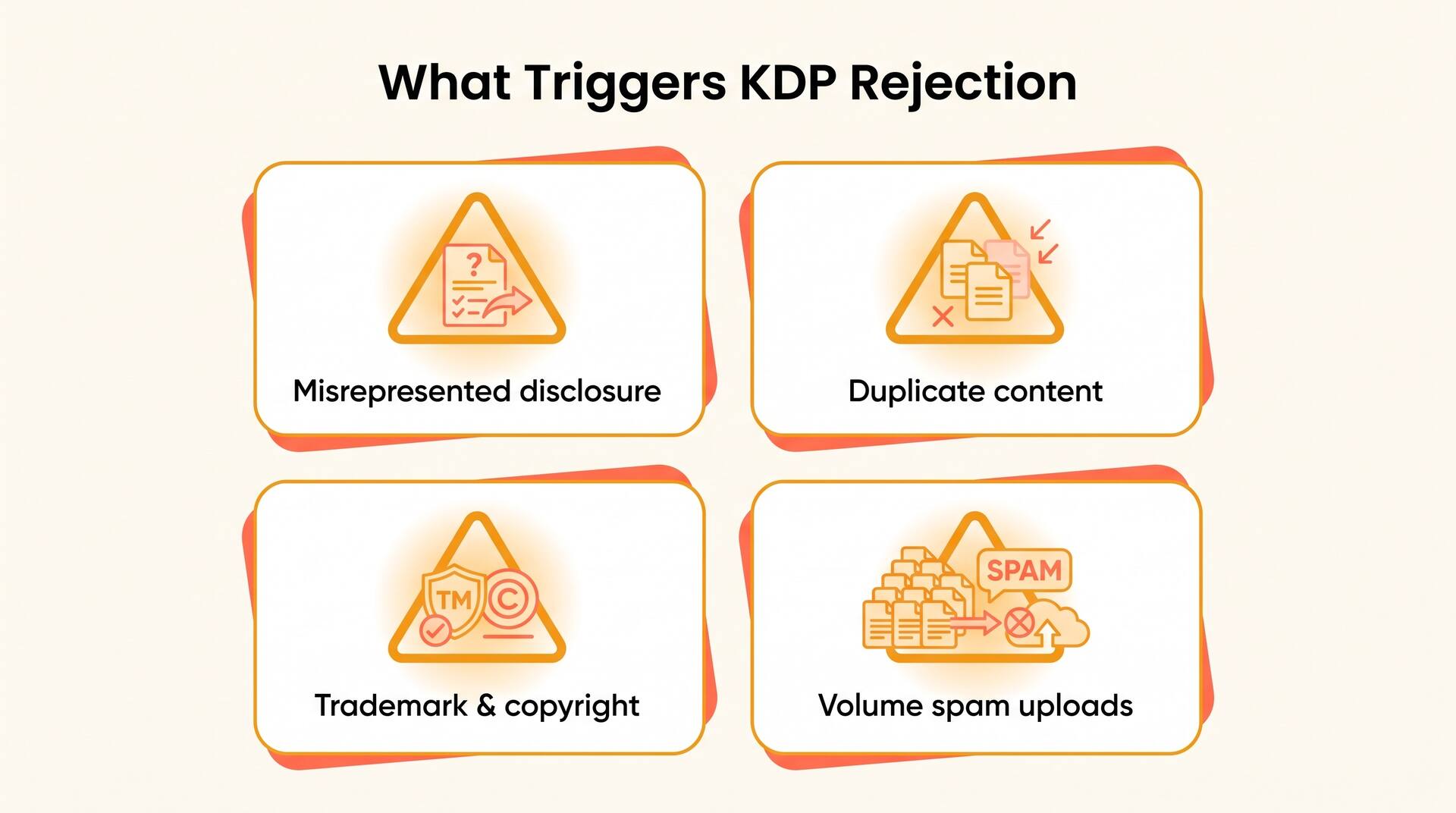
AI disclosure on its own does not cause a rejection. The reviewer flags a book when something else fails the content guidelines, and undisclosed AI content shows up as part of that pattern.
Misrepresented disclosure
Marking a fully generated book as AI-assisted or Not AI is the fastest path to a takedown. Amazon uses machine learning plus human reviewers, and false declarations are treated as a content guidelines violation that can extend to account termination.
Low-quality or duplicate content
Books that read like raw model output, share large passages with other titles, or recycle the same outline across pen names get pulled under the duplicate and disappointing content policies. The AI did not cause the rejection. The lack of meaningful editing did.
Trademark and copyright issues
ChatGPT will happily produce a novel about Harry Potter or a guide using a trademarked brand name. KDP rejects those on IP grounds whether a human or an AI wrote them. Treat anything the model gives you as a draft to be cleared, not a free pass.
Volume publishing patterns
There is no published per-day cap, but accounts that upload many similar AI-generated titles in a short window trigger review. The safe pattern is one well-edited book at a time with real category and keyword work, not a batch upload.
Copyright Status of AI Books on KDP
Disclosure is one question. Copyright is a separate one. The two interact in ways most ChatGPT authors do not think about until they try to enforce a takedown against a pirate site.
The U.S. Copyright Office position, restated in its 2025 guidance, is that purely AI-generated text is not protected by copyright. A book where ChatGPT wrote every word sits in a strange zone, you can sell it on KDP, but you cannot register the prose itself with the Copyright Office and you have limited recourse if someone copies it.
Human-authored elements remain protected. Your selection and arrangement of AI passages, your edits, your original characters and plot decisions, your cover artwork if you made it, all of those keep their normal copyright. This is why heavy human editing matters beyond quality, it is what gives you something to register.
Amazon does not require copyright registration to publish, and KDP royalties flow normally on AI-generated titles. Your customer-facing rights, ISBN, royalty splits, and Kindle Unlimited eligibility are unaffected by the disclosure answer.
The practical answer for most authors, write with AI as a drafting partner, edit substantively at the chapter and scene level, and you end up with a book you can both disclose as AI-generated on KDP and register as a compiled work with meaningful human authorship.
How AIWriteBook Handles the Disclosure Flow
AIWriteBook is built around the assumption that you will disclose AI-generated content to KDP, so the export tools surface the right answer instead of leaving you to guess.
Honest defaults at export
When you export a manuscript to the KDP-ready format, AIWriteBook shows a disclosure summary, the text is AI-generated, the cover is AI-generated unless you uploaded your own, and translations into other languages are AI-generated. Copy that into the KDP form verbatim and you are done.
Editing that creates real human authorship
The in-app editor logs your chapter-level edits so you can see where you have added meaningful human authorship versus where the draft is still pure model output. That is the same line the Copyright Office uses for registration decisions.
Cover and metadata you can defend
The cover designer outputs at the 1600 by 2560 KDP spec, and the keyword and category tools rely on your own niche research rather than scraping competitor titles. Nothing in the pipeline pushes you toward a copyrighted character name or a trademarked phrase.
Audiobook and translation disclosure
If you add an AI narrator from the 25 verified voices or translate the book into another language, those components show up in the export summary too. KDP asks separately about audio and translation, and AIWriteBook gives you the right answer for each component.
ChatGPT Workflow vs AIWriteBook Workflow for KDP
| Feature | ChatGPT Direct | AIWriteBook |
|---|---|---|
| Disclosure guidance at publish time | None, you decide on your own | Pre-filled summary per component |
| Chapter consistency across a full book | Resets each session | Persistent characters and plot |
| KDP-spec cover output | DALL-E with manual resizing | 1600 by 2560 export ready |
| Manuscript export | Copy and paste from chat | EPUB, PDF, DOCX, KDP export |
| Audiobook for ACX or Virtual Voice | Not available | 25 verified AI voices |
| Translation for global KDP marketplaces | Manual, no disclosure trail | Built-in, tracked for disclosure |
| Time to a 20-chapter draft | Many sessions, hours of prompting | About 30 minutes |
Three Real Publishing Scenarios
Pure ChatGPT draft, polished and published
- Disclose as AI-generated for text
- Disclose cover honestly based on what you used
- Edit substantively before upload to give the work human authorship
- Expect normal royalty treatment, no surcharge or penalty
Outline by human, chapters generated, heavy editing
- Still AI-generated under Amazon's definition because the AI wrote the first draft
- Heavy editing strengthens your copyright registration case
- Keep notes on your edit pass for any future IP dispute
- This is the most common AIWriteBook author pattern
Human manuscript, ChatGPT used for proofreading and blurb
- Text is AI-assisted, no disclosure required for the manuscript
- Marketing copy and blurbs do not get a separate disclosure field
- Cover and translations still need their own honest answers
- Standard copyright applies to the manuscript
Three Myths to Drop
Myth: Amazon bans AI books
They never did. The policy from day one has been disclose, not prohibit. Books are removed for content guideline violations, not for being AI-written.
Myth: There is a three-books-per-day limit on AI titles
That number circulates in publishing forums but does not appear in KDP's published guidelines. What exists is a general anti-spam stance that flags accounts uploading many near-identical titles fast. A normal one-book-at-a-time author never hits any threshold.
Myth: Heavy editing converts AI-generated into AI-assisted
It does not. Amazon's definition explicitly covers AI-generated content "even if you applied substantial edits afterwards." Editing strengthens your copyright position, not your disclosure category.
Pre-Publish Checklist
Run through these before you click submit on KDP.
- Text component answered honestly, AI-generated for any ChatGPT or AIWriteBook draft
- Cover component answered honestly, AI-generated if any AI tool produced the image
- Translation component answered for each non-source language you uploaded
- Manuscript read end to end for tone drift, repeated phrases, and timeline errors
- No real brand names, trademarked characters, or copyrighted passages survived from the draft
- Cover renders at 1600 by 2560 with text readable at thumbnail size
- Categories and keywords chosen from your own research, not copied from a competitor's listing
- Author bio, blurb, and back matter reflect a real publishing identity
The Bottom Line
ChatGPT for Amazon KDP works. Books written with it, with AIWriteBook, with Claude, or with any other model can go on sale tomorrow if you disclose them correctly and put real editing work on top.
The risk is not the AI. It is the temptation to skip disclosure, skip editing, or skip the IP check, all of which read as the same problem to a KDP reviewer. Treat the disclosure form as a feature that protects your account rather than a hurdle, and you will publish without drama.
If you want the disclosure flow handled for you alongside cover, audiobook, and translation in one workflow, AIWriteBook was built for this. Otherwise, ChatGPT plus an honest answer on the publish screen will get you on the Kindle store.