

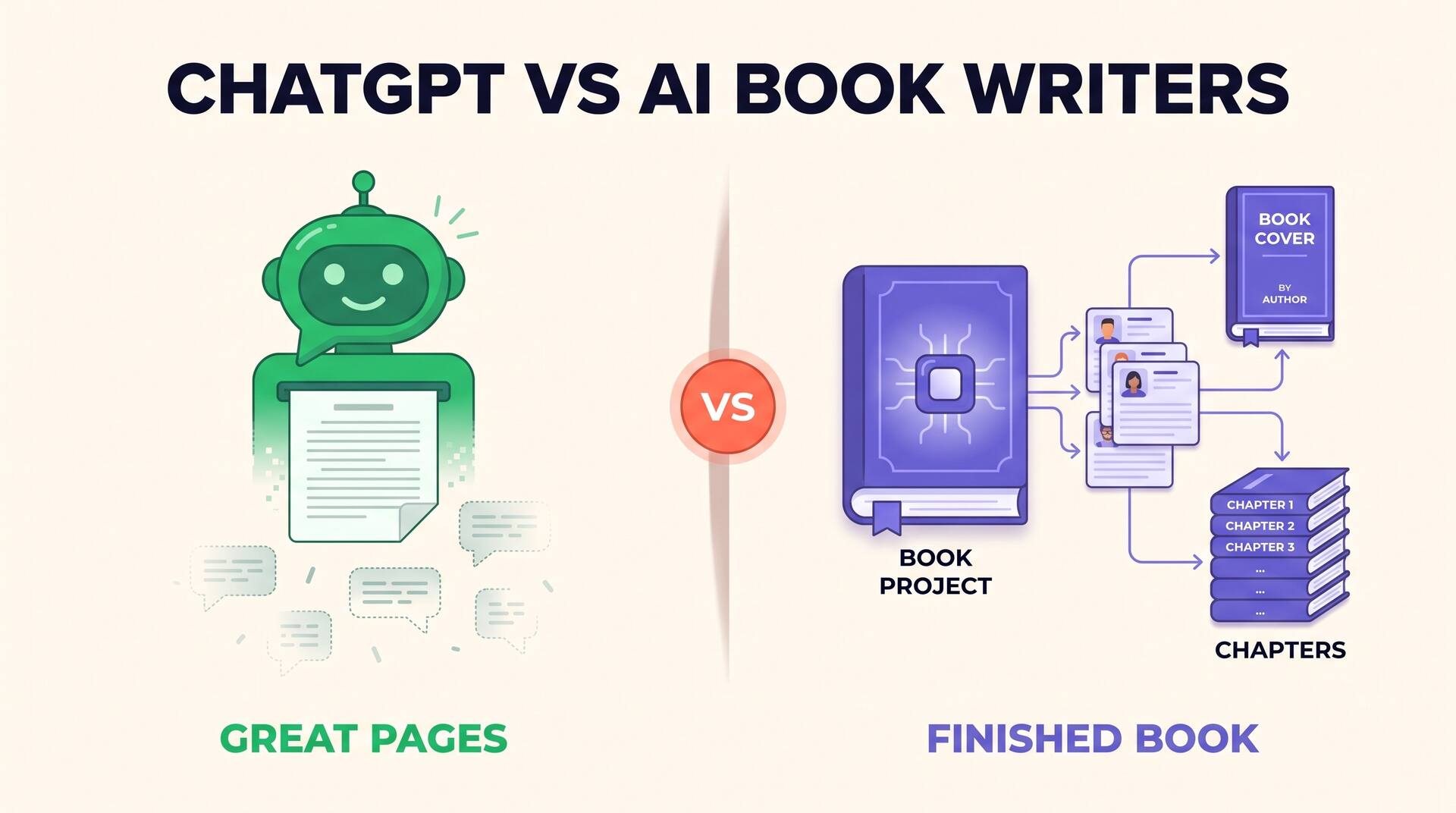
When authors discover AI can help with writing, ChatGPT is usually the first tool they try. It's accessible, powerful, and—since the GPT-5.5 release on April 23, 2026—genuinely capable of high-quality prose. But after working with thousands of authors, we keep seeing the same pattern: ChatGPT is excellent at producing pages, and terrible at producing a finished book. The gap isn't the model. It's everything that surrounds the model.
ChatGPT in 2026: which tier are you on?
OpenAI has reshuffled ChatGPT's plans. All tiers now run GPT-5.5 (launched April 23, 2026); they differ in usage caps, tools, and seat management. Here is what each plan actually buys you for book writing:
Free
GPT-5.5 with strict daily message and image caps. Fine for testing one chapter. You will hit the cap mid-novel.
Go
OpenAI's entry paid plan. Higher caps than Free, but no advanced reasoning budget. Good for short-form.
Plus
The default writer plan. Generous GPT-5.5 limits, custom GPTs, image generation. Still no persistent project memory beyond what you paste each session.
Pro
Highest individual usage, longer reasoning, priority access. Useful for long edits — but the missing pieces (character schema, KDP export) are not features OpenAI sells.
Business
Team workspaces, shared custom GPTs, admin controls. Built for ops teams, not novelists.
Enterprise
SSO, audit, dedicated capacity. Same writing tools as Plus. Buying Enterprise to write a novel is paying for compliance you do not need.
Where ChatGPT Excels
ChatGPT is genuinely impressive for many writing tasks:
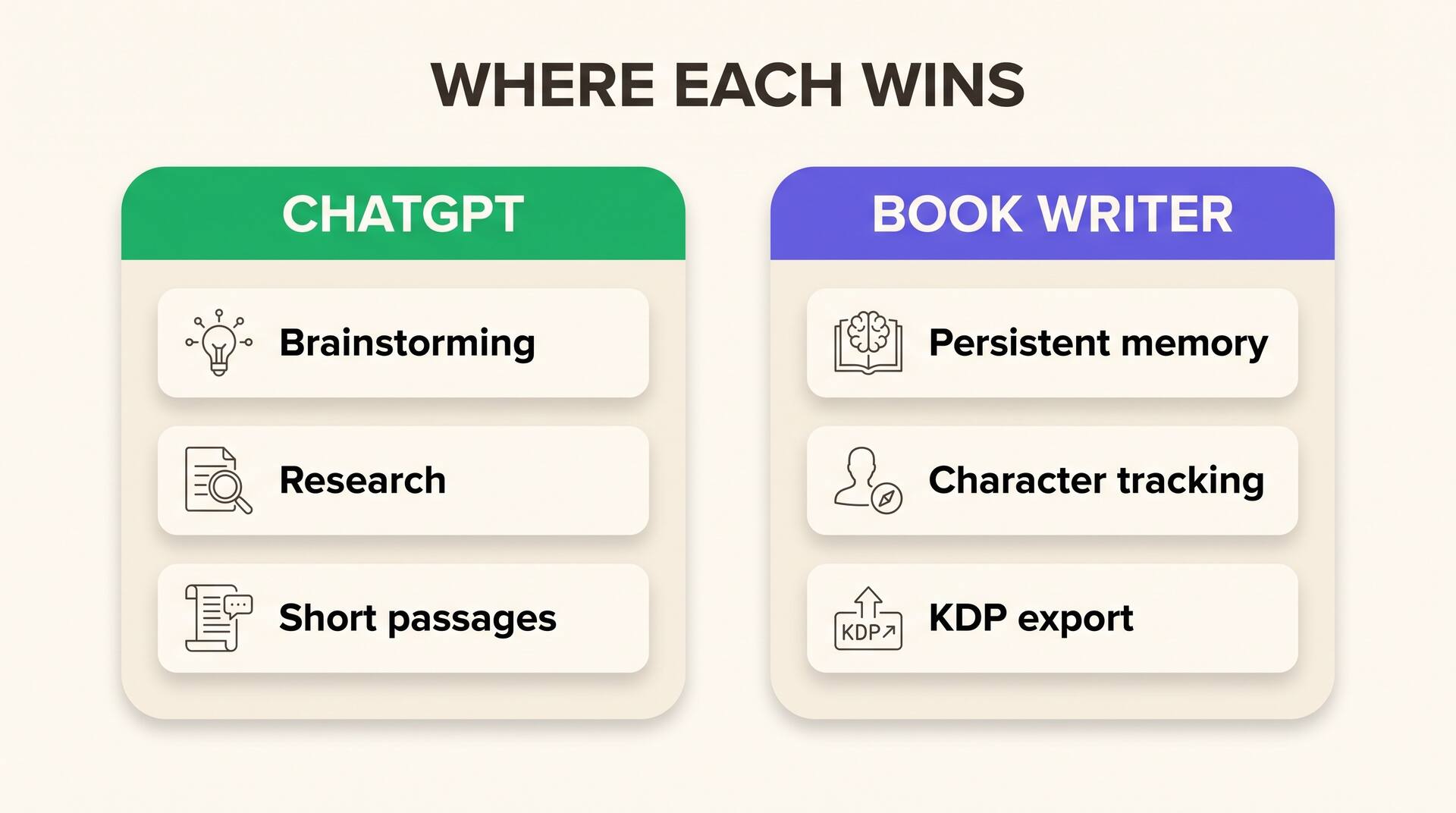
Brainstorming & Ideation
Need 20 title ideas? Character name suggestions? Plot twist possibilities? ChatGPT generates creative options instantly. Its breadth of knowledge makes it excellent for exploring directions.
Research & Fact-Finding
ChatGPT can quickly explain historical periods, summarize complex topics, or help you understand technical subjects for your book. It's like having a knowledgeable research assistant.
Writing Short Passages
Individual scenes, dialogue exchanges, or descriptive passages often come out well. For content that fits in a single prompt-response cycle, ChatGPT performs admirably.
Editing & Feedback
Paste a paragraph and ask for improvement suggestions. ChatGPT provides thoughtful feedback on pacing, clarity, and style—useful for self-editing.
Flexibility
You can ask ChatGPT to do almost anything: write, edit, explain, translate, summarize. This versatility is valuable when your needs vary.
Why a bigger context window will not fix this
Every six months OpenAI ships a larger context window and authors hope it solves long-form writing. It does not. Here are the four problems that stay broken no matter how big the window gets:
Persistent project memory
ChatGPT context resets the moment you start a new chat — and any single chat that grows past ~60 messages starts dropping early turns from active attention. A book project lives for weeks or months. AIWriteBook stores the whole book — outline, every chapter, every character — as a project you reopen. Chapter 18 sees Chapter 2 the same way Chapter 3 did.
Chapter and character schema
ChatGPT sees your manuscript as one long blob of text. A specialized tool sees it as Outline → Chapters → Scenes, with separate Character records (name, age, voice, relationships, arc). When you ask 'have her doubt herself here' the tool knows which 'her' you mean because the character is a typed object, not a phrase you mentioned 40,000 words ago.
Integrated publishing pipeline
ChatGPT outputs text. To ship a book you still need: a KDP-spec cover (1600×2560), an EPUB, a print-ready PDF at the right trim size, an audiobook in 20 voices, and the AI-content disclosure filled in on the KDP form. AIWriteBook generates all of that inside one project. With ChatGPT alone you are stitching together five tools and praying the formats line up.
Voice training
ChatGPT's default voice is the ChatGPT voice — slightly hedging, slightly listicle, slightly the same across every paragraph. That is the 'AI slop' tell readers spot in five sentences. A specialized writer trains on a sample of your prose (or on a target author's style) before it writes a single chapter, then re-checks every chapter against that voice. The result actually sounds like you, not like a model.
How to use ChatGPT for a book (and where you will get stuck)
If you want to do this with ChatGPT alone, here is the realistic flow. We use it ourselves for the early stages. We have also watched hundreds of authors abandon it around step 5.
Step 1 — Premise and outline (works)
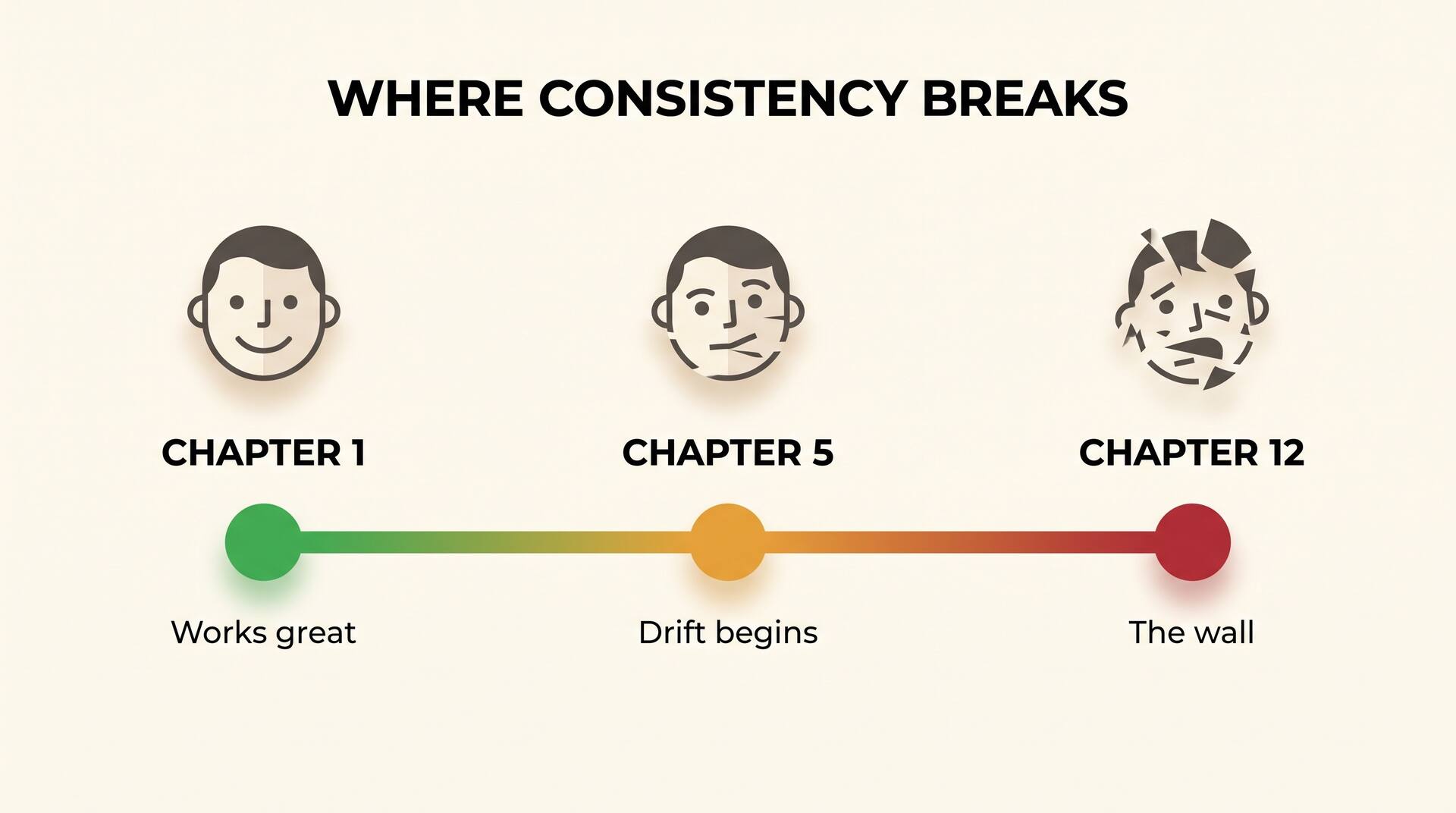
Open a new chat. Paste your idea. Ask for a 20-chapter outline with chapter goals and a one-line hook each. GPT-5.5 is excellent here. Save the output to a doc. This is the part of writing-a-novel-with-GPT-5.5 ChatGPT genuinely accelerates.
Step 2 — Character bibles (works, manual)
Prompt: 'Generate full character profiles for the four main characters: name, age, voice description, three speech tics, internal flaw, external goal, secret.' Save each character as a separate text block. You will paste these back at the start of every future chat.
Step 3 — Chapter 1 (works)
Paste the outline, paste all four character bibles, paste a 200-word voice sample, then ask for Chapter 1 in 2,500 words. Output is usually good. You feel optimistic. This is the trap.
Step 4 — Chapter 5 (drift begins)
By Chapter 5 you have a 30,000-word chat. ChatGPT forgets that your protagonist mispronounces 'particularly' and that the antagonist was introduced limping. You start each chapter by re-pasting bibles, outline, last chapter, and voice sample — a 10,000-word preamble before the actual prompt. This is what 'ChatGPT forgets characters in a book' looks like in practice.
Step 5 — Chapter 12 (the wall)
You start a fresh chat because the old one is too long. You re-paste everything. The model picks a slightly different voice. The protagonist is now mildly more sarcastic. The antagonist's limp is gone. You either accept inconsistency, manually rewrite, or paste the entire prior manuscript every single time — which exceeds the context window for anything past Chapter 15.
Step 6 — Cover, EPUB, audiobook (separate stack)
ChatGPT will not produce a KDP-spec cover at 1600×2560 with the right bleed, will not export EPUB, will not narrate. You leave to DALL-E for the cover (and re-roll fifteen times), to Calibre or Vellum for the EPUB, to ElevenLabs for the audiobook. Three more tools. Three more learning curves.
Step 7 — KDP upload + AI disclosure
You upload to KDP, hit the new AI-content disclosure questions, and realize you do not remember exactly which chapters were AI-drafted, which were AI-edited, and which were yours. You guess. Disclosure is mandatory; getting it wrong is a takedown risk.
What about a Custom GPT for book writing?
A Custom GPT (available on Plus, Pro, Business, Enterprise) lets you pin a system prompt, files, and tool config. It solves a small slice of the problem: you stop re-pasting the system prompt at the start of every chat. It does not solve persistent memory across chats, does not give you a chapter schema, does not enforce voice across 80,000 words, and does not export a book. Custom GPTs are great for a 'consistent first-draft tone' but they are not a book writer.
KDP's AI-content disclosure (and how AIWriteBook handles it)
Since Amazon added the AI-content questions to KDP, every uploaded title must declare whether the text, images, and translation are AI-generated, AI-assisted, or human. The categories are real and the form is mandatory. Hidden AI use is the takedown risk — disclosing accurately almost never is.
Text
If a model wrote the prose and you edited, KDP calls that AI-generated with edits. Pure brainstorming with ChatGPT where you then write the prose yourself is AI-assisted. AIWriteBook records, per chapter, whether it was AI-drafted, AI-edited, or human-written, so you can fill the form correctly instead of guessing.
Images
Covers and interior images have a separate disclosure. If AIWriteBook generated the cover, the export bundle tells you so. With a ChatGPT + DALL-E + Photoshop stack, that audit trail is on you.
Translation
Multi-language editions are a third disclosure category. AIWriteBook's translation feature flags which language versions were machine-translated; you copy that into the form.
What this means in practice
Disclosure is paperwork, not punishment. KDP keeps publishing AI-assisted titles every day. The authors who get delisted are the ones who hid it. ChatGPT gives you no audit trail; a project-based tool does.
What Specialized Book Writers Offer
Purpose-built tools address these limitations:
Persistent Character & Plot Tracking
The tool remembers your characters' names, personalities, backstories, and relationships. Write Chapter 20 and your protagonist still acts like they did in Chapter 1.
Chapter-Based Organization
Your book exists as a structured project with chapters, not a chat history. Navigate, reorganize, and manage your manuscript like a proper document.
Outline Integration
Generate and refine outlines that connect to chapter generation. The AI knows where you are in the story and what comes next.
Style Consistency
The tool learns your writing voice and maintains it throughout. No more drifting into different styles between sessions.
Publishing Pipeline
Export to EPUB, PDF, DOCX, or directly to platforms like Amazon KDP. Generate covers, audiobooks, and marketing copy in the same workflow.
Side-by-Side Comparison
| ChatGPT vs Specialized Book Writers | ChatGPT | Specialized Book Writers |
|---|---|---|
| Memory across sessions | None (starts fresh each time) | Full project persistence |
| Character tracking | Manual (you manage it) | Automatic with profiles |
| Chapter organization | External tools needed | Built-in structure |
| Style consistency | Requires constant prompting | Learned and maintained |
| Export formats | Copy/paste only | EPUB, PDF, DOCX, etc. |
| Cover generation | Separate tool (DALL-E) | Integrated |
| KDP formatting | Not available | One-click ready |
| Price | $20/month | Varies ($0-30/month) |
Side-by-side prose: same prompt, same chapter, two tools
We took the same setup — a mystery novel, eight chapters already written, the detective named Marrow speaks in clipped formal sentences, the suspect Audrey already gave her alibi in Chapter 6 — and asked both tools to write the opening 180 words of Chapter 9.
ChatGPT (fresh chat, full context re-pasted)
Marrow leaned back in his chair, smiling slightly. "So, Audrey," he said, "why don't you walk me through where you were on Tuesday night? Take your time." The corner office was bright with afternoon sun, motes of dust drifting between them like questions waiting their turn. Audrey crossed her legs, returned the smile, and began to explain — for what she clearly hoped was the first time — that she had been at her sister's apartment, watching a movie, eating leftover pasta. Marrow nodded along, occasionally jotting in his notebook, his eyes never quite leaving hers. It was a small dance, this one, but a familiar one: the polite first pass, the gentle re-tread, the moment when a story would either firm up or start to crack.
Problems: Marrow is suddenly casual ("why don't you walk me through"), the dim office from earlier chapters is now "bright with afternoon sun," and Audrey is asked her alibi as if Chapter 6 never happened. The prose is fine. The book is broken.
AIWriteBook (same project, Chapter 9)
Marrow did not sit. The office stayed as it had been all week — dim, the blinds half-drawn, a single lamp pushing the shadows back to the corners. "Tuesday," he said. Nothing else. Audrey had already given him Tuesday, of course, three days earlier in the same chair: her sister's apartment, the movie whose title she had not been able to name, the pasta. He waited. The version a person tells the first time is rehearsed. The version they tell the second time, unprompted, is where the seams are. Audrey opened her mouth, closed it, and started — slightly differently than before — at her sister's door.
What changed: voice held (clipped, formal, no contractions for Marrow). Setting held (dim office). Continuity held (the alibi is already on record from Chapter 6, and the chapter uses that fact as its lever). Nothing was re-pasted. The project remembered.
When to Use Each Tool
Use ChatGPT When...
- You're exploring ideas and not committed to a project yet
- You need help with research or understanding topics
- You're writing short content (articles, blog posts, short stories)
- You want quick feedback on existing writing
- Budget is extremely tight and you need versatility
Use Specialized Tools When...
- You're writing a full-length book (novel or nonfiction)
- Character and plot consistency matter
- You plan to publish (especially on Amazon KDP)
- You want a streamlined writing-to-publishing workflow
- You're writing a series with recurring characters
Use Both When...
- You want ChatGPT for research and brainstorming
- Then transfer refined ideas to your book writing tool
- Use ChatGPT for marketing copy and book descriptions
- Keep specialized tool for the actual manuscript
Our Verdict
ChatGPT is a remarkable general-purpose tool that every writer should know how to use. It's genuinely useful for many writing-adjacent tasks.
But for actually writing a book—especially one you plan to publish—specialized tools provide significant advantages. The time saved on consistency management, the reduced frustration of re-explaining context, and the streamlined path to publication make specialized tools worth their cost for serious book projects.
The most effective approach: use ChatGPT for exploration and research, then write your book in a purpose-built tool designed for long-form content.
Quick Decision Quiz
Answer these questions to find your ideal tool:
How long is your writing project?
Do you plan to publish?
Do you have recurring characters?