The AI writing tool landscape has exploded. With dozens of options claiming to help authors write better and faster, choosing the right tool can be overwhelming. We tested them all so you don't have to.
AIWriteBook Team
AI Writing Analysts & Published Authors
Quick Verdict
Short answer: AIWriteBook is the best AI book writer for authors who want one tool from an idea or an existing draft to a finished, publish-ready book: outline, chapters that stay consistent across a whole series, editorial review, cover, print PDF and EPUB, audiobook and translation. Sudowrite is best for sentence-level fiction prose, Novelcrafter for planners who want to bring their own AI model, Atticus for formatting a book written elsewhere, and ChatGPT or Claude for general drafting and editing help.
We tested AI writing tools specifically for book authors. Our evaluation focused on what matters most: long-form writing capability, consistency across chapters and books, voice preservation, and publishing-ready output. Here's what we found.
Our Testing Methodology
Each tool was evaluated using the same criteria: we wrote a complete short story (5,000 words), a nonfiction chapter (3,000 words), and tested character consistency across multiple sessions. Pricing and features were checked against each vendor's public website in November 2026.
Long-form coherenceVoice consistencyCharacter trackingExport optionsValue for price
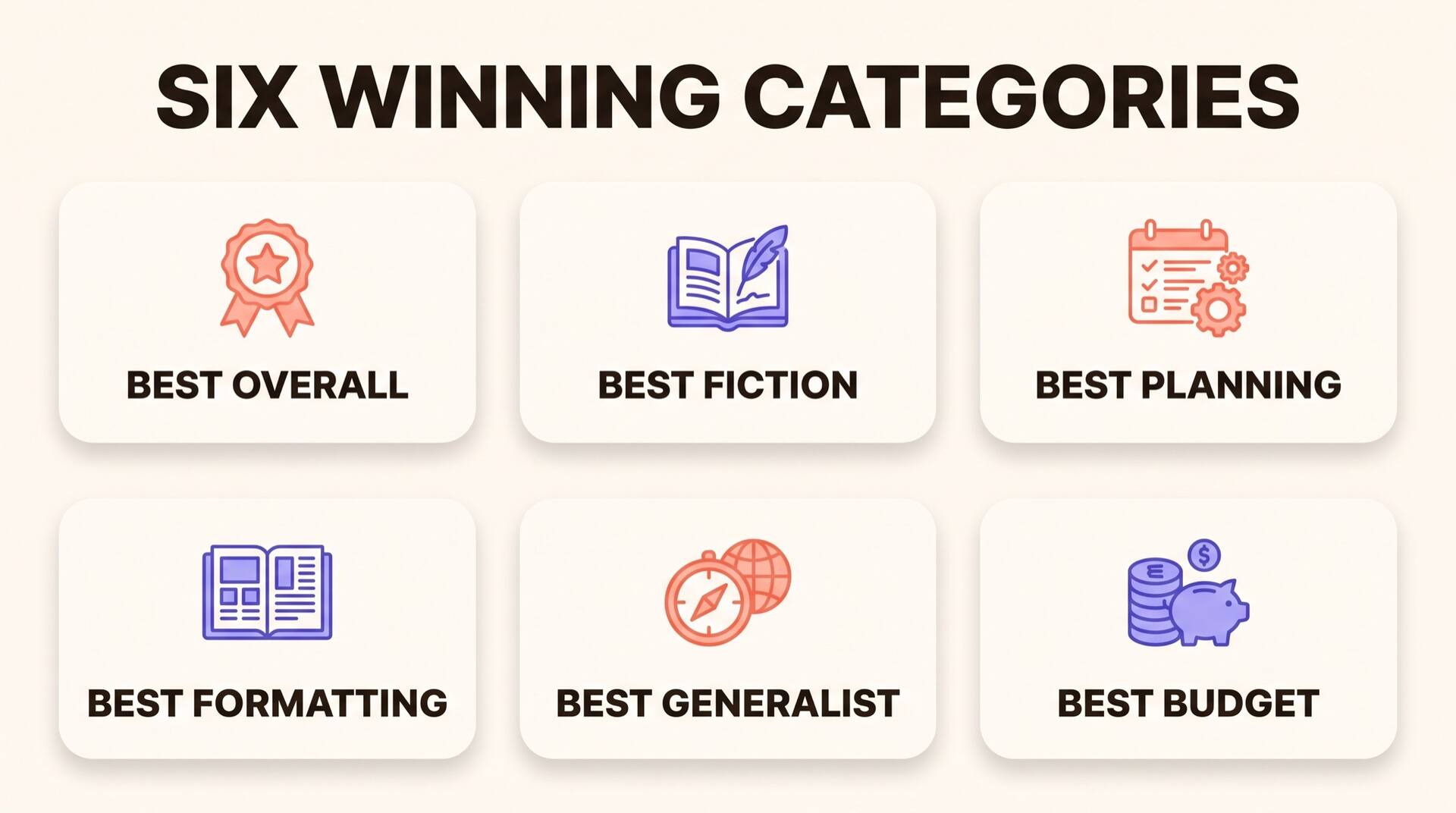
Best Tools by Category
Best Overall for Books
AIWriteBook
End-to-end workflow: outline, chapters with continuity across a whole series, Book Editor review, cover, print PDF and EPUB, audiobook (25 voices), translation into 37 languages, and an author page
Formatter for Windows, Mac, Linux and Chromebook with ebook and print-ready output for a one-time $147
Best Versatile Generalist
ChatGPT
Handles brainstorming, editing, research, and short passages across any genre — at the cost of manual project management
Best Budget Pick
Claude
Strong prose on a usable free plan, with Pro at $20/month or $17/month billed yearly
At a Glance: Which AI Writing Tool Is Best for What
Every tool in this roundup, the job it does best, and its starting price as listed on the vendor's site in November 2026.
Tool
Best for
Pricing
AIWriteBook
Authors writing full-length fiction, nonfiction or a series who want one tool from idea or draft to a publish-ready book
Free plan; paid plans from $20/month or $12/month billed yearly
Sudowrite
Literary and genre fiction writers who care most about prose craft
From $10/month; free trial, no card
Novelcrafter
Series authors and detail-oriented plotters who want full control of the model
From $4/month; 21-day free trial
Atticus
Self-publishers who write elsewhere and need clean ebook and print files
$147 one-time
ChatGPT
Writers who want a flexible assistant and don't mind managing files themselves
Free; Plus $20/month
Claude
Drafters who care about prose quality and have their own workflow
Free; Pro $20/month or $17/month billed yearly
Squibler
Writers who want a full first draft of a novel or screenplay generated in one go
Free; Plus $15.83/month and Pro $49.17/month billed yearly
Automateed
Publishers producing many ebooks and low-content books
Lifetime plans from $149 one-time
NovelAI
Genre fiction writers and fan-fiction communities
From $10/month
Raptor Write
Fiction writers who want to try many AI models in one workspace
Free; one-time upgrade about $79
Type.ai
Bloggers, essayists, and short-form content writers
Free; paid from $8/month billed yearly
Inkfluence AI
Budget-conscious authors who want covers and audio in a low-cost plan
Free; Creator $9.99/month, Premium $19.99/month
YouBooks
Nonfiction authors who want a long, source-grounded first draft
From €9.97/month plus credits per book
Complete Tool Comparison
We grouped 13 tools into three buckets: end-to-end book platforms, prose-craft assistants, and adjacent tools authors still rely on. Each entry links to a detailed head-to-head where one exists. If you're weighing dedicated desktop apps like Scrivener and Atticus, our novel-writing software comparison covers those in depth.
4.7
AIWriteBook is built for writing complete books, fiction and nonfiction. It keeps names, relationships, places and plot facts consistent across chapters and across every book in a series, reviews the manuscript with a built-in Book Editor, generates covers, narrates audiobooks with 25 voices, translates into 37 languages, and builds a print-ready PDF, EPUB, DOCX and wrap cover in one Format step. You can start from an idea or import an existing Word manuscript, then publish to an author page or NanoReads.
Pros
Full pipeline: outline, chapters, editing, cover, print PDF and EPUB, audiobook
Continuity across chapters and across every book in a series
Nonfiction from your own files and live web research, with APA references
Free plan with a full outline and the first AI chapter
Cons
Single-user — no real-time collaboration
Manuscript import takes Word .docx files
Runs in the browser (no native desktop or mobile app)
Best for
Authors writing full-length fiction, nonfiction or a series who want one tool from idea or draft to a publish-ready book
Pricing
Free plan; paid plans from $20/month or $12/month billed yearly
4.4
Sudowrite is built around writing fiction prose. Write, Rewrite, Describe, Expand and Brainstorm work at the sentence and scene level, and its plans list style matching, continuity across a series, and developmental edits, line edits and beta reads on the higher tiers.
Pros
Sentence-level Write, Rewrite, Describe and Expand tools
Style matching and series continuity features
Developmental edits, line edits and beta reads on Professional and Max
Cons
No cover, audiobook or EPUB tools
Credit-based plans: heavy drafting uses credits faster
Built for fiction
Best for
Literary and genre fiction writers who care most about prose craft
Novelcrafter is a favorite of plotters and worldbuilders. A codex links characters, locations and items to scenes, outlines sit next to the manuscript, and from the Hobbyist plan up you can bring your own API key for the AI model of your choice.
Pros
Deep codex and scene-by-scene planning
Bring-your-own-key model choice from $8/month
Teams and shared novels on the Specialist plan
Cons
More setup than guided book tools
No cover or audiobook tools
No free plan (21-day free trial)
Best for
Series authors and detail-oriented plotters who want full control of the model
Atticus is a formatting tool, not an AI writing tool. It turns a manuscript into EPUB and print-ready PDF files, runs on Windows, Mac, Linux and Chromebook as well as in the browser, and costs a one-time $147 with updates included.
Pros
Runs on Windows, Mac, Linux, Chromebook and the web
One-time price with ongoing updates
EPUB, PDF and DOCX export from one file
Cons
No AI drafting or outlining
No cover designer or audiobook tools
You write elsewhere, then import
Best for
Self-publishers who write elsewhere and need clean ebook and print files
Pricing
$147 one-time
4.3
ChatGPT handles drafting, editing, brainstorming, and research across any genre. It is not built for books — there is no chapter manager, no character tracker, no export pipeline — but it is the most flexible chat-style assistant on the market.
Pros
Extremely versatile across tasks
Large context window
Free tier and broad ecosystem of integrations
Cons
No book-specific structure or export
Loses continuity across long projects without manual prompting
No covers, audiobooks, or KDP tooling
Best for
Writers who want a flexible assistant and don't mind managing files themselves
Pricing
Free; Plus $20/month
4.4
Anthropic's Claude is strong at long-form prose and nuanced instructions, with a context window of up to 1M tokens depending on the model. Like ChatGPT, it has no book-specific workflow.
Pros
Excellent prose quality and instruction following
Context window of up to 1M tokens, depending on the model
Usable free plan for drafting
Cons
No chapter, character, or outline tooling
No publishing or formatting features
Project organization is on you
Best for
Drafters who care about prose quality and have their own workflow
Pricing
Free; Pro $20/month or $17/month billed yearly
3.9
Squibler is a writing environment for novels and screenplays, with AI generation of full manuscripts and scripts, chapter organization and goal tracking. Its free plan includes 500 AI credits a month, and paid plans export PDF and DOCX.
Pros
Full manuscript and screenplay generation
Free plan with 500 AI credits a month
Unlimited AI images on paid plans
Cons
No audiobook tools listed on its plans
Exports PDF and DOCX, no EPUB listed
Best for
Writers who want a full first draft of a novel or screenplay generated in one go
Pricing
Free; Plus $15.83/month and Pro $49.17/month billed yearly
Automateed covers planning, drafting, editing, design and export for ebooks, novels, storybooks, cookbooks, workbooks and puzzle books, with PDF, EPUB and DOCX export. Its site also lists audiobooks, author websites and course creation, sold as lifetime plans with monthly credit allowances.
Pros
Many book types, from novels to puzzle books
PDF, EPUB and DOCX export
One-time lifetime plans
Cons
Monthly ebook and image allowances per plan
No free plan (limited preview only)
Extra credits and website hosting cost extra
Best for
Publishers producing many ebooks and low-content books
NovelAI has a devoted following for genre fiction. Its text generator and image generator are both included in subscriptions, which makes it a creative playground for storytelling rather than a book-production tool.
Pros
Text and image generation in one subscription
Popular with genre and fan-fiction writers
Image credits available without a subscription
Cons
No cover, EPUB or audiobook tools
No free plan (trial only)
Niche aesthetic
Best for
Genre fiction writers and fan-fiction communities
Pricing
From $10/month
3.4
Raptor Write is a fiction writing workspace from Future Fiction Academy. Each chapter, character sheet or outline gets its own tab, and you can switch between AI providers through OpenRouter. According to ScribeCount's review, the base version is free and a one-time upgrade adds folders and your own API keys.
Pros
Free base version
Many AI models through OpenRouter, switchable mid-project
Cons
Exports Markdown, .doc and .txt
No dedicated character-arc or worldbuilding tools
No collaboration features
Best for
Fiction writers who want to try many AI models in one workspace
Type.ai is a clean Notion-style writing surface with an inline AI assistant. Best for blog posts, essays, and short documents; not built for book-length structure.
Pros
Clean, distraction-free document editor
Inline AI for short-form drafting
Cons
No chapter, character, or outline tooling
No cover or audiobook tools
Built for documents rather than book-length structure
Best for
Bloggers, essayists, and short-form content writers
Inkfluence AI writes novels, stories and nonfiction chapter by chapter, with a cover designer, audiobook narration, translations and picture-book images on paid plans. The free plan gives 5 chapters to start plus 5 more each month, with PDF export.
Pros
Free plan with 5 chapters a month
Cover designer, audiobooks and translation on paid plans
PDF, EPUB and Word export on paid plans
Cons
Monthly chapter, audiobook and translation allowances on Creator
Free plan exports PDF only
Advanced cover designer only on Premium
Best for
Budget-conscious authors who want covers and audio in a low-cost plan
YouBooks drafts long nonfiction books, up to about 300,000 words, from a brief, optionally grounded in your own files and live internet search, and can match your style with a model trained on your writing samples. It exports DOCX, EPUB, Markdown and RTF; its site says generated books do not include covers.
Pros
Long drafts from your sources and web search
Style matching from your writing samples
DOCX, EPUB, Markdown and RTF export
Cons
No covers included
No audiobook tools
Monthly credits plus a flat credit fee per book
Best for
Nonfiction authors who want a long, source-grounded first draft
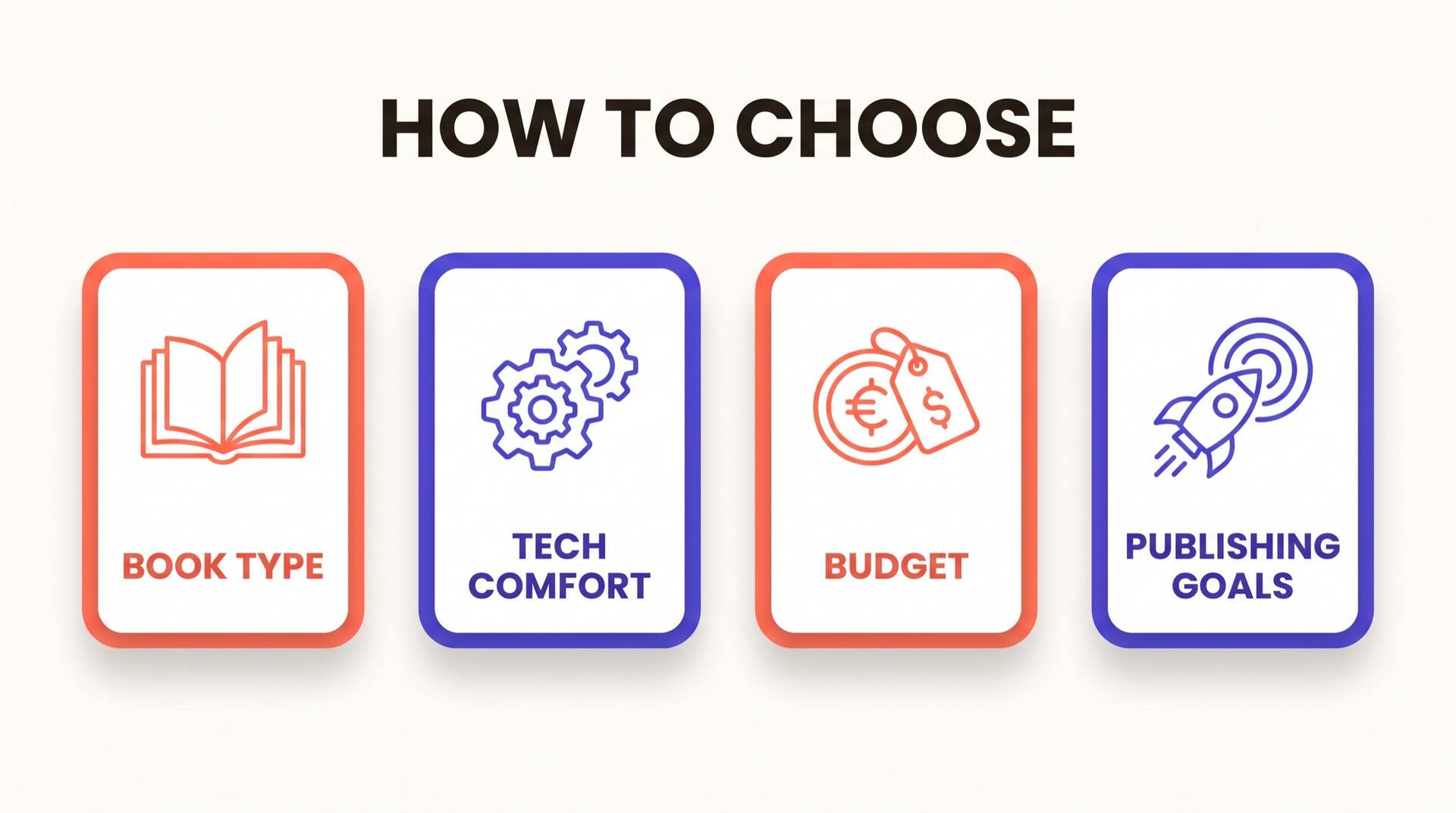
Consider these factors when selecting your tool — and if you already live in ChatGPT, check whether a custom GPT built for novelists covers your needs first:
Book Type
Fiction writers need different features than nonfiction authors. Choose a tool aligned with your genre.
Technical Comfort
Some tools require more technical setup. Be honest about your comfort level with technology.
Budget
Tools range from free to $50+/month. Consider the ROI based on your publishing frequency.
Publishing Goals
If you're publishing to KDP, tools with built-in formatting save significant time.
Quick Decision Guide
Writing fiction or nonfiction?
Fiction
Consider AIWriteBook, Sudowrite, Novelcrafter, or Squibler
Nonfiction
Consider AIWriteBook, YouBooks, ChatGPT, or Claude
Publishing to Amazon KDP?
Yes
AIWriteBook builds the print PDF, EPUB and wrap cover, and its Chrome extension fills in the KDP setup form. Atticus formats a book written elsewhere.
No
Focus on writing quality—try ChatGPT, Claude, or Sudowrite
Budget under $20/month?
Yes
Start with the free plans of AIWriteBook, ChatGPT, or Claude
No
Invest in purpose-built tools like AIWriteBook or Sudowrite
Our Final Verdict
If you want one tool that takes you from a title or a draft to a KDP-ready ebook, paperback, and audiobook, AIWriteBook is our pick. It covers outline, chapters, continuity across a series, editing, cover, print and ebook files, audiobook, and a reader-capture author page in a single workflow.
If you already have a workflow you love, pair it: Sudowrite for prose polish, Novelcrafter for planning, Atticus for formatting, Claude or ChatGPT for editing — our ChatGPT vs specialized AI book writers comparison shows where each one fits. Most working authors use two or three tools, not one. None of them find readers, which is why the same authors keep one more slot in the stack for audience work: an email list they own, plus an AI-powered X (Twitter) growth tool so the posting habit survives the weeks when drafting takes everything.
For most authors writing a full book, AIWriteBook: it takes a book from an idea or a draft to a print PDF, EPUB, cover and audiobook in one place. Sudowrite is the pick for sentence-level fiction prose, Novelcrafter for planners who bring their own AI model, Atticus for formatting, and ChatGPT or Claude for general drafting help.
If you want the tool to draft chapters from your outline and keep characters consistent, choose AIWriteBook or Sudowrite. If you write every line yourself and want planning help, choose Novelcrafter. For a series, pick a tool that carries facts from earlier books: AIWriteBook reads every earlier book in the series before it writes the next one.
AIWriteBook writes nonfiction from your own materials (PDF and Word files, slides, web links, YouTube videos and recordings), can research your topic online, and lists sources in APA style. YouBooks also drafts long nonfiction from your sources. ChatGPT and Claude help with research and editing but leave structure and publishing files to you.
They can draft chapters, but neither keeps a chapter plan, a character record or an export pipeline for you, so you paste context back in and assemble the files yourself. Dedicated book tools handle continuity across chapters and produce the publishing files.
AIWriteBook produces a KDP-spec print PDF, EPUB and wrap cover, and its Chrome extension fills in the KDP setup form for you. Atticus formats a manuscript you wrote elsewhere. Whichever tool you use, Amazon asks you to disclose AI-generated content when you publish.
Yes. AIWriteBook's free plan includes the full planning flow, a complete outline and the first AI-written chapter. ChatGPT, Claude, Squibler, Inkfluence AI and Type.ai also have free plans, while Sudowrite, Novelcrafter and NovelAI offer free trials instead.
Every tool wrote the same 5,000-word short story and the same 3,000-word nonfiction chapter and was checked for character consistency across multiple sessions. Prices and features were checked against each vendor's public website in November 2026.
AIWriteBook is our own tool, so judge it against the table rather than the pitch: it is built for authors who want a full manuscript, a cover, and store-ready export files in one workflow instead of a chat window. The comparison above lists what it does next to every alternative we tested.
Start Writing Today
Ready to Write Your Book with AI?
AIWriteBook combines powerful AI with book-specific features. Create outlines, write chapters, generate covers, and export to any format.