

How we picked
We searched the GPT Store for 'novelist', 'book writer', 'plot generator', 'character', and 'fiction', filtered to GPTs with at least five-figure conversation counts and a 4.0+ rating, then ran each one through three real tasks from a novel one of us is drafting: a three-act outline for a romantic suspense, two scenes from chapter four, and a flawed antagonist with a believable motive. The ones below survived all three.
The 7 best custom GPTs for novelists
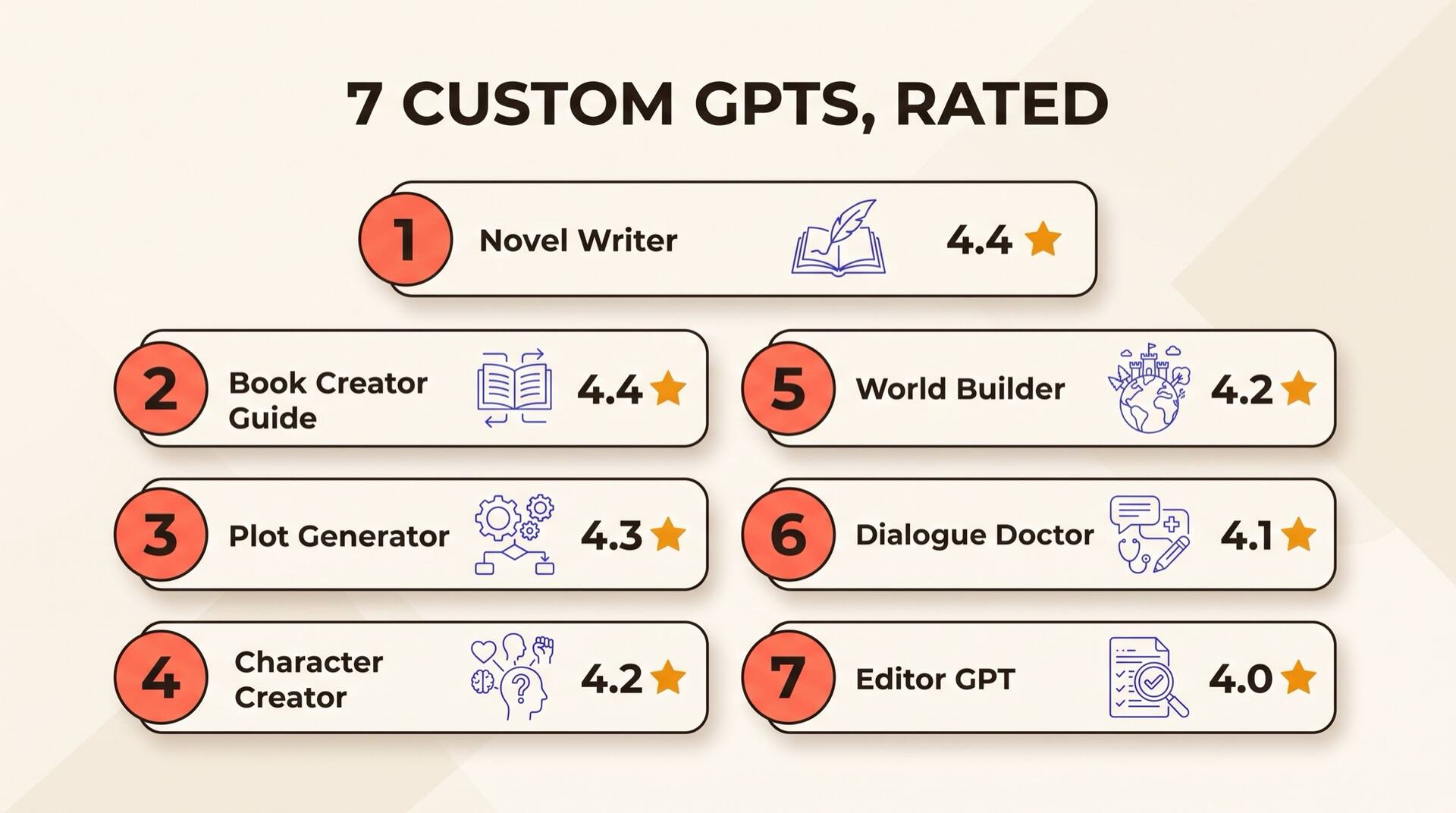
Use it for
Drafting scenes, dialogue, and prose passages
What it does well
Stays in fiction mode without you re-prompting every turn. Will happily write 600–900 words of usable scene prose at a time and remembers tone for the length of one chat. Good at matching a sample of your voice if you paste a paragraph first.
What it can't do
No project memory between chats. If you open a new conversation tomorrow it has forgotten your protagonist. No outline tracking, no chapter numbering, no export — you are copy-pasting into Word or Google Docs by hand.
The pattern you are starting to notice
Every GPT above is excellent at one slice — outline, character, dialogue, world, edit. None of them holds the whole novel in its head. That is not a flaw in any specific GPT, it is the shape of the format: a custom GPT is a single chat with a system prompt. There is no project layer underneath, no manuscript file, no character database, no cross-chapter memory, no export. You are the project layer.
What the full GPT pipeline cannot replace
If you stack all seven GPTs above into a workflow, here is what is still missing on the day you want to publish:
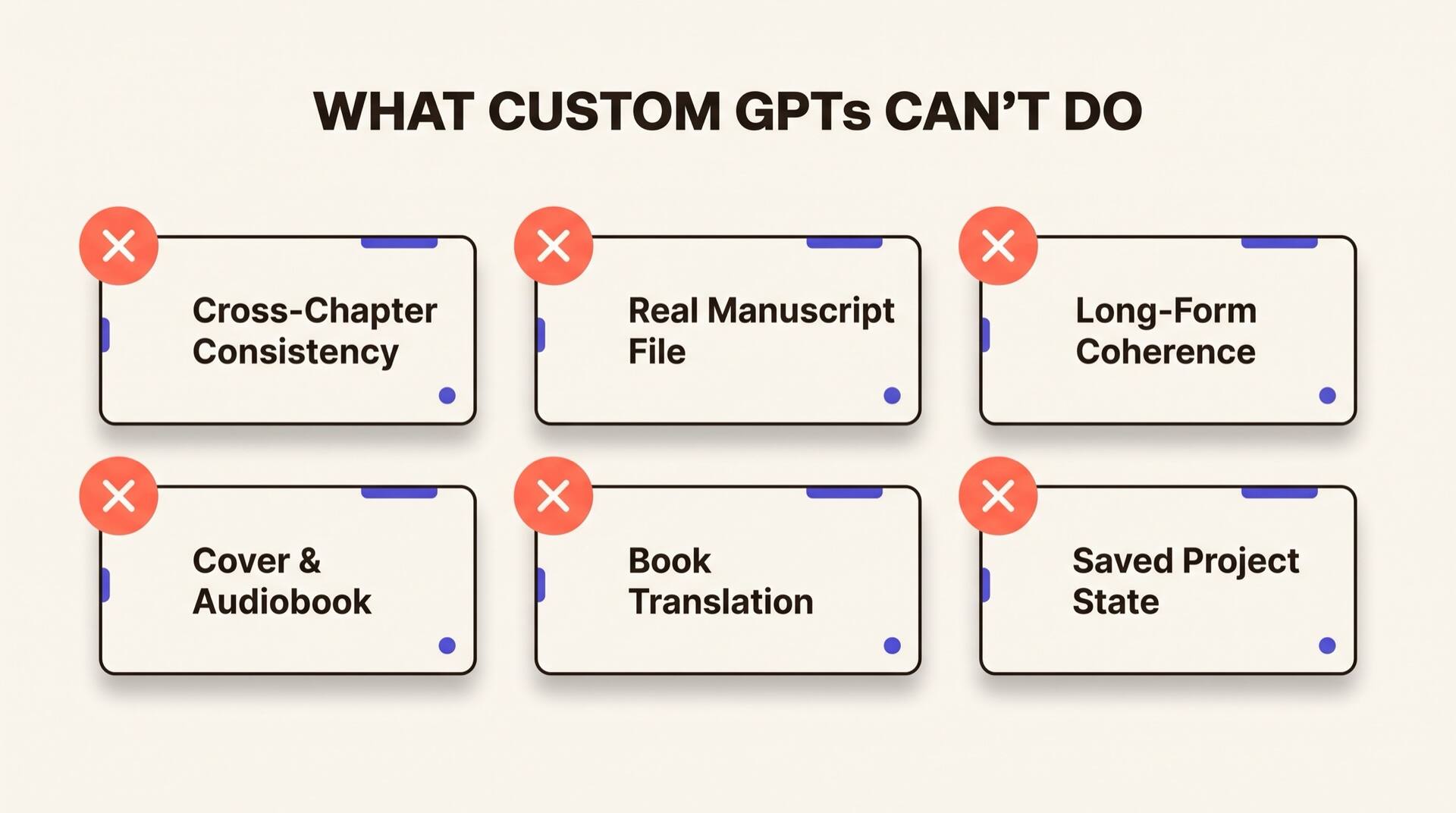
Cross-chapter consistency
Custom GPTs forget your story between chats. After chapter three, your protagonist's eye color, sibling count, and accent are all up to you to maintain in a separate document.
A real manuscript file
GPT output is chat bubbles. There is no .docx, no EPUB, no chapter list, no word count by chapter, no find-and-replace across the whole book.
Long-form coherence at length
Even with a 128K context window, pasting a 90,000-word draft back in every session is slow, expensive in tokens, and the model still drifts. GPTs are tuned for chat, not for holding a full novel.
Cover, audiobook, and KDP-ready export
Custom GPTs cannot design a 1600×2560 cover, generate audiobook narration, or produce a KDP-formatted file. You are leaving ChatGPT for at least three more tools.
Translation and rights
If your book takes off, you will want a translated edition. No GPT in the store will translate a 70K-word novel while preserving voice and continuity — that is a separate, very large job.
Project state you can come back to
Close the tab and your novel exists only as scattered chats. Search history is not a writing tool.
A realistic custom GPT workflow
This is what an honest GPT-only workflow looks like in 2026:
Outline in Plot Generator
Get a 15-beat outline. Save it to a Google Doc.
Build characters in Character Creator
Run each major character through the GPT. Paste outputs into your character bible Doc.
World-build in World Builder
If genre needs it. Save the lore to its own Doc.
Draft in Novel Writer
Open a new chat per chapter. Paste in the outline beat, the relevant character sheets, the relevant worldbuilding, and ask for the scene. Copy the scene out into your manuscript Doc.
Polish dialogue in Dialogue Doctor
Paste in each scene's dialogue, take the rewrite that fits the character best.
Edit in Editor GPT
One chapter at a time, dev-pass and line-pass. Apply notes by hand in your manuscript Doc.
Format, cover, and publish elsewhere
Custom GPTs are done. You move to a layout tool, a cover designer, and a KDP uploader.
It works. People publish books this way. It is also seven GPTs, three or four side documents, and a lot of copy-paste — and you carry the novel's continuity in your head and in your Google Drive.
Where AIWriteBook fits if you want fewer tabs
Custom GPTs are a great way to learn what AI can do for a novelist. After a draft or two, most authors hit the same wall: chat is the wrong shape for a manuscript. A book is a project, not a conversation.
AIWriteBook is built around that observation. It treats the novel as the unit of work — outline, characters, chapters, cover, audiobook, KDP-ready export, and multi-language translation all live against the same project. Multi-model frontier AI under the hood, free tier with full character creation, a free outline, draft import, and one chapter written for free so you can compare it against your GPT workflow on a real book.
Use the GPTs above for what they are excellent at — quick brainstorming, line-level dialogue passes, structural beat sheets. When you are ready to actually finish, having a manuscript layer underneath helps.
Frequently asked questions
Are custom GPTs better than plain ChatGPT for writing a novel?
Yes, for narrow tasks. A 'Plot Generator' GPT has Save the Cat baked into its system prompt, so you skip the priming you would do in plain ChatGPT. For broad work — drafting a chapter, holding character continuity — a custom GPT is the same model with a fancier preamble, so the gain is small.
Can a custom GPT write a whole book?
Not really. The context window will not hold a 70K-word manuscript across sessions, the GPT cannot export to a file, and there is no project memory between chats. You can use custom GPTs to write every chapter of a book, but you are the one stitching them together.
Are custom GPTs free?
Custom GPTs themselves are free to use, but you need ChatGPT Plus (currently $20/month) to access them at usable rate limits. Free-tier ChatGPT users hit caps quickly.
Which custom GPT is best for plot?
Plot-structure GPTs that explicitly load Save the Cat, the Hero's Journey, or three-act structure outperform generic 'plot generator' GPTs. Look for one with a high conversation count and a 4.0+ rating, and check that it actually asks about your premise before producing an outline.
Which custom GPT is best for character development?
Look for a Character Creator GPT that uses wound/want/need structure and asks about contradictions. The output is only as deep as the questions it asks, so test it with a side character first.